
A podcast where you join me (Colie) as I chat about what it takes to grow a sustainable + profitable business.
Business-First Creatives Podcast

CRM Guru, Family Filmmaker, and Host of the Business-First Creatives podcast. I help creative service providers grow and streamline their businesses using Dubsado, Honeybook, and Airtable.
Hey, I'm Colie


Be honest — do you actually know if every package you’re offering is profitable? Not “profitable enough to justify existing,” but genuinely working for your business and your life?
If you’ve ever booked 50 weddings and wondered where all the money went, this episode is going to feel uncomfortably relatable. Here’s the thing: the problem usually isn’t your marketing, your talent, or even your pricing number. It’s that nobody ever told you that the “get them in the door” package shouldn’t be a money pit — and that camping out in the 6 to 8K range might be costing you more than you realize.
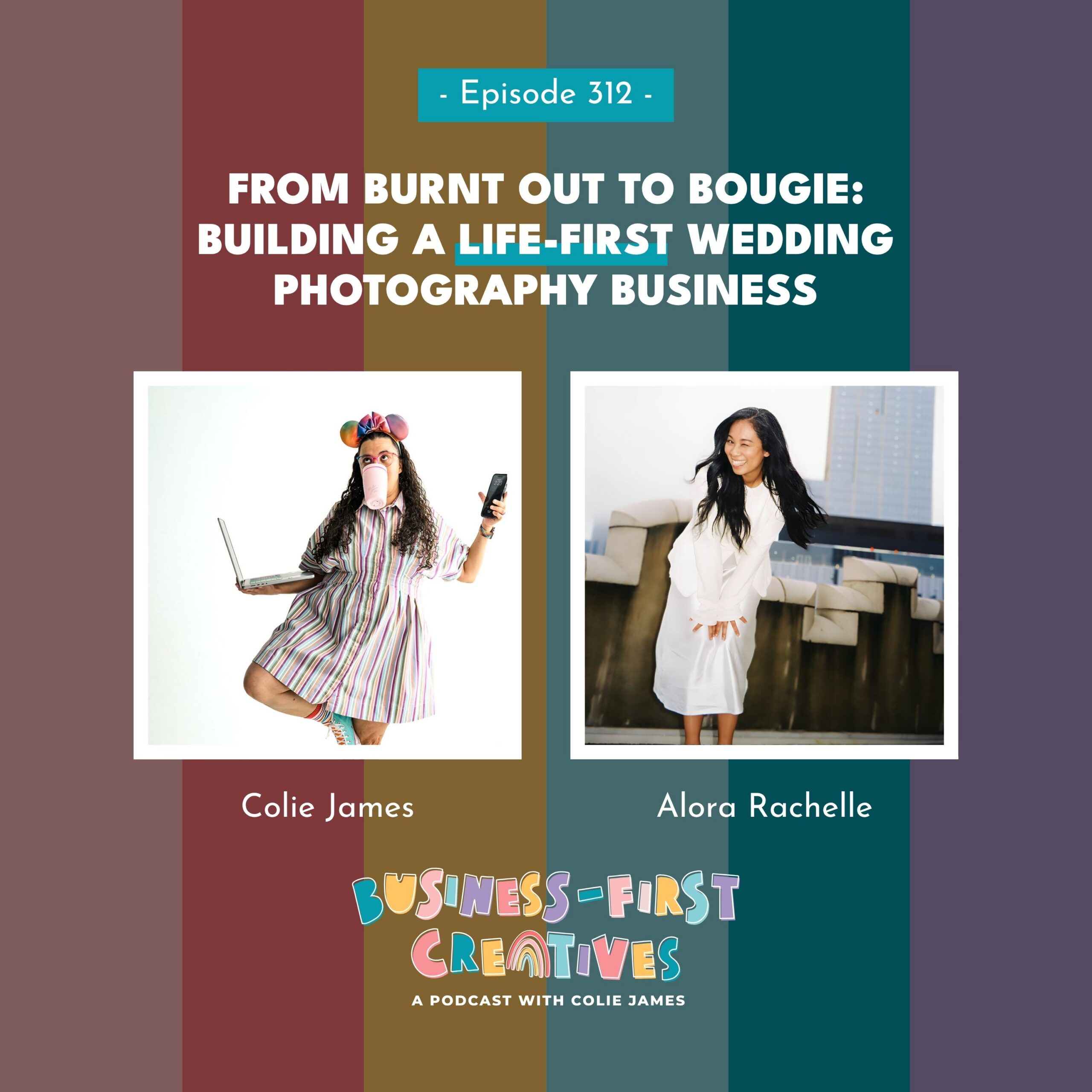
I sat down with wedding photography educator and pricing strategist Alora Rachelle for a conversation that I knew was going to be spicy — and y’all, it delivered. What started as a chat about the “messy middle” of pricing quickly turned into a deep dive on why the mid-range pricing tier is quietly disappearing, why all of your packages need to be profitable (not just the middle one), and how burnout often shows up long before photographers realize their business model is actually the problem. We also got into outsourcing your editing, the three-year mark that tends to shake photographers to the core, and why slow season is genuinely the best time to fix your systems — not just catch up on your editing queue.
What You’ll Learn in This Episode
- Why the middle pricing tier for wedding photographers is shrinking — and what that means for where you position your packages right now
- How to structure a three-package system where every tier is profitable, not just the middle option
- The mindset shift that makes it possible to send a proposal with a number that genuinely scares you
- Why your systems and your pricing are more connected than you think — and how a “messy middle” in either area erodes perceived value
- What the three-year mark in a photography business usually signals, and why it’s the perfect time to think seriously about outsourcing
- How Alora went from emotional resistance to a five-star client experience by outsourcing her editing — and why it takes more than one try to get it right
- Why slow season is for systems (not just catching up), and how to use that time to build the business you actually want
- How to balance capacity, happiness, and the actual numbers so you can build a business that brings you a paycheck and your life back
Pull Quotes
“Somebody’s gonna pay. Someone will say yes. Somebody out there is already charging this — and so can you.” — Alora Rachelle
“You should always be offering someone one level higher than what they said they want.” — Colie James
“Why in the world are we offering unprofitable packages? That bottom package still needs to make you the profit you want.” — Colie James
“Slow season is for systems.” — Alora Rachelle
“I had a 90% conversion rate and I was left with 20 weekends — and dreading every single one of them.” — Alora Rachelle
“Your systems and your pricing are intertwined. If you have shitty systems, you’re not going to be able to sell a premium product — regardless of what that product is.” — Colie James
“Don’t camp out in the 6 to 8K range. Use it as a bridge, not a destination.” — Alora Rachelle
“The point is to build a business that doesn’t lead to burnout. The point is to have the time and flexibility to actually live your life.” — Alora Rachelle
“A ‘no’ isn’t failure — it’s data. Put the number on a proposal, send it, and see what happens. You can’t learn anything by keeping the scary number in your head.” — Colie James
“I only have so many summers left where my daughter actually wants to hang out with me. You have to decide what’s important and build your business around that.” — Alora Rachelle
FAQs
Is the mid-range pricing tier really disappearing, or is this just happening in certain markets?
It’s showing up across markets, and it tracks with broader economic shifts. Alora has noticed that couples are increasingly making all-or-nothing decisions — they’re either working within a tight budget or they’re ready to invest at a premium level. That comfortable 6 to 8K middle ground that used to feel like a safe landing spot just isn’t converting the way it used to. It doesn’t mean you need to panic, but it does mean that staying there without intention is a choice worth examining. The photographers Alora works with who push past that range — even incrementally — are finding that the right couples will meet them there.
How do I know if my packages are actually profitable at every level?
Start by looking at what’s included in each tier versus how much time it actually takes you to deliver it. A lot of photographers discover their lowest package has almost as much in it as their middle package — which means both tiers are underpriced and overpromised. The question to sit with: if every single inquiry booked my lowest package, would I still be financially okay and genuinely happy to show up? If the answer is no, that package needs to change before you send it to one more person.
What if I raise my prices and nobody books?
Then you have data — and data is not failure. A “no” or a non-response tells you something worth paying attention to: maybe the packaging needs to be clearer, maybe the positioning needs work, or maybe that particular client wasn’t the right fit anyway. The only way to find your real ceiling is to test it. Colie’s approach is to treat every proposal like an experiment — put the number out there, see what happens, and adjust from there. You can always iterate. You can’t learn anything by keeping the scary number in your head.
I tried outsourcing my editing once and it didn’t work. Does that mean it’s not for me?
Almost certainly not. Alora went through editors for over a year before she found the right fit — and she’ll be the first to tell you that the problem usually isn’t outsourcing itself, it’s the feedback loop. If you handed someone your gallery and expected them to nail your style without detailed direction, that’s not a fair test. The photographers who make outsourcing work are the ones who show up with specific feedback (“these skin tones are too orange, pull back the saturation”), use tools like Loom to walk editors through their galleries, and give themselves the grace period to find the right person. It also helps enormously to start during slow season, when there’s no pressure to rush the process.
When is the right time to start thinking about outsourcing?
If you’re booked and busy and running out of hours, that’s your red light — outsource something as soon as possible. If you’re still building, the best time to start the process is slow season, when you have space to experiment, give feedback, and go through the inevitable rounds of revision without a full shooting schedule breathing down your neck. The mistake most photographers make is waiting until they’re completely underwater to start, and then expecting it to work perfectly on the first try under pressure. Slow season exists for a reason. Use it to build the infrastructure that makes your busy season sustainable.
Does raising my prices mean I need to completely rebrand or overhaul my marketing?
Not necessarily — but your systems and your brand experience do need to match what you’re charging. Colie makes this point clearly: you can’t sell a premium product with shitty systems. If a client pays a high-end rate and then falls into a clunky, inconsistent client experience on the back end, the perceived value of what they paid evaporates fast. Before you raise your rates, it’s worth taking an honest look at what happens after someone says yes. Does the experience they get match the number on the proposal? If there’s a gap, that’s where to start.
What if I build my business around fewer, higher-priced weddings and I’m wrong about what I can charge?
You’ll find out quickly — and you’ll adjust. That’s the whole point of treating your pricing like an experiment instead of a permanent declaration. Alora’s students don’t make one giant leap and hope for the best. They move incrementally, send proposals that push their ceiling, pay attention to what converts and what doesn’t, and use that information to keep refining. The goal isn’t to price yourself out of your market. It’s to stop assuming your ceiling is lower than it actually is.
Building a Life-First Business (Not Just a Business That Pays)
The thread running through this whole conversation is something Alora and I are both pretty vocal about: the goal was never just revenue. The goal was a business that actually lets you live.
For Alora, that means raising prices, booking fewer weddings, and creating space for her family — knowing that her daughter is nine now and those uncomplicated years are moving fast.
For me, it means having the systems in place that make it possible to step away during a birthday sabbatical, during school holidays, during the seasons of life where my family needs more of me.
The business should fund the life. Not consume it.
If you’ve been building something that looks successful on paper but feels exhausting every single day — this episode is a flag in the ground. The way you’re doing it right now is not the only way to do it.
Meet Alora Rachelle
Alora Rachelle is a wedding photographer turned business strategist who believes marketing, and sales are essential to scaling a profitable business. In two years of going full-time, she took her business from $10,000 to $100,000 using the strategies she teaches.
After almost burning her business to the ground from booking 30+ weddings two years in a row, she created a unique brand strategy and sales psychology pricing method that helped her triple her prices, launch a team and hit multiple six-figures after having her second babe.
Alora’s work has been published in several publications, such as ELLE, The Knot, Channel 7 ABC News, Popsugar, etc. She is also the creator of the Wedding CEO, where she’s helped dozens of wedding photographers collectively make $2M+ by raising their prices, make $100k, and master the art of sales so they can build a life-first business and free up their weekends.
Links Mentioned in This Episode
- Alora’s free live masterclass — The 10K Wedding Formula: alorarachelle.com/10K
- My guest episode on Alora’s podcast — Creating a Warm Client Experience for Wedding Photographers


Signature Series


Your business works, but your backend is costing you.
A 4-Part Audio Series for service-based business owners who are ready to upgrade their “just fine” client experience, unlock higher pricing, increase referrals, and grow more sustainable revenue—without overworking behind the scenes.
Get the FREE 4-part audio training series
Systems That Sell


© 2022-2025 Colie James


