


What if the reason your offers aren’t selling has nothing to do with your pricing, your audience size, or your content quality—and everything to do with how often you’re willing to talk about them?
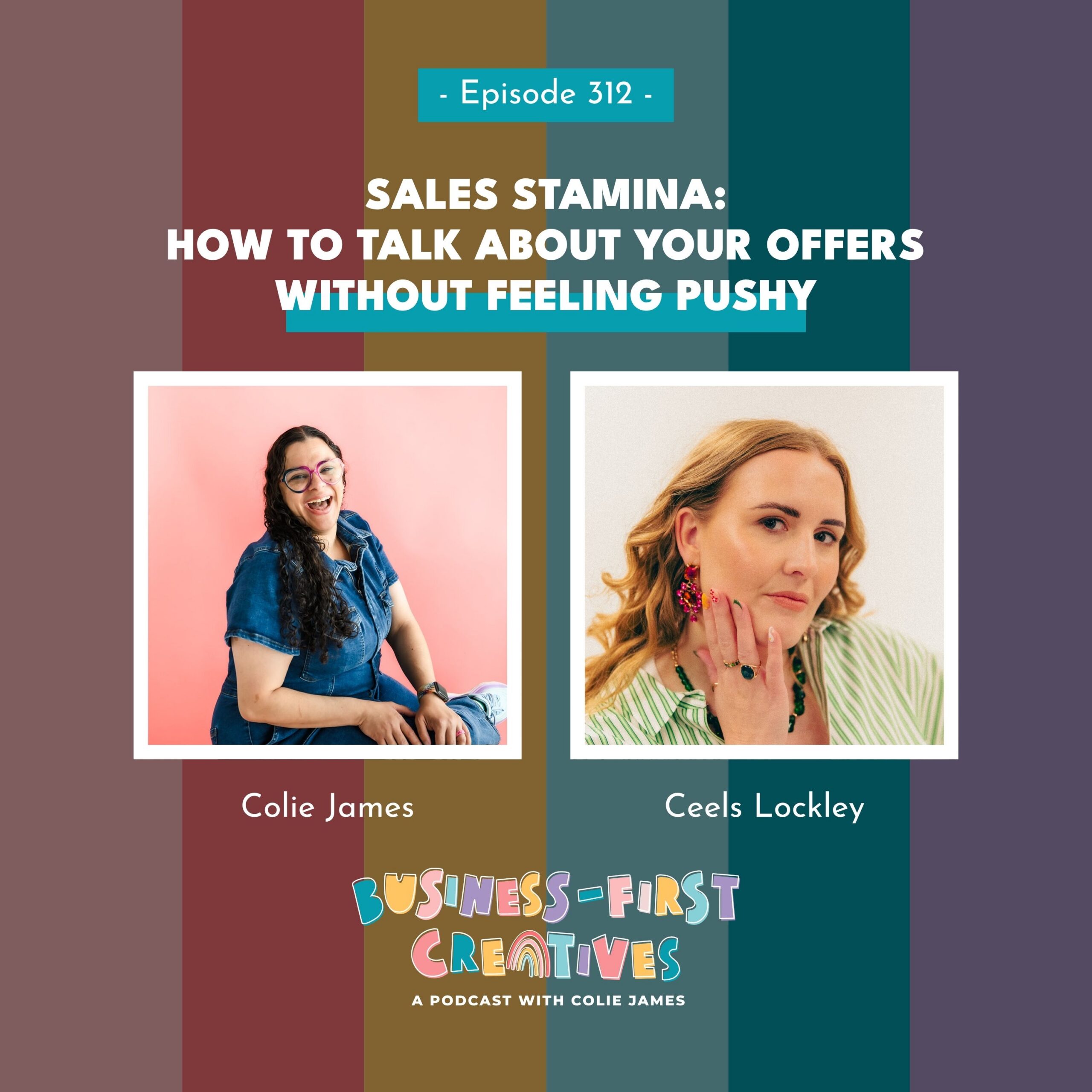
In this episode, I’m joined by the incredible Ceels Lockley to unpack the idea of sales stamina: the ability to consistently talk about your offers without spiraling into fear, awkwardness, or “I’m annoying everyone” energy. We dive into why repetition matters, how to stop treating sales like a dirty word, and what actually happens when you give your offers the spotlight they deserve.
Ceels shares the philosophy behind her program, Sales Parade (now evolving into Parade on Tour), and explains why selling isn’t about posting “buy now” every five minutes. Instead, it’s about creating momentum, warming your audience up over time, and building trust through repeated exposure.
What You’ll Learn in This Episode
- Why talking about your offer 52 times in two weeks isn’t as wild as it sounds — and why it’s actually necessary
- The difference between selling and calling to action (and why mixing them up is tanking your conversions)
- Ceels’ three-phase sales framework — Tease, Tempt, and Turn — and how to use it whether you’re selling a high-ticket offer or a freebie
- Why your freebies deserve their own parade (and how promoting them actually warms your audience up to buy your paid offers)
- How to sell multiple offers without confusing your audience or diluting your message
- The real reason people aren’t seeing your content — and why you need to repeat yourself way more than feels comfortable
- How sales stamina builds over time, what to do when it feels like you’re talking into the void, and why community makes all the difference
- The one place you already have everything you need to start selling today (hint: you built it, you paid for it, and you probably forgot about it)
Quotes from Colie and Ceels
“You can have great offers, but if you don’t have a sales strategy that supports it, we’re not going anywhere. We’re not selling anything, we’re not getting any clients.” — Ceels Lockley
“There are not very many people who literally consume every piece of content we produce. Most people are getting little bits — almost like there’s a rushing river in front of them and they’re catching the odd little minnow.” — Ceels Lockley
“You need to let your offers be the bell of the ball. They want their time to shine.” — Colie James
“You don’t have to create 52 original messages and announcements and promotions about your offer. What we are really working on together is you getting comfortable talking about your offer on repeat.” — Ceels Lockley
“When I talk about one offer nonstop, I end up selling all of these other things that I really wasn’t even talking about.” — Colie James
“Selling is simply asking people if they want to come and work with you. It’s simply bringing the sales and the money into your business.” — Ceels Lockley
“If you are running a business, you need to also say: I’m a salesperson. And being a salesperson is not something to be embarrassed about.” — Ceels Lockley
“Free offers are exactly the same as your paid offers. Your offer ecosystem isn’t just your paid work and your paid services.” — Ceels Lockley
“Your freebies grow your audience, they get you an email, they do those things, but they also warm your audience up to hear about your offer.” — Colie James
Review the Transcript
Colie: Hey y’all. Welcome back. We are now in the third episode of this sales series, which I mean, I created it on a whim. I interviewed Kelsey McCormick, who was on last week, and then I was like, you know what? I know a lot of people who say a lot of good shit about selling to your audience. Let me just invite them all onto my podcast at the same time.
And so today I am here with Ceels Lockley, the Amazing Ceels. Let me just. Put that out there. And the offer that I have of hers is called Sales Parade. And it’s basically, I mean, this is not gonna be an infomercial, but also everyone needs Sales parade. So my affiliate link is in the show notes. But the way that Ceels like runs sales parade in this short two week sprint to get you to talk to your audience about the thing you want to sell them is nothing short of bloody amazing.
So, Ceels,. Welcome to my podcast.
Ceels: Thank you for having me.
Colie: Uh, so let me, let me tell you, there’s another, uh, episode ’cause Ceels has an amazing podcast. It is linked in the show notes, but one of the reasons that I was like, oh, Ceels has to come on my podcast and talk about this, is she had an episode a few months ago and it was all about sales stamina. And I was like, man, that’s an amazing way for Ceels to like introduce what she talks about.
So I wanna kind of take a step back. First of all, Ceels, would you call yourself something other than an offer strategist or is that your current label, that you love?
Ceels: It is my label, but I would say my work is so much more than offer strategy because offer strategy is quite broad reaching and it’s actually always. Challenging, trying not to deep, deep dive into every single area it touches. But in my view, sales is a big part of offer strategy. So you can have great offers, but if you don’t have a sales strategy that supports it, then we are not, we’re not going anywhere.
We’re not selling anything, we’re not getting any clients.
Colie: We are not gonna earn any money. talk me through how you started to like focus on sales. Was it that you were helping people create offers and then they weren’t seeing the results, or was there a different reason that you went all in on sales?
Ceels: When I was helping people with offers, a lot of the questions I was getting once we had actually created the offer was. Okay, great. Well, how do I sell this? How do I go out and take this offer and get people to buy it? And I really wanted to help people be able to do that in a way that wasn’t, well, now you need to learn about launching, because launching is a whole skill and a lot of service providers don’t want to learn that skill or aren’t ready to go in all in on a launch in a formal way.
And so. Over the last few years, every time somebody was like, oh, Ceels, you know, now we’ve created these offers. What do I do? How do I get them out there? I was like, well, you know, maybe I need to actually teach this stuff and I need to teach what I do, which is kind of, it is like launching, but it’s not like it’s a different type of approach, which we can obviously get into.
Colie: Well, I mean, that’s why you’re here because last week I talked all about launching, and you are specifically here because you do it differently. So the thing that I love as a mathematician, as a statistician, the thing that I love most about the sales parade and your way of kind of talking about sales is that you are actually talking about it in terms of building a muscle.
You are talking about the repetition. You actually. Had a number on it when I bought the sales parade, and that was, can we talk about your offer 52 times in the next two weeks? I’m gonna be honest, you’re not really positioning it in that way anymore, but that’s definitely how you got my attention because I was like, wow, 52 sounds like such a big number.
How am I gonna talk about my offer 52 times in two weeks? And as you know, I’ve done it in every single sales parade that I’ve done, and so. You know, it sounded like this really abstract, far away number that I would never hit, but in reality, when I got into the offer with you and I started working on it, 52 really wasn’t that hard.
Ceels: Yeah. Yeah, exactly. Uh, and this is the thing, it’s about that repetition of your message. You don’t have to create 52 original messages and announcements and promotions about your offer. What we are really wo working on together is you getting comfortable talking about your offer on repeat in a way that previously would’ve thought after three times.
Oh my gosh, I’m boring. Everyone. This is so repetitious. Everyone’s thinking that I’m saying the same thing, and my philosophy is that you need to keep saying the same thing. Otherwise people aren’t going to get the message.
Colie: I mean, and there are still people, you and I both know this from being inside the sales parade, but there are still people there that contact them and are like, oh, I didn’t know you were selling this thing really.
You missed it after I talked about it for the last 14 days, straight 52 times. Like you still missed it.
You didn’t know that I was trying to sell you something. Wow. I mean, the first couple of people that said that I was like. Oh my gosh. Is my audience the same? Like I, I still find it hard to think about the fact that I do it 52 times, and there are still people in my audience that if I said, I currently have three spots left for this, I’m trying to fill them now, they’d be like, oh, this is the first time that I saw it.
Let me go, you know, check it out. It’s like, really?
Ceels: Yeah, and it’s so one of those things that we don’t really appreciate until we’ve done the work of talking about our offer 50 times and then having that feedback and, and actually realizing that. In our minds, everything we are putting out there, we think everyone can see. We think everyone is consuming every piece of content and that everyone is reading every inch of our captions and every carousel slide we are putting out there and every email we’re sending.
And of course there are some people who literally consume every piece of content we produce, but there are not very many of them, and most people are getting. Little bits. They are almost like there’s a rushing river in front of them and they’re catching the odd. Little minnow or the odd, you know, bigger fish.
Maybe it’s a bigger blog post or a podcast episode, but they are not consuming everything. And so whenever you are in that mindset of thinking that, oh my goodness, I’m talking about my offer too much. Everyone’s so bored of it. I’m talking about, you know, everywhere and it’s too much, and I’m, people think I’m noisy.
These are the thoughts that often come up during that process. And we just have to go back to. Remembering that, that really, people are not seeing everything. They just are not, there’s too many other things in their feeds. There’s many, many other things in their brains as well.
Colie: So I feel like that takes away part of it. The part where we are afraid that we are repeating ourselves too much, which you can probably never repeat yourself too much about your offer,
but I feel like we’ve kind of brushed that to the side. There is definitely a mindset issue that you are so great at, like putting people’s mind to ease when it comes to thinking about what it means to sell your offer on repeat over and over again.
But I do wanna focus on that word selling right now because I think one of the myths, if I could just pull this out in the air, is that people think that if you’re going to talk. About your offer 52 times within 14 days that you’re actually actively selling every single time. Like you’re putting a sales link wherever it is that you’re going and basically saying, buy my things.
So Ceels, why is that a myth?
Ceels: It’s a myth because if we did that well, maybe we would piss people off. Because actually if we’re just saying, I’m my thing, buy my thing, but my thing is available, like click the link. Like of course that’s spammy. And of course that’s what people do not want to respond to. People wouldn’t respond to that.
And so it’s a myth because we actually are not selling through. Call to actions. Call to actions isn’t the thing that’s, that’s like closing the sale. And the way I teach selling is very much founded upon all of the principles of launching. It’s very, very similar. It’s like the way I teach it is kind of like a distant cousin.
We are not. Doing it completely differently to launching, but we’re taking away all the heaviness and the structure and the big sequence strategy funnel upsell down of like all of that piece of launching, which might just feel too much. And we are just working with almost like telling a story of your offer.
the way I teach this is in three phases. So we are thinking about this, this phased approach. We are starting with a tease. We are teasing what you’re selling. So we’re not actually using a call to action at that point. We are simply just starting to drip the details of what you are selling. So this is like the warmup period, the pre-launch, however you want to, to badge it.
Then we have the temp phase. And the temp phase is where maybe we’re starting to unpack the details. We’re starting to get people aware of what your offer is, and this is where you can really start to build trust. You can show your results, and you can start to show people how your brain works, how your methodology works.
And then finally we move into the turn phase, which is where we go a bit heavier on the cause to action. Now, the reason why selling can’t be all just turn phase because of course that would be tempting just to go right. Well, I’m gonna skip. I’m gonna skip the Ts and the temp and go straight to the turn.
The reason we can’t do that. Because your audience needs warming up. They need warming up, and they need to build awareness of your offer first before they decide to buy. So the reason why a two week sprint is what we do in Parade as part of that experience is. It’s just enough time for you to get used to this, this kind of phased approach.
It’s not too long that you lose interest and you basically quit, but it also gets your audience warm enough. Two weeks is a really good amount of time to get your audience warm enough to start thinking about working with you, and that’s why I love it. That’s why it’s a real nice, sweet spot for that experience.
Colie: I mean, I love the structure and I wanna tell you why, because I feel like. As someone who really likes to teach, if you will. Um, I don’t have a problem selling. Oh, I will put an offer in front of you any day of the week and be like, buy my shit. I have no problems doing that. But where I struggle is like the tease part.
I need to make sure that I am giving you the details before I’m actually asking you to buy it. Because a lot of the times myself, and I feel like other people who are like me, do this, I just make the assumption, oh, but it’s all on the sales page. If you wanna know exactly what’s included and the results that I’ve gotten, and like all of those kinds of things, go look at my sales page.
But the whole purpose of this is talking about your offer enough to get somebody to eventually go look at your sales page. But on the flip side, they shouldn’t have to go to your sales page in order to get some of that information. So that is what I love about the way that you teach this, because I am somebody that goes all in on like giving results.
Like, this is what my client got, this is how we did it. I forget that there are many other ways to talk about my offer besides really focusing just on my clients. And you know, we have a lot of different kind of buyers out there. I also feel like your method helps us reach the four buyer types, if you will, at different stages of awareness, as you said, so that we can determine where they are if they’re ready to buy the first time that you tease it.
If it’s available, that person’s gonna go find it. But if they’re not ready to buy, you’re taking that particular person through a journey that maybe gets them ready to buy in that two week period. But as you and I know, lots of people buy things after the two week period because the two week period is when you actually made them aware of the offer.
And so even if they weren’t ready to buy, then they eventually are ready to buy when they figured out that your offer is the thing that they really need.
Ceels: Yeah, exactly. And that really is a reflection of what we talk about. In parade around the compound effect and the fact that the more you talk about your offers, the more you do this consistent selling. Even if it’s just a two week period, it could just be one week.
You don’t have to be doing this all the time, but that’s going to compound your message over and over again into the minds of your audience. Remembering that they’re not going to see every piece of content, so you’re probably going to have to talk about your offer more than you expect. And at that point, then you’re starting to plant the seeds of them thinking, considering buying from you.
That awareness turns into consideration, which then turns into their conversion, and that’s the. The typical buyer journey that we need to take people on, whether they are the type of buyer who needs an emotional story, whether it’s somebody who needs to see data and results, whether it’s someone who is going to be moved by the fact that you match their values.
So when we sell, using all of the different, almost all the different corners of the story and all the different. Practicalities of our offer and all the different results of our offer. We really scratch as many itches that our clients have around, do I need to buy this offer and is this right for me and should I trust this service provider?
It really helps to tick all of those boxes really, really nicely.
Colie: Ceels. I only wrote down one question for today’s interview because I knew that we were gonna cover all, you know, all kinds of things, but you’ve already mentioned it and so I’m gonna ask my one question now and then kind of check it
Ceels: Yay.
Colie: list. The one thing that I think. Like gets a lot of people with their panties in a bunch, if you will, is when I have more than one offer.
I don’t know how to just sell the one offer. Like how do you sell multiple offers? And so you kind of tease this, but like what’s your thought process? If I have an entire ecosystem of offers, how I go about selling them? You mentioned the compounded effect, and I have personally witnessed that when I talk about one offer nonstop, because that’s what I’m trying to sell you, I end up selling all of these other things that I really wasn’t even talking about.
Like I, I didn’t mention it for like three weeks, but I sold three or four of them just because I was talking about the other offer. So how does that like feed into how people can build up their sales stamina? And related to like picking the one offer that they wanna sell.
Ceels: So I have a few different answers for you, Colie. So the first thing I would do is I would think about which are your almost your hero offers, the offers that you want to talk about the most, because either they are. The offers that you want to sell the most spaces for, or they’re the offers that you think represent your work the best like they are your signature offer perhaps, or the offer you really want to talk about because it’s new and it needs lots of airtime and I would.
Try not to talk need, fill the need to talk about every single offer all at once, but really plan out when you are almost parading each offer. And you could think about this in quarters. You could think about this in in months. I like to do it per quarter. So I’ll say, okay, which offer do I really want to be talking about this quarter?
And I might just talk about one offer for one month, and I’ll go through the whole tease, tempt, and turn. Across a month, or I’ll say, okay, I’m gonna do a big launch because I do do a bit of launching, but I’m also gonna do parading like little mini campaigns for each of my smaller offers for, you know, a set period of days or a set week in that month as well.
And so we are kind of, it, it’s, there’s no rules. We can flip and switch if we decide one day I wanna start talking about my one-on-one. Talk about your one-on-one, but my golden rule is talk about one offer at a time. And the only time we can break that, I think in terms of not confusing our audience is if we decide to stick to, okay, I’m gonna talk about a different offer.
Every day of the week on the same day of the week. So let’s say you, on Mondays, you always talk about your high ticket offer. Tuesdays you talk about your warmup offer. At Wednesdays, you talk about your freebie. Thursdays, you talk about your podcast, Fridays, you talk about your one-on-one, and maybe you go through that kind of cycle.
The other exception is maybe when you’re doing a ways to work with me this month, right? You do like an announcement post, so you can talk about all of the offers you have available and the availability and the spots that you have for the month ahead. And I love doing that on Instagram on threads.
That’s a really, really good thing to do to get people aware of what you’re selling. But if we want to. Build that compound effect, and we want to create awareness in offers. We have to focus on talking about one at a time because. Otherwise, people do tend to not either notice the me, the, you know, the messages we need to share with them.
Or indeed, like you said, sometimes people will end up buying the other things and that’s actually, that’s actually not a bad thing. But if we really, really want to sell spots in a specific offer, we do need to talk about it on a concentrated basis, on a fairly regular, concentrated basis if it’s something that we want to fill on a regular basis.
Colie: You need to let your offers be the bell of the ball.
That’s what I got from what you just said, Ceels like, like everybody wants to be in the spotlight. Well, maybe not everybody, but your offers certainly do. They want their time to shine. What something that you just said is you were saying if you wanna talk about your high ticket offer, your low ticket offer, your podcast, and I just realized we should all be in the habit of parading our freebies.
Talk about that Ceels.
Ceels: Yes. And this is so timely because today I did, this is so funny. I did a class today in my group program around free freebies, and I call them pre hypes because I was basically saying that. Free offers are exactly the same as your paid offers. Your offer ecosystem isn’t just your paid work and your paid services.
All of the offers you have, which are your free things as well, are all part of that ecosystem. And if we don’t have, and I call it in my analogy of a festival, we, if we don’t have that main street with all the buzz going on. You know, imagine the food trucks and the little attractions along this main street, and you’ll know this ’cause you’re a Disney gal.
Um, that kind of main street vibe we will miss out on people potentially popping in and enjoying each of those free things first. And so that’s why it’s so important to think about your free stuff as almost its own little mini experience. So. Your podcast, your newsletter, your blog, maybe you have some kind of download, maybe you have some kind of mini course.
All of those things compound, um, together to build the hype. Right? And actually those are really good things to be talking about in between talking about your offers. So. Every so often, you should be talking about your newsletter. Every so often you should be talking about your podcast, and maybe you do that on a, you know, like I say, a cyclical basis.
You choose a day of the week, or you say once a month I’m gonna do a, a feature on, you know, one of my, one of my podcast episodes, or do like a little roundup of all my podcast episodes about, I don’t know, Dubsado, et cetera.
Colie: I think it’s so interesting ’cause I don’t know. I mean, we all say the same things. I don’t know why I just get so inspired when you talk Ceels. First of all, when you said the whole, this is how many spots I have, I literally just watch for you to do it. And when you post that on threads, I’m like, oh, I need to update mine.
Let me go update it. Let me go say how many spots I have for this thing because when I see you do it, I’m like, oh yeah, I mean, I should. Make a little note in notion in my beautiful new dashboard to remind me of these things. And so maybe before our next parade, I will have that done because I’m a lifer, everybody.
Ceels is never getting rid of me. I love parading. I love what it, what it does for my business. I love how it makes me motivated to talk about my offers. And in a lot of cases, I have actually done my parade after I just launched. So in other words, you guys have seen me talk about offers for like 30 days straight.
I don’t necessarily get tired of it because I know that if I talk about my offers, my offers will sell. But the one thing that I wanna say about you mentioning that freebies need their moment in the spotlight too, is I feel like we don’t talk enough about growth audience. In relation to our freebies. So your freebies grow your audience, they get you an email, they do those things, but they also warm your audience up to hear about your offer.
And so it makes perfect sense that we should do. The same kind of hype for our freebies that we would do for our paid offers. I would also say Ceels for people who are feeling a little gun shy about selling, putting out a sales link, asking for the money. Do you feel like if they do a sales parade on their own for their freebie, that it helps them when it comes time to sell the offer?
Or has anybody mentioned anything like that?
Ceels: I don’t know of anyone who has done it just for their freebie, but I can totally imagine it would be a very, almost like low risk and less. Scary way to get into building that muscle and to feel confident about selling something. And you know, look, here is the thing about parading your offer. All we are saying you have to do, it’s not some magic complex,
Colie: Oh, but it is magic.
Ceels: It’s magic, but it’s, it’s not, we are not asking you to do something which is, feels really heavy what we’re asking you to do within the realm of what, what we, you know, teach in the, in the program. It, it’s a, you know, it’s a really, really. Based upon you talking in public about what you are offering.
That’s it. Whether you do that on an email, whether you do that on a thread, whether you do that on your Instagram stories, whether you put out an Instagram post or a LinkedIn post, however you choose to do that. And that really is something that people find uncomfortable at first, because we are used to content being.
Cute, cute. You know, I’ve done something cute. I’ve, I’ve gone to this event, or, um, I’ve, I’ve got this client win. And those things are safe and easy, and selling is not safe and easy. It feels unsafe. Why? Because we’re having to put ourselves out there. We’re having to be visible. And the, the biggest thing of all is it’s almost like waving a flag saying, Hey, hey, buy something from me, which at first feels so icky.
And what, that’s why people resist it. But if you can start and get started talking about something which doesn’t require money, an exchange of money, I think that would be an excellent way to get started. Yes,
Colie: I mean, I think that that was worth this podcast episode in itself.
I’ve never really thought about that and it’s, it’s a little weird because I. I recently made a brand new, uh, freebie. It is a private podcast called Systems That Sell, and you have just made me realize it needs a parade. Like I need to take it on tour because I made it so that I could share it with the audiences of a few summits that I did, but.
I didn’t actually have a lot of people that converted to my list from those summits, and so like I created this podcast and now I’m realizing like it needs its own parades of Ceels. I have written it down. I am gonna do that.
Ceels: Amazing. I love that you got the updated. We are. We are renaming Parade to Parade on tour and I love that you got that in there, Colie.
Colie: Oh, I didn’t even know that. Did
you
Ceels: had it here first.
Colie: it. Okay.
Ceels: had it here first.
Colie: I, that’s awesome. I actually really like that Now. You know what? Let’s talk about that for just a minute though. Seels, why did you take sales out of it? I feel like, I feel like telling people that you need to be selling, whether it’s something free or not.
It’s super important. Does it have a subtitle?
Ceels: Oh, I’m sure it will do. We, we are not, uh, we’re not back until July, so that’s some way off. But yeah, the, the concept is that we’ve done parade five times now and we know that two, this two week sprint is magic. But we also know that a lot of people, including yourself, Kaley. Do not just wanna sell for two weeks.
Colie: Yes.
Ceels: We know that some of you want to parade for longer, and so we want to go on tour for a bit longer. So we’re gonna be going on tour for 90 days. And within that 90 days, there will be a two week sprint. So still the same magic of the two week sprint, but there will be more of an on tour feel for those that want it.
And I think that this is really important for making it not just almost like a one time thing. Because actually what we’ve learned from building that community, and it’s been so amazing and you’ve been such a big part of that Colie, is that we’ve learned that there is a community behind. The, the act of parading and selling is not a solo act.
It’s better when you’re doing it with friends.
Colie: Yes. if I had to pick one thing about Sales Parade are now gonna be parade on tour. Uh, if I had to pick one thing, it is that it helps you build the sales stamina, which is the whole point of this podcast episode. But like you said, doing it with others kinds of builds your hype squad so that when you are feeling a low, because that is something that you talk about.
Often is when you are doing selling every single day, whether it’s in the tease phase, the temp phase, or the turn phase, you are bound to have some feelings that need to be addressed when you are not getting responses, when you feel like your audience is not hearing you or seeing your message, and you kind of feel like you’re hitting a wall and you don’t know what to do, it is great to know that there are tons of other people.
Doing this at the exact same time as you that can hype you up and let you know that something good is just around the corner. I mean, because as business owners. You mentioned this earlier, we’re like waving a flag and we’re like, Hey, I’ve got this thing to sell you. But like, fear of rejection is what keeps a lot of people from doing the thing that they were meant to do.
If you feel that way about your business, I mean, I know many people that like create great fucking offers and then they never actually put them on sale because they’re too worried about no one buying it. No one commenting that they’re gonna be, you know. Talking into the wind, and so I feel like your idea of sail stamina.
Is something that should be normalized because the first time that you do it, you’re probably not gonna get a sale. You’re probably not gonna
get the reaction that you want. But guess what? When you do it the second time, it’s gonna be better. It’s gonna be more received. And the third, and then, I mean, you know, if you sprinkle in some freebie parades in there.
That’s when you’ve really got this ecosystem that is helping you grow your business and sell your offers. Whether you have one signature offer or you have an ecosystem, which is what you’re all about helping people with.
Ceels: Yeah. Yeah. And I, I think that’s a lovely way to, uh, to kind of bring in that sales stamina. Peace because actually the sales stamina is, in my belief, in my belief is that every business owner needs to have sales stamina and a lot of business owners check out of sales.
Because they think that it’s not something they’re good at or they think that they don’t need to worry about it because they get loads of referrals and they’re always busy. But my opinion is that if we are saying I’m running a business, we need to also say I’m a salesperson. And being a salesperson is not something to be embarrassed about, and it’s not something to feel weird about because having a business is literally making money and selling is simply.
Asking people if they want to come and work with you. It’s simply bringing the sales and the money into your business. So if we can’t almost face that and train that muscle, then we are not necessarily accepting all the terms of being a business owner. And therefore, if you are serious about your business, you need to have sales samr.
Colie: I feel like maybe it’s because of when I started my business, I started my photography business way back in 2012, and back then I feel like there was this movement of people who thought, oh, if I just create a business and I create a website and I slap it on the internet and I say I’m open. People will just come buy my thing.
And I mean, that literally almost never happens. I have coached hundreds of photographers at this point, and that has only happened for two of my clients. Now, these two clients were very, they were unicorns, you know, in their own right. One of them had like. She lived where she had grown up. She had a lot of friends in her network that needed a photographer and they didn’t already have somebody that everybody was going to.
So she quite literally turned on her website and said, I’m for hire. And she was fully booked like four months out. But that is not normal. That is not what happens. And I feel like. One of the things that I love about SEO is that you blog, you do these things, you put yourself on the internet and through the magic of Google, if you do it right and you are highlighting the things that people are actually looking for, you will eventually get traffic.
That doesn’t negate the fact that you still have to talk about your offers. You still have to sell them because only having SEO as your strategy is not probably gonna get you where you want to get in your business.
Ceels: Yeah, and I, I really relate to that coia because I started my first business in 2010. I remember that era, the wedding blog era, right. it was, it was a magical time actually, but I remember how it felt where everyone, one was just setting things up and had, you know, we didn’t really have like. Proper Instagram, then it was just pictures and we didn’t have stories.
Um, and we didn’t have threads. I mean the horror, we had Twitter, but it was very different. And so people were only really using social media to kind of. Uh, almost share like their lunch and then like occasionally post a link to their blog. But there was no, I don’t think I remember there being very much selling happening through socials.
And so what I’ve seen in the way that it’s evolved is that people are now. You know, because everything has advanced, because everyone is now online and there’s more and more businesses than ever. There’s more and more offers there has. So there has been, you know, there’s so much competition, and so we have to talk about our offers.
This is no longer an optional, it’s no longer a, oh, I’ll do it if I feel like it. No, you absolutely have to do this. If you are sitting there telling me that you’re not making sales, your business isn’t, isn’t working, the first thing I’m gonna ask you is, are you talking about your offers? If you say no, then I’m gonna, I’m gonna say, okay, go away.
Go do that, please. Because otherwise this isn’t gonna work. This is no longer an optional piece.
Colie: I mean, I think it, it goes all the way back to the rule of seven, and I had a dear friend on my podcast, her name is Dana Schoff, but we talked about the rule of seven, had the. And become the rule of 12 is probably now the rule of like 200.
Ceels: Yes.
Colie: there’s so much noise out there that the reason that you have to talk about your offers over and over and over again is because when someone finally discovers you, they need to be able to like dive into your content.
It’s my favorite thing about podcasts and long form content, and I guess some people do it on Instagram. I don’t, but like if I find you. And I’m interested in working with you. The first thing that I do is go down the rabbit hole of your long form content, but the likelihood that that’s how you got me hooked is pretty low.
It was probably something that you were talking about on your social, and I saw it and I’m like, Hmm. That sounds like something I might be interested in, and then I go down the rabbit hole. But I, I feel like one of the things that I kind of wanna get your perspective on is, one thing that I think social media has done for us recently is it’s made us continuously chase new leads.
I feel like people only think about marketing and selling. If you’re doing it on Instagram and you’re constantly trying to get in front of someone and wave your flag, and if they find you. They don’t buy from you. You’re not continuing to nurture that person. You’re just looking for the next person that you can wave at in order to sell.
So how does sales stamina play with people who come into your audience and let’s say that they don’t buy within the first, I’m just gonna throw some numbers out there. Seels, like first 30, 60 days, like how does sales stamina play with that particular part of your audience?
Ceels: Well, I’m gonna give you an example because this literally happened to me yesterday, and I think it’s a really good example of how my sales stamina has paid off. So I think that you have to be. Constantly talking about your offers on a consistent basis so that people who got in your freebie, right? I had somebody download my freebie.
Now, every time somebody downloads my freebie, they go through a little funnel and one of the almost like projects within the funnel is they can fill out a lineup, which is almost like fill out the offers that you have and you send it to me. I’ll send you a little revenue planner, which is a. Acute spreadsheet, but I’ll also always message the person.
I’ll find them on Instagram and I’ll just drop them a really friendly DM and just be like, Hey, thanks so much for filling out the lineup. I want, you know, I wondered if there any questions came up for you because. I mean, you’re not filling this out for just chips and giggles. You are filling it out because you have, you have thoughts and you have questions and you are fig trying to figure out your offers.
And my thought is I’m always wanting to be helpful. So anyway, I, I did this reach out, this was probably two or three months ago now with this particular person. Two days ago I decided, okay, I’m gonna start talking about my one-on-ones. ’cause I wanna get some more one-on-ones booked, right? I’ve just been talking about them, you know, for a few days.
And I ran this offer anyway. This person reached out to me yesterday and said, I’m really interested in booking this offer. That wouldn’t have happened if I hadn’t have kept talking about my offer, and if I hadn’t kept being front of mind for that person, if I hadn’t reached out to them and had that conversation.
You know, selling isn’t just social media, it’s having conversations, it’s reaching out, it’s following up. It’s making sure people know you fucking can’t fucking exist. I’m here, I’m still here. Oh, by the way, have you, have you had any more thoughts about working with me? Like never be afraid to ask that question.
And I think we’re so, we’re so scared, aren’t we to be like, oh, did they think I’m pushy? No, just ask the question. you know, are you ready to move forward? Have you had any more thoughts about joining? Those types of questions are so healthy because look, that person hasn’t not given you that intention, right?
If they have already expressed an interest, you’re simply just asking them. Are you still interested? So in terms of what you were saying about the stamina and the importance of, you know, not just thinking that people are seeing stuff once and then they’re. You know, disappearing and they’re never coming back.
Those people are still waiting. They’re still lurking. And this is, I guess, is another important point. There are so many people lurking in your audience. They have never liked any of your content. They will never, ever interact with any of your sales posts or any other marketing. They won’t be, maybe they won’t even download your freebie.
Maybe They won’t even join your email list. They are lurking in the background and then all of a sudden. They join your offer and you are like, where did you come
from?
Colie: did you come from? And
that’s why you send them that marketing because you’re like, hi, where did you find me? This recently happened to me. I had like three different people who weren’t on my email list and just bought for me. And Ceels. Two of them came from YouTube.
Ceels: oh my gosh,
Colie: I was like, what the actual hell? And
then my next question was, okay, wait. So the thing is, when it comes to YouTube videos, I have my own channel, which is basically like repurposed podcast episodes with a tiny bit of Dubsado content. But then I have five videos on Dato’s YouTube. From webinars that I’ve done.
So then I always have to go back to the person and be like, hi, you said you found me on YouTube. Can you tell me if it was my channel or Dodos channel or somewhere else? And both of them were like Dodos channel. But then I went to your channel and watched your content and reached out. And
the thing is, one of them, just, so one of them bought a proposal template and follow up email templates in the morning.
Then she joined email, like you mean it that night Ceels two days into the sprint and then when email like you mean it was over, she upgraded into systems in session. That was someone who found me on a YouTube video, had apparently been consuming my content for quite some time, but she was not on my email list at all.
So you never know where people are finding you. Which Ceels this is gonna bring up? I mean, I wrote it down while we were chatting. Marketing channels. We’ve talked about stamina. We’ve talked about social media, we’ve talked about email, but like how do you help people decide, or what should people consider when they’re figuring out where they should go?
Talk about their offers?
Ceels: Well, the basic thing to do is think about where your audience are hanging out. So there’s no point you going and creating loads of great Instagram content, spending hours and hours on, on Canvas if your audience are much more likely to be on LinkedIn.
Don’t try and force your audience to be somewhere they’re not, and I would just pick two channels. Why? Because. I mean, I, my background’s in social media direction. I used to work in agencies, social media director. So social media is something that I have lots of opinions about. And one of the opinions I have is that we do not need to sweat across all the social media channels.
And I would just pick one channel that you go all in on, and then I’d have one to stop, be getting bored. Like just like have like an alternative. So for me, I am Instagram and Threads. I love Instagram because it’s just, it’s really where I make a lot of my business. My money and threads is just where, where we have fun, but actually, do you know what we make?
We make lots of money through, through threads as well. But those two channels for me are. You know, I’ve used them for a long time. I’ve spent a lot of time on them. I’ve built an audience. But then I also think it’s important to think about your owned channels. So those are earned channels. The owned channels are your email list, your blog, your podcast.
So I’d also focus on having at least one of those as well, and one of those that is based on what you feel most comfortable doing on repeat. You know, when we talk about stamina, if you hate writing, don’t have an email list. If you hate making videos, don’t have a YouTube channel. If you hate doing this speaking thing, don’t have a podcast.
But if you like that, then do that and make that like deep dive on that. Make that the thing, and your people will find you there on your own channels. And that’s where they’re going to almost like come from those earned channels. And they’re going to come in, like Cody said, they’re gonna come in the long form and start deep diving and really consuming all your stuff.
Colie: And I wanna say, just because I’ve experienced this in my own business, don’t let someone else tell you what channel you should be on if you have data to back up the fact that you’re not getting anything from that channel. In my own business, I focus on the podcast and emails. Why? Because I ask every single person who, who buys something from me?
Where did you find me? And. A separate question from that is what pushed you to buy the thing that you bought? And it turns out that most recently. It doesn’t matter where someone finds me, if they then start listening to the podcast. There is something on this podcast where they were like, oh, well, you said this thing, or you had this case study, or whatever it is.
They’re like, oh, I just knew that I had to buy right then. And so no one can convince me to go spend more time on threads than I spend on this podcast because at the end of the day. People buy from this podcast. Now, are my downloads like the same, that they would be on viral posts, on Threads or Instagram?
Absolutely not. But that doesn’t matter to me. If the right people are listening to my podcast and they are saying, yes, Colie, I want to work with you, and they’re actually handing me American dollars, which would be even more if someone was hand handing me pounds. But you know.
Ceels: The exchange rate is a joke at the minute. Oh.
Colie: So let’s kind of wrap up this conversation. If someone is like, I am struggling with my sales, I know that I should be talking about my offers more, I know you’ve convinced me. What is the first step besides joining Sales Parade? ’cause again, guys, I’m sorry. This sounds like an infomercial actually. I’m really not sorry.
It is one of the best things that you can do for practice inside your business to build the Stale stamina because like she said, there’s community. There’s getting over the ickiness of talking about your offer over and over again when no one buys. But other than that, Ceels, what’s the first step that someone can take to start building this muscle of talking about your offer and actually selling, because that’s what every business owner needs to do.
Ceels: This is such a good question, so I would choose one offer that you want to talk about. That you think I actually need to start talking about this software? Maybe you’ve got, uh, spots you need to fill, right? You’re a done-for-you service provider if you have a group program or a mastermind or a membership.
You can just start talking about, you know, ahead of the next launch. The thing that we need to be doing is we need to make this really easy for you. So I would go on your sales page. This is such a, such a little hack. Go on your sales page. You already have a sales page for this offer. If you don’t have a sales page for the offer, then just, you know, take 10 steps backwards and then come back to this point.
But go on your sales page and I want you to go through every piece of copy and look at what you’re saying about your offer. And that’s a really good starting point for starting to talk about your offer. So take that first, you know, that headline, take that first little piece of copy that tells the person about, you know, who your offer is for, take the piece of copy, which is about what’s included and.
This does not have to be perfect. This does not have to be the best copy or the best content you’ve ever created. What we’re doing here is we’re getting you started practicing. Speaking about your offer, at this point, I don’t need you to do a call to action. I don’t need you to say bye now. Spots, fill the spots.
Now, you don’t need to do that. You simply need to start unpacking what your offer is about. That’s where I would begin. That’s where I’d start practicing, and then as Colie said, if you want more help with this, we can come. You can come into parade on tour and we can get started to talk about all of the different aspects of the offer and get you feeling really good about that because it really is as simple as that.
Colie: I feel like your sales page is like this hidden thing that people spend either hours of their time or hundreds of their dollars to pay somebody to create, and once you put it up, you just forget about it. Now, you know, I’m not that person. I’m tweaking my sales pages constantly every other week, um, every other month, whatever it is.
But going back to your sales page is such a good idea because all of the things that you decided were important enough to put on your sales page are the things that you probably need to be talking about on your other marketing channels because your website is your website. But if the whole purpose of talking about your offers is to do it in your emails, on your podcast, on YouTube, on your social media channels, the first thing that you should do is just repeat all the shit that you already have on your sales page Ceels.
That’s such, I mean, even I feel like I needed this reminder today, even though I just recently rewrote a sales page like a month ago. I’m like, I didn’t share the new stuff anywhere else other than the sales page.
Ceels: Yeah, just think of it like your sales page is almost like the key talking points of the news bulletin, and you are going to go in and you’re going to. Pull pieces of the key points and you’re gonna reshare them and you don’t need to reinvent your message because you’ve already got it on the sales page.
It’s already there. So we don’t need to start writing new angles because we’ve got them. We’ve got plenty of content already there to just then pull and turn into other stories.
Colie: Ceels. I can’t say thank you enough for coming on my podcast to have this conversation. I hope that everyone has experienced your awesomeness and is a little motivated to work on their own sales stamina in order to grow their business. And sell more of their offers. Now guys, this was only the third episode in the sales series.
We are coming back next week for the final episode with Zoe Do. And the funny thing is Ceels already led us into Zoe’s topic earlier in this conversation. I am specifically talking to Zoe. About one-to-one marketing and what you do when you’ve been putting your messaging and your offers out there, and you either have people who have contacted you, joined your email list or their previous clients, how can you further the conversations with them in order to get conversions?
You all have homework. Like Seal said, pick the offer that you wanna sell, that you wanna talk about more in the next 30 days. Go to your sales page and break it apart into bite-sized pieces of content that you can start sharing across your marketing channels in order to talk about your offer. Alright, that’s it for this episode.
See you next time.
Frequently Asked Questions
Isn’t talking about your offer 52 times in two weeks going to annoy people? It feels that way — but it’s mostly a mindset thing. The reality is your audience isn’t seeing everything you post. They’re catching pieces of your content here and there, which means you could repeat yourself far more than feels comfortable and still have people who genuinely haven’t seen it yet. The key is that you’re not just dropping the same “buy my thing” link over and over — you’re telling different facets of your offer story across the Tease, Tempt, and Turn phases.
What if I have multiple offers? Do I have to pick just one to talk about? Yes, and it’s worth it. Focused attention on one offer creates the compound effect that actually moves people to buy. Ceels recommends planning your offers by quarter or month — giving each one its dedicated airtime — rather than trying to promote everything at once. You can do a monthly “ways to work with me” roundup post, but for building real awareness and conversions, one offer at a time is the move.
What if I talk about my offer and nobody buys? That’s actually a normal part of building sales stamina — especially early on. Ceels’ point is that the muscle has to be trained. The first time you do a sales sprint, it might feel like crickets. The second and third time, your audience is more warmed up and your confidence is higher. Lurkers are real — there are people in your audience right now who have never liked or commented on anything but are absolutely watching and waiting until the moment is right for them.
Do I need to be on every social media platform to sell effectively? Nope. Both Ceels and Colie agree: pick two channels and go deep on them. One platform you’re showing up on consistently, and one owned channel (email list, podcast, blog) where your audience can find you on their own terms. Don’t try to be everywhere — be really, really present somewhere.
Can I use this approach to promote a freebie, not just a paid offer? Absolutely — and if selling feels scary, this is actually one of the best places to start. Parading a freebie lets you practice all the same skills (consistency, repetition, talking about value) without the emotional weight of asking for money. It warms your audience up for your paid offers and helps you build the muscle before the stakes feel higher.
About the Guest
Ceels Lockley is an Offer Strategist and Business Mentor who helps service providers, coaches, and experts show up confidently and sell their offers without getting stage fright.
With over 20 years in the digital marketing space—and experience as both a freelancer and agency owner—Ceels brings real-world expertise to offer strategy. She blends practical tools and frameworks with mindset work to simplify and modernise the often complex task of creating productised done-for-you, done-with-you, and DIY services. To date, Ceels has supported more than 300 business owners to overcome imposter syndrome and position and price themselves as industry leaders.
Her weekly podcast, Sold Out Offers, has surpassed 70.000 downloads, while her signature program, Dreamium, has gained a solid reputation in the industry for helping service providers to overhaul and streamline their offers.
Based in the UK, Ceels is passionate about helping entrepreneurs break free from the cycle of undercharging and overdelivering, so they can grow their revenue with clearer offers that feel easy, exciting, and worth celebrating!
Find It Quickly:
00:40 – Meet Ceels
02:05 – Why Sales Matters
03:57 – The 52 Times Muscle
07:53 – Tease Tempt Turn
14:14 – Selling Multiple Offers
18:21 – Parade Your Freebies
24:51 – Parade On Tour Community
29:14 – Sales Is Not Optional
33:18 – Nurture Leads And Lurkers
38:29 – Pick Your Channels
42:09 – Start With Your Sales Page
Connect with Ceels:
Website: ceelslockley.co
Instagram: instagram.com/ceels.lockley
Threads: threads.com/@its.ceels
LinkedIn: linkedin.com/in/ceels
Sales Parade / Parade on Tour: coliejames.com/parade


Signature Series


Your business works, but your backend is costing you.
A 4-Part Audio Series for service-based business owners who are ready to upgrade their “just fine” client experience, unlock higher pricing, increase referrals, and grow more sustainable revenue—without overworking behind the scenes.
Get the FREE 4-part audio training series
Systems That Sell


© 2022-2025 Colie James


