
A podcast where you join me (Colie) as I chat about what it takes to grow a sustainable + profitable business.
Business-First Creatives Podcast

CRM Guru, Family Filmmaker, and Host of the Business-First Creatives podcast. I help creative service providers grow and streamline their businesses using Dubsado, Honeybook, and Airtable.
Hey, I'm Colie


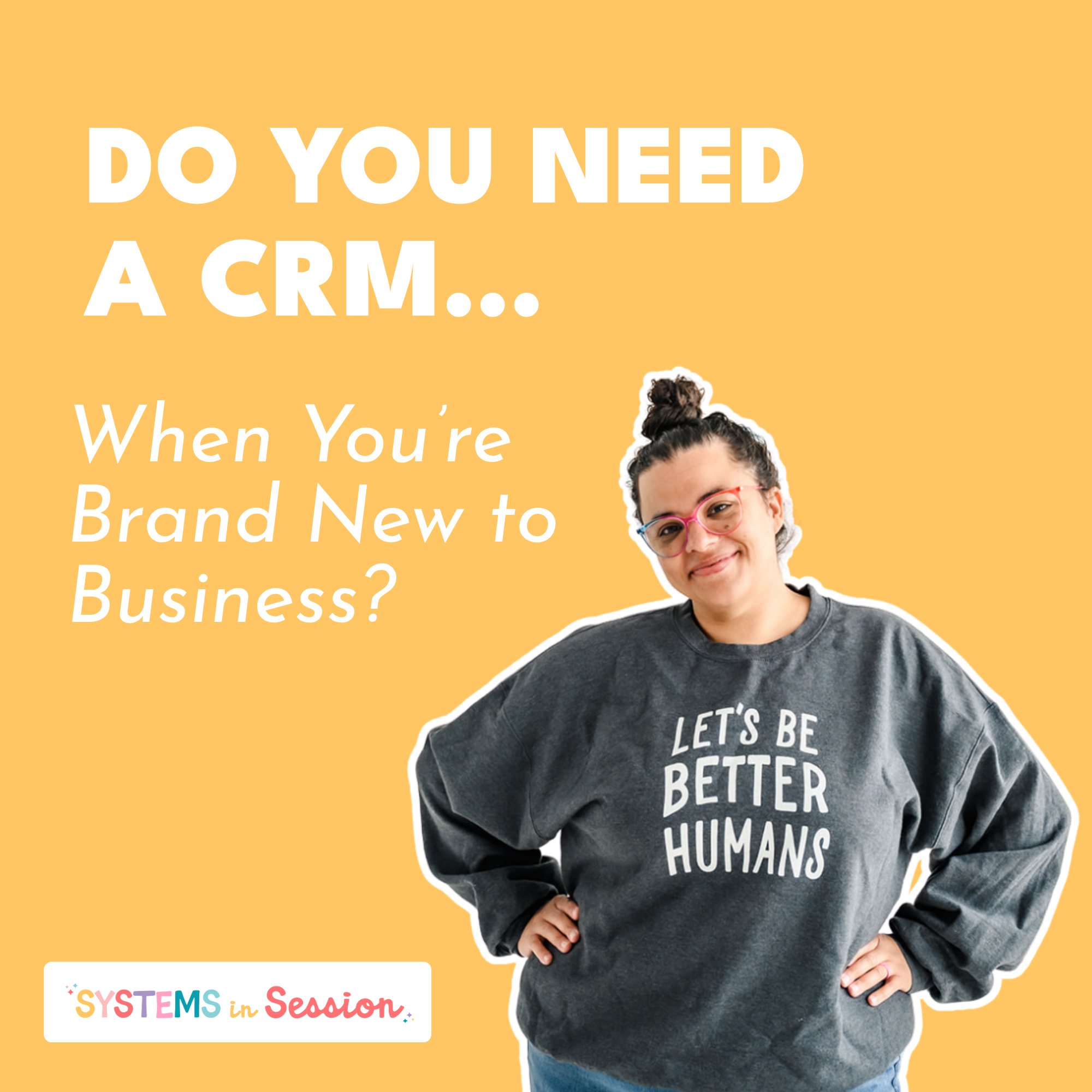
Do You Need a CRM When You’re Brand New to Business?
I’m just going to come out and say it: yes. Yes, you do.
I know, I know. You’re probably thinking, Colie, I barely have two clients. I don’t even fully know what my offers look like yet. I can’t justify the cost. And honestly? I hear this every single week. It’s practically a running joke at this point.
But here’s what I want you to understand. Every hour you spend setting up your systems now will pay you back tenfold later. When you’re busy and you’ve got a waitlist and three discovery calls on the calendar in one week, you’re not going to want to set up the systems you’ll so desperately need. Instead, do it now, while you have the time, while your clients are forgiving, and while you can actually fix things without it being a crisis.
I recently sat down with Anthea, a pet photographer who came to me brand new to business. No clients yet. She had a CRM she’d snagged in a Black Friday deal and the wisdom to know she didn’t want to figure it out the hard way. And in this episode, she makes the case for starting before you’re ready better than I ever could (because she’s living proof that when you build it right from the beginning, you don’t have to blow it all up and start over later).
So if you’ve been telling yourself you’ll get to your systems eventually, this one’s for you.
You were brand new to business when you joined Systems in Session. What made you decide to get a CRM and work on your systems before you even started letting people pay for your services?
I think it comes from my corporate background. I’ve worked in CRMs pretty much my entire professional career. I know how important they are, and I know what an absolute pain it is if you try to move anything down the road.
The longer you’re in something simple, the harder it is to change to something that you need as you grow. So I just figured, let’s start with the end goal in mind.
I figured, let’s just set up my new CRM, because the sooner I’ve got that set up, while I’m still new to business and my clients also know that I’m newer to business, if things go wrong, they’re a little bit more forgiving. I’ve still got the time to have the personal touch with them, to really explain why things haven’t quite worked out as I thought they would, and then I can fix it, so that when I do get busier and I lose that time to fix anything, it’s already working fine.
Can you tell us more about where that mindset comes from?
My corporate job is in learning consulting. I work with all sorts of different corporate organizations designing training, and a lot of the time it’s for change projects (change of policies, change of procedures, change of systems).
The change of systems is always the most frustrating and annoying one, partly because it’s change of behaviors. People are so ingrained in “this is how it works,” and the amount of time it takes to get them to shift their thinking and behaviors for the new system is one of my most hated things. I would much rather design an onboarding program than a change program, because onboarding is a fresh, clean slate. They don’t know what used to happen, they don’t know anything else. So you’re able to just go in and say, this is how it is, and then develop the behaviors and the processes and everything you want.
Change is a lot harder.
How did you find doing Systems in Session and basically setting up your CRM systems in 30 days?
We did it in a 30 day block, and I think I said to you at the start, I don’t know if I’m going to be able to get it done in the 30 days. And I did.
I was kind of lucky because I do juggle a lot (my corporate job, being a contractor so the hours change, and I’m also doing a Master’s of Education). But I just happened to have a lull, and I said, it’s not that terrible that I’ve got a lull because I’m trying to set up all this stuff in my photography business. So I was able to smash it all out. That way, all I have to focus on in the photography is getting clients, editing their photos, having the shoots, really maximizing that client engagement, and just continuing to build the nice little add-ons.
On my website I’ve got a client portal area where they can look at different products, a guide on what to wear, how to prepare your dog for a session (grooming, how to match clothing color to where you’re shooting, all those kinds of things). I’ve got the core basis there, it’s good to go, and I can just add to it as I’m able to.
What has your marketing and working with clients looked like since you finished Systems in Session?
I’ve been focusing more on organic marketing, not paid ads so much. So I’ve gone to markets and I’ve had referrals. I literally had a woman put an inquiry through my website using the Dubsado contact form, and she just said, hey, I want to book a session. I didn’t know the name, didn’t know anything. And then when we were on a call I asked how she got to me, and she said she was referred from her niece (whose dog I had photographed).
Every time they visit, they see the photo in her house. That dog was actually a model call while I was still learning how to shoot dogs! It’s one of my all time favorite photos I’ve taken (a German Shepherd at Parliament House here in Melbourne, Australia). We were just starting to hit golden hour and it was hitting the building, and it was just beautiful how it was all complimenting his colors. And she said, I want that, I want you to create something like that. I want your vision.
Talk to me about how you see your inquiry form working for the rest of your system (because it is one of the most in-depth inquiry forms I’ve ever seen)!
I want to gather information at that initial stage that tells me, number one, am I going to be the right photographer for you, but also, what value can I add to your experience?
If you tell me your dog is reactive, and I do specialize in reactive and aggressive dogs, then I immediately know we are not going to the CBD on a weekday at peak hour when there’s a lot of people around. Maybe a forest location is going to be better. So when I have that consultation with them, I can already be having those conversations.
I can get an understanding of their level of training, too. If they’ve got a dog that’s high in prey drive, we probably don’t want to go out into the middle of the bush where there’s kangaroos. I’ve actually recently also seen deer and goats out there, so it can be pretty intense with the wildlife in some of my locations. I can take reactive dogs to locations where I can guarantee we’re not going to see people, but the downside is that means we have our native wildlife (and native wildlife are very prey-triggering). I want to know that as early as possible so I can drive them towards the right time of day, time of year, and type of location (both for what they’re looking to display in their homes and what’s going to be best for their dog).
You were also asking about vaccine records in the inquiry form and I’ll be honest, I questioned whether you needed that right at the inquiry stage!
It’s not that I need a copy, it’s more so around younger dogs or newly rescued dogs, those dogs don’t have the same immune system as older dogs that have been getting regular vaccines. Depending on where your dog is at, they may not have had all of their vaccines, and things like parvovirus can actually hold into dirt and grass for 12 to 18 months.
So if your dog is very young, maybe not fully immunized, or newly rescued and just starting to go through that immunization process, I’m going to be steering you away from public parks with lots of grass. We’ll stick to either the middle of the bush where there’s hardly any other dogs, or a concrete environment like the CBD where parvovirus can be washed away very quickly and easily. So again, it’s about helping me inform them of the different risks and benefits of different locations for their dog.
What have your clients thought of your process (taking them from the inquiry form all the way through to gallery delivery and their ordering session)?
I’ll go with the first one, because she actually started her process while we were still building Systems in Session. Once we built the initial workflow up until basically where the session date would be, that’s when I sent her the form and the proposal and everything. She was a girl I had worked with professionally (she’d seen some photography awards I’d won and photos I’d shared, and she was like, oh my God, I want to book with you).
I’d said to her, can we just wait until I get everything set up, and then I can run you through it? She was able to be my guinea pig and give me some feedback.
So she filled it in and her pretty much first comment was, I can see you all over this. Having worked with you, I can hear your voice. While some people might think it’s probably a little bit overkill, I know you’ve got a logic behind absolutely everything you’ve included and every question you’ve asked. She said, I don’t necessarily know exactly where you’re going, but I know you’re going somewhere.
And what about the client who came through as a referral (the one who didn’t know you personally at all)?
I pulled up the proposal in our consult and said, if you know you want to book with me, here’s the form. I’m going to send you the link, and if you want to sign on, just literally scroll straight down to the bottom.
A marketing coach I’d spoken to actually said, don’t do that, they’re gonna have to scroll so far. And I said, yeah, but if I’m on the call with them, I can just tell them to scroll all the way down to the bottom.
As this client was scrolling, she was like, oh wait, is that the different collections you offer? And I was able to pause and have that chat with her then and there. We talked about the fact that they weren’t looking for fully custom artwork but would like more than three digital files, and we were immediately like, okay, that’s the middle tier. For something as simple as that, we were able to have that conversation around her expectations. And because we chatted about the collections, I also got a feeling for the type of artwork she was going to be looking for, so during the session I was already planning and thinking about how she might want to display things on her wall.
And how quickly did she sign on after the consultation call?
She did it literally within minutes of getting off the call. I think it was like three minutes after.
What does your process look like after clients get booked, and how did we craft systems to create that consistent experience?
Once they sign the contract and pay the invoice, that invoice being the session fee, that then sends them information to the client experience portal. I deliberately called it the experience portal so it was different to the Dubsado client portal. In that portal I have a location guide that covers my main options, the best time of year to go to them, the best times of day, and if you’ve got a reactive dog, considerations for that (whether it’s a “this location is not at all suitable for reactive dogs” or “it is at these times of day”).
So if they sit there and go, I want a CBD shoot but I’ve got a reactive dog, they know when they’re looking at my calendar they need to be looking at weekends and sunrise. If they want to be out in the forest, well the middle of summer during peak snake season is probably not a great idea for an afternoon shoot (and I will say my dog and I have come across a tiger snake in one of these locations, which is why I say no afternoon shoots in that location in summer).
This way, they can make an informed decision and pick the day and time that is most suitable for them, their dog, and the artwork they want in their home.
And what about reminders leading up to the session?
About two and a half to three days before the session, I have an email go out reminding them of their session (remember to look at the guide about what to wear, what to bring, all of that). And then I have another one that goes out about six hours before, covering what I need them to literally bring to the session (things like appropriate footwear, because if we’re in the middle of the bush in winter, your little sandals are not going to cut it in the mud, a long line for their dog if they can’t be safely off leash, treats, toys, all of that).
I knew I wanted those reminders at those times, but I also know my memory is bad enough that even if I had the time, I would probably forget to send them or forget a key piece of information. So having it all automated, and then about two weeks before the session I get a Dubsado reminder to go in and just tweak little bits I might need to adjust for their particular location choice, Then it all just does it for me.
It’s been six months since you finished Systems in Session. Have you made any major adjustments to the systems we built?
I wouldn’t say major, but a few small tweaks. There have been things that didn’t work quite as smoothly as I wanted, or a step I wanted to add because working with clients I’d think, oh, I kind of wish I could do that, oh, that’s right, I have workflows!!!
The main one was the client feedback form. A friend of mine went to fill it in, she answered all the questions and clicked the link to go to the Google Review, and then she freaked out thinking she’d lost all her answers because it didn’t open in a different window. She was texting me at six in the morning, I hadn’t even woken up yet. I got up half an hour later and she was like, oh it’s okay, it saved.
She said maybe if there was a little line in there explaining that, she wouldn’t have freaked out. So literally that day I went in and put a line in saying don’t worry, fill in this form, click the Google Review link, it’s all going to save. Once you press send on the Google Review, come back to this and then press submit.
What is your favorite part of your systems inside Dubsado?
I think it’s just the workflows as a whole. I love having everything automated. That way, I don’t have to sit there and remember, okay the invoice is paid, now I need to send them the link to book their date and time, now I need to send the reminder email. I don’t have to be chained to my computer doing that.
I manage so many things in my life, I don’t want to have to do that. Having the workflows take up probably 80% of the emails and communication just takes so much off my brain.
If they have a very specific question they’ll contact me and I’ll answer it, but if it’s general things it’s either in the client experience portal or already being provided in one of the automated emails. It even changes based on the calendar dates after the session has happened and sends them a thank you email automatically. Clients appreciate those little touches. They don’t have to sit there going, you said you’d send me this and I haven’t gotten around to it. I don’t have any of that stress.
What percentage of your client communication would you say is automated?
Probably more than 95%. The only real time I personally have to do anything is like the one or two days before a session, just quickly checking in on something specific, or on the day saying I’m running five minutes late. Or when clients have seen sneak peeks on my Instagram story and they know the gallery is getting close and they’re messaging me saying they can’t wait. Like the girl who got her gallery last night literally sent me a message saying I’m sobbing, these photos are amazing, you’ve literally captured a moment in time. So those kinds of communications are obviously me personally, but everything else is automated.
Tell me about your feedback form: I know you were already sold on having one, but what made you want to use a structured form rather than just asking for general feedback?
I know for me personally, when I’m giving feedback, if people give me questions to answer it’s much quicker for me to give feedback and much quicker to give them the information they need. So I knew I wanted to do that, but I didn’t really know what the right questions to ask were.
Getting your template gave me a really good basis. I tweaked a couple of questions to suit a pet photography audience, but it was really beneficial.
Is there anything else in your pre-session questionnaire that you’ve found particularly useful?
In the session questionnaire that goes out two or three weeks before the session, I ask them to upload photos of their dogs. Someone actually asked me, why do you do that when you’re going to see them in the session anyway? And I said, every dog is a little bit different (coat color, markings, everything). If I know ahead of time what they look like and what location we’re going to, I can start planning where I want to be in that location at what point of the golden hour to make their dog look as good as possible.
Like fluffy dogs, you get this beautiful rim light, but you want it more filtered than you would with a short coated dog because you’re more likely to blow out the highlights. So it’s those little things. I have been known to be filling up my car with fuel, looking through someone’s session answers on my phone going, do I need to respond to this, do I need to ask any follow up questions when I get home?
What made you decide to do Systems in Session vs. trying to DIY your systems set up?
I’d gotten Dubsado in the 2024 Black Friday deal, done some research, and decided that was the CRM I needed long term. So I just invested and figured between all the resources available online, I’d be fine, I’d figure it out. And then I got to July and people were starting to ask me about booking in, and I was like, if I haven’t done it by now, I’m not doing it without help.
I have a bit of a control freak problem in that I need to know how my own systems work so that if I want to tweak one small thing, I don’t have to outsource it or wait three to five business days. I can do it then and there. So I knew I wanted to be the one to actually build it.
Do You Need a CRM As A New Business Owner? The Answer is Yes!
Here’s the thing Anthea said that I keep coming back to: she’d rather design an onboarding program than a change program. Because when people are brand new, there are no bad habits to undo. No “but this is how we’ve always done it.” Just a clean slate and the chance to build it right the first time.
That’s exactly what Systems in Session can give you.
Whether you’re brand new like Anthea was, or you’ve been in business for a few years and you’re finally ready to stop doing everything manually and hoping nothing falls through the cracks, this is where we fix that. Together. In 60 days, we build out your entire client experience inside Dubsado, from the first inquiry all the way through to the final gallery delivery and the feedback form that gets you the testimonial you actually want.
You stay in control of your own systems. You know how everything works. And when you want to tweak something at 6am on a Saturday, you can (no waiting on anyone else to do it for you).
If you’re ready to stop putting it off and just get it done, I’d love to have you inside Systems in Session. If you’re not sure whether it’s the right fit for where you are in your business right now, send me a message. I promise I won’t bite, and I will absolutely tell you the truth.
Because the best time to build your systems was before you signed your first client. And I know it sounds a little cliche but the second best time is right now.


Signature Series


Your business works, but your backend is costing you.
A 4-Part Audio Series for service-based business owners who are ready to upgrade their “just fine” client experience, unlock higher pricing, increase referrals, and grow more sustainable revenue—without overworking behind the scenes.
Get the FREE 4-part audio training series
Systems That Sell


© 2022-2025 Colie James


