



What if the easiest sales you’ll ever make are from people who already know, trust, and love your work? You’ve been told to post more, grow your audience, and chase new leads. But what if your next booking is already sitting in your world, waiting for you to reach back out?
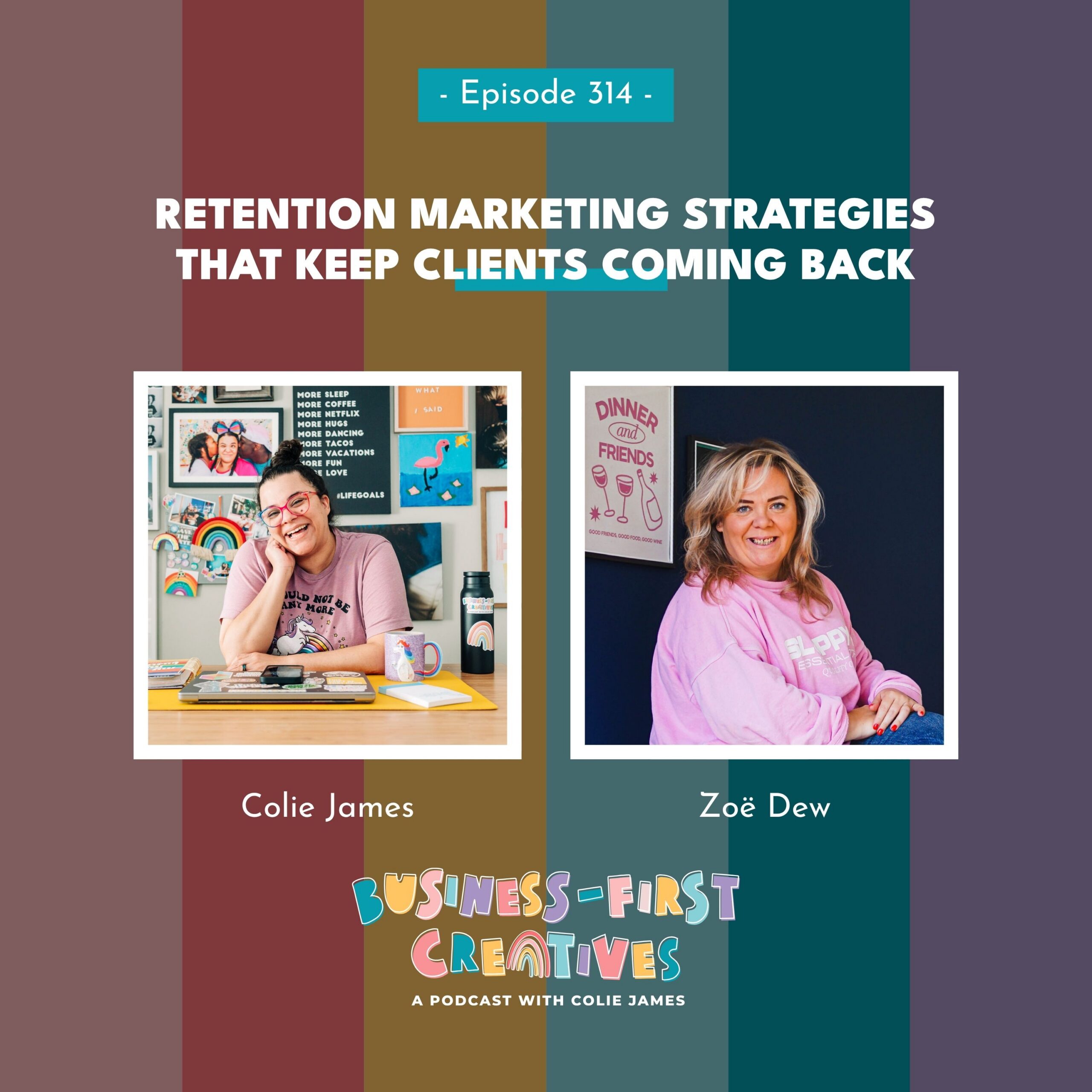
In this episode, I’m joined by Zoë Dew to wrap up my sales series with one of the most overlooked strategies in business: retention. We’re diving deep into why so many service providers leave money on the table after delivering a service, and how building intentional relationships with past clients can completely change the way you market and sell. We talk about the power of one-to-one outreach, why follow-up is your responsibility as a business owner, and how to stop chasing cold leads when warm opportunities already exist inside your business ecosystem.
What You’ll Learn in This Episode
- Why doing this work only when you’re starving will never give you the pipeline you’re looking for
- Why past clients are five times cheaper to convert than cold leads — and how to actually capitalize on that instead of just nodding along to the stat
- The four ways to approach past client outreach beyond “when do they need me again” (including one angle most service providers completely miss)
- Why “they’ll come back when they’re ready” is not a sales strategy — it’s just hoping really hard
- What object permanence has to do with your follow-up rate (and why it’s especially relevant if you have a neurodivergent audience)
- How to start a one-to-one outreach conversation without it feeling cold, weird, or like you’re being run by a shady sales agency
- The difference between broadcast marketing (megaphone) and one-to-one marketing (fishing rod) — and why you need both
- Why Zoë argues you probably already have enough people in your world to hit your revenue goals without generating a single new lead
- How to know when someone’s “paid you” even if they haven’t paid you money — and why that changes who belongs on your follow-up list
- What retention actually means (hint: it’s not a retainer, and the distinction matters a lot)
Review the Transcript
Colie: This might actually be the fastest that I have ever brought somebody back to this podcast.
Zoë: Oh
my gosh,
Colie: say hello to Zoë Dew. She is back.
Zoë: I’m back baby. When your email landed in my inbox to be like, I want you to come on again. I was like, oh my God. I feel so honored like it and I, ’cause you’d said before if I like you, I’m gonna invite you back and here I am. So you like me, you really like me.
Colie: I do really like you Zoë, but also, again, like I feel like this is the fastest that I’ve ever had someone back, because I have several people that I talk to on like a rotating basis. I mean, one of them is my business bestie, and we do it every quarter like clockwork. But there are other people that I invite back maybe twice, you know, a year maybe, that they’ve come back like every 18 months.
But you’re, you’re seriously the first person that I think has returned in less than six months.
Zoë: Wow. Wow. Amazing. Well, I mean that’s also because like I’ve got super specific on what I’m doing now. Like the last time I came on I was kind of dipping my toe in the thoughts about data and kind of being really mid about it. And now I’m so zoned in on what it is, like I have a load of different things to say now.
So I was really pleased to be asked back.
Colie: mean, it’s really hysterical though that you say that because I feel like you’re saying the same things over and over again, but that’s probably because I understood perfectly where you were coming from the first time. And so I’m not someone that you have to, explain where it is that you’re going, because I already know and I already agree, and I’m like, yes, let’s talk about this more.
Zoë: Yes, I think, probably when I came on last time, I had just started exploring the ideas that I now talk about all the time, and I think I hadn’t named it, I hadn’t put names to the people I hadn’t. Established a pattern to, to use every single time. it, was very much like, this is what you should be doing.
Why is no one doing it? Here’s the mechanic of how we can make that happen. Whereas now it’s like, no, these are the people. This is the
thing. Here’s what you do. It’s so much clearer. And so, yeah, I think I’m, I think we’ve, we are obviously very similar as we’ve spoken about before, in like terms of what we think and what we know, but. For people who are not in that world of basically let’s, let’s be honest, systems thinking
and pattern recognition. It’s so alien that it’s like, well, it, it sounds good, but like, that won’t work for me. And so,
Yes.
I am having to say it all the time, but I’m getting clear every time I say it. So that’s all that matters.
Colie: everyone you guys know, I’m in the middle of the sales series. Zoë is here to kind of wrap this series up because everybody previous to this, Kelsey, Chelsea, Ceels, oh my gosh. Like that’s hysterical to say all their names At the same time, all three of them were basically giving you information on what to say to your wider audience, and so I specifically brought Zoë on this series to wrap it up and say, okay.
But what if you need to actually target and talk to the people who have already paid you money? And so I am just gonna put a plug in here quick. Zoë’s last episode was episode 2 66, and it launched in December of 2025. You do not need to listen to that episode in order to get goodness from today.
But if you’re listening to Zoë and you’re like, yeah, she really makes a lot of fucking sense, you should probably go listen to that episode. Because it was really good, because you guys know I wouldn’t have brought her back if it was shit the first time that she was on here. So I mean, add it to your queue, give it a listen.
But today we are gonna dive into. The retention part of the three Rs that I am constantly talking to each and every one of you about inside of your offboarding process. And that is why are you leaving money on the table from the people who just paid you? And so this is what Zoë’s expertise is. So Zoë.
First of all, why are we targeting our past clients in this way? Like, what’s the impetus to get us on? This is why past clients are who you really need to be engaging at this stage.
Zoë: They are your easiest win because you have spent time, money, and energy getting them to spend money with you the first time. Some people, I’ll give you an example. Someone got in touch with me yesterday wanting to work with me. I’ve known her for three years. It’s taken me three years to get her to the point of wanting to work with me. And now that she is, I know full well it will not be another three years before she is my client again. And. We spend all of our focus looking outwards at who else is out there? Who else can I acquire? You know, in the corporate world, that’s what it’s called. Acquisition, how can we bring people in? But actually, if you want some stats, I’ll give you some stats.
it’s a,
very, well, it’s a, it’s a very well, trodden stat, but it’s five times more expensive to convert someone who is new to you than it is to convert someone who is already in your world. And actually. Especially the, your, your clients. How many clients do you actually need to be fully booked? How many clients do you actually need to be servicing at any one time? To have a full roster, to have a wait list that’s, you know, an active wait list,
presuming that you’re not launching group programs, et cetera. Actually, when you break down what that number is, the likelihood is they are already in your world. You didn’t finish with them the first time. No one is a one and done, especially when you’re in a, when you are a service provider, especially when you’re building things out or when you are solving one problem that they have. If you build a system that sorts that one problem, for instance, and I know not everyone’s building systems, but if you build a website or if you create a brand for, for one iteration of a business. That problem that they had will be solved for however long that problem is solved for. But they grow and their business evolves and their focus adapts and their what they sell changes. They will be needing a update on a brand or a new website or a completely different business will bloom out of whatever they’re building and. It is so much more likely that they will want to have the person that they already know. They already, like they already trust and they’ve already spent money with, sat in front of them solving that new problem for them.
Colie: I feel like the part that everybody misses is when we say this, it, it sounds really good, Zoë, right? It’s like, oh, well yeah, I should just invite them to spend more money. But then the clients that I work with are always like, yeah, co Let’s, let’s speak specifically to family photographers first and then I’ll kind of give some other examples.
But like family photographers in particular. Everybody thinks people only want photos once a year, or some people do it every other year. And so when they tell me this, I’m like, yeah. But having that idea in your mind, even if I would fight you on whether or not that’s actually true, are you actually doing the work to bring them back the next year or are you basically putting it in their lap and saying, I’m here if you need me,
and
Zoë: Yeah.
Colie: doing?
So like for someone who doesn’t have that one year cycle in mind, like let’s say that you do brand photography or you do design websites, or you write copy, I think the first step is figuring out what that cycle is, like how long is what you did for them the first time going to last, but like what’s your perspective on that?
Zoë: I think that’s quite a linear way to approach it of thinking, okay, well what’s the next thing that I can do for them? There are pro, there are four other ways that you could also look at it. So the one that springs to mind with, and this the four ways aren’t appropriate for every person. I just
wanna make that really clear. A lot of people that I work with work in the wedding industry, so photographers, you know, fit into that, into that bucket. used to work in the wedding industry, so that’s why I’ve got a lot of audience in that world. Where I would be going with them is thinking laterally across. Every person that they know. So who are the referral partners for that person? And I know referral partners sounds like a really wonky way to call, like friends and family. But the way to answer your question, the way that I would approach it is, okay, so you’ve got a yearly cycle. Number one, you’re correct. Thinking they’ll come back to you when they’re ready is a really passive way of doing sales.
Well, it’s no, you’re not doing sales. It’s just a really passive way to exist in business. object permanence exists for people as well as things. So if you are not in front of them in front of mind and having conversations with them regularly, then you are not gonna be the thing, the thing they’re thinking of booking. the referral partner piece is that if they were a perfect client for you, if you love their family, they, you know, paid on time, they, gave you feedback, you know, they did everything that they should do. The likelihood is that their friends and family will be of a similar ilk to them. So how can you incentivize them to send more people your way as well as booking them again? So then you
are multiplying the opportunities from every single person. The third thing is a lot of people think that they have to lead with them at the center. So for a photographer or a website designer or someone who works, um, you know, like books, their time out to complete a project. A lot of people will lead with my next availability is June, or the next slot I have to work on a project of this kind is then, or you know, I’m booking four weeks out. And that’s a really redundant way of approaching these conversations because you’re making it about yourself. No one cares. Literally, no one cares about you. They’re not, you are not top of mind for anyone apart from yourself. So the way to lead with things is, so if you are a family photographer. Maybe they do a pumpkin picking shoot every year, like as their kids grow up. So I would be looking and going in maybe February. Okay, well, uh, what’s happening in spring? Like what, how could we make it so this becomes a biannual activity? And then I would be going to people and going, oh, the, I, I dunno if you’ve noticed, but this farm over here, like it’s really close to where we go, pumpkin picking.
But they actually do tulip fields. And I’m thinking about producing like a bit of a session around the tulip fields. Would that be something that you would be interested in or is there something else that you always do in spring that, warrants having photos taken or, you know, something like that? Or just making it about them leading with curiosity. Because what I find is a lot of people are put off these conversations thinking like, oh God, I dunno what to start. I dunno what to start with. I dunno how to even bring up, you know, anything that I’m doing. And my answer to that is don’t, it’s literally not about you. No one cares. It’s about them. What are they up to? Where are they up to in life? What’s going on? And then start that, the conversation from there, it will flow naturally and that sooner than you think an opportunity will come up for you to suggest working together again.
Colie: Absolutely. And I think that one of the things that you are talking about in your current sprint and that you just talk about on your own podcast is making sure. It, you are actively keeping a list of past clients and identifying when it might make the most sense to work with them again. But I think that the problem that a lot of people have is that they’re not thinking about this as a system.
They’re thinking to themselves, oh, I have low bookings this month. What can I do? Who can I go back to that’s paid me in the past that I can reach out to now instead of actually making it a fucking system where you do it as part of your process to reach out to people on a regular basis to again, find out what it is that they’re interested in.
I mean, I think brand photographers, in my opinion, because I have been like working with so many of them recently. That is they need new photos for their business. So what’s going on in your business? When is your next launch? Are you launching a podcast? Like, tell me what you’re currently doing so that we can decide if you need additional updated photos for that thing.
And so it’s, it’s, what I love most about you, Zoë, is you need list. And guess what? You should be updating that list. On a weekly basis, on a monthly basis, so that you are not doing this kind of reach out, this kind of marketing, when you are starving, you are doing it. When you are thriving to actually keep your calendar full.
Zoë: Oh, a hundred percent and it is just part of a routine. It’s just your routine. It should take probably no longer than 30 minutes. Like if you’re doing it every day, probably if it’s 15 minutes, it’s probably taking you too long. Because really, if you think of it like a game of tennis. They worked with you, so that was like their serve. And you played that point. And then the next opportunity is gonna be your serve. So like send that, serve back in one of your reach out sessions or just even, you know, like when you are waiting for the kettle to boil in the morning or when you are, I don’t know, put, you’ve put your lunch in the microwave and like you’re waiting for it to heat up. You can just send a few messages of like, oh. Something that I find that’s really easy. It depends what social media you use, but is keeping an eye on what they’re doing on social media so you can be reactive in a way that feels really natural. And it is always natural with me. If you’re listening to this and you are in my world, please know that I’m never doing any of this with like a, a really cold thought in my head.
I am very reactive anyway, so I do kind of keep on top of conversations that I have running, but it takes, for 80% of sales, it takes five. Touch five follow-ups from the person selling to the person that’s buying. And I would say on average, most people do one. And if they do one, that’s probably more than they’ve ever done before. So, and, and when I say follow up, I don’t mean like buy my thing. Why have you not bought my thing? But follow-ups can be. When I was doing the follow up to the sprint, people had said to me, oh, I’m definitely buying. But they’d never done anything else. They’d not looked at the sales page, they’d not looked at anything. So I’d go back and be like, just so you know, we shot on Sunday. This was last week. We shot on Sunday. case you’ve forgotten. Then they were like, oh yeah, I need to take a look at it. Nothing happened. I followed up with someone four times I think. Last time was on Sunday, Monday night, she messaged me going, oh my gosh, I didn’t sign up.
Can I sign up now? Like, yeah, of course you can. You know, because again, this is probably gonna be the theme of the episode. No one cares. No one’s thinking about me. No one cares about me. And once you realize that, and once you can get your ego out of the way. Actually having these conversations is really easy and really interesting because every time you get a no, that’s data.
Every time you get a yes, that’s data. Every time you get a maybe it’s data, and once you have data you can analyze it for patterns and then build off those patterns. So more everyone should be doing this all of the time. You could probably have the business that you want on the people that are already in your world without having to generate any more leads, which is a very bold statement, but for most people, that is true.
Colie: It is. I mean, and you started this episode by saying you need to identify exactly how many people you need to work with in a year. For me, currently in systems in session, that’s 40, maybe 50, if we hit like my next level goal. That’s 50 people. Do you have any idea how many people I’ve worked with in the past?
I mean, even if those people only take up half those slots, I only need 20 to 25 more people. So getting clear on what your actual goal is is key, because a lot of us are like, oh, we need to constantly bring in new leads. But like, do you even have enough spots
Zoë: Yeah.
Colie: book all the people if you’re constantly trying to get new people?
of wanna tie it back around to like the previous people that I had inside of this series because. I feel like we should about the balance, Zoë. Yes, you to specifically reach out in this one-to-one marketing format to people who have been past clients, but remember they’re probably following you on your social media as well, on your email list.
And so even if you’re not reaching out to them directly, they’re seeing the other things that you are sharing with your audience. You know, at any given time. And so then when you do that, reach out, when you DM them, when you send them a personalized email that is in, you know, conjunction with the other things that they are possibly seeing you sharing.
Publicly, and that is just gonna move them a little closer to working with you again versus you’re not talking to like your wired audience and then all of a sudden you send them a personal reach out, but they haven’t seen anything from you about this offer in like two to three months, anywhere.
Zoë: Uh, yeah, I think that’s a really good point, but also to slightly challenge it, I think we make too many assumptions of how much people actually see. I know that’s my experience. Like the sprint that you mentioned earlier. I was promoting that for a month on email, not as long on socials, but you know, I’m an email girly and I had people on the last day open and click an email from. I think I sent probably 40 emails from all of those 40 emails they opened on the last day on the email that said it was
closing.
Colie: they open ’em one after another. Do you get that too? Like I will get people that are like, oh my gosh. And then I see that they opened eight emails in like 10 minutes because oh, it finally got in front of them. It finally caught
Zoë: Yeah. Yeah. Um, I don’t necessarily look at it in that way. It’s more the clicks that I’m looking at, but there were definitely people, like in the last two days, the emails that I sent those people had never clicked before. And, we also make an assumption that if someone’s on our email list, they’re following us on social media. Like if you take something like thread. There’s so many times I click on threads on someone because I see them all the time, and I’ll click on their profile. I’m like, I’m not following them. Just like that. The algorithm doing its work, you know? So. Uh, but that you make a really good point in social media, email lists, even teaching that we are broadcasting, that’s like a broadcast with a megaphone of like, Hey, you guys look at all this stuff.
I’m doing personalized outreach is specific. Accurate to the person that you’re speaking to. You can refer back to conversations that you’ve already had. You can refer to the work that you’ve already done. You can qualify people so much faster than by broadcasting. Out to however many people are in your audience, you need the two because you’re so right.
Like to get those nods of interest, there has to be a broader piece that you’re doing. And sometimes you know, when it’s a new offer, you kind of have to do the nets rather than the fishing rod. ’cause you have to like spread it out and be like, catch everyone that might be interested. But when it comes to actually getting right fit clients in the thing that you’re selling. You only really know that from having conversations with them and then being confident enough to go, yeah, this is the right thing for you. You need to, you need to like ask me more questions about it. Or you need to come into it. And some people like you bought the sprint without even speaking to me in my, for me in my business, that’s so rare.
Like that doesn’t really happen. and so it’s. Even, even people who were in there who were like a no-brainer from the beginning, they still had conversations with me of like, I think I’m gonna buy this. And I was like, okay, cool. Like I think it’d be great for you. Here’s the reasons why. And then two weeks later, they still hadn’t joined.
So that gave me a reason to be like, hi, did you know this is closing? But equally, a lot of my audience, like, again, this is very personal to me, but a lot of my audience are. Um, neurodiverse. So the object permanence thing is such, is so prevalent to them. Like they will not remember unless I am in front of them.
And once I understood that, it makes it so much easier to follow up. But I think it’s true, you know, across lots of different people. We’re all busy, we’re all overwhelmed by. Everything that’s going on in the world. So actually, if someone comes and knocks on your door and goes, hi, I’ve got this thing, it would be perfect for you.
Don’t even have to think about it. Here’s everything. It’s gonna do that. What a gift. That’s so helpful.
Colie: is, and first of all, Zoë, yeah. I didn’t talk to you before I brought the sprint, but I have talked to you multiple times and so I
Zoë: I know. No, I know.
Colie: number one. Number two, it’s so interesting what you said about the follow-ups because I make that same argument all the time about getting somebody to hire you.
The first time. So in other words, they’re not a prior client. They filled out your contact form, they sent you a dm, whatever it was that they did to start the conversation, and then you know, you chat, you realize that they’re a good fit. You make the offer in the form of a proposal or a sales link, and then they don’t buy.
I’m constantly telling my people minimum of three follow-ups, and you can automate them if you want. I mean, today we’re talking about one-to-one marketing, not the same as automating them, but in general, I just wanna say how aligned these two things are because not only do you have to do the follow-ups with the first booking, you might have to do them for the second and the
Zoë: Oh yeah.
Colie: and then it’s clear that it has nothing to do with whether or not you’re the right fit for them.
You were already the right fit for them. They paid you the fucking money. Now you’re trying to get them to pay you again. And if it still takes the same level of follow up, that is not about you as the business owner and your offer that is about how busy people are, and that at this stage, as you said, the object permanence, but also just the, no, the world is fucking noisy right
Zoë: Yeah.
Colie: a lot of things that people are paying attention to, and so once again. I say it is your like responsibility as the business owner to continue to follow up if it is something that you actually want to work with them on again. I mean, you can’t just say, hi, I’m here. And
Zoë: Yeah,
Colie: like, just leave them open to come hire you when they’re ready, because that’s just not how things work.
Zoë: no. No one’s gonna wake up and go, I wanna spend some money today. Where can I go and spend some money? Unless, like, I did actually do that last week, but that was the first time ever that I’ve gone. I want to hire a copywriter who is a copywriter that I can hire. That’s the first time
that I’ve ever done that, Yeah. Best thing I ever did, by the way, highly recommend. Um, but the, it’s so like, I’m not gonna wake up and go, I want to buy a course today. Whose course can I buy? Like, that’s just not gonna happen. So it’s so important and it, you are right, like responsibility is such a great phrase to use. The difference with people who’ve already worked with you is in theory. They are lower hanging fruit because they already know the results that you can give them. They already know how good you are. You already probably have most of the onboarding information. Like it’s an easier win, um, both for them and for you. so that’s the, probably the only difference. But in terms of the amount of follow-ups it takes or the amount of conversations.
And also something else I wanted to touch on is when it comes to retention, I think sometimes. We can get it twisted in terms of like what retention means for me. Retention doesn’t mean that someone is paying you constantly. It is not a retainer that’s, that’s really
important. So like retention is someone who is in your world and continues to come back to you to be a client over. The period of time that you work together. So that could be, you know, if we talk about photographers again, that could be 18 years. You know, if they’re a family photographer and they get shoots every year, that could be 18 years. You are still retaining them as a client. They’re not going elsewhere. They’re not choosing anyone else. They’re not, um, they’re not, not working with you anymore. And I think in. The online industry as we call it, um, it’s sometimes encouraged that there is a fast turnaround. The people who are so hell bent on bringing new, growing their audience with new people all the time. I find the people who are, teaching or educating on beginner level things. Once those people have learned those things, they move on to people who are not teaching beginner things. So they constantly need a stream of beginner people. Whereas when you are providing a service rather than educating often. As I said before, you evolve. They evolve. So there’s always an opportunity to work together again, because you’ve both evolved and, and different, there’s different problems. and when I say problems, I mean like different problems to solve as like
a, a, service provider. so when you are. Keeping a list of leads or keeping a list of people to keep in contact, like a little black book, your CRM system. For me, my follow ups might be like, oh, I’ve spoken to today. I’ll follow up in six months or see where they are in six months. It’s not going to be a follow up every week. Like that’s just unrealistic. Um, yeah, so like. You need to get it out of your head that this is like a, exactly what you said before, like doing it when you’re starving is not gonna get you very far because it’s going to take a long time. But once you’ve got into that rhythm of that long time, actually it, it means that you have a pipeline that is constantly moving and, and you can fulfill.
Colie: and I, I can’t remember who it was, it might have actually been Kelsey that said something about dialogue and starting conversations. But that’s how I’ve decided to like, take an approach to a, to, you know, getting back in contact with my previous clients is every week, who can I contact to get an update?
Now whether or not I am immediately trying to sell them something, or I wanna find out how the systems that we built before are still working for them, I mean. It is about checking in. I will say, I mean, a sales goal is there like, don’t get me wrong, I’m not saying just check in to check in, although
Zoë: No.
Colie: in sometimes is good, but like there should be a balance and like even if you are doing like this free training or you know somebody else that’s doing a free training that your client could use, I mean, just popping into their inbox and being like, Hey.
It has been three months. I would love to hear how this is going. Like I literally just did this this week. ago. I got on a one hour strategy call with someone. First time she hired me and I set up her mini brandand session scheduler so that she could automate the booking process. Well, I. I did another one yesterday and I was like, oh, I should check in with Susie and find out how her thing went.
Sent her an email just saying, Hey, I know that you’ve already booked the event. Like, how did the systems treat you? Was it easy to use, blah, blah, blah. I mean, she responded. She said, you know, it was awesome. She also added in all on her own. When I’m ready to tackle my systems, I will be back. That left the door open for me to contact her again in the future and just be like, Hey, I mean we’re approaching a new season of business, a new season of life.
How are your systems treating you? Or if I know of anything else that’s going on that I think she could benefit from, I will put it in front of her. A lot of this is about having fucking conversations and building relationships with the people that have already hired you, and that relationship should not stop.
When the delivery of the first service ends,
Zoë: 100% and like that ties in, you know, with a lot of that you talk about in terms of off-boarding and off-boarding, I think probably is the wrong term for it. It’s just closing that chapter. It’s not closing the
book and it’s, I think a lot of us have been burnt by crappy sales agencies. Coming into DMS and going, how’s business treating you? Or like, what’s your problem at the moment? Like, that’s not, that’s not outreach for me. And like I need to be really clear. I don’t do well with cold. Like I’m not a cold, um, traffic or cold outreach person. And I do agree with probably what some of the people have spoken about in terms of there needing to be called traffic at some times.
Like at some point you were called traffic to me and look, I’m on your podcast for the second time in, in four months. So
like. There’s, yeah, there we go. But it’s, it’s really important that you understand that the conversations that you’re having, again, lead with curiosity, lead with personalized details, lead with a genuine want to know how someone is. That’s all you need to lead with. It doesn’t need to go into a sales conversation. At very least these people that you are approaching, even if they’re not ever gonna be your client again, if you show up in a way that’s authentic and being a good service provider, then the likelihood is they’re going to refer you to someone else or you are going to refer them business from, ’cause you have a knowledge of what they do now. So you are building your network of being able to, Basically run your business without ever having to advertise again. Like that’s the be. That’s the dream of being able to have a pass roster of clients who keep you booked and busy, and you don’t need to bother with any of the other stuff. That’s my dream anyway.
Colie: It was my dream, and I actually did achieve that as a photographer. I mean, I used to talk about this. I, I don’t really talk about my photography anymore as I don’t currently do sessions. but, back in the day, you know, every year I would get new clients and most of my clients came from Google. So, I mean, I wasn’t running ads, I was just.
Putting out content, they were contacting me. My inquiry booking process was very smooth, and so I was actually closing a lot of my leads. I also offered a very particular service that not a lot of people around here did. So it did make me like very unique, but. Years. One, two, and three was really building like a solid client base.
And then I would say years four, five, and six were when some of the people were coming back, but not everyone. But then, you know, then the referrals started coming in. Then I started getting. People who were coming to me that were saying, oh, you took so-and-so’s pictures, I would like these pictures of myself and you know, my clients were also doing some of the heavy lifting.
I promise you there’s this one family. Every time I photographed them, I could tell when she shared the photos on Instagram. I would have no fewer than three inquiries from
Zoë: Wow.
Colie: who knew her that would see the photos and being like, oh my gosh. Like I didn’t know that I could get photos like this.
Because again, I don’t take photos outside in front of the mountains. It makes me very rare here in Colorado that I don’t do that kind of work. And so once people see it, they know that they want it. I also used to. Spend a lot of time and effort on getting the person for one session and then especially if they were like having a baby.
No, let’s come back at six months. Let’s come back at one year. And I feel like I’m constantly trying to tell people, no, there’s value in, in basically building your roster to then fill your calendar with the same people over and over again. And it’s not that you’re never gonna need new clients again. I mean,
Zoë: No.
Colie: have a client who.
Is basically aging out of her current roster so their kids are getting older. And you know, for the listening audience that doesn’t know this, when your kids get to be school age teenagers like Chloe, I mean, I’m not doing sessions every year. It’s hard enough to get her to give me the one every three.
And so there is a natural drop off, you know, as your family’s children age. And so you are gonna have to like go back to the pot and like restart. Again, don’t overlook the value of the clients that basically brought you here, because there are ways to continue to build that relationship and increase the lifetime value even if they are not hiring you as frequently as they used to.
Zoë: 100%. Like the, so something that I would always argue with someone if they go people, I’m a one and done, people wouldn’t come back to me, is I used to work in the wedding industry. As I mentioned before, I was a venue coordinator, so I would sell the wedding venue. I would sell 180 weddings a year. I was really good at my job, really really good at my job. Um, and so I would argue, I, I always argue that, um. If you think you’re a one and done, you’re not. Because when I sold the wedding venue, I sold it to twin sisters, like both separate weddings over six months, like six months apart. I sold it to brothers, bridesmaids, uncles, aunties, best men. I, you know, I, I, because. I sold it really well, number one, but number two, they would have such a good time attending that wedding that they would be like, I want that for my wedding when I get engaged. And I even had a groom come back for his second wedding with his second wife to the same venue that he’d got married at for the first time. So even if you think you’re a one and done. There are, every single person that you work with has a network of people, all of whom want what they’ve had if they’ve been treated right. And the other thing I was gonna say is that I have. Five areas and conversations that you can start with people. The first one is a reach conversation.
And a reach conversation is for the new people that are coming into your world. So for the new people that are coming into your world, it does, it does lend itself more to the like, how are you getting on? What’s going on, type of thing. But actually, if you flip it round and take an interest in their business and what they’re doing so you can understand. Where they might be better to enable you to be a good referrer, a good connector, a good networker. You stay in their brain as someone who actually takes on board everything you say. Basically, it all boils down to be a good human. Just be a good human and good things will happen to you. And I know it sounds really trite and I don’t want it to, but I mean, realistically, that is what it boils down to.
Colie: also you just have to have the damn conversations. Like I
Zoë: Oh yeah.
Colie: takes anything away from what we are talking about, it’s that closed mouths don’t get fed. if you’re never going back, like if your clients are dead to you, the moment that you deliver the service. You will never get, uh, a rebooking, well, I shouldn’t say never.
You were unlikely to get rebooked. You are unlikely to get referrals because you’re not front of mind. And so. You know, having these conversations, making sure that there is a system in your business for accountability to make sure that you are doing this in a measured way. I mean, like I said, I’ve started trying to reach out to at least one to two clients every week just to check in, or even the leads that have come in to my business
Zoë: Yes.
Colie: you know, inquired, asked me questions and then didn’t end up booking.
I have all of it documented in my Notion dashboard with actual reminders that’s like, Hey, Colie. You should check back in with this person. I mean, it doesn’t have to sound as cold and calculated as I’m making it right now, because again, sometimes when people reach out the first time, they’re just not ready and
Zoë: No.
Colie: to sit back.
They need to figure out what’s important to them. They need to let their business evolve in the way that it is. Then maybe if you check back in with them 60 days later, something has changed or moved them closer to being ready for the service that you offer. But it’s your job to still wave and say, Hey, I’m
Zoë: Yeah.
Colie: If you are still thinking about updating your systems, let’s chat about what that would look like now versus what that looked like the first time you reached out.
Zoë: I had a client who I’d worked with for three years for like, let’s call it coaching. It was more accountability really, but we’d worked together for three years. So she knew exactly everything I could do, and as time went on, it petered. So it used to be every week, and it was every two weeks and it was every month.
And then it was like as and when you need it, like, pay me to top up your sessions. And in January this year, she reached out and said, look. I am really struggling. I’m running group coaching. I need a way to document lots of stuff. Can you build this for me? And I was like, absolutely. Here’s my quote. So I sent her the quote across and she came back and was like, I don’t really have the funds right now, but I’m waiting for some funding to come in.
So when I’ve worked out like what I’ve got and stuff like, will you come back to me? Absolutely. So I left it for three months. I went back to her and said, look, I’ve got capacity. is everything still the same? And she came back and said, it is the same, but I want more. And actually, I ended up quoting and she signed for double what I’d originally quoted because
she’d had that time to think about what I’d scoped.
About what was included about, and, and also she had also in that time period, tried to set something up herself and realized
that what she’d, yeah. What, yeah, What, she had originally asked for me to scope wasn’t gonna fit the requirements that, that she had for it to, for it to happen. So. Again, my word of the year is the long game, and like everything I do, I just have to think this is for the long game.
And also like I just want everyone to know the reason why I’m so passionate about this, the reason why I started to like really go hard on all of this is because I tried the cold stuff. I tried social media posting every day ads, try to get on fucking LinkedIn, like I tried it all, going to networking events the last year. It was all about me trying to grow my audience. Nothing worked. Nothing worked. I would go up a few hundred, I would come back down a few hundred, my email list would go up a little bit and then come back down a little bit. And I had this thought of like, well, I’ve got like my business is thriving and I’m not growing.
So like. Do I need to grow if my business is thriving? And yeah, absolutely. I will need to, I will need to add people in. I’m looking at ways of how I can grow, but it’s growth without the thought immediately being, how can I convert ’em as quickly as possible? It’s
growth to be like, how can I help these people as quickly as possible?
And in the future maybe that they will work with me, um, or they’ll refer me to other people. And I think once I started to. Go back. It is so much comfier doing that and like having conversations. You know, if I said to you, okay, I am gonna give you a way to get 10 warm leads and then I’m also gonna give you a way to get 40 cold leads, what would be comfier messaging?
Like where would it be comfier to like have conversations? It’s a hundred percent gonna be comfier having 10 warm conversations than 40 cold conversations. So give me 10 warm leads, over 50 cold ones any day.
Colie: Let me be honest. I would rather have 10, but more than just having 10, I prefer to speak to people that I have a connection with. Now, don’t get me wrong, I mean, again, cold leads.
I had someone recently who found me on a YouTube video, came to my website, scheduled a call, and then booked my systems in session. Signature offer. I mean, and all of that was in like three days. Don’t get me wrong, I, I, I convert cold people, but I feel like those of us. That are doing a service and maybe do something where people are not just like immediately ready to solve their problem.
Ugh. I, I remembered what I wanted to say, Zoë. So the thing about systems that I have found is a lot of people want to attempt it themselves. And so you said that you had the client that attempted it and then they came back. I am never opposed to someone telling me on a call, you know, I, I think I’m not ready for this.
I think that I need to try to solve it, and I don’t try and shame them. I don’t try and say, oh, but you’ve been trying by yourself for 18 months and it’s still not done. What I do instead is. Well, let me know how you want to approach this and I’ll send you over some resources from my blog, from my podcast, whatever it is to kind of see if you can actually get this done on your own.
And if you can’t, I’m still here,
Zoë: Mm.
Colie: feel like a lot of us are so focused on like closing the deal that you are not nurturing them to
Zoë: Yes.
Colie: resources. And I mean, I love a good downsell. I mean, if someone inquires about your signature offer and that’s not right for them, but you have this lower ticket item that would give them the win that they need to kind of continue on their journey, and perhaps they will eventually be ready for your signature offer.
You should definitely be putting that in front of them.
Zoë: Mm.
Colie: don’t be so narrow minded to where you’ve got this one offer. You’re really trying to sell them this one offer, and if they don’t take you up on it, that you just go run and try to find new leads because again, the whole purpose of this conversation is stop chasing new leads all the time before you have attempted to convert your warm, hot previous clients.
Zoë: 100%. I’m right there with you. Like I think it is ego driven. Again, like I’ve mentioned ego a few times, but it’s just been, I’ve been, it’s, it’s probably very personal to me, but I’ve been doing a lot of unlearning recently and I just had someone say to me yesterday, why you. Doing things this way, what’s the outcome you actually want?
And I was like, actually I wanna help as many people as I can to do this work. ’cause it’s so important. And I feel like it’s very anti what has been fed from like 2020 to 2022 maybe, and is still like, trickling down. And I think I closed the sprint, did send out a feedback form of like, why didn’t you join? The majority of people said, I don’t have past clients to go back to. And I was like, oh God, that just breaks my heart. Like you’re so much earlier. Not in time in business, but in, in, terms of like what you think you need. You know, if you’ve ever worked with anyone, you have enough clients to be able to do this work, but also as you’ve seen in the sprint, even if you don’t have. Um, a huge pool of clients to go back to. You have so many people who are in your world. It’s not just about the people already in your client list, it’s about people like you said, who have inquired and maybe didn’t go over the line or have had downloaded a free resource from, you have left a comment on a blog, have.
Sent you a DM about anything. They are opening up the conversation. I think more of us probably need to recognize what the signals are that people are interested in us. Um, a bit like dating probably. And then be able to follow up on that and start a relationship. And sometimes we have to start relationships not knowing where they’re gonna end up. You know, is this, if we take the friendship thing of like people in your life for a reason, a season or a lifetime. So if they’re in your life for a reason, they need one specific thing from you, they might get that from a free download or, or a local. Paid resource and that’s fine, but they might send other people your way. If they’re in for a season, they probably have a problem that they need solving that one problem. It’s a bit longer term, but they’re gonna be a fan of yours and they’re gonna stick around. It’s just you might not work together again. And then for life, they’re gonna keep coming back to you. Every time they have anything that you can help with, they’re gonna keep coming back to you.
And even though the time might kind of get longer between each time, they’re not gonna leave. So it’s just about understanding that. Timing wise, not everything has to be now, and we have to be patient and play the long game.
Colie: we’ve talked about so much, and I feel like as we wrap up this conversation, there’s something that you just said and I feel like. weird trying to clear the air 45 minutes later, but I just realized I keep saying prior clients.
I keep saying leads, but I wanna it clear I brought Zoë on here. Not just for you to go back to the people who have already paid you money, but in general, this concept of following up and doing a more personalized one-to-one marketing doesn’t mean that they necessarily had to have paid you money.
I mean, Zoë just said that, but I just wanted to make sure that I like. Pulled that out and like highlighted it because I think that why this is different than the other conversations that I had inside of this series is while the three of them weren’t necessarily talking about only going after cold leads, the things that we talked about in those conversations were more for cold general.
Audience marketing, launching sales. But what I specifically brought Zoë on here to talk about was one-to-one. So regardless of the level of relationship that you have with the person that you are starting the conversation with, it is a one-to-one conversation versus the other kinds of marketing that I have talked about or that my guests have talked about inside this series.
I’m sorry, I just felt compelled. To
Zoë: Well.
Colie: this conversation before we like head towards the door.
Zoë: No, no, it’s all good. I think like something that I learned quite early on was people can pay you in a few different ways. So they can pay you with money so they can pay you for a service or whatever they’re paying you for. They can pay you with time, so they can come and do something for free, but they’re gonna give you time to get to know them and help them. They can also pay you with their email address. You know, they can
download something. There’s there. As long as there is an exchange for me, most of the time it doesn’t really matter if they paid you or not. I would still class them as a client. I would still class them as warm. If they have given you something in the return for you, giving them something, whether that is time, money, email, address, you know, whatever it might be. so yes, it’s, it’s people who are already in your world, and you know them well enough to like pick them out of a lineup or, or, you know, message them however that might be, um, one-to-one. Very true.
Colie: Zoë, if people are interested in learning more from you and perhaps getting in on the next booked sprint, where can they find out more information besides the show notes? I mean, I just want you to say it out loud so that they can hear it.
Zoë: Um, so the best place is Instagram or Threads. My, username is the same on both Zoë, R-D-Z-O-E-R-D-E-W. I am just writing a new download, um, that will be available very soon. Probably will be available now. As you’re listening to this, that will go through like the diagnostic I use to categorize what people are in your life and then the conversations that you can start with them.
the best place to be is on my email list to find out about anything that I do. I generally market to my email list most, um, I’m. Quite hit and miss with social media. As soon as I make big money, the first thing I’m outsourcing is social media because I, it takes me so long to do everything. but I yap on stories all the time, and I’m very, like I talk about not business on threads. That’s pretty much it.
Colie: I mean, and I only get your side of thread, so I thoroughly enjoy it. Okay, Zoë, thank you so much for being like the last minute edition to this series because I really do, um, the part of the conversation that you have brought in listening audience. Again, I tell you this all the time, but now I have another expert on the podcast to reinforce the things that I tell you all the time.
You should be keeping a list. You should be having conversations, you should be reaching out, and there is nothing that someone else is going to put on you to tell you that you are following up too much. You are being too salesy if you’re not doing it. You will never know the benefits of actually doing this kind of one-to-one reach out in your business and then I will just fucking feel sorry for you.
Alright, that’s it for this episode. See you next time.
Zoë: Bye.
Soundbites
“It’s five times more expensive to convert someone who’s new to you than someone who’s already in your world.” — Zoë Dew
“Thinking they’ll come back when they’re ready is not sales. It’s just a really passive way to exist in business.” — Zoë Dew
“No one’s gonna wake up and go, I want to spend some money today. Where can I go spend some money? So it’s your responsibility as the business owner to keep showing up.” — Colie James
“Every time you get a no, that’s data. Every time you get a yes, that’s data. Once you have data, you can analyze it for patterns and build off those patterns.” — Zoë Dew
“Closed mouths don’t get fed. If your clients are dead to you the moment you deliver the service, you will never get rebooked.” — Colie James
“Retention doesn’t mean someone is paying you constantly. It means they keep coming back to you over the period of time you work together — and they’re not going elsewhere.” — Zoë Dew
“You could probably have the business you want on the people who are already in your world without generating any more leads. I know that’s a bold statement. But for most people, it’s true.” — Zoë Dew
Why Your Past Clients Are Your Easiest Win
Here’s a stat that should stop you mid-scroll: it’s five times more expensive to convert a brand new client than someone who has already paid you money. Five times. And yet most creative service providers spend the majority of their marketing energy pointed outward — growing their audience, chasing cold leads, posting into the void — while the people who already know exactly how good they are sit quietly in their inbox, completely forgotten.
Zoë Dew calls this the biggest missed opportunity in small business, and she’s right. (If you want to go deeper on why communication is the foundation of all of this, this post on improving client retention is a great place to start.) When you work with someone, you’ve already done the heavy lifting. You built the know, like, and trust. You delivered a result they cared about. You removed friction from the sales process by actually doing the thing. Getting them back to the table isn’t starting from scratch — it’s picking up a conversation that already went well.
Think about what it actually costs to land a brand new client. There’s the content you create to get visible, the freebie you built to grow your list, the inquiries that go nowhere, the consultations that don’t convert, the proposals that ghost you. All of that time, money, and energy — just to get someone to say yes for the first time. Your past clients already said yes. That’s the whole point.
How many clients do you actually need?
This is the question Zoë wants every service provider to sit with before they spiral into another lead generation strategy. How many clients do you actually need to be fully booked? Not in theory — in reality.
For Colie, that number for Systems in Session is 40 to 50 clients a year. That’s it. And when you factor in how many people she’s already worked with, how many have inquired and not yet booked, how many are on her email list — the math gets very interesting very fast. Chances are, a huge chunk of that number already exists somewhere in her world. The work isn’t finding new people. It’s showing back up for the ones she already has.
When you get clear on your actual capacity number and start mapping it against the warm people already around you, the pressure to constantly generate new leads starts to feel a lot less urgent. You might not need what you think you need.
The Problem with Passive Sales
There’s a version of running a business that a lot of creatives fall into, and it sounds reasonable on the surface: deliver great work, and people will come back when they’re ready. Word will spread. Referrals will happen. Just be good at what you do and the rest will follow.
Zoë is not here for that, and neither am I.
Thinking your past clients will rebook when they’re ready isn’t a retention marketing strategy. It’s wishful thinking dressed up as confidence. Object permanence — the understanding that things exist even when you can’t see them — is something humans struggle with too, not just babies. If you are not actively in front of the people in your world, you are not on their radar. It doesn’t matter how good the work was. The world is loud, people are busy, and no one is sitting around thinking about when to hire you again.
This is especially true if you serve a neurodivergent audience. Zoë has built a significant part of her community around people who openly wrestle with object permanence — and once she understood that, following up stopped feeling pushy and started feeling like a service. You’re not bothering people. You’re helping them remember something that would genuinely benefit them.
Passive availability is not marketing
“I’m here if you need me” is not a sales strategy. It puts the entire burden on your client to remember you exist, seek you out, and initiate the conversation — all on their own timeline, with zero prompting from you. That’s a lot to ask of someone whose brain is full of their own business, their family, their to-do list, and everything else competing for their attention.
The business owners who stay booked aren’t the ones who are the best at what they do. They’re the ones who stay in the conversation. Consistent, genuine, personalized outreach is what keeps you top of mind — and top of mind is what gets you the rebook.
Four Ways to Approach Past Client Outreach
Most people, when they think about re-engaging past clients, think about it in one very linear way: figure out when that client is likely to need you again, and reach out around that time. And yes, that’s part of it — but Zoë argues it’s actually the most limited way to think about it. There are at least four angles you can work, and most service providers are only using one.
1. The cycle approach
This is the one everyone knows. A family photographer thinks about it as: they booked me last fall, so I should reach out in the spring to get on their calendar again. A brand photographer thinks: they launched their business a year ago, so they’re probably ready for updated photos. A web designer thinks: I built their site two years ago and they’ve probably outgrown it.
The cycle approach is valid — but it’s also passive in its own way if it’s your only move. You’re still waiting for the right moment to come around instead of actively creating opportunities in the meantime. If you’re a photographer specifically and want a step-by-step breakdown of this, how to get repeat clients as a photographer is the full guide. And if you want to see what a retention system looks like in practice for photographers, Kati of Xilo Photography built one that keeps 60–70% of her clients coming back — and sold out her first exclusive client day in under 24 hours.
2. The lateral network approach
This one is the most underused and, arguably, the most powerful. Every past client you loved working with has a network full of people just like them. If they were a dream client — paid on time, gave great feedback, respected your process — their friends and family are probably cut from the same cloth. So instead of just thinking about when to get them back, think about how to make them a referral engine.
Zoë spent years selling a wedding venue and watched this play out in real time. She sold to twin sisters getting married six months apart. She sold to bridesmaids, best men, and uncles who attended a wedding and decided they wanted theirs there too. She even sold to a groom for his second wedding at the same venue where he’d had his first. None of that happened because she waited for people to find her. It happened because she stayed connected and gave people a reason to send others her way.
The question to ask yourself: if this client loved working with me, who in their world should also know I exist? (This is exactly what I dig into in How to Turn Happy Clients Into Your Best Sales Strategy — worth a read alongside this episode.)
3. The lead-with-them approach
A lot of service providers make their outreach about themselves. My next availability is in June. I’m booking out four weeks. I have a new offer I want to tell you about. And every single one of those sentences starts with I, which is a really good sign that you’ve lost the plot.
No one cares about your availability. They care about their own life, their own business, their own problems and milestones and celebrations. So lead there instead.
If you’re a family photographer and you know a past client goes pumpkin picking every fall, reach out in February and mention that the farm near your shooting location also does tulip field sessions in spring. Ask if that’s something they’d be into — or if there’s something else happening in their life that season that would be worth capturing. You’re not pitching. You’re starting a conversation that’s genuinely about them. The sales opportunity will surface on its own.
4. The curiosity-first approach
This one underpins all the others. Lead every single outreach with genuine curiosity. Where are they in their business? What’s changed since you last worked together? What are they working on, excited about, or struggling with? Not because you’re mining for sales opportunities — but because you actually want to know.
When you approach outreach this way, two things happen. First, the conversation feels natural because it is natural. You’re not performing interest; you’re expressing it. Second, you learn things that help you serve people better — and often, those things reveal an opportunity to work together again that you never would have found if you’d led with your pitch.
One-to-One Marketing vs. Broadcast Marketing
Here’s something worth being clear about, because it’s easy to conflate these two things: what Zoë teaches is fundamentally different from your regular content marketing, email marketing, or social media strategy. Those are broadcast channels. You’re speaking to many people at once, and the messaging has to be broad enough to land for a wide audience.
One-to-one outreach is a fishing rod, not a net. You’re not casting wide and hoping something bites. You’re specifically targeting a specific person with a specific message that’s relevant to their specific situation. That’s a completely different kind of conversation — and it converts at a completely different rate.
This doesn’t mean broadcast marketing doesn’t matter. It does. The content you put out keeps you visible, builds your authority, and warms your audience so that when you do reach out one-to-one, they already have context for who you are and what you do. But if you’re only broadcasting and never personalizing, you’re leaving a lot of conversion on the table.
Zoë made a point that’s worth sitting with: even if someone is on your email list and following you on Instagram, don’t assume they’ve seen everything you’ve put out. People miss things constantly. She sent 40 emails during a recent sprint launch and had people open the very last one — the closing email — as their first engagement. They’d been on her list the whole time. They just hadn’t tuned in until something finally caught their eye. Personal outreach cuts through that noise in a way that broadcast marketing simply can’t.
The follow-up math most people ignore
Eighty percent of sales require five follow-ups. Most people do one — if they do any at all. That gap is enormous, and it’s not because people are lazy. It’s because following up feels presumptuous. It feels like you’re being annoying, or needy, or desperate. So you send one message, hear nothing, and tell yourself they’re not interested.
But here’s what’s actually happening most of the time: they’re just busy. They meant to respond. They got pulled away and forgot. Life happened. This is especially true when you’re reaching out about something that isn’t urgent for them right now — even if they’re genuinely interested.
Zoë followed up four times with one person during her most recent sprint launch. On the night it closed, that person messaged her and said: “I didn’t sign up. Can I still join?” They could, and they did. Four follow-ups. Not four desperate check-ins — four touchpoints that kept the door open until the person was ready to walk through it.
The reframe that makes all of this easier: no one is thinking about you as much as you think they are. That’s not an insult. It’s just the truth. And once you truly internalize it, following up stops feeling like pressure and starts feeling like a gift.
Building a System for Outreach (So You’re Not Doing It When You’re Starving)
The biggest mistake creative service providers make with past client outreach is doing it reactively. They look at their calendar, see a slow month coming, panic, and start firing off messages to everyone they’ve ever worked with. And it doesn’t work — not because the strategy is wrong, but because the timing is off and the energy is off. People can feel desperation through a DM.
The version of this that actually works is proactive and systematic. You’re not reaching out because you need clients. You’re reaching out because staying in relationship with the people you’ve served is just part of how you run your business.
Colie keeps a Notion dashboard with every past client and inquiry documented, including reminders to check back in at regular intervals. It’s not a cold CRM play — it’s an accountability system that makes sure the relationship doesn’t fall off just because the project ended. She reached out to a past client this week, just to ask how the system they’d built together was holding up after her first event. The client responded immediately, shared that everything had gone smoothly, and added — entirely on her own — that when she was ready to tackle more of her systems, she’d be back. That’s a door that just opened for a future conversation, all from one simple check-in.
The goal is to make this a rhythm, not a rescue mission. Zoë recommends spending no more than 15 to 30 minutes on outreach sessions — short enough to be sustainable, consistent enough to actually keep the pipeline moving. If you only show up in people’s inboxes when you’re desperate, that’s the version of you they’ll associate with your outreach. If you show up regularly, just to connect and add value, the sales conversation happens naturally when the timing is right. (And if your backend isn’t set up to support that kind of consistent, high-touch experience, this post on building a high-end client experience that practically runs itself is your next stop.)
What “warm” actually means
One thing that came up at the end of this conversation that’s worth highlighting: you don’t have to have a past paying client to use this strategy. Your warm world is bigger than your client list.
Anyone who has exchanged something with you — their email address, their time, their attention — is warm. That includes people who downloaded your freebie, attended your webinar, inquired and didn’t book, left a comment on your content, or sent you a DM about anything at all. These people have already signaled interest. They’ve opened the door, even if just a crack. It’s your job to walk through it.
Zoë’s framework for thinking about this: people come into your world for a reason, a season, or a lifetime. Some people need one specific thing from you — maybe a free resource answers their question and that’s the extent of it. Some people have a problem that takes a season to solve, and then they move on but stay fans. And some people keep coming back every single time they hit something you can help with. You don’t always know which category someone falls into at the start. But if you stay in relationship with them, you’ll find out — and you’ll be there when the moment is right.
Redefining Retention
Retention gets conflated with retainers all the time, and it’s worth clearing up because the misconception keeps people from seeing the full picture. Retention doesn’t mean someone pays you every month. It means they keep coming back to you over the lifetime of your relationship — however long or short each gap between projects might be.
A family photographer who photographs the same family every year for 18 years has incredible retention. It doesn’t matter that there are 12-month gaps between bookings. That family isn’t going to another photographer. They’re not shopping around. They’re yours, and you’re theirs. That’s retention. (For a full breakdown of the 3Rs framework — Repeat, Refer, Retain — and how to put it to work in your photography business, this guide covers all of it.) retention.
In a world obsessed with recurring revenue and subscription models, it’s easy to feel like anything less than a monthly retainer doesn’t count. But for most creative service providers, the real value of retention isn’t in the frequency — it’s in the loyalty. A client who comes back to you three times over five years, refers two colleagues, and leaves a glowing testimonial is worth more to your business than almost any new lead you could chase. And the way you earn that loyalty is by staying in relationship with them long after the invoice is paid.
FAQs for Retention Marketing Strategies
That’s one of the biggest objections Zoë hears — and she’s got a lot to say about it. Even “one-and-done” niches have a network. Every past client knows people who need what you do. The job isn’t just to get them back; it’s to make them your most active referral source. Zoë literally sold the same wedding venue to twin sisters who got married six months apart, and to a groom for his second wedding. If you think you’re a one-and-done, you’re not seeing the full picture.
Lead with curiosity, not a pitch. You’re not sliding into their DMs to sell them something — you’re checking in as someone who genuinely cares how things are going. Ask about their business, their life, the problem you helped them solve. The sales conversation will emerge naturally from a real one. As Zoë puts it: it doesn’t have to go into a sales conversation at all — but the relationship you build will pay you back a hundred times over.
Research shows it takes an average of five touchpoints to move someone from interested to paying. Most people do one. Zoë followed up with one sprint participant four times before the person messaged her the night it closed saying “wait, can I still join?” This isn’t about being pushy — it’s about recognizing that no one is thinking about you as much as you think they are. The world is noisy. It’s your job to keep showing up.
That’s completely fine — and honestly, you should plan for it. Zoë’s follow-up timelines are sometimes six months out. The goal isn’t to pressure someone into a yes; it’s to stay on their radar so that when they are ready, you’re the obvious choice. Sometimes people need to try to solve the problem themselves first (Colie sees this constantly with systems work). That’s not a loss — it’s a setup for a better second conversation.
Yes — and this is the part Zoë is most passionate about. Your “warm world” isn’t just past paying clients. It includes people who downloaded your freebie, sent you a DM, left a comment, inquired and didn’t book, or attended a free training. Anyone who’s exchanged something with you — their time, their email address, their attention — is warm. You have more to work with than you think.
About the Guest
Zoë Dew is a UK-based strategic ops partner who helps ambitious business owners scale smarter with AI, automation, and Airtable. With over a decade of experience in sales and operations — from coordinating hundreds of weddings to managing backend systems for leading online entrepreneurs — she now specialises in building streamlined systems that fix inefficiencies, uncover hidden revenue, and keep businesses running smoothly without relying on the founder’s constant input.
Find It Quickly
03:59 – Why Past Clients Matter
06:41 – Stop Being Passive
11:19 – Make Outreach a System
13:44 – Follow Up Like a Pro
15:52 – Broadcast vs One to One
23:08 – What Retention Really Means
25:28 – Check Ins Build Trust
36:53 – Warm Beats Cold Leads
43:13 – Beyond Paying Clients
45:31 – Where to Find Zoe
Mentioned in this Episode:
Episode 266: Stop Chasing Vanity Metrics: The 4 Habits That Actually Grow Your Business with Zoë Dew
Connect with Zoë
Website: zoedew.com
Instagram: instagram.com/zoerdew
Threads: threads.com/@zoerdew


Signature Series


Your business works, but your backend is costing you.
A 4-Part Audio Series for service-based business owners who are ready to upgrade their “just fine” client experience, unlock higher pricing, increase referrals, and grow more sustainable revenue—without overworking behind the scenes.
Get the FREE 4-part audio training series
Systems That Sell


© 2022-2025 Colie James


