
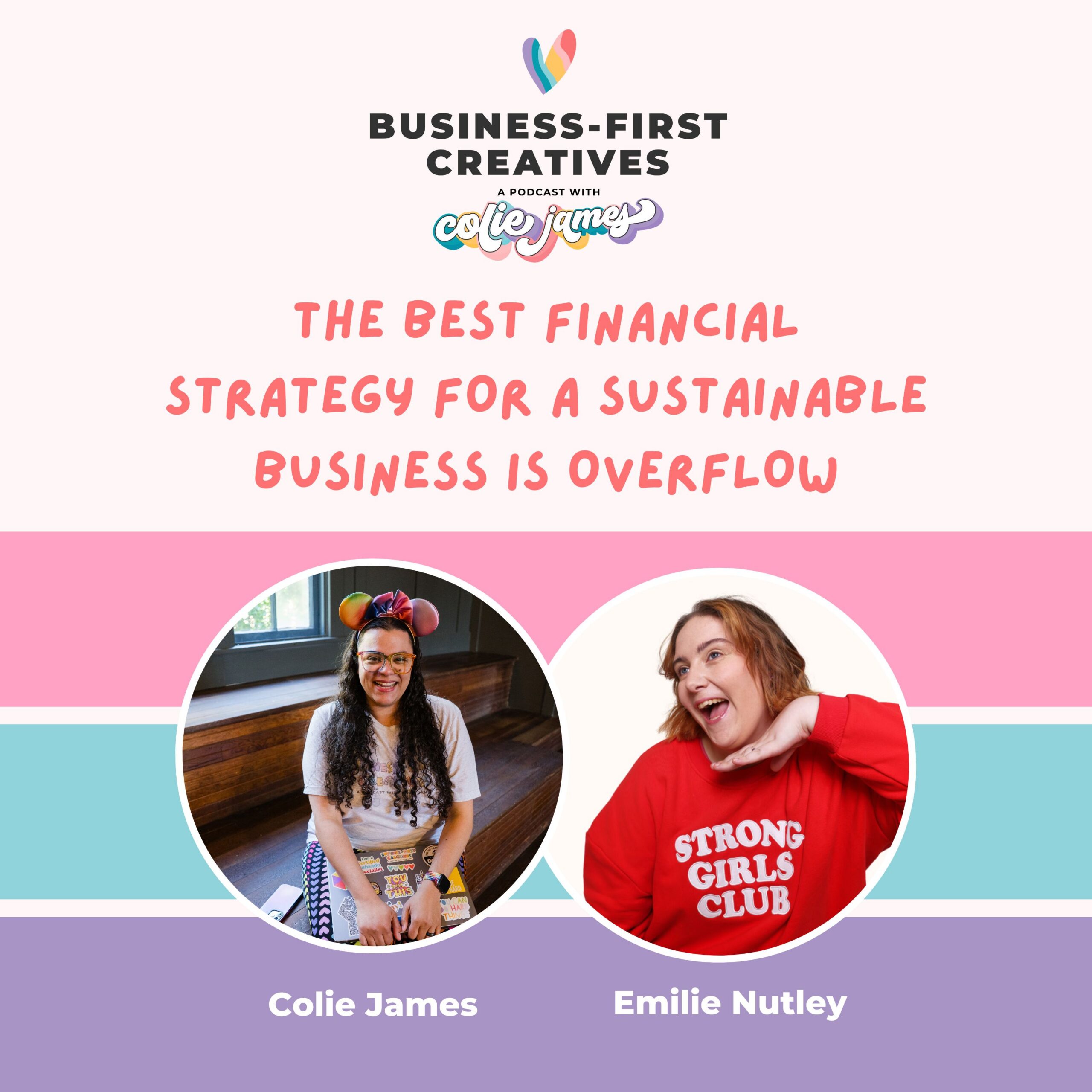




If you’ve been avoiding your numbers this year—this is your sign to review them. I invited financial expert Emilie Nutley to join me for a powerful, no-fluff conversation about pricing your signature offer, paying yourself consistently, and a financial concept that will completely change the way you think about business finances: overflow.
We talk about why you should never price based on competitors, why revenue is not the same as take-home pay, and how to build a business that brings you both joy and a paycheck. If you’ve ever had inconsistent income months, questioned your pricing, or treated your business like an ATM, this episode is for you.
Review the Transcript
Colie: So I feel a little guilty guys. We are now a couple months into 2026, and I haven’t talked about money on this podcast. Like if you’ve been around for a while, you know that at the start of the year, I really zap into that new year, new me energy, and I usually have a financial person on to talk to us about money. And this year it just slipped through the cracks. Honestly, because I was too busy trying to sell you email like you mean it. But I am rectifying that today and I have invited Emily Nut Leon, and we’re gonna talk about money, and you are gonna be forced to think about the pricing of your offer and what you are currently doing in your business related to profits, revenue, expenses, and this new word that Emily is going to introduce us to called overflow. Emily, welcome to the podcast.
Emilie: Hello. Oh my goodness. I’m honored that I am 2020 six’s financial guest.
Colie: There you go.
Emilie: yeah, very excited. So thank you.
Colie: Ah, okay guys. So how I invited Emily on the podcast, I, you know, and if you guys don’t give a shit about these backstories, y’all should like, let me know so that I can stop telling them. But like I decided a few weeks ago that I was going to record an episode about. Pricing your offers, and more specifically how we get into making sure that your offer is sustainable and profitable inside of systems in session before you ever touch your CRM. Because it’s very important to me that we not build systems around an offer that has a shit price. I mean, I think everyone knows this at that point, and I was like, oh, I’m gonna record this episode. And I was driving Chloe somewhere, I don’t even know. It was probably school. And Emily’s podcast came up as like, you know, my next episode to listen to. And I was probably like five minutes in and I was like, oh shit. No, I should have Emily come talk about money. And then I can follow up with an episode about how we price your offers inside of systems in session. ’cause I mean, I’m not a money person, so I brought you an actual money person to discuss this.
Everyone listening, you’re welcome. Okay, so Emily, let’s get right into it. I feel like when people decide, and by the way, we’re gonna start with a signature offer, because knowing Emily as I do, if I ask her these questions, she’s immediately gonna jump in with, oh, but it depends on your different offers. I don’t wanna go there today.
Right now, I wanna stick to a signature offer. So, Emily, when you sit down and you’re like, I have a business. I do this thing amazingly well. I wanna offer it to people. What’s the first thing that people should consider when they start to think about how to price their offer? And I know that it’s a big question.
You can take it wherever you want.
Emilie: It’s a big question, but a really easy answer, which is, how much do you wanna pay yourself? Always start with that. Never start with what do you wanna make? Because you don’t get to take that all home. So yeah, how much do you want to be paying yourself? And obviously for that you need to go and look at, you know, what your bills are, what are you spending on average, like what do you need to survive?
And then also, what do you want to be doing? Like do you want to be building savings? Do you have personal debt you wanna pay off? Like all those things. That’s the first consideration. That’s then gonna inform your revenue goal that your business needs to generate. Once you’ve got your business revenue goal, which is obviously like what you wanna take home from your business, plus your business expenses, add a little buffer for tax and a little buffer for overflow, which, we’ll, we will get into, that’s your revenue goal.
And then after that, it’s looking at your capacity. So obviously revenue goal. Okay. You could sell, let’s say a revenue goal is like, I dunno, a hundred K. Let’s just make it a nice round number.
Colie: I mean, and I
know how you feel about a hundred K, so I’m so glad that you just pulled that number out. Guys. She has rants all the time, about six figures and a hundred K, but I love that she pulled that number out. It is really just to make the math easy. Okay, continue, Emily.
Emilie: Yeah, I can’t do mental maths if anything like that is how my entire business started, was like, I can’t do mental maths. How can I make ma money? Make sense? Okay, this is how, um, but yeah, if you’ve got like a six figure, like that’s how much your business needs to make for you to be comfortable and everything, and you can only take, you know, 10 clients in a year.
Well, you’ve gotta charge 10 K.
Colie: Yeah.
Emilie: So then you’re thinking, okay, but do my looking at my ideal client, do they have 10 k.
Colie: Mm-hmm.
Emilie: Do they value this at 10 K? There are lots of different things that go into pricing, but ultimately you’re gonna be looking at that first number, which is your revenue goal, divided by the capacity.
So how many clients you can actually take in this signature offer. And that is gonna give you what that price should be. And obviously, yes, you know me, there are a load of caveats and nuances to that, but in very simplistic terms, that is pricing.
Colie: Well, let’s go back to the very first number that you mentioned. You mentioned that we need to know how much we want to pay ourselves, and I’m gonna throw a different word in there. I’m gonna say how much you need to pay yourself. ’cause I feel like people need to start with what you need. then maybe what you want is higher, but how do people determine what they actually need to take home in their paycheck?
Like what things do they need to bring to the table to be prepared to even make that a reality?
Emilie: Yes. So I found something called the bare bones budget, which is when I was like paying off my own debt and kind of going through my own financial journey, if you will. And it really helped solidify this concept of like, how much do actually just need to survive? So that is like, I mean, literally your bills, right?
So Bills, some subscriptions because I’m a firm believer of there’s no point not having any joy in. Like, you can say needs is literally what you need to survive, but you need spending money in order to survive. Um, I’ll
Colie: I need Disney
Emilie: a second. Yeah. Right. Like, you need Disney trip. I need pink and red striped clothing.
It’s just Right. It,
Colie: see I wore my magenta sweater just for you, Emily.
Emilie: You came on brand. I love it. So you’ve got your bills, and then you’ve got your like what I call necessary spending, which is like your. How much do you average spend on groceries? So to do this activity and something that I do with pr, like all of my clients, no matter whether you come to me in a group, you come to me one-to-one, the first thing we’re always gonna do is we’re gonna audit your spending.
And it’s not to like throw shame of like you are spending too much money. It’s literally to go, okay, this is what you need. Because there’s no point pulling a number at a thin air and being like, I guess I wanna pay myself 2000 pounds. It’s not gonna help you if you don’t actually know if you are
spending
Colie: is enough.
Emilie: yeah, you don’t know.
So go out and look like, look at the, it’s just, it’s data, right? Like we’re here numbers, data, categorize it. How much do you averagely spend on food, on groceries? Obviously fuel for like, getting about, not travel, but like, you know, you need to go to the shops. Maybe your partner has fuel to like get to their work.
You know, kid go to school or that sort of thing. Uh, prescriptions, medical costs, literally like what you need to do to survive and to earn money. So that’s like your bills, your necessary spending. And then afterwards is this joyful spending. So obviously with budgeting, traditional budgeting, we see things as needs or wants, and that can get really, it can actually be quite dangerous because what happens is we try and shut off the wants.
We think they’re like frivolous. So we go, well, I just need this to survive. And you’ll try and live on that and you might survive for like a couple of months and you’ll think you are like all holy. Earlier than thou, like, you know, like I’m so much better than everyone ’cause I don’t spend like money, I don’t, I dunno, I, I’ve seen it.
Um, and then something will happen, you know, and it can be something as little as you are on your period. It can be like a bad mental health week. It can be your kid is just driving you absolutely crazy. Or it can just be, you see your friends like having a meal out. But they
Colie: you. wanna go too? Mm-hmm.
Emilie: wanna go, but they didn’t invite you.
’cause they’re like, well she, you’ve said like, don’t, I’m on a budget, like, don’t invite me out. And then you’ll break and then you’ll end up overspending. Because it all, it’s almost like in, the relationship with money is very similar to people’s relationship with food. And this like binge restrict cycle.
So if you restrict, we will then see the binge. So there’s no point doing that. So always give yourself an amount of money for like joyful spending. It can be small, but again, use your actual data to work out what that should be roughly so that, you know, let’s say you’re spending a thousand pounds a month on just like random.
Stuff that you like and enjoy and you know, you just put 200, well that’s not gonna be realistic, but you could maybe go, okay, well let’s try 700, you know, and then you can like intentionally work it back down if you want to. So yeah, that’s how I would work out what is that need category? And then you can grow from there.
Colie: Yeah, and I mean, I am totally with you. I think that everybody needs joyful spending. I just think that I tell my people that you need to know the need. And you need to know the want because at the end of the day, if the want number, like what you want to actually pay yourself is the number, that’s the goal. And let’s say that you have a really rough couple of months and you don’t hit your want goal. I personally, you know, me personally with my personality, I like knowing oh, but that’s okay. Like I said, that my want was 15,000. But my need is actually eight. And so if I didn’t hit my goal of 15, but I was making 10, should I really be complaining because I am actually still running a sustainable business for what I’ve calculated for myself And again. To bring it back around. I think that one thing that people struggle with is with pricing. With pricing, your offer is they go and they look at all their competitors and they’re like, oh,
well this person’s charging like $700 a session, or this person’s charging $1,200 a session, and they’re like, Hey, I’ll just meet in the middle and charge a thousand. And I’m like, okay. But like, do you live in the same house as them? Do? Does your partner make the same amount of money that their partner makes if they have one? Do you have the same amount of kids like. None of us should be basing any of our money decisions on what other people are doing, what other people have, because no one knows the backstory of that price.
It could be that no one is buying that offer from them at that price. It could be that they are completely sold out and overworked and stressed. Still can’t pay themselves what they actually need every month. So I, I think what we should take away from this part of the conversation is everybody has their own money story. And part of what you should do in this work and creating a relationship between you and your money is making sure that the decisions that you make are grounded in what you actually want, what you actually need and your circumstances, and not anybody else’s.
Emilie: Yeah, absolutely. And I think when you are looking at other people’s financial, that other people’s financial data, I was gonna say, but other people’s pricing, it can be a useful tool, but it is just that, it’s like part of the toolkit when it comes to pricing like. There are certain industries where, yes, market rates are within a certain reason.
And again, this is where like there is so much nuance when it comes to pricing. I find looking at competitors is more useful for my clients that are under charging because we can go and look at like. Here’s your evidence. Most people believe that they can’t charge a certain amount or they won’t make the money.
Their clients will run a thousand miles, or they’ll find someone cheaper. So I’m like, well just go and find the evidence that someone is out there doing what you do and charging more for it. So I think it’s really good for that. But for anything else, for actually setting your rates, then, yeah, no, definitely.
Look at your own financial goals. First, and then you kind of build onto that with the other areas of context.
Colie: Yes, and I feel like part of the reason that I wanted to have this conversation with you is I’ve never really. It’s not that I didn’t consider it part of my job, because clearly I’m not a money coach. This is not what my specialty is. But I end up having a lot of money conversations with my clients because we are building, you know, the actual systems where you collect money from people. And sometimes when people bring me their offer, like immediately my brain just starts questioning their choices. Like, wait, you’re only charging 600 for that. How many people are you? Booking, how many people are you actually booking a month? And then again, they tell me, and I start doing the math in my head, and then I’m multiplying by 12.
And I’m thinking to myself, okay, but like your max, your max revenue goal is this. And then I’m like, are, are you paying yourself regularly? Like, is that what you need to be making in your business? And then I feel like now my response is, Hey, I’ve got someone that you can go talk to because I mean. You know, at the end of the day, I am not an expert in this, but I do feel like I am an expert in questioning people’s decisions and determining whether or not they need to spend a little bit more time in a corner with like a piece of paper and a pencil and perhaps a calculator.
’cause the mental maths, as Emily says, in order to make sure that the offer that we are putting inside of your Dubsado, inside of your HoneyBook is actually profitable. Okay. I feel like now that we got that out of the way, Emily, we’re gonna talk about overflow. Because I think this is one of the most unique perspectives that I have seen on these internets related to money. And I feel like if people just understood this concept, they would feel better about the inconsistency that they might be experiencing inside of their business. And I’m gonna say this is a very timely, um, episode to come out because I feel like right now. For family photographers in particular. This is the slow season and Emily and I are recording this in mid-February, and this is legitimately when half the family photographers start questioning their life decisions because fall was probably very busy.
They probably had to turn some people away. They probably maxed out their calendar. Now we’re mid-February where your inquiries are still really cold. And so, you know, this wave of revenue in a photography business is real, and particularly in Q1, it’s you start to question, is anybody ever gonna hire me for my services again?
Because you went from like, I don’t know, 20 inquiries a month in the fall to now, maybe you’ve had two. And if they weren’t like a really good fit and you booked them. You might not actually have any revenue coming in this month, and so talk to me about what overflow is and how
it’s related to having these like rollercoaster revenue months or inconsistency inside your business.
Emilie: Yeah, overflow man, I love it. In really simply, it is what evens out. So obviously if we have really high highs and really low lows, but you still, when you pay the tax man, you’re telling them you’ve made a profit, then we should be able to even out what is happening. So what we do is we take the. Owners pay that we talked about a minute ago.
When you’re setting your prices and ultimately your owner’s pay has, is probably the most important number that you will come up with in your business. You need to pay yourself a set monthly salary that doesn’t change. Like, sure you have a great month, you can give yourself a bonus, but not without consulting or overflow.
So you are paying yourself this set monthly take home pay, and your business expenses are relatively similar month to month. You know, you might make the other investment here and there, but again, consulting or overflow. So you’ve got this consistent expenses. The income might not be consistent, but the expenses are.
What we can do is we can map out what is going to happen. And this is forecasting. And I think forecasting is scary for quite a lot of people. ’cause it’s like, well, I can’t predict the future. I don’t have me a crystal ball. The cards aren’t giving me the numbers. so what. What we can do is we can, if you’ve already got, and this is great for people who are, maybe have clients on payment plans, right?
You can just map out those payment plans, like what do you have coming in? If you have someone on a six month payment plan, map out the next six months worth of money coming in and money going out again. If you’re someone who maybe doesn’t have payment plans and maybe you take deposits and you know when the rest is gonna be coming in, map that out.
Or if you’re gonna have a launch, you can map out, you know, what do you think your launch is gonna hit? Maybe you can use past data to look at that and conversion rates and all that fun stuff. But, so even though we can’t, we can’t tell the future, we can have a bloody good guess. And what we can do with that data is we can map out what’s coming in, what’s going out.
Obviously that’ll give us our profit. That is where most people stop. That’s where your accountant stops. That’s where your bookkeeper stops. And you are like, great, thank you. Made a profit. I’ll be on my way. But the most important thing is what your profit does in your business, because obviously your profit, we need to put aside a bit for the tax man.
Unfortunately, we just got, we gotta do the do
unless you live
Colie: taxes and dies. Yes.
Emilie: Well, yeah. I’ve got a client in Dubai there and I kind of hate her so.
Oh, just anyway, so the tax goes aside and then we pay ourselves. Okay, so the profit, we have to pay ourselves, but then we should have something left. We don’t always, but on the months where we do have something left, we are gonna put that aside.
And then on the months where we don’t have any, like we, let’s say we map it out and we pay ourselves and it has a minus number as like the remaining. We can go to our overflow pot where we’ve been putting money in and pull it out. We can just chop it back up and we can also, we might not even necessarily need to top it back up because maybe we can look and see that next month we’ve got more cashflow coming in.
So because we are mapping out what is happening. So it’s kind of a combination of like forecasting cashflow tracking. This bank account management system and all of that is I kind of call the overflow formula and it is just so we have this concept of we can keep a buffer in our business. That means we can always pay ourselves consistently so that we can plan our personal life and hit personal financial goals and cover our bills with ease and so that we can also plan our business.
Because if you can map out months ahead and you can look at what the gap is gonna be. I can look at, say, may, and go, okay, payment plans drop off. I need to make an extra 3000 pounds. That now gives me two, three months to go and plan a sales campaign. I can go and look at, okay, I need to bring in more leads.
Okay, I’m gonna do a month of lead generation that I’m gonna do a month of warmup, and then the third month I’m gonna do the launch. You have all that extra time to make those decisions to bridge the gap. Whereas if you don’t have any of this information, you’re literally just kind of playing it month by month, week by week, day by day, which is really, really stressful.
And when you are under, and this is why I bang on so much about the work that I do, is that when you are under financial stress, your brain, it actually triggers the same response as a trauma response. And your survival mode basically kicks in that Fight flight, fa freeze response kicks in.
Now, you cannot do big picture thinking, creative thinking. Your personality isn’t gonna shine through in that period of time when you are under financial stress. So you cannot grow a business from that place.
Colie: Yes.
Emilie: So if you want to grow your business and you want to grow your business sustainably. You have to feel calm around money, and you cannot feel calm around money unless you know what is going on.
And you give yourself that breathing room in terms of yes, financial, in terms of the overflow, but also with like the numbers and having that data to see so then you can make those strategic decisions and that is when your business is going to grow.
Colie: You called it a strategic decision. I just realized like data-driven decisions is where all of this comes from. And there was something that you said, Emily and I was literally laughing in my head because why have we not made overflow like a team member in our business yet? When you said you consult overflow and then you said it again, I was like, what if we just all thought of like overflow as a team member and I mean, I guess you could call it Mr.
Overflow, but yeah, I’d rather it be Mrs. Overflow or maybe we just make it a llama in my case so that it doesn’t be, you know, it’s not gendered, but. Uh, overflow can help you make so many decisions. So again, let’s, let’s actually list them out. So the first thing that you said was, we have these inconsistent income months, revenue months perhaps, and if we have a low month. We don’t automatically panic, we just look at our spreadsheet. We look at what we are anticipating coming in through payment plans, through projected sales to make sure that this is just a one-off. And if it’s not, then we do need to try to make some, some decisions. And like you said, it’s currently February.
If you look forward and you know that your payment plans are dropping off in May, I mean, I think that we can’t say this enough. On every single podcast, whether it’s related to money or not, you are marketing today. For who is going to pay you and hire you quite often in 90 days. And so if you see that you’re gonna have a low overflow month next month, I mean, besides doing an actual flash sale like immediate to get people, if you’re doing like more long-term marketing, you would need to market now to get the leads that are going to convert. Next quarter. And so this is not something that you can just push aside. This is not something that you should be looking at only on a monthly basis because then you are making panic driven decisions about bringing in things to your business. And I don’t know if you come across this, but my clients are often, um, scared or resistant. Two, putting out sales, doing a lot of marketing because they don’t wanna seem desperate, and I always tell them, but the key is to do it before you’re actually desperate. Like no one wants to do a sales campaign where you actually need to make $7,000 in the next week. That is extremely stressful. But if you know that you need to make $7,000 extra in the next 60 days. You’re not gonna come across as desperate if you are making strategic decisions about your money and your marketing.
Emilie: Yeah, I mean, I have nothing else to add. I’m like preach. Just preach to all of that. Like it, it is that like the decision making and that this overflow gives you the time to make those decisions and the growth decisions, right. So another thing I mentioned was that you can decide when to invest in your business.
Like it’s overflow that allows you to decide, can I hire, can I pay myself more? Can I take time off? Like there’s so many things that we just want, we want to do, or that we kind of have to do as a process of just doing business. That if we don’t have, like you say someone to consult something overflow to consult, then we are just kind of guessing.
And that is when the panic comes in, that is when the guessing comes in.
Colie: Yeah. And you mentioned hiring. And I wanna say there’s like, in my mind, there’s two kinds of hires. There’s a hire that you make that is actually revenue generating. So in other words, if I hire a new team member, which is basically a mini me. And that enables me to bring on more clients to bring on more revenue. Making that hiring decision is probably easy. Like if I can take five more clients, if I bring on this team member and I know that I have five clients like literally waiting to hire me, that’s an easy yes. Like hiring the person is going to cost me money, but in the end, if I am priced sustainably, it is actually going to increase my revenue versus if we want to invest in someone’s program. Let’s say copywriting or you know, getting done for you, marketing, design, whatever it is, that’s not specifically revenue generating. That is when you have to actually see, am I currently making enough money to make this investment? And in most cases, you should be looking at your overflow to see, well, I anticipate that you know it’s gonna be this much and this is how long I’m going to be paying them. Am I currently, financially and in quotes guys, I’m saying stable enough, but really what I’m talking about is looking at your overflow to make sure that there is going to be enough in there for the next 60 days, four months, six months, to sustain that investment when it is not a revenue generating investment.
Emilie: Yes.
In case there are people wondering, ’cause I know it can, it can sound like, okay, so I put this money aside and I put it in this bank account.
I’m still having to know like how much of that should I keep for a buffer and how much of that can I actually dip into? That is where we have this and it is like, like. I’m gonna need you to like back me up here, but like, it’s a very simple spreadsheet.
Colie: It is very simple,
and y’all know how much I hate spreadsheets.
Emilie: right? I, again, I can’t, I don’t wanna do complicated spreadsheets if it has like a, a tab for each of the months.
No, thank you. Color coded. No thank you. Like different like formulas. No, thank you. Like, we just wanna know, so on this spreadsheet, you can literally see month by month. Like is it a minus or a plus? Like at the end of the month after you’ve done everything, is it a minus or a plus? And then you can allocate bits to the pot aside for sure, but you’re not gonna have to be making like the big, you know, maths of like, how much do I actually have available this, that, and the other.
’cause it always shows you.
Colie: No. And then one of the things that I feel like we talk about a lot in your program is debt reduction. We’ve already said it more than one time, but like looking at your overflow is not just about what investments can you make. It’s also, Hey, I’ve got this debt that I, you know, has been sitting and so. Am I currently making enough money to where I can take a little bit more out of my overflow and send it over to make. Debt payments so that that can be reduced. But again, that’s like everybody has their own money story. Everybody has their own priorities, and you have to know what your money is in order to make the decisions that you need to make, not only as a business owner, but just as a human that has a life and has to pay personal bills in order to have somewhere to sleep at night.
Emilie: I think that’s a big thing as well is that people may see the business as like the big scary, the big scary monster. Like that’s what business finances are. And so what I see happen a lot is people kind of just take the money that’s left over, like maybe they get to the end of the month and they’re like, I’ll just pay myself.
What’s in the account and hope that you know enough money comes in next month. Or they’ll like, they’ll do the maths of like, okay, I need to put this into tax and then this is my profit and okay, I’ll pay myself that. But what that, that’s still living month to month. That’s still like, you’re not planning ahead like the month after and the month after and the month after.
So I think with personal finances people can feel like, oh, I’m actually really good. I’m actually really on top of things. ’cause their bills are paid. Right, but it’s, you’re still having to make those panic decisions in your business. ’cause you’re not looking at the longer term. You’re only looking at, can I pay myself this month?
Okay, yes. Great. And that’s it. Or you are treating your business like an ATM. You’re just pulling the money out whenever you want. And that’s not sustainable.
Colie: Well, and I mean, it’s really not good for your mental health. And I mean, the funny thing is I think all of us have offers where we’re like, this is the thing that I want people to do at the end. And just in case you guys are unfamiliar with Emily, like the thing that she’s going to the hill, the hill that she’s going to die on is everybody needs to pay themselves. Every single month regardless, and it shouldn’t be dependent on how you know how well you did or how bad you did. Everybody needs to have like. The goal of paying themselves. And you know, Emily isn’t like, well, you know, at the beginning we did that calculation, you know, what do you wanna pay yourself? And I, you know, butted in with the need and the want.
But at the end of the day, Emily wants you to make sure that you are paying yourself. And once you get in the habit. As your revenue increases, and as you know, you are mentally able to like not make panicked money decisions, that’s when you can start to increase what you’re paying yourself. But like bare minimum, everybody should get in the habit of paying themselves, and I’ve said it on this podcast, but since Emily is here as a money expert and she already knows this, uh, I didn’t pay myself like that until the pandemic. I mean, I was one of those people who treated my business like an ATM. Now guys, there was always enough money in there for me to pay myself what I wanted. But I wasn’t actually paying myself like twice a month, you know, on a particular schedule. It was, oh, James got paid today. Let me go into the business and transfer the money that I need to pay myself for this pay period.
That was literally what I did. And then during the pandemic, I got in the habit of paying myself every two weeks and I was like, oh, this is great. Okay, let’s continue this. But like. It doesn’t have to be that you are starting at like what your goal is. It could be that it’s a habit that you need to build, but everyone should be looking at their numbers in order to start building that.
I’m going to pay myself regularly going forward. It could be twice a month, it could be once a month, but it should be on a schedule that you can maintain without feeling that kind of panic that some of us do when we have inconsistent. Revenue months,
Emilie: It’s, I think what is important of like, what, the bit I kind of wanna pick out from what you just said is that it for a lot of people, this is gonna be something new if this isn’t what you’re doing already. This is something that is gonna feel really new, really scary.
It might even feel impossible. So it is about building that skill and it is about like, just starting where you are at. Like you don’t have to jump in and like you said, like wait until the end of the month and pay yourself if that’s not what you’ve been doing. Because you’re gonna get like one week in and be like, huh, I’ve got no money.
Um, so you have to look at your realistic situation. And I’ve had clients where. We’ve done, they pay themselves weekly until they can build up the overflow in their business, and then they can start to go to like fortnightly and then it’s monthly. So. You can do it however you want, but it, it has to work for you.
But I think, yeah, knowing the key here really is knowing your numbers. Like you have to know what you need. You have to know what your financial goals are, if you want to hit them. cause I know that one of the question will be, okay, so I’m paying myself, but how much should I be saving?
Colie: Mm-hmm.
Emilie: Which, you know, is something that I absolutely hate So how much should you be saving is my least favorite question because how long is a piece of string? Um, I think people just assume that I’m gonna tell them like, oh, 20% of your salary. But it’s not that because your, your savings goals are not 20% of It’s the reason why I hate profit first, right? Your take home pay, your owners pay is not a percentage of your income.
Like your owners pay is, your owners pay. Your bills are your bills. The mortgage company does not care if you made more or less money this month, you know? So no, we do not do anything on percentages. You need to know what is the goal, okay? If you wanna buy a house, go and look at how much does the house that you want cost, and then go and look at how much can you afford to borrow.
Okay? What’s the gap? There you go. That’s your savings goal.
Colie: How long do you have? I mean, yeah, it, yeah. I’m sorry, I just, I wanna focus on that math for just a second. ’cause you wanna go find a house, you wanna pick a budget, you wanna figure out how much of a loan you’re gonna be able to get, and then basically you need to figure out what you need to bring to the table as the down payment. And you’re not gonna probably save that in one year, like, or maybe you could, depending on your business revenue. But guess what? You won’t know how long it’s gonna take you to save for that house unless you currently know how much revenue your business is getting, how much expenses you have, looking at your take home pay. Then figuring out how much is left over that you could potentially save. And don’t forget about taxes. Sorry, I never mentioned that in my numbers. I just assume everybody does, you know, put some, puts away the money for taxes. But you’re, you’re making sure that you know those numbers so that you can make those decisions so that you have a realistic goal for that savings. You don’t wanna be like, oh, well I wanna buy my house in the next two years. And then you run all your numbers and you realize that you are gonna be nowhere near the amount of money that you need to have saved for the down payment. Now, does that mean. That you just give up? No, it means maybe you have to increase the revenue in your business.
Maybe you need to cut down on your expenses where you can in order to save more money for that down payment. But if you don’t do the initial calculation, you have no idea what is possible and what is not possible, and what decisions you need to make in order to hit the goal that you’re trying to hit.
Emilie: Yeah, so go and research. Go and research what you want. Because when you have that number, like you say, like you might not be there now and you might not be able to hit that goal in the two years that you want, but if you do wanna hit it in two years, what’s the gap? ’cause then you can build your business strategically to that.
I think so many people are out here trying to make sales. It’s like, I need to make more money. I need to make more money. I need to make more money. But it’s like, why? What is, what is it all for?
Colie: Yes. And at the end of the day, is buying a house, joyful spending. Yeah. Probably to me. I mean, I love my house. I like being in my house. I like that my new house gave me an office with a door where I didn’t have to share space with my husband. I mean, that was joyful spending. And I would say that in some ways it was a necessity.
But all of us have different necessities. I mean, I know people. That actually have no goal of owning a house. Like they like renting, they like that they don’t have, you know, the responsibility of maintenance and like these things. And so maybe your goal is something else. Maybe your goal is, you know, a yearly vacation to Europe for two weeks, or a vacation to The Bahamas, or buying a new car.
I mean, we all have things. That we want in life, and a lot of them are related to money, and I feel like a lot of us go into business for the flexibility. We get stuck in the stress of everything that it takes to run a business. But like at the end of the day, if you have a goal, again, I’m gonna go back to like buying a house because it’s a big number, and most people know this. As independent business owners, we actually have the capability of raising our prices. We have the capability of taking on more clients if you have the capacity in order to generate more revenue to meet our goals. But like my husband’s check is my husband’s check. I mean, and granted it’s nice and it’s steady and he brings it home twice a month, but he doesn’t have any kind of like flexibility to increase it, you know, at whim as needed, whereas.
As a business owner, I do. And so I just also wanna bring that part to this conversation because owning your own business can be stressful in terms of money, but it can also be extremely freeing because you know, at the end of the day, there really is no limit to how much money you can bring into your business other than the capacity that you have. But then there are ways to increase your capacity by hiring team members. So. I mean, we should all be running the business that we want to run, but in a lot of cases, we need to know our numbers so that we can be running a business that brings us joy and a paycheck. Hey, there’s the tagline from podcast.
Emilie: Joy and a paycheck. I’m just gonna change my business name to that,
Colie: I mean, we could both have the same tagline. It’s all good.
Emilie: We have this beautiful, beautiful ability as business owners to make more money, and so we need to.
We need to look like, almost look after that ability, like almost treat it like this little magic ability that you have. Because like you say, like you can go get like, yeah, sure, you can go get nine to five. Like yeah, sure, nice, predictable income. But like, like you say, the income is your income and like you can have to work up the ranks and like office politics and like you who no, not for me.
Whereas with business is we do have this ability, like we can increase our capacity, we can hone our skills. So while. I don’t like that we are all out here trying to make more money, trying to make more money, because people out here trying to make more money without knowing what it’s for. So what happens is they make more money, but they’re still as broke.
And no, we don’t wanna see that. We wanna see you hitting your goals, paying yourself sustainably. And when you know what the gap is, if you are like, Hey, I currently pay myself 5K, I wanna pay myself eight k. At least you know what the gap is. And when you know what the gap is, then you can, you can make more money sustainably.
’cause you can go again, know what the gap is. I can look at my business and almost like identify what the problem is. What lever do I want to pull in order to make that more money? And then you can go and get that help. Like see how you can just walk through the steps of making more money as opposed to, I’m kind of trapped here unless I get another job.
Or unless I do X, Y, Z. Like we have this beautiful ability to like turn on the money tap of like, I wanna make more money, let’s go make more money. Because like you say, even if, even if you wanted to make money today. You could, there are things that you can do to make more money today, but we can also, and what is more sustainable and more calming is going, okay, I wanna make an extra five KA month and I kind of have like five to six months to like achieve that in, okay, let’s go reverse engineer.
Once you have the goal, reverse engineering is so easy and. Just what I wish everyone would do.
Colie: Yes, and I mean, I feel like now is where guys, I made Emily focus on one signature offer because it made the math easy. let’s say for example, that you have a signature offer. And it is priced well. It is, you know, your capacity allows you to earn the revenue that you want in order to have the take home pay that you want.
Blah, blah, blah, blah, blah. And then you’re like, oh, but you know. I want to increase my revenue. Well, you could try to increase the capacity with your current signature offer, or that is where your other, like secondary offers could come into play. And whatever you make from those can go into, you know, your overflow pot or increase your, your take home pay or whatever it is that you wanna do. So. It’s not that I’m telling everybody that you have to have a one offer business, but I do feel like for a lot of people, if you could look at your signature offer and make sure that that offer is going to get you where you need to get, you can bring in the other offers. I mean, and you guys all know I tried the digital product route and after two years I was like, yeah, no, I don’t really like this. Let’s get rid of this. But at the end of the day, if I was making what I needed from my signature offer, what I was making from the digital products was just, you know, bonus. But it was taking up part of my mindset in order to have to market it and put it out there, because nothing really sells passively. But once you’ve got your signature offer nailed down. And you know your numbers and you are making decisions based on those numbers. That is when you can kind of bring other things into the pot and play with the numbers a little bit more. Whether you know you’re trying to sell your other offers every single month, or you’re doing a sustained marketing campaign on like one week, two weeks, out of a quarter, whatever that is. At least you’re not just throwing things at the wall to see what sticks in a moment of panic because you all of a sudden know that you need to make $3,000 in the next two weeks. Like I don’t want anybody to be in that position. And so going through your numbers, knowing what they are, both personal and business, is a way to avoid those kind of panicked decisions. Now, Emily. You cover all of this in six Figure Safety guys. I’m in her program. Just in case that wasn’t clear. I’ve been in both iterations. First it was called Cashflow Confident and now it’s called Six Figure Safety, which I mean, clearly she loves alliteration. But, uh, if people are interested in learning more about you and your offers and how they can work with you, uh, where should they go?
Emily?
Emilie: Well, I am all over the internet, um, or as at Emily Nutley, Emily with an IE just to be difficult. And my website is just emily nutley.co uk because. I’m over the pond. Um, but yeah, six figure safety, that is my signature offer. ’cause I agree with you. I’m very much a fan of like, let’s just have one bread and butter and then we can sprinkle in the other little things for a bit of fun.
Um, and yeah, six Figure Safety is like this really holistic program that takes you all the way from structuring your business finances so that you can pay yourself. Consistently right through to managing that consistent take home pay to build your savings and pay off your debt and through to building wealth, your retirement planning and all of that.
So it’s kind of your one-stop shop for everything finance. And yeah, would love to, love to see anyone in there.
Colie: Yeah, and I mean it’s, it’s a new program that’s at a year, and I wanna say that because there are multiple phases and I do feel like Emily does a great job of not just saying, this is what your business needs, needs to be. It is a combination of personal business and then actually looking into the future, which I know that you guys all know that I constantly ask you, what’s your plan going forward?
Because I think all of us, particularly related to money. It can be stuck in the moment of, oh, well this is what I need to do this month, this year, maybe two years. But like, my question to you is, where are you going to be in 10 years? Where for me, where am I gonna be in 20 years? Because that’s when you know. That’s the regular age of retirement, which I mean, we could go off on a whole thing for this, but like, you know, self-employed people, when do we retire? I mean, I feel like I’m kind of thinking to myself, well, my husband’s probably gonna retire at 65, so am I gonna still be actively running my business until then?
Maybe, maybe not. But you need a plan. And so what I’m telling you is start thinking about that now.
Emilie: the choice is yours.
Colie: yeah, to do what you want in your business, but you gotta have your numbers in order to make good decisions.
Emilie: Yeah.
Colie: Yeah. Emily, thank you so much for joining me on this episode. It was great and everyone, I wanna kind of forecast what you are going to hear in the next episode because you are going to hear a solo episode.
Next where I am going to take this amazing conversation that I had with Emily and I’m gonna start talking about what it means. To have premium pricing for your premium offers and how systems are the way to get that sustainability in your business. I hope that you have enjoyed this conversation with Emily for something other than her accent, because I personally love listening to her first thing in the morning. I feel like it brightens my day from across the pond.
And you know, it’s morning for me. It’s afternoon for her, but it’s always a delight. But if you have taken nothing else away from this conversation, I need you to schedule an hour on your calendar. Get a piece of paper, get a pen, get a calculator, and start thinking about some of the things that we have brought to your attention that you need to know about your money and your finances in order to make good strategic decisions going forward. Alright, that’s it for this episode. See you next time.
Meet the Guest
Emilie Nutley is a Money Coach + Strategist who blends financial strategy with money psychology to help service-based entrepreneurs ditch old money patterns, and finally see their business funding both their current lifestyle and their future wealth.
Find It Quickly
01:19 – Meet Emilie Nutley
03:16 – How Much Do You Want to Pay Yourself?
04:37 – Revenue Goal ÷ Capacity = Price
05:41 – Need vs. Want: What Do You Actually Have to Pay Yourself?
06:11 – The Bare Bones Budget Explained
09:05 – The Restrict/Binge Cycle with Money
16:10 – What “Overflow” Is and Why It Matters
18:41 – Profit Isn’t the End: What Happens After Profit
21:40 – Using Overflow to Make Strategic Decisions
24:20 – Overflow & Growth Decisions (Hiring, Investing, Time Off)
25:11 – Revenue-Generating Hires vs. Expense Investments
26:43 – The Simple Overflow Spreadsheet
28:36 – Stop Living Month-to-Month in Your Business
29:42 – The Habit of Paying Yourself Consistently
33:08 – How Much Should You Be Saving?
38:33 – The Freedom of Owning a Business
40:46 – Focus on Your Signature Offer First
44:17 – Thinking Long-Term: Retirement & Future Planning
Connect with Emilie
Website: emilienutley.co.uk
Instagram: instagram.com/emilienutley
Youtube: youtube.com/@fundthedamnlife


Signature Series


Your business works, but your backend is costing you.
A 4-Part Audio Series for service-based business owners who are ready to upgrade their “just fine” client experience, unlock higher pricing, increase referrals, and grow more sustainable revenue—without overworking behind the scenes.
Get the FREE 4-part audio training series
Systems That Sell


© 2022-2025 Colie James


