
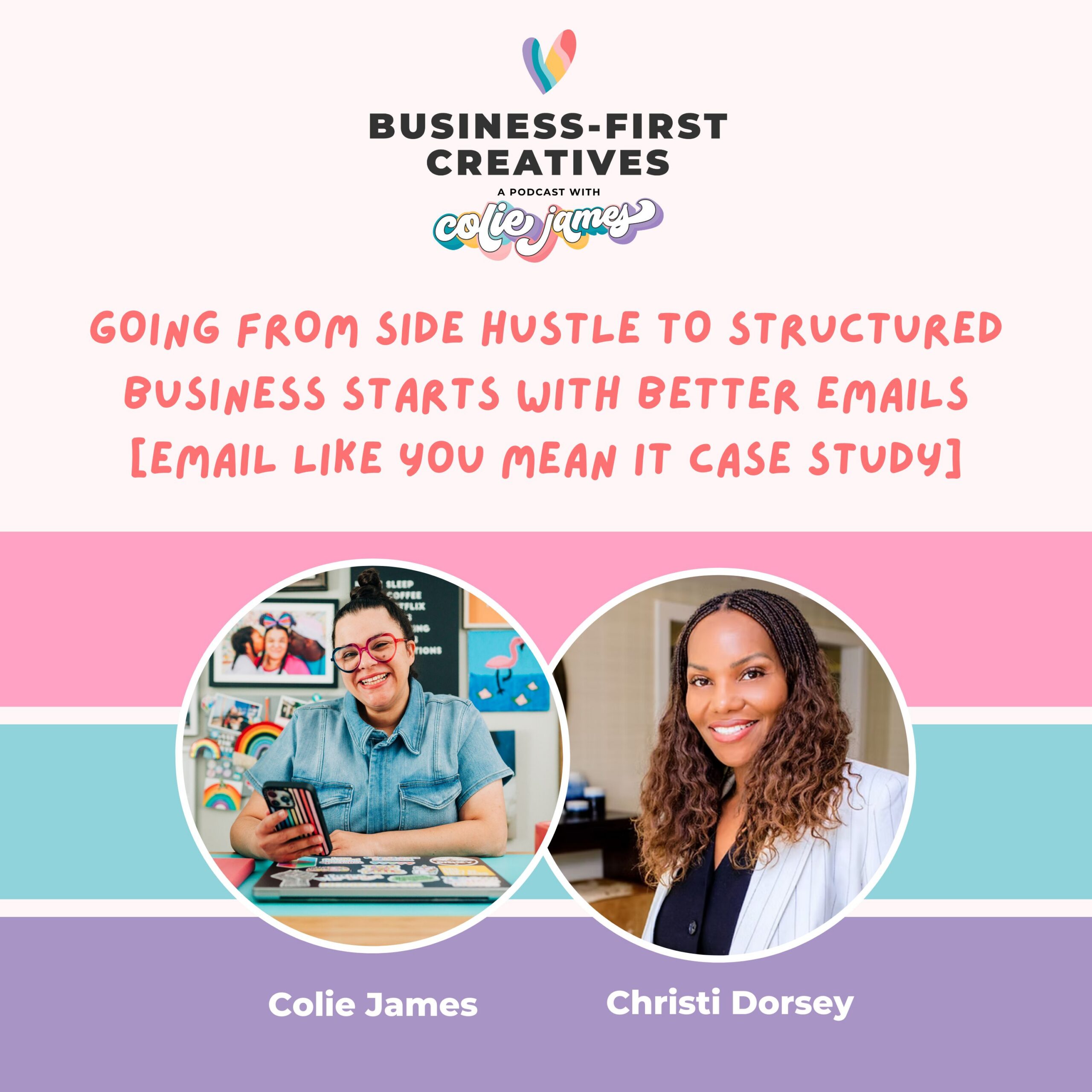


What if your side hustle wasn’t just extra income, but the most creatively fulfilling part of your life? In this episode, I’m sitting down with Christi Dorsey, a nutrition expert, food science consultant, and full-time government professional. We talk about what it really looks like to build a thriving consulting business alongside a 9–5.
Christi isn’t new to entrepreneurship. She’s been running her consulting company, Taste Symmetry, for over a decade. But as her business evolved, her systems and client communication needed to evolve with it. That’s when she joined Email Like You Mean It to overhaul her customer journey and finally build backend systems that matched the elevated experience on her new website.
Review the Transcript
Colie: Hello. Hello. Welcome back to Business First Creatives y’all. I am talking to another one of my email, like you mean it clients today for a new case study. And you guys know I always bring you my clients, but I bring it to you with like a certain flare. Today we’re gonna be talking with Christi Dorsey and she is running her business alongside her nine to five, which happens to be one of them good government jobs.
So we gonna talk about that today. Christi, welcome to the podcast.
Christi Dorsey: Hey.
Colie: So let’s talk about your, I mean, I don’t wanna call it a side hustle, but it’s probably a side hustle.
Christi Dorsey: Mm-hmm.
Colie: talk about your business. So. First of all, I like to sometimes ask my clients what their degrees are in, because I feel like all of us that are, you know, at least, barely meet people that actually have photography degrees from college like
Christi Dorsey: Wow.
Colie: one, but I was a photographer for over a decade. So, Christie, what did you actually go to college for?
Christi Dorsey: Right. Good question. So I went to college for nutrition, dietetics, food science. So I have a bachelor’s of science in dietetics, nutrition and food service management. And I have a master’s in international affairs. And I did my, medical nutrition therapy rotation at John Hopkins University in Baltimore, Maryland.
Colie: Just in case y’all missed that. Uh, Christie is very educated. Let’s, let’s just, let’s start with that. Okay. So you went to college, you
Christi Dorsey: I did.
Colie: and you went to Master’s. ’cause I mean, I feel like we’re a certain breed, those of us who choose to go to college longer. I mean, ’cause at the end of the day. and seven. I was in college for 13 years. When you add up, oh, act. Yes. When you add up my bachelor’s and then my first master’s and then the work that I did on my second master’s and then the PhD, ’cause I am a dropout, but 13 total years in college. And if you had told me at that point. That I was gonna end up being a photographer and self-employed and now doing system strategy.
There is no amount of liquor that would cover up the fact that I just would’ve laughed to you like every day of the week and twice on Sunday. In fact, when I first became a photographer and I told friends from graduate school, they were like, I’m sorry, what?
Christi Dorsey: Yeah.
Colie: you do, you, you take money to take pictures. They were like, what is wrong with you? And then when I finally came around to, oh, but I also have this online course where I’m teaching photographers how to do in-home sessions for family. They were like, oh, okay. That, that makes more sense. Let’s, let’s start with that. Let’s go with that. And I was like, whatever.
I’m still a photographer, but it just didn’t make sense. So. Your business is actually related to your degree, but like walk me through a timeline, if you will. So you went to college, you got your bachelor’s. Did you go to graduate school right after, or
Christi Dorsey: I did,
Colie: period where you worked?
Christi Dorsey: did. So, you know, us New Yorkers have to say we’re from New York. And so I think that helps to a large degree. So yes, I did my undergrad as well as my, grad school in New York. So I went to Lehman College, in the Bronx and I also, did my masters at Columbia University and from there, so that was almost 30 years ago, by the way.
Next year, I think it was the next year. Next year, yeah. About next year. We’ll make 30 years. And so. When, even when I graduated, I had a vision for myself after my master’s of what I thought I was going to be, and I did a little bit of that. So part of it was I knew from an international affairs experience, I wanted to do something on a global scale, and it had to be related to food, but.
I was always sort of being pulled in the clinical aspect. So in nutrition there are sort of three pillars. One is you’re either going to school to do something related to clinical, so that’s working. You know, you’re a dietician, you’re working in a hospital, and you’re working on formulas of some sort.
Or you’re gonna do some level of community nutrition. So that could be anything related to like USDA programs or something. Mostly program related, experience. And then the third is anything related to food service. And I was like. I’m not, I’m not chic chic, but food service, I’m like, nah, I’m not really getting my hands dirty.
But I do like to understand where food comes from. I like to understand, the biology and the chemical components around food. So after, um, working all over the world, so I worked as a international food safety order, not necessarily right after college, but I had. These little stints here and there. but one of, one of the jobs that I had that I loved, and I was about, five years, in total working for a company, I, I got to travel all over the world and I was doing things as a third party food safety auditor, as well as a regional technical, manager for doing things like organic certifications.
Food safety auditing and at that time we would call it applied nutrition. So basically working in supply chain management, but helping the company to sort of make the deal on like approving coffee beans at someone’s fabulous farm in Kenya or, I had an opportunity to help at that time, at one time. Whole Foods, grow and expand their stores in Europe.
And, had an opportunity to work in Alaska and at a salmon plant, for a commercial restaurant that is pretty well known today. And with their new CEO, they, he’s making a lot of changes,
upcoming year. And so I can’t necessarily speak to some of these past clients because we often signed NDAs, but.
Having certain full-time jobs allowed me to create a new job for myself. And so I started my own company, called Taste Symmetry, which is a consulting company in 2011. And so that, yeah.
Colie: so fascinating to hear how people you know do or don’t take what they did in college and kind of go out into the world like you did and get all of this experience, and then you’re like, okay, I’m gonna create a business for myself now. Did you at any point when you were in college or while you were working for these individual companies, think to yourself, I want to start my own company.
Like when did you start to have that vision and how long did it take you until it came to fruition?
Christi Dorsey: Oh my gosh, that’s like the best question someone has ever asked me in years. So a couple of things. So currently I work full-time in the District of Columbia and, for the longest time, even while I was in college, I always had a side hustle. So I do call myself the ten ninety nine queen. That has never diverted, that has always stuck with me.
I am still, I am still that queen to this day, and I have mastered the 10 99 namesake, up to this point. But something hit me back in. I wanna say it was 2008, 2009. I was working, a side hustle with my full-time job in dc. Now, while I was working in DC government, there was something that was really cool.
I was working in, child nutrition programs for the USDA. And if you can connect child nutrition programs and the political realm with USDA, guess who I was working for? The Obama administration.
So,
yep. So doing all of these things, these activities, and I enjoyed doing it, but in that space. I gained 30 pounds, I was stressed out, my hair was falling out, and at that time it was just full-time work.
And there was something inside of me where I was like, you know, I was leaving the, the, the working at a gym where I was doing some nutrition counseling and I’m like, something’s gotta change. And. I started working for another third party, um, food safety auditing company, and that at that time, now this is 2008, 2009, I had made $8,000 in one month, and I thought that was a lot of money.
I was like, oh. I need to like, figure this hustle out on my own terms. What can I do? So I, I actually took a part-time position at that time, um, and this is between 2008 and 2010. I took a part-time position so that I can really focus in on, as one would call it my hustle. And from that experience, I started taste symmetry in 2011 and I was just making nutrition facts, labels for food products.
I wanted to start small and gradually over the years. Companies started asking me for things like a scheduled process in food science. So what did I do? I would take certification classes from 2011 up to this point where I take a certification in, you know, formulations. And this is around food science.
And so I was able to just bring additional services to my clients and that’s how I was able to grow my consulting company.
Colie: So let’s fast forward to now because you are kind of, you know, you’re in a place where you, you, you have your money, your, your monthly money is coming from the government job, and that’s, you know, I, I don’t know that I’d call it safe at this point, but that’s a
Christi Dorsey: Oh, it’s not safe. Yeah, it’s not safe.
Colie: You know, and it used to be that it was safe though, and in this particular climate. It’s not. And so you’re coming back around and you’re in a place where you’re trying to ba basically expand your business again, and you came to me, you, you joined my email list. And you ended up joining email like you mean it. And just for the listening audience, if you don’t know, this is my newly formulated five day live done with you Sprint. It is in a group format, but basically we are making sure that we look at your signature offer we think about all of the touch points, all of the components going from inquiry delivery, and we make sure that you have the client communication so that you know what you want to say and when you want to say it. It’s pre-planned and pre-written basically to save you money and time as you, you know, work on your business. So what is it now that kind of made you gravitate towards working on the customer journey for your signature offer and then writing the client communication? Like what made you say yes? ’cause you were the first person I sent the email and I’m, I, I should have checked, I think it was like two hours later, you were the first person to join.
Christi Dorsey: I’ve been stalking you for like two years. And when I say stalking you, I, I mean that literally. I, I have listened to all of your podcasts, actually listened to one this morning on the way to the office, and, I think it may have been two or three years ago, I, I had, ordered one of your email templates.
And so. I’ve found that the way that you gravitate to your customers, it resonates with me. So it made it easier for me to say, okay, I, I want to take ownership of, you know, not just understanding the front end and making things look pretty, but I really wanna understand the back end. And I wanna understand it for myself.
So one of the reasons why I wanted to start sort of like hit the reset button for myself was because I created a new website. So whenever you get a chance, go to taste symmetry.com. It’s a new webpage on there. And so with that new website that I was developing for 2026, I want, I really wanna take. My customers through the entire trajectory of not just like piecemealing, like my emails and my proposals.
I, I wanna do everything in totality to make sure that they’re getting the best user experience that, um, I could learn and do myself. And so, that’s another form of, of education. Email, like, you mean it was, you know, something that I wanted to tie into my clients and my offers, and so far so good.
It, it has been great thus far. I have put in all of the emails that we have created through, your class and, I have it in Dubsado and I’m testing it out as we speak. I’ve only, I’ve, I’ve, I’ve been live with my new website for about a week now, so we’ll see how it goes.
Colie: I mean, it is so exciting and I do wanna kind of put this in here. You know, Christie’s coming back around. She’s wanting to expand, you know, her side hustle, her consultation business. She wants to make it more, she’s doing front end work, which is what clients are, you know, looking at when they find her on her website.
She wants a backend that matches the new experience that they get on the front end website and like. This is not something that is particularly special to Christie, if you will. It is that I have a lot of clients that aren’t just attacking one part of their business, like they’re giving , their offers an overhaul.
They’re making sure that you know what they’re delivering and the inclusions and the price is where they want it to be. And then quite often, my clients are redoing their website, building a new website, which usually includes both design and copy,
Christi Dorsey: Yeah.
Colie: then they’re doing their systems. And so. I quite often see this at the beginning of the year for photographers.
Now it might not have been for you that it was any kind of seasonality, why you chose to do it in January and February versus another time of the year, but I do find with my clients that you know, photographers if fall is their busy season, winter, January, February, March, Q1 of any year is where everybody decides to attack all the parts of their business at one time.
So we just said you looked at your, your website. And you started the process of upgrading and creating these systems. Um, did you also give your offer an overhaul or are you working towards the same offer that you have had in the past?
Christi Dorsey: So I gave my, services an overhaul, but the one service that you and I worked on still holds up. In value today. And so that’s what I call the foundation experience because I do have clients that come to me, for different reasons. Around, and, and, and let me preface most of my clients. Are in the food business.
I like to call them corporate dropouts who are interested in working in the food business. Because they may have like a recipe or a product and they want to put that product into retail. So I take them through the entire, almost like a concierge, where I, um, work with Cornell University’s Food Venture Center and test get their products tested for what we call a scheduled process to ensure that their products can meet.
The shelf life expectancy of, um, any retailer that they decide to go with. And then from there, I’ll work on the nut nutrition analysis, as well as anything else. And when I say anything else, it could be, you know, a sell sheet, a product, specification sheet, very detail oriented in terms of nutrition and and food science to, to a t to get them ready for distribution.
Now, in that offer. They could have different services that they can pick within the offer. So I may have a list of, right now on my website, I think I have a list of like eight services, but they can pick like up to three or four from anywhere to $800 to. $3,000. It just depends on what they need at that time.
So the foundation is really a way for them to be rooted in, um, whatever it is that they are, are working on.
Colie: I love this. I mean, you know, I love a good off offer ecosystem and when we’re talking about the offer that you choose to go through, either email like you mean it, or systems in session, I always say, you know, you could pick a bunch of different paths. If you have an offer that is foundational, which it is for you, this can just be the doorway to working with you in kind of an introductory manner because you are possibly and probably working with your clients in a very long term strategy.
So this might be like step one to maybe take your menu, your recipe, through the process to get it on the shelf. But then there are many other services that you offer that they could continue to consult with you and, you know, perhaps bring different products through or working on that one product to take it even further.
Christi Dorsey: Yes, that’s true. And so. In that space or in the, in this experience, it, it could potentially be layered with additional products. Or it could also be that they want a website and I can, you know, I can do a little something with websites. But again, all of this came out of necessity of the client.
I don’t feel like I’m a do all, be all kind of person where, oh, if it’s something that I can do I’m just gonna do it because they said that they need it. This side hustle that I have had forever would because again, I’m the 10 99 queen. What it really does for me, one, it relaxes me. Why? Because it’s mine.
It’s like I own it. I don’t have to speak to a boss. I don’t have, you know, I can work when I want to work. I, I set my schedule when I wanna set my schedule, but most importantly, it has given me the creative outlet on a job that I always knew that I had. I just didn’t know what to call it. So it’s like my own creation.
And if I’m interested in something like again, just a little, like I dip and dab a little bit in website design. Why? Because it relaxes me. It allows me to use my creative edge because in government it’s none of that. It’s very black and white. I don’t get a chance to do that. So that’s my outlet for myself.
Colie: I mean, I feel the same way being an academic and now
Christi Dorsey: Mm-hmm.
Colie: I mean, my husband made a joke last year. I was feeling a little, I don’t wanna say uneasy, I don’t know how to describe it though. I was like, do I still want to be self-employed? I was a little tired of the marketing hustle, if you will.
Not the actual doing of the job, but like the constant, you know, your marketing today for who’s gonna hire you in 90 days. And so there’s really never like the opportunity to let up. Or if you, you know, fall behind in your marketing, you won’t know it immediately. You’ll know it next quarter when all of your leads have dried up and you’re like, why is nobody hiring me? So I was in a position, or I was at a point where I was telling my husband, I mean, you know, I don’t think I wanna go find a job, but what if I wanna find a job? And my husband looks at me and he’s like, oh, but you’re gonna go consult for somebody, right? And I was like. does that mean? And he was like, yeah, no, you’re, you’re not gonna actually get like a real job, right?
And he was, in quotes, a real job. He’s like, you’re gonna go consult for somebody. And I was like, why are you saying that? And like, I was really quiet for a minute then I was like, James, do you not think that I could work for somebody again? He’s like, oh, oh, I know you can’t. know you can’t ever, ever work in a corporate situation.
And I mean. My husband is like you. He has a government job in the state of Colorado. And so, I mean, you know, there’s things that he does and that he doesn’t do and everything is
Christi Dorsey: Right.
Colie: by his job. But he was like, yeah, you’ve been self-employed for too long. He’s like, I never thought or imagined that you would own your own business, but you going, you know, to an actual job where you have bosses and they tell you what to do.
He’s like, I can’t imagine that you are ever gonna go back to that. And I was like, okay.
Christi Dorsey: there’s a, there’s a lot of truth in that to the point where you’re probably at a point, and I even feel this way, I’m unhirable. You’re unhirable because there, there’s a certain rhythm that you have where, you know, just the thought of having, so, honestly, the thought of me having to interview for a position, it, it doesn’t scare me, but it’s like, ugh.
Really? No. Do I have to do that? Are you kidding me? But having to be able to project myself with other, whether it’s a C-suite company or, , if I am working with nonprofits, with founders, when I can easily sort of resonate with them on the type of work that I do, because I, I show up well and I show up in a different, in a different way.
And you do too.
Colie: I, I can’t imagine literally I, and the, I think the thing is, when you, when you brought up the interview, I think that for me, I can’t even imagine the application because when I was an academic, like my curriculum Vita was. Was very specific. It talked about what I was qualified to teach.
Christi Dorsey: Yep.
Colie: that I’d taught, like the curriculum that I had developed, my experience, my education, I mean, it was all laid out in a
Christi Dorsey: Wow.
Colie: way.
And I’m gonna be honest, it’s been almost what, 20, 20 years? 20? I mean, it’s been a long time since I was out like interviewing for actual academic jobs, but like. I did before to get all of my teaching jobs would, would not be anything that I would do if I was gonna go out and get like a real job.
Like I don’t even know that I would know how to put together a resume because I mean, all of my academics from before and then all of this time that I’ve spent self-employed, I don’t know that I would be able to comply. I would have to hire somebody for
Christi Dorsey: Wow.
Yeah.
Colie: somebody that I could dump all of this stuff on and be like, can you make me hireable? And they probably couldn’t, but you know, it’d be, I, I would maybe have to give it a try.
Christi Dorsey: Right. Yeah. I mean, that’s, that’s it. Yep.
Colie: So let’s talk about this client communication, because one of the things that you did, I mean, you know, we worked on your customer journey,
Christi Dorsey: Mm-hmm.
Colie: you took emails that you had before and you, I know you’re laughing ’cause you know where I’m going with this. So guys, she submitted one of her email feedbacks, right? And I’m running through and I’m making feedback in the Google Doc on every email, and even though Christie told me like this was totally on me, not her, she told me that the new emails. Like halfway down, I started giving her feedback on all the first emails. Right. Guys, I’m, I’m making comments. I’m, and it wasn’t until I got to
Christi Dorsey: No.
Colie: new email, I was like, oh, those were your old emails. I just gave you all this feedback and like all of these things have been corrected in your new emails, so
Christi Dorsey: Yeah.
Colie: ask you specifically for email, like you mean it,
Christi Dorsey: Mm-hmm.
Colie: did it feel to rewrite those original emails to now the ones that you know have gone through? My GPTs have been written with the three P framework, which if the listening audience doesn’t know that is purpose. Personality and a preview of where you are in the process in every single email, but like how did it feel to take what you were doing before and like craft the client communication, I don’t wanna say from scratch, but like girl, when we compare your new emails to your old emails, it was pretty much from scratch.
Christi Dorsey: Amazing. It felt amazing because not only was I able to. Take what you taught me, but most importantly, when I was able to like inculcate those three Ps into my Dubsado for, and by the way, I do use a Dubsado Dubsado, framework, I was able to use some personality. In my emails, it didn’t feel so generic.
Which were the generic ones that you like, took all your time working on? I was like, oh my gosh. But, um, it felt great because again, these were emails that sounded like me. Um, and it really, I, I, I sort of took. You took me through the process from beginning to end. So for every sort of functional area, whether it was an invitation or if it was, you know, an initial email and in a closeout email, we went through that whole life cycle of what it meant to take my customer on that experience from beginning to close out.
And it just felt like, I just felt like my work was done and it really tied nicely with my new website. So I’m just. And so far so good.
Colie: I mean, it’s so great and, you know, I didn’t really like take your emails because I’m, I’m gonna do this. The next run, I will say the next run of email, like, you mean it is in April, but I’m going to do more of like pulling my client’s emails out and sharing them inside of the group so that, you know, everybody can see what people are writing. But your. Final closeout email, if you will. Like, I read it and literally my jaw dropped and I was like, okay, this is how you bring back your clients to rebook. And so I posted it in the Slack channel and you know, the other, the other students were like, oh my God, no. That is amazing. That sounds like you, you know the things. But like, I was so impressed. I was like, I, I don’t even have a company where I need food science, but like I would definitely hire you again if I read this email because. I feel like this is where I’m really trying to focus going forward is a lot of people do a really good job of booking a client, a pretty decent job of like the onboarding and actually delivering the service, but that’s where a lot of people drop off, and it’s like in that offboarding period, that’s when you can really hit people for those three Rs, which is a rave review, a referral.
Or repeat business. And like that email that you wrote where you’re coming in and you’re telling them, these are the different ways that we can continue to work together. Like you were the first
Christi Dorsey: Excellent.
Colie: it out in a way that I was like, oh, I feel like this is a menu. I mean, not at Cheesecake Factory.
’cause there wasn’t like 30 pages, but I mean, I could pick and choose what was next. And I think I even made the comment to you that that was an opportunity for you to highlight these are the ways that we can work together, but based on this initial work that we did. I would highly recommend that we do this next, and that’s where that personalization really has the ability to shine even in a pre-written email.
Christi Dorsey: Agreed. And that is one reason, again, the main reason of why I wanted to join email, like you mean it, and take what you’ve given us to, to, to turn it around and put it in my business because it, it’s a, it was a need and so. The void had been for, oh gosh, for years of, you know, just me just sending an email on the fly and I just.
Don’t wanna do that anymore. You know, I just want things to sort of be succinct and in one place because again, because I have a full-time job, I can’t be in all these different spaces and sending emails at urgency. I wanna be able to. Really, you know, support my clients along the way, but at the same time have some structure.
I have to have structure for myself. And, um, I think email, like, you mean it was a, a great start in just kind of moving this along.
Colie: I love that you said that it was a great start. So
Christi Dorsey: Yeah.
Colie: for you. What’s coming next in your systems?
Christi Dorsey: Oh my gosh,
Colie: got your customer journey mapped for this main offer,
Christi Dorsey: yeah.
Colie: got your entire pre-written client communication library that you’ve already put in Dubsado.
Christi Dorsey: Mm-hmm.
Colie: you get a gold star.
Christi Dorsey: Thank you.
Colie: you working on now? Because I can’t imagine that that is where you have stopped working on your systems. So like have you identified what it is that you are going to tackle next inside of your client experience?
Christi Dorsey: Yeah. Um, and it pains me to say this because, you know, I feel like every time I, I, I. Wanna get more money or money, it’s like money’s going right back out the door. So, um, I am planning to sign up for systems in session because that really is the next step in setting myself up for success. And when I say I am speaking of course of my business, but having all these emails unsure is like, you know, where to place everything.
It only makes sense because. From that experience, I could hear other, you know, the, the other, um, members who were in, in the class with me, they kept referring to, you know, well, what do we do with, you know, like the work streams and, and how do we, you know, put all of this into place? And you’re, you’re like, no, let’s start here first, and we’ll move into that, as we go into systems and session.
But I can see again the, trajectory of moving along in that space. And honestly, it feels natural. So I’ve updated a few of my pro proposals in, um. In, uh, Dubsado, I’ve done that already. That was again, part of the plan. So my emails, yes, I wanted to tighten that up. Um, I’ve done a few proposals here and there, and that’s just because again, it lines up with some of the services that I offer.
Um, and I just want people to be able to just make sure, like, make sure everything sort of matches in a way. It’s clean and it’s fresh and it’s new. So systems in session is like the next step where I think it’s just gonna tie everything together, and, and break me. It’s just gonna break buying bank.
But that’s, that’s okay.
Colie: Guys, I didn’t, I didn’t pay her to say that actually. I didn’t know she was going to systems in session. I was just literally asking what is your next step? But
Christi Dorsey: It is my next step. I know.
Colie: have you in systems in session, and I just wanna say that what you just said kind of makes my decision on how I have laid everything out so much better because Christie mentioned that, you know, some of the members inside the group were asking about what to do next.
And the thing about. The run that I did in February, and I intend to do this going forward, is that it was not only people who were signing up for email, like you mean it alone. It also had six members that had already signed up for systems in session and I was basically beta testing. They were my Guinea pigs. I wanted to see where they would go in systems in session if I forced them to do email, like you mean it first, so the way that it’s happened. Uh, you know, historically, I mean, I say that, but this offer’s only been around for almost a year. But the way that I have done systems in session up to this point. Was people would have a one hour kickoff call and you were basically giving me all of the information that you did inside of email, like you mean it to plan out your customer journey. We did that live together, then you wrote the emails either at one time, you wrote your entire client communication library. You wrote those emails as we built your client experience in each phase. But what I realized was once I decided where I was taking email, like you mean it going forward in 2026, Hey, my clients and systems in session, if they do that first I wanna see how much more space we have inside of our 60 days to do more. Can I get the first offer completely built in 30 days so that then you have the second 30 days. For refinement, for testing
Christi Dorsey: Mm-hmm.
Colie: on your secondary and your third offers, you know, whatever else it is that you had , in your offer ecosystem. So I’m really happy to hear that you felt like that was a natural progression because it wasn’t necessarily a natural progression for you as you were one of the people that had just signed up for email.
Like you mean it and I have onboarded some of the people that you were in email, like you mean it with
Christi Dorsey: Yeah.
Colie: like their kickoff call. Was completely different. It was like, okay, this is where we ended an email. Like, you mean it, how are you feeling about your customer journey? Like, we reviewed it, we looked at the emails and we said, okay, first step is we’re going to do this.
And then it was like just an immediate progression to, um, going to work on assets instead of kind of like the first week we would sit with the customer journey, we would review it, we would, you know, make sure that everything was where we wanted it to be. But going forward, that’s already taken care of inside of email, like you mean it.
So you get basically more time with me to do more inside of your 60 days.
Christi Dorsey: Oh wow. Yeah, I mean, again, I think that makes sense. It is a natural progression. , If I had to do it all over again, I would want to go sort of in that, that under that path. That makes sense. But then you have some people like myself who are like, no, I wanna try to do it myself because. As I mentioned to you earlier, there is this space where I do wanna learn.
So there’s some things where it’s like, no, let me just see what I can do to try to massage this new, like, 3.0 with Dubsado, which is a whole nother beast. But, it gives me more ownership of learning how to, how to master, my own. Sort of process on the backend. And that to me is a responsibility you have to have going into this.
I do feel like some people, you know, who were in your, in, in the email, like, you mean it had some ideas of like. They were doing it, but they were also relying pretty heavily on you to almost not do it for them. But you know, as one has like very high expectations of you, I think sometimes they look at you as like the crystal ball.
Like, oh, you’re gonna just fix everything for me, like. You do have to make time for this, and so I have, I think what has helped me is I have been doing the work ahead of time to try to get ready for you. So I do feel like you have to be in a, you have to have a mindset, and you have to be ready. To, to do the work to make sure that you’re checking all the boxes.
When Chloe says, no, you must do this. I need you to do this. Okay, we’re gonna spend this day so you can do this. In my head, like I was like, I did that already, so I’m good. That’s how I felt. I was like, ah, we’re talking emails. I got that already. So, systems and session. My proposals are ready, you know?
So I just feel like, again, doing some of the practical work that shows a willingness of being ready so that they’re ready for you. So it doesn’t feel like you’re, you’re actually handholding along the way too. You have to take some level of ownership.
Colie: I mean, and I hear you and it’s really funny that you’re like, she has a magic ball. She’s gonna fix it for you. That’s actually what I used to do in the done for you. So, you know, to kind of give you a, a vi, I know you’ve said you’d followed me forever, but that kickoff call was four hours. I did done for you.
We got on a call and I learned everything about your business. And then I planned everything. I created everything. I tested everything, and I presented it to you at the end. Completely done for you. But the problem in that is, and it’s funny because I was just talking to someone before we got on, and so many of the systems and session clients right now are saying, oh my gosh, the best thing that I got out of systems and session was the confidence in my systems. And it’s like. But do I really wanna pay $2,500 for conference? Like, is that what I’m really gonna get? And I’m like, no, you’re getting a fully, you know, designed and implemented, you know, system inside of Dubsado or HoneyBook. But also you are getting the confidence to run your business like you want to run your business and when you need to make adjustments in the future. are capable of doing that. And so it did take me a hot minute because I was very proud of the work that I did in done for You. But it really was Christie, like you brought me your business in whatever shape it was in, and I fixed everything and then I kind of handed it over to you. And in a lot of ways I was taking away like some of the things that perhaps if you had done it would’ve made you better able to use the systems that I was giving you.
On the other side of it.
Christi Dorsey: That makes sense. Yeah, I could, I could see that. But I do like your current approach. I, because again, what it does is it really just, it encourages ones to. To be in that space of, of continuous learning and you know, troubleshooting, but just to a certain point, and that’s just what I need.
Colie: Well, I am happy that it is what you need. I
Christi Dorsey: Yes.
Colie: you are in my world. I am, you know, over the moon that you’re gonna join me in systems in session, but also I was just happy that you were the first person to join email like you mean it because I mean, you know, you do something and I don’t really let grass grow.
I mean, I decided to do it as a live. Five day sprint, and I think three days later I was sending the email out. here, it’s here’s the buy button. And every time you do it, it doesn’t matter how confident you are in your offers, there’s this moment where you’re like. But does anybody actually want this?
And
Christi Dorsey: Right.
Colie: the first sale, it’s like that just, you know, it
Christi Dorsey: Yep.
Colie: and you’re like, okay, no. And then, you know, I got another sale and then I got another sale and I was like, okay, people do actually want this. I’m not crazy. This is not me, you know, spinning my wheels. It
Christi Dorsey: Right.
Colie: And then the feedback that I’ve gotten from the systems and session people that, you know, did join the Sprint,
Christi Dorsey: Mm-hmm.
Colie: can already see that their experience is going to be different.
And so, you know, me. Being the statistician, I’m looking at all the data, quantitative and qualitative so that I can make sure that that is the right decision. But everything has shown thus far that it is going to enable systems in session to be an even better container. And you know, what you’re able to do inside , the 60 days is going to rock your world no matter where you are
Christi Dorsey: Wow. That’s brilliant. Yeah, I, I love that. I love that for you and I love that for us.
Colie: I love that for Yes. Yes, girl. Okay. So in as a final question, one of the things that I find most interesting when I have asked people about tackling your client communication or your systems is I get a lot of people who have been in business for like a really long time and they think to themselves, oh, I don’t need that.
Like, my emails are fine. Like, how do you feel about that? And if someone told you that, what would you say in response to be like, you know. Maybe you should still check out email like you mean it, and this is why.
Christi Dorsey: Good question. So. I think it really depends on where a person is in business. So for me, I had been using Dubsado for a little over two years, so now I’m going into year three and some of my service offerings have changed. And as a business owner, especially coming out of the pandemic, I’ve cha I’ve changed and It is also keeping up with the pace of technology these days because it is going at such a fast pace that I still feel like you have to meet your customers where they are and because again, I have a nine to five elsewhere, I need to meet my customers where they are not just in, you know, using a system, but, but learning how to communicate.
And email like you need, it gave gave me the confidence to communicate in my own voice, but with a sense of urgency because now, you know, I have emails that are going out while I’m asleep. I have emails going out while I’m on my way home from work. I have emails going out before I get to work. So that has been the, the blessing.
All of this and I’m seeing that as we speak right now. I have an email that’s gonna go out to a client. I scheduled it for four o’clock today, so it should And why, because. She mentioned that Friday afternoons are better for her so that she can look at the work over the weekend. So it’s things like that that have given me the confidence of, oh yeah, I could just set the email a certain way, but that email is like the same email I’m sending to five other clients.
So why not, you know, make it as a part of my work stream so that it goes out at a certain time on a certain day and I don’t have to think about it. So that is the blessing in all of this for me.
Colie: Christy. mean, guys, I’m so happy that Christy said yes to come on the podcast because I feel like I haven’t really been able to have one of these conversations where I hear about someone’s background and like basically how they built their business up and then what their systems mean now. I mean, because she’s 10 plus years, just like me and my systems now look very different than they did when I opened my business in 2012, but they’re still. opportunities even for me as the system strategist. I mean, I think I told you guys a couple episodes ago, I am currently working on my client communication and my systems for my systems and session clients because this is very different than what I was offering a year ago. And so. Systems are not something, even your client communication are not something that you write and you, you know, upload them to your CRM of choice and then you just leave them alone. Your business, your offers, your systems should be something that grow with you over time for the particular season of life. Or business that you are currently in. But Christie, I mean, I can’t thank you enough for taking the time to come on the podcast and talk about your experience inside email, like you mean it. I am gonna have all of your links in the show notes,
Christi Dorsey: Uh oh. Okay.
Colie: Um, but thank you so much for coming.
Christi Dorsey: No thank you, Colie. This has been amazing. I, I’ve had so much fun.
Colie: that’s it for this episode. See you next time.
Meet the Guest
Christi is a seasoned entrepreneur with a dynamic career spanning the fields of nutrition & wellness, food safety, and technology. Before founding Taste Symmetry, she led impactful projects in USDA Child Nutrition Programs, Manufacturing, Wellness & Food Safety offering guidance to school systems, healthcare institutions, and retail grocery companies. By day, she’s a IT Project Manager for the government in the district of Columbia. In her spare time, she works as an independent food consultant and trusted partner to executives, founders, and public-sector leaders across food systems and digital transformation projects in the Mid-Atlantic region.
Find It Quickly
00:24 – Meet Christi Dorsey
03:21 – From nutrition degrees to global food safety work
07:20 – The “1099 Queen”
10:18 – Why she decided to expand her business again
11:40 – Why she joined Email Like You Mean It
15:13 – Her Foundation Experience offer explained
23:00 – Rewriting her client emails from scratch
25:47 – The offboarding email and the power of repeat business
29:03 – What she’s working on next in her systems
40:05 – Why “my emails are fine” might be holding you back
Mentioned in this Episode
Connect with Christi
Website: tastesymmetry.com
Instagram: @tastesymmetry
LinkedIn: linkedin.com/company/taste-symmetry


Signature Series


Your business works, but your backend is costing you.
A 4-Part Audio Series for service-based business owners who are ready to upgrade their “just fine” client experience, unlock higher pricing, increase referrals, and grow more sustainable revenue—without overworking behind the scenes.
Get the FREE 4-part audio training series
Systems That Sell


© 2022-2025 Colie James


Close
Join Systems in Session to start in August or September
8 5 spots open