
Finally stop overthinking what to say and when. This free guide helps you write clear, consistent emails that sound like you — and build trust without burnout.
GRAB THE Client Experience Email GUIDE!

Blog Categories
A podcast where you join me (Colie) as I chat about what it takes to grow a sustainable + profitable business.
Business-First Creatives Podcast
CRM Guru, Family Filmmaker, and Host of the Business-First Creatives podcast. I help creative service providers grow and streamline their businesses using Dubsado, Honeybook, and Airtable.
Hey, I'm Colie



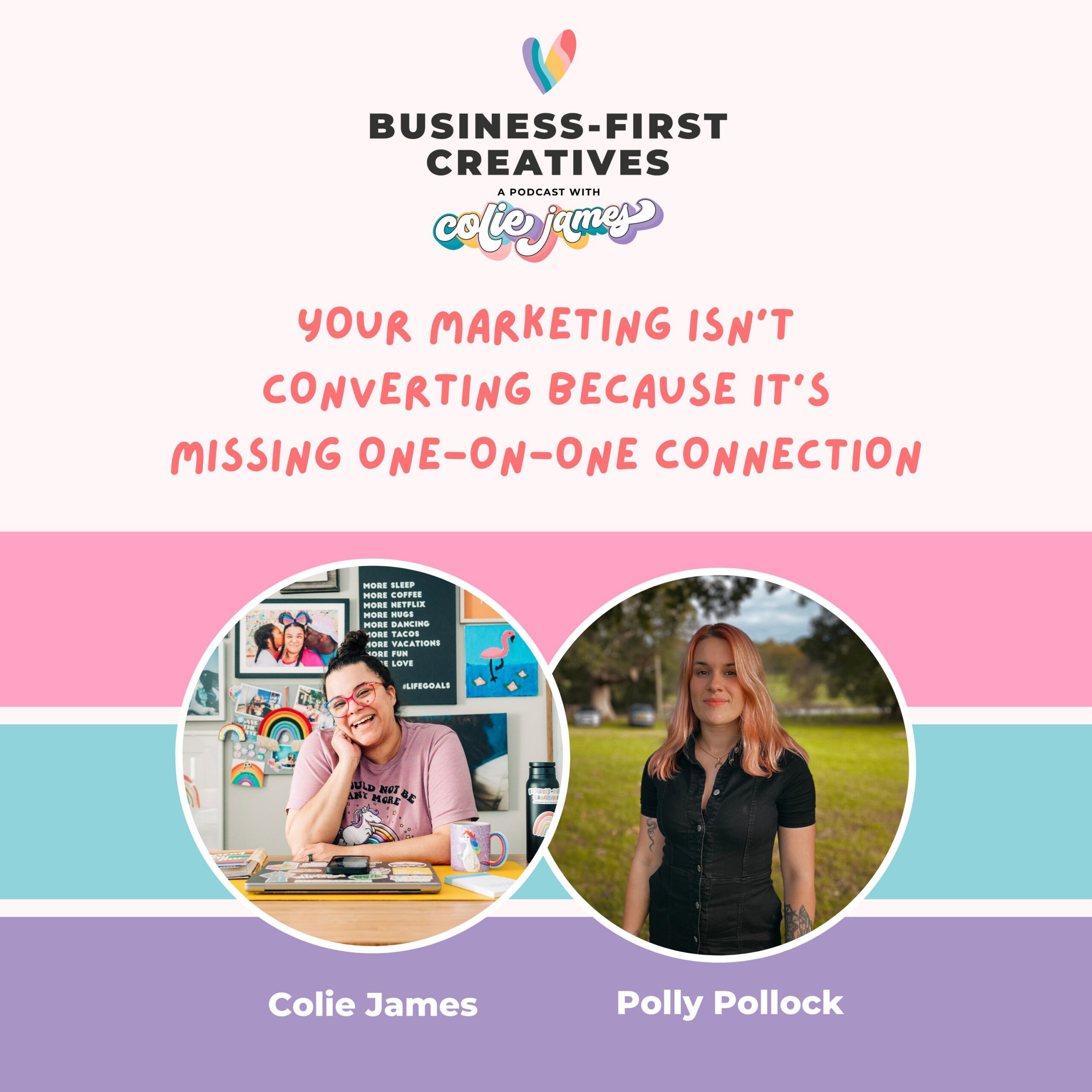
If your marketing feels like a constant cycle of chasing new leads but never quite getting the sales you want, this episode is going to change how you think about everything. Polly Pollock joins us to dive deep into what actually works in marketing right now—especially if you’re tired of relying on Instagram or social media altogether.
Listen in as we talk about why so many business owners feel stuck, what’s really missing in their marketing strategy, and how to shift your focus from constant visibility to building real, one-on-one connection with your audience. Polly shares her perspective as a marketing expert working with neurodivergent entrepreneurs, and together we unpack the biggest mistake people are making: ignoring the “messy middle.”
Review the Transcript
Colie: Hey y’all. Welcome back. So I know that a lot of guests that I have on this podcast are people that I know really well. We’ve had like a really good relationship. I know their business, probably not as well as they do, but pretty well. But that’s not today’s guest. And so I’m gonna tell you the story of how I met Polly because I feel like it’s important.
For the conversation that we are gonna have today. So as you guys all know by now, I am in Launch Your own way with Kelsey McCormick of coming up Roses and Polly is in there with me too. And we were just having conversations around our offers and launching, and I don’t even remember at this point exactly what Polly said.
I do know there was cussing involved, but I was immediately like, oh my God, come on my podcast. Let’s have a conversation. And so Polly, welcome to Business First Creative.
Polly: Thank you so much. I’m so not surprised that the first thing that comes to mind is cussing. ’cause I do cuss a lot, so I’m happy to be here.
Colie: I mean, me too. It’s funny, Kelsey recently put on threads that, um, you know, people in her, like in real life world, were seeing what she posted on social media and that they were commenting on it. And so I responded and said, oh, you mean like my mom used to stalk me on Instagram and then immediately text me and say, Colie, did you mean to say shit on your, on your business?
Instagram? Yes, mom. I really did. And if you scroll a little bit more, there’s like a whole cussing like bit after that. I mean, but like sometimes as business owners, especially if we are on social media, we don’t realize that people who know us outside of business are seeing what we’re posting for our business.
And sometimes, you know, I don’t know if it’s controversial, but it does bring things up when people see something that you didn’t necessarily create for that audience.
Polly: Yeah, for sure. I think honestly that’s where a lot of people’s fear of like being authentic or being bold actually comes in, is like, oh my God, what if someone I know sees this? Like IRL, like my mom actually used to do the same. She used to kind of like. Be supportive and like, like my Instagram posts and stuff.
And then she’d just s say over like a random evening and she’d be like, you know, you swear a lot in your post. And she just wouldn’t let it go. And I’m like, I swear a lot in real life. So do you, who are you? Like what’s the problem? And uh, I, I love my mother, but I did have to actually block her From my Instagram and I said, it, it’s no hard feelings, but I love you, but you gotta go.
Colie: but I can’t have you like telling me this every time. And I do think that like for people who aren’t in business or for people who maybe aren’t running like a personal brand business, they don’t really understand that showing up authentically. Is really important to make sure that everybody knows the person that they’re hiring.
Like when I was still doing photography and I was actually going to people’s houses, it was super important to me that we had a conversation, whether it was on the phone or on Zoom, and I mean, when I did these really long sessions where I would actually fly across the country and stay with your family for a weekend.
Yeah, no, we have to have like a. A face to face on Zoom so that you know who’s coming into your house so that there are no surprises. Because yes, I am a loud black woman and I will say, I used to warn my clients I cuss a lot, but I will not cuss in front of your children. Don’t worry about that.
Polly: Yes. Yeah. Yeah. Oh, oh my God. I’m the same. I get really mortified when, um, like this used to happen a lot when I.
used to send voice notes to clients who were so, like, they were the same as me, and then I could hear like, in the background of their next voice note, like their kid playing, and I’m like, oh, great.
I just sent like, but they’re the same. And then they’re like, don’t worry. He gets enough of it with me. I cost loans. And I’m like, oh, I don’t know if that’s good or bad.
Colie: I don’t know. I feel like it’s totally new now. I don’t know if you know this, my kid’s 15, so I am, you know, parenting a very old child and there was a a, a moment where she wasn’t cussing yet, but like if she said the occasional cuss word, my husband would be like, stop. Don’t do that. Now, our only rule is please don’t do it in front of your grandparents.
Not my mom. She cusses in front of my mom all the time. But like, don’t cuss in front of your dad’s parents because they are very old school and like, even we don’t cuss in front of them. But I mean, I, I don’t think twice about it anymore. I love though, when people have podcasts and they’re like, listen, there’s a lot of cussing in these episodes, so please don’t listen with little ears if that’s a concern for you.
And I’m like, no, that was never a concern for me, but I get it.
Polly: Yeah, it is. it.
is nice. I mean, yeah, my podcast, it’s so interesting because on the subject of kind of, you know, people getting to know you and needing to get to know you through your content, I have, I swear a lot on my podcast like. It’s, it’s a lot. Um, and I actually got an email once from some woman and she said, um, like she felt compelled to email me in on my email address and actually go find my email address.
And I was like, okay, you do you, and she had emailed me. Saying something to the effect of, hi Polly. I listened to your podcast for a while, and I noticed that you keep cussing and using cuss words, and I just want you to know that I now don’t trust you. I’m gonna be unsubscribing from your, uh, podcast.
Like I’m not listening anymore. And I was like, okay. I’m sorry that that happened to you, but like. PY at the same time. And then I’ve also had, you know, people who have ended up being clients say, I actually trust you more because you’re so human and because you swear all the time. So it’s just that repel, attract effect and it’s hilarious.
Colie: I mean, let’s bring it around to your marketing because you are not doing an effective job with marketing if you are not bringing in the right people and repelling the wrong people. And before we really jump into that conversation, I wanna say one more thing about that woman who said, I’m unsubscribing from you.
I don’t trust you. Do you know sometimes when people are like saying things on social media like threads and Instagram and someone always says, this is not an airport. You don’t need to announce your departure. Like literally as you were talking, I was like, I have never felt more compelled to like say that or write that because yeah, I don’t need to know that you are unsubscribing.
Like, girl, there’s a button. Just click it. Bye.
Polly: Just click it. Like the amount of times that I like, and this is the thing, is like we are not for everyone, and everyone is not for us. And that, that I’m not angry at that person because I’ve decided that they’re not For me, I would just click the unsubscribe button. I wouldn’t message them like, oh my God, you wore denim jeans in your, your real that I saw, and I hate denim.
So bug you. I’m unsubscribing. It’s like, what? It’s so weird. It’s, anyway, people have their own stuff that they’re dealing with. I’m sure that was it, really, but yeah.
Colie: They do. But I mean, let’s talk about marketing. ’cause as you said before we hit record, that’s your bag. So I talk about systems, but I am really focused on like client experience systems. So I always say. I am what you come to after you’ve brought the leads in, which is you’re doing it with your marketing.
So let’s talk about systems for marketing, and let’s just start with like a topic that I feel like is really hot because my very first guest of this year was Kylie Kelly, and we were talking about. Visibility without having to shake it on Instagram, and that just resonated with like so many people in my podcast audience that I’m super excited to talk to you today about marketing off social media because I feel like right now everybody is feeling.
This overwhelming dread of marketing on social media. Whereas if you ask people like, you know, where are you marketing? I don’t know, 2, 3, 4 years ago, I think Instagram was probably at the top of many people’s, list. But now everybody is being really intentional about trying to do things off social media.
So first, let’s start with marketing channels. Polly. What is your favorite marketing channel that is not social media.
Polly: Hmm. So first before I answer, I definitely just wanna say I totally get where you’re coming from, but I, and, and the thing is, like four years ago, you asked people, where are you marketing? They’ll say, Instagram, you ask most people today, where are you marketing? They’ll still say Instagram, but they’ll say they freaking hate it.
You know what I mean? I’ve so many worrying conversations with people. Over the last couple months especially who have been saying things like, if, if not Instagram, where else, where else can I market other than Instagram? I want to get off Instagram. I hate it. It’s not my, not my thing, but I just don’t know where to go and I’m stuck.
And I see that really prominently with people who kind of got into the online business world post 2020 because Instagram was all the rage. They’d never been in business before. And. It’s not their fault, it’s just that Instagram was all the hype. And so now people are really having to come back and relearn all of the things that we kind of did before Instagram was a thing for marketing all the old school stuff that still is really, really, really, really effective.
But people, it’s not sexy. It’s not like sexy to talk about, ’cause everyone wants to talk about, you know, virality. And I think people are getting over it though. You know what I mean?
Colie: I do.
Polly: Yeah.
Colie: So I think, I think part of it though is I’m not anti Instagram. It’s not for me anymore. I have actually haven’t posted on Instagram in so long. I can’t even remember. But I feel like a lot of, a lot of the conversation when you say, let’s go back to old school, like let’s, let’s maybe touch on email marketing is that people didn’t have a plan.
Like, yes. If people are finding you on Instagram, how are you bringing them into your bigger marketing channels? That’s not Instagram like. So that you don’t feel compelled to be on the app for hours and hours each day. And I do also feel like part of it is like that instant gratification. I feel like you get that off social media when you really don’t get it off of any other marketing channel like people are reading your emails.
You know, in the, in the comfort of their own home when they’re in the car waiting for carpool. So like we’re not getting that sense of people immediately typing out a response, liking your post, sharing your post off of email, the same way that you can get it off social media. So that instant gratification is just something that people have become used to and.
I do think that’s part of what keeps them on the app. But the flip side of that is if you’re not getting the instant gratification, then you feel like you’re not getting anything from social media and you’re like, well, what else can I do?
Polly: Yeah, you’re, you’re so right. It is the, it’s the fake dopamine as I call it,
Even if it’s not working though, like even if you’re not actually getting the results that you, you want and you are like hoping for, it still keeps you hooked and it still keeps you going back.
And. I’m not anti Instagram either by any means, but that is what the app is designed for. That is what the guys and robots behind the scenes there are aiming for. And so that can be really dangerous for, for a lot of people, I think, especially where I work with A DHD and neurodivergent business owners where that kind of mental reliance and almost like addiction can be a really real thing that people feel with social media.
Even people without a DHD and neurodivergence. But, the thing with things like email marketing, once you actually have people on your list in your community, it’s not instant gratification like Instagram is, but the quality of people and the conversion rates, as you probably know, are like. Hella different than e on email list than socials, but I think even if it’s like a, like a comment, a spike in views that’s like, oh, it’s working, but is it, or are you just getting likes, comments, views?
Do you know what feels better sales from people who are way more engaged? Do you know what I mean?
Colie: Absolutely. I mean, when people are struggling, I mean, ’cause again, I do the systems after you get the people, and not necessarily, but a lot of the coaching that I do, photographers will, you know, if they’re telling me that they didn’t have enough bookings this month or whatever, I’m like, okay, but like, do you have a leads problem or do you have a conversion problem?
Because I’m always concerned with the conversions. Like once you actually get the people to your website to fill out your contact form. What is your conversion rate then? But if you’re not actually getting people that are inquiring about your services, then that is marketing and you need to go find a different expert to help you with that.
’cause that’s not me.
Polly: Hmm.
Yeah, I mean, marketing is so, I mean, I always say like sales is a byproduct of marketing in a way because the whole process of marketing is not just visibility, it’s also building trust and, and really building connection with your audience. And that’s oftentimes what people miss out. It’s like, okay, I’m getting leads, I’m getting people, I’m getting numbers.
But then I’m not getting sales. And then you’ve got this whole bridge of the middle ground of like warming people up or building connection, knowing how to actually speak to your people and speak to things below just surface level stuff. So yeah, I mean sometimes it is leads, sometimes it’s, it’s not, sometimes it’s a convergent problem.
It’s, it’s also nuanced. But I think Instagram and social media has you definitely thinking it’s a reach problem all the time because that’s how. It works and social media works. But that’s not marketing. And I always say like unfortunately, and I know there are some people that would disagree, social media is not marketing.
Social media is the vehicle or a vehicle of marketing. And I think people have really, really lost sight of like, or haven’t ever learned what marketing really is. So yeah, a controversial take, but it’s true.
Colie: I don’t think it’s that controversial, but something that you said really, you know, struck a nerve with me and that’s that I don’t feel like enough people concentrate on the messy middle. So a lot of people, and I mean, we could talk about top of funnel, middle of funnel, bottom of funnel, but I feel like that doesn’t hit a lot of people that I work with.
Like they don’t think about it in terms of those terms, but. When you’re constantly on social media and you’re constantly trying to like grow your audience, that’s one thing. But then what happens after someone actually, you know, follows you in the case of social media or joins your email list, if that’s, you know, where you’re trying to get them to, what are you doing with those people?
Because I feel like, again, the instant gratification currently is, well, they joined my email list. I made them an offer they didn’t buy in five days, and so now they’re dead to me. Let me go find somebody else
Polly: Yeah, it
Colie: my email list to try to sell in five days and like it’s a constant hamster wheel, but I’m like, no, like they, they indicated some level of interest.
How are you going to build trust? So, I mean, do you feel the same way? Do you feel like people are not focusing on the messy middle, where that’s where people really need to be thinking about their conversions increasing and building that trust?
Polly: Yeah. 1000%. You’re so right. And again, it’s that, it’s that I want it yesterday mentality. And I get that big time. I have a very impatient brain at times. Very, A DHD wants to be way further ahead than she is, even when she’s achieving her goals. It’s, it’s wild. But yeah, people, I think it’s the, the missing piece here is people don’t realize that people aren’t gonna buy from you unless they trust you in the, in the most like.
Basic sense. That’s it. You could have an absolutely, like deal breaker offer, and if people don’t know, like, and trust you, especially trust you, it’s not gonna happen. And this is where it really takes like. Three months plus, I would say you are actually very lucky if it happens before a couple months.
I mean, yes, that of course we have the minority of situations with people. Like, found your podcast, I messaged you straight away. I know it’s a fit. I’ve had that, but it’s not the majority of what happens. I’ve had that a fair amount. But it’s, yeah, it’s not, it doesn’t happen all the time. And yeah, we need to, we need to like really put time in into nurturing those people and just quieting that voice that is telling you that you should have it before.
And again, it doesn’t help the whole mentality of the coaching business, coaching world, definitely a few years ago and before that, like make sales in your sleep, like effortless sales, like all of this kind of rhetoric and it’s like, oh, it just doesn’t help. And I believe it’s caused by that.
Colie: No, and it’s interesting that you mention the podcast because I do feel like that is an advantage that you and I have because we have a podcast or people who are blogging because when someone is interested in you. They join, you know, one of your marketing channels, your audience, however it is that we’re gonna describe this.
If you’re emailing them once a week, you are basically dripping out the trust. If that’s the only thing that you’re offering them besides maybe social media posts, like that’s all they can do is basically wait for those weekly emails. And so you are really dictating the timeline in which they can build trust.
But if you are someone who has long form content. Somewhere that if someone is like, oh, like I really hear Colie, she’s really speaking to me, I really need to hear more. You go to my podcast, , this weekend I’m gonna be, publishing episode 300. So I have 300 episodes where you can go and like listen to me, talk to you a mix of solo and you know, guest episodes like this one, but.
That definitely gives me an advantage to accelerate the trust factor. But so if someone doesn’t have a podcast, what is it that is like, if we wanted to say, Hey, what you’re missing is focusing on the messy middle. And what you really need to make an attempt to do is build the trust with the people who have joined your audience.
Where would you recommend people start, or what kind of system should they put in place in order to make sure that they are doing what they need to do to get that accomplished?
Polly: Yeah. I love that question. It’s, it’s, yeah. I, I think especially so when someone joins your email list, and like you mentioned, if you’re just sending out one email a week, like yes, that is necessary. It’s a, it’s a great start. But, so what I do, for example, is I’ll have my main newsletter that comes out on a Sunday evening.
It’s like a marketing reset for neurodivergent. Online business owners, but then I’ll also send an email out maybe on a Wednesday with like a, a mini training or a value piece, and I’ll link it to my podcast so that I’m actually bringing people from my list to my podcast. It’s, and I want ’em to learn, of course, but I also want ’em to hear my voice.
I want them to feel like they know me. I really, really think I will die on this hill. Podcasting is one of the. Most sustainable and quickest ways to allow people to come into your world and get to know you and eventually trust you because it’s like they’ve, every episode they listen to, it’s like it’s if you’re doing it right.
It’s like they’re on a call with you every time. It’s like you are, you are their coach or service provider every single time. And I think it’s, it’s great. Something I would recommend doing though, if you don’t have a podcast, think of it in the same mentality of like, you need to allow people essentially a version of that one on one time with you.
That’s what I believe and I think. We’ve got, you know, a lot of suggestions about create warmup offers that are maybe like, PDFs or guides. And yes, those can be useful, but I don’t think, especially in 2026 where people really are lacking trust and people really are buying into the person and their expertise.
It’s my belief just by opinion that. I think people need some version of one-on-one time with you before buying to really get that quickly or quicker. And also just make sure that they’re making the right decision as the buyer as well. So if you can do some sort of maybe like a monthly life session that you can invite your list to.
I do like monthly co-working sessions. I’ve actually called it the procrastination station now because it’s like where you come and you bring that thing that you’re procrastinating on and you get some free coaching and you can get it done. Just something that, you know, your audience wants. But that in itself is a, a tricky thing when you’re in the messy middle.
’cause how do you know what your audience wants? You gotta test a bunch of stuff. You gotta just put some stuff out there that’s imperfect and see what people respond. To. Have conversations with people is definitely another thing. You know, whether that’s in the dms or in email, find out what people want.
Like, don’t be afraid to. Really get on people’s level and like, what can I do to support you? ’cause that’s the only way that you’re gonna get to know your audience. I think it’s really common for people to feel like, oh, I can’t ask people ’cause I need to be presented as the expert. And I don’t want people to think I don’t know what I’m doing.
And I do this all the time because my audience is always changing. People’s needs are always changing, and I wanna make sure I’m the first one to know what people need. That has nothing to do with my expertise. It’s just. How am I gonna know? Like, so yeah, that’s my long-winded answer.
Colie: I loved your long-winded answer honestly, and like, I am not diagnosed with a DHD. I feel like the older that I’m getting, I, I am having trouble like holding a thought. But the whole time you were talking, I was like, oh my gosh, this is what I’m gonna say. Polly, I love that you brought up this one-to-one angle and it made me think of something else because.
People are always like, Hey, Colie, how do you decide what to talk to people about on your podcast? And I’m like, most of the time it’s some shit that I saw on threads and I’m like, I wanted to yell at the person who posted it. So instead I come to my podcast and I talk about it. But when you said one-to-one, it’s so interesting to me because right now I feel like there is a very big movement to like move away from sales calls.
And so I would argue that is the one-to-one piece that used to be like, this is what you can do to do conversions. And it’s why everybody buys into sales calls, because even myself included, I’m like, oh no. If I talk to somebody, like my close rate is like 90%. Like we have a conversation, I give you the information that you need, and my close rate is very high.
But as we don’t have as much time to do that one-to-one. We have to look for alternatives to still build the relationship that we would normally build in a 20 minute call in another way. And so you’ve already mentioned a couple. If you have a public podcast, that’s great. If you don’t want a public podcast, I’ve seen many people creating small, private podcasts.
I actually just launched one this month called Systems That Sell, and so this is my way to like give you four episodes. Back to back that are like the things that I wanna tell you about your systems to make more sales and why you’re probably struggling. So again, not everybody has to have a podcast, but if you’re not gonna do those, can we find something else for you to do?
Because the PDFs are not cutting it just like you said.
Polly: They’re not. They’re so not like a couple students in, my program, the neuro friendly sales accelerator, literally have seen this firsthand in the last couple months. They both created PDFs that were like checklists and audits, and they kind of were like, yeah, I think this will will do. And you know, I think it’s okay.
And I, I feel, you know, and I’m like, just test it. Just put it out there. And they both fell flat. And they felt really bad about it. And then I was like, look, this is the name of the game you have to test and obviously your people aren’t responding to this. So anyway, onto the next one. Uh, given that also, just keep in mind that their audience are like busy burnout kind of women.
Both of these students, they did a monthly, kind of live session to, or. Of some kind. Both were very different, uh, where people could come live and just be looked after and just get that support in a different way in a group, not one-to-one. Like in that sense of like being on a sales call, no strings attached.
It was completely value driven. One student literally doubled her email list. For, from people signing up from that as a lead magnet, and then the rest of her email list was like, uh, this is great. So it’s not that your people aren’t interested, it is just that people want connection. People don’t want another fricking PDF, like you said, it’s not enough anymore.
And I actually, I, if you saw my Google Drive, you’d see years worth of PDFs that I haven’t in like a good couple years. But from, you know, when I first started out, those PDFs that never got opened ever, like I never opened them.
Colie: Well as, and also I feel like now in the age of ai, I mean, Polly, we’re 26 minutes in, and this is when we’re starting to talk about ai. But in the, in the, you know, new realm of ai, I feel like people are producing written content, um, at astronomical rates because they’re having the AI do it for them. And so that is also something that, like a live monthly call or even a video training would give somebody over reading the same shitty content that everybody else is putting out. Again, it allows them to still get the content, but it allows them to make a connection with either you by looking at you on a video or listening to you. And, you know, you mentioned that your clients are busy entrepreneurs and that they’re. Perspective audiences are also busy.
And so that’s why I feel like podcasting is really where it’s at right now. Because lots of people are listening to these things as they’re driving their cars, as they’re washing the dishes. It does not require the same level of effort that a one hour masterclass, for example, requires, or even, I mean, I stopped doing like.
One hour master classes for a while and just started doing ones that were like 10 to 20 minutes. And even that requires somebody to sit at a table and like watch it and give it their full attention versus just listening to you in the background. And guess what? People are actually listening when they’re doing the dishes or when they’re driving their cars.
’cause I am very known for pulling my car over and like typing notes in my
Polly: Yeah, I, yes.
Colie: verbally dictating yes.
Polly: I’m literally the same. You’re so right. Like I listen so intently. If I, especially if there’s something like, okay, I am washing the dishes, and then something’s like a real writer downer. I will stop and I’ll be like. Damn chuck the dishes down, like, go write a note. I’m the same.
And yeah, people really are, I think they almost ab absorb the information more in a way. I’d be really interested to see like some stats and studies,
Colie: studies. I know. See Polly, you and I, same page and I mean, I don’t, I’m gonna admit this to people, like sometimes I am passively listening to something and if it was something that like, you know. Like, let, let’s for say, for example, I’m working at the same time. I don’t necessarily stop, do what I’m doing and like make notes, but I will go back and listen to it again.
And guess what? When I listen to it the second time, sometimes it hits me differently, but then I’m also like more prepared to like, think about it a little bit more deeply. But like that’s, that’s definitely my buying preference right now. I mean, I could probably name six or seven people just last year that when they did something. I was interested. I went and found podcast episodes that they were guests on or their own podcasts and like listened to as much of it as I possibly could because to me that’s how I’m qualifying people now, the people that I’m paying. And so I kind of take my own podcasting from that approach, like. If someone’s listening to business first creatives and they’re listening to my solos, what do I need to tell them so that they have the right information to know whether or not working with me is the next step that they wanna take?
And I’m sure that you feel the same way about your podcast.
Polly: Yeah, for sure, for sure. I mean, I think, yeah, pod podcasting, I, I don’t think I’ve ever signed on a client or a student without them saying, I’ve listened to your whole podcast. I don’t think it’s ever happened, honestly. It’s so, yeah. I, I can’t even think about of one per, maybe. No, I, I think every single student has.
Colie: Well, I’m gonna bring, I’m gonna bring Kelsey into this conversation. Hi Kelsey, if you’re listening. One of the things that Kelsey kept giving me pushback on and launched her own way originally was that I wasn’t on social media, that I was actively avoiding it.
And the thing that I brought to the conversation was my data. I was like, Kelsey, I just signed 13 people into systems in session, and every single one of them said they listened to the podcast. I’m about to go put a lot more effort into my podcast than I am on the social media. And so not everybody has that advantage though, but like if you have an audience, listen to what they’re telling you.
If you have people who are converting in your audience, really listen to what they’re telling you because you know. If I wasn’t asking people, if you listen to my podcast on their intake form, I might not know that every single person that I’ve brought into my new signature offer listens to my podcast.
I mean, some of them are even telling me the specific episodes, and a lot of them converted after hearing my case study episodes. So you know what that told Colie? Oh, every time I have like a really great student client win, whatever, I’m immediately sending them a scheduler. Can we talk about this on my podcast, please?
Polly: Yeah. Literally it’s, yeah. One of my things that I still really need to do is, is bring some students on my podcast so that I can like. I’ve really, I, it’s just such a good idea and I’ve noticed
Colie: you’re gonna do it Polly.
Polly: I’m gonna do it and I know my students will be so stoked to do it as well. I think it would just be so fun.
Um, but yeah, I do, I do need to do it. But yeah, building trust in that way so people can really know that you are the real deal and like, you know, not only that you are the real deal, but your, your approach is something that they can really, really feel supported in as well. And this is why, you know, obviously podcasting isn’t just, we’re talking about case studies and.
Talking about your program is to provide like value aside from that or with that as well. But you know, just explaining your methodology and teaching in the way that you do and giving those little snippets. It’s what people really need. And again, if you can’t do that via a podcast, just do it in a different way.
Colie: I mean, I just, I feel like everybody needs podcasts. Everybody that likes to talk needs podcasts. There are some people that I see on threads that are like, I can’t believe I don’t have a podcast. I’m like, I know. I can’t believe that you do. Like, can I help you put one out into the world somehow? That’s not my gig.
You know, I don’t do this for like a business, but I am more than willing to give people all kinds of tips to get podcasts out in the world. Why? Because I need more good podcasts to listen to. Like, that’s just a fact. And like swinging it back around to the students. I will say, Polly, I hope that you are motivated to interview your students.
And if not, I’m gonna give you little nudges inside Launch your own way.
Polly: Please do it.
Colie: like, I feel like that’s a conversation that I have in there all the time. Because, you know, it’s like when there’s somebody that’s semi new and they don’t know me, and then I respond and I say something like, um, you know, well, when’s the last time you talked to your clients?
And ask them these things? And they’re like, oh no, I’m, I’m not doing that. And I’m like, why? Do you have any idea what kind of gold marketing gold your current clients give you? And then I share my case study page, and then I share my sales page and they’re like, oh my God. I’m like, yeah. I’m like, it is like a rule.
Now, I interview almost every single one of my clients when they come out of systems in session, like sometimes I wait. Like one person that went live in February, I was like, guys, I feel so bad. He was like, David was the second person in the program and I’m just now interviewing him and it, you know, it wasn’t for any particular reason.
I’m just like, you know, sometimes I interview people right after they get out, but then. When you interview people months down the road, after they’ve gotten out of your program, after they’ve gotten more results, they’ve used and implemented the things that you taught them or that you did with them. Like the information that you get from those interviews is so different and so rich and all of that can be used across your marketing regardless where you’re marketing, your website, your Instagram, your threads, your podcast, whatever it is that you wanna do.
And I think people are in this particular, you know, day and age. Again, in the, in the land of ai, I feel like people are very distrustful of people giving social proof and results, but they can’t deny it. If you’re interviewing your clients and they can see it coming out of their mouths.
Polly: Yeah, literally. And you look at like how, and again, all of this distrust that we’re seeing on and off of socials with online business owners totally justified. I think it’s good. I think it’s really bloody good, and especially I’m someone who’s had those bad co uh, coaching experiences.
And look, it shouldn’t be a problem if you’ve got nothing to hide. I, of course, the confidence and the action is a totally different thing, and I know that that’s not easy. And that’s the thing that I see a lot with. With my students, it’s like, how do I talk about my case studies without sounding like I’m, you know, whatever.
Because they sometimes have a bit of a confidence issue with like, oh, I don’t wanna sound like I’m digging myself up, but, yeah, look at how many coaches in the, in the past have just kind of, and service providers. But I, I, I’ve referenced coaches a lot because I think that that really was the boom of.
I think what caused a lot of this distrust, in my opinion, just what I’ve seen, , you know, those, those fake screenshots and fake testimonials just on their story highlights and stuff like that. So yeah, you’re right when it’s something as deep as a podcast episode where it’s like, I’m a student, like I’m talking about it.
Same with like video testimonials and stuff, but there’s a different effect it has on a podcast, I think. And, um, yeah. Something else you said. Which was around like collecting that data of what people are telling you, clients and community members. That’s all that marketing is like. That’s the basis of your marketing.
We have something in NFSA called your messaging Oracle, where essentially you just put brain dumps of what people are telling you and you can put it together later If you try and perfect it the first, the first time, it’s not gonna happen. Especially with. Like a DHD brains. So you just dump it in this Google file, and you, you perfect it kind of at the end of every, every few months or every couple months.
At the beginning it’s kind of a bit of a guessing game with, okay, before I do my market research, I’m guessing what I, kind of. Know the most to be my ideal client’s, struggles and desires and everything like that. But you will refine that over time and you need to get that data that’s, you know, and oh my God, on the topic of AI as well, when people put into chat, GPT, give me my ideal client avatar. Oh, kill me. It’s like, for fuck’s sake. So this AI is like a great tool. I love using for certain things, but for for marketing, it just can’t do a better job than you and your lived experience and your connection with people. But again, that is all that marketing is. AI can’t do that for you. AI can pull scrappy bits of information from the internet and give it to you, which is helpful sometimes, but it can’t replace real marketing for that reason.
Colie: Yes. And I’m, I’m gonna say one thing and then I wanna talk about AI again. ’cause
Polly: Mm-hmm.
Colie: you hit a button. Um, so the one thing that I wanna say is when I start telling people, you need to talk to your clients, you need to interview them, you need to get this information. People now, and I’m talking about in 2026, come back to me and they’re like, yeah, but Colie, you, you have a podcast.
And I’m like, I’ve been doing this. For a couple years before my podcast, so what I used to do when I was still doing my CRM blueprint course was I would just invite the students to join me on Zoom for 30 minutes. It wasn’t for a podcast interview. It was just an interview because I knew then asking them directly how they felt about the program, what the results were for them was going to be better than anything that I could like.
Assume that they had done so. I just, everybody listening, you don’t have to have a podcast to schedule a 15, 20 minute interview with your clients to ask them questions. And if you need to know what to ask them, I have a blog post is linked in the show notes, but let’s flip it around to ai because I love ai.
I don’t love ai. To give me things. I love AI to synthesize the things that I already have, and I just wanna put it out there that I love taking all of my case study interviews, all of the transcripts, all of the calls that I do with my students, put it in AI so that it can highlight for me the things from each of those interviews.
And then also. Tell me the things that somehow I missed, that multiple people have said. ’cause I mean, there’s been a couple things where it brought it up and I was like, oh wow, I didn’t realize five different people said that exact same thing. ’cause I’m usually focused on what each of them say after each interview.
And so, you know, Polly and I have talked very negatively about AI in this interview and a lot of it is, you know, completely warranted. But I also just wanna say that one of the things that I love is really. Is really fantastic for me and my brain and how it currently works is synthesizing the things because sometimes I am unable to like see the connections, because I can’t hold it all in my brain anymore.
Polly: yeah,
yeah. No, I’m the, I’m the same like I, I think. How do I kind of, I mean, the best way to kind of describe it is just how I personally use it. AI is for input, not necessarily for all output. I think anything that really needs your creative energy, you to use your brain where it’s things like connection based or anything in your marketing that involves you speaking, expressing, informing, that kind of thing.
I just don’t think that. It’s your best use of, like, I, I think it will give you maybe some short term like, oh, that was easy. I can put my feet up now. But long term, I just, I really worry that the overuse of AI in business. For businesses, for people, it’s just gonna be like downhill eventually. ’cause you’re gonna blend in.
Especially with, with things like copywriting as well. But yeah, just before I move on to the copywriting part for input for stuff that I, you know, don’t see, even with like my information that I create, like workbooks and modules on, I will put my information into it and I’m like, look, can you short sort this?
Shit storm out. ’cause my grammar and my formatting is terrible. Please take the words and format it better. ’cause I don’t want my,
Colie: Same.
Polly: I don’t want my students to look at a workbook and cry because it’s so poorly formatted. So I use it for things like that. But yeah, for copywriting. People are now able to see.
I mean, I, I’m like a blood hand with it. Even when people have made it like, not ai, I can, I can smell it a mile off and if I can’t, then there’s no problem if they’ve edited it that much with their brand voice that I can’t tell there’s no issue and go, go for your life, do it more, whatever. But my partner Jack, who has, he’s a mechanic.
He’s not in the online world. He doesn’t own a computer, he’s. Salt of the earth. Like he, he’s not, yeah, he’s not on online. And he can now tell when something has been written by AI on Facebook. So guys, literally everybody can tell now. And I don’t mean to say that to scare you, but you know, you ha you have like way more creativity and creative power than you know, and maybe, like I was saying to you, earlier.
Is like doing less, but being more intentional with that so that you don’t feel like, oh, I have so much content to put out there. I have so much stuff to do that I just have to use chat GBT to write it. No, do less because that all of that output will just be pointless if it’s just going over people’s heads.
Colie: Okay guys, that’s a clip for YouTube. So the funny thing is, I was sitting here and I’m like, the next thing that we’re gonna talk about before we wrap it up is doing less. And then Polly opened her mouth and just brought it to the conversation. I mean, you get a gold star today because I do feel like people are feeling a lot of pressure to create more and more content when you and I both agree.
It needs to be that you’re creating more intentional content. And so I just wanna say two things about that. Number one, the intentional content that you’re creating should be based on what you, your expertise, your authority anchor, and then what you need to like communicate to people as your. Area of expertise.
And then the second thing that I wanna say that you should be doing in terms of your content creation is that you shouldn’t be trying to make sure that you’re like posting 50 different things. You should be intentionally pointing people back to past content. That was super good because. Instagram, your shit is seen by like a handful of people in 24 hours, and then it’s basically dead to the world.
But when you have other content like blog posts and podcast episodes and YouTube videos, those are still existing and people can find them later, but that doesn’t take the responsibility off of you. To point people back to it when it’s relevant to like something new that you’ve created. So like for example, um, you know, we talked a little bit about the fact that people are eliminating sales calls and you need to do more, more one-to-one.
Well, I have a few podcast episodes that talk about exactly how to do that. I’m gonna link ’em in the show notes because if you’ve listened to this episode and you’re like, Hey, no, that sounds great. Like I do wanna connect with my clients more one-to-one. I’m gonna give you. Other content that I’ve created related to that thing.
Okay. So Polly, since you cut me off and you brought in the less do, let’s do less. I’m gonna ask you one more question, which I think would be a really good wrap up to this conversation. And I find it really interesting that you mentioned it. You mentioned that your clients did it, and then it’s also something that I feel like someone else in Launch your own way mentioned.
Oh, I know who it was. Hey, Kate. Kate, you’re your, your best. BFF. Okay. She mentioned she’s actually been doing like a com, like a a live event every single week, and so. You are like, no, once a month is good. But if someone listened to you say that and was like, Hey, that sounds like an interesting thing to try.
’cause guess what I mean? I think I’m a little motivated to try it. Um, how should someone approach, like creating this live value-driven event every month to either grow their audience or nurture their current audience? Like what are the steps that you took to implement that in your own business?
Polly: I mean, like, first of all, what I’ll say is approach it from a very trial based and test based angle, if I’m being honest. Doesn’t have to be perfect again, like in the first instance. Done is better than perfect. And if it is something that you’re gonna do every month, every week, every fortnight, well, like whatever it is for you.
Like I only do mine once a month because I feel like it would be a bit much for my current audience and me, I’m a very busy lady, so Right, right now anyway, so definitely approach it with, with test. And I think if you are using it as a like lead magnet to bring people, let’s say from your socials onto your email list or even from like a blog post, your podcast, wherever it is onto your email list, you can, you can do both.
Like you can use it to bring people in and you can use it for your current list as well. Uh, you can just frame it differently. That’s exactly what I do. And with the event itself. Don’t be, again, with the, it’s kind of like the PDF mentality. Maybe we can like call it that from now on. Don’t be tempted just to kind of do like, I’m gonna do a one hour webinar on X, Y, and Z.
Like, do you know what I mean? Maybe that’s what
Colie: I hundred percent know what you mean.
Polly: it’s just, I think, I think people don’t love them anymore because, and I think again. The distrust thing where webinars became a kind of, comical in the end. Some of the ones that I’ve been to, it’s like, I’m gonna talk to you about something for 20 minutes, then I’m gonna do a half an hour pitch and I’m gonna tell you all about my offer.
Whereas it should be 40 minutes teaching, giving value, no strings attached, and then maybe like a five minute max shameless plug at the end, and then you can follow up with an email sequence. You know, so I think people don’t love the webinars anymore and also they, they can be a bit boring for some audiences.
Maybe your audience wants something like a challenge, something like a live session where they can get coached by you. Maybe it’s like a, a week long like situation where they can be like in a group with you for a week or a few days. Like, again, totally depends on your audience and you know how you find out.
Ask people, talk to people like a human. Email your list and get them to vote on a poll. You know, reach out in the dms at anything that you can. And you, you’ll see more success that way than guessing.
Colie: Okay. I hope every single person who’s listening to this podcast is just a tiny bit motivated to try this. I will say I’ve already done a couple different like iterations of this, but I’ve never really kept it going, but like. A monthly. ’cause one of the things that I’ve realized, we’ve been trying to like look at my current launch and compare it to like last year, and one of the things literally that I told two people this week was, I haven’t done a live event since November.
I was like, maybe that’s beginning to show, because I work really well in a teaching format because I’m a former professor. I love to help people like. Figure their shit out. And I also feel very compelled to say, I agree with you now. I don’t think it’s 40 and then five minutes. I’m more of like a 35, 10, and then you take questions.
But whatever your ratio is, the point that you made is that it shouldn’t be. Let me tease you with this shit. Let me only tell you how you can get the result from me and only me, and then let me tell you for 20 more minutes what awesome bonuses I’m gonna give you if you join my program. Now I, I do agree with that.
Like I don’t find those kinds of webinars to be compelling at all. Like, I want you to show me that you’re capable of teaching me something and then I’m more likely to just hand over my money. I’ve always been like that though.
Polly: Yeah. Yeah.
No, you’re totally right. Like it, I think it almost pisses people off and it, it severs that trust when those kind of webinars happen, unless I’ve seen it before with, with coaches in particular who have had like a very like. Cult like following quite literally on Instagram. And these people will just lap up anything ’cause they’re just so obsessed with these people.
Personally, that’s not really the vibe that I want. I, I don’t really want that. How I’m not gonna provide you anything and you are gonna be obsessed with me, actually makes me feel a bit unwell. I’m being so honest. But, you know, it does when people don’t know you. It severs that trust. So, you know. Again, it’s that middle part of building community, connecting that sales is a byproduct of that.
It’s just that, you know, the positioning of your offer does need to come into account. It’s not, you know, there are plenty of people who do the connection and then they don’t present their offer and then nothing happens. So look, you need both for
Colie: You do need both. It was really funny. In November I tested something. I, the last live event that I did, I had planned on doing a pitch and then I just didn’t feel like it. So I literally did like 45 minutes of teaching and then I said, Hey guys, like I was originally gonna pitch you something. I was like, but I don’t currently have anything to sell you, so here’s my course.
If you want more information, go check it out. Join the wait list. It’ll be open soon. Here’s my systems in session. I currently don’t have any openings for this for the next quarter, but if you wanna get on the wait list, here’s the thing. And then I was like, what questions do you have? Like my pitch was literally two slides in like, I don’t know, two minutes.
And then I was like, let’s go. What questions do you have? Um, and that felt really good. Now, might it have been different if I actually had something to sell them? Maybe. But like it was just something that I felt compelled to test and just see how it did in order to nurture my audience and, you know, provide value, which is a lot of what we’ve talked about today, Polly.
If people wanna learn more about you and your program and just this awesome fucking way of being a human and bringing a little one-to-one into your marketing, where can they find you?
Polly: Yeah, I mean, my podcast is probably the best place to find me, which is the neuro preneur Rising. So it’s like neuro and then like preneur as an entrepreneur rising podcast. I’m not too active on Instagram at all anymore. I don’t post on there, but please come and like talk to me at the dms if you just wanna ask any questions or have a chat.
Like, I genuinely love to talk, so you’re never gonna be like. Bothering me or anything like that. So come talk to me. And I will leave my link to the monthly coworking session there as well. So if you wanna get some coaching, if you feel like you are procrastinating on something and you just wanna get some support and get it done, ask questions about where you’re feeling stuck in your marketing, then you can come along to that as well.
Colie: Guys, I’m gonna go, so maybe you’ll see me there. Alright,
Polly: Do it. Yes.
Colie: at the end of this conversation, first of all, Polly will be back. You guys know when I interview somebody and I fucking love ’em, I’m like, oh, they’ll be back. If I had to give you an estimate, I feel like Polly’s gonna be back in less than six months.
But, what I wanna say about this episode is that it went in a totally different direction than I thought it was gonna go. And you guys know I love it when that shit happens, but. The one thing that I’m walking away with and that I hope all of you are walking away with is that I want you to focus more on the people who are already in your audience in that messy middle, and figuring out how you can bring a little bit more one-to-one with your marketing instead of the constant creation of content.
Either with or without the use of ai, but like just making sure that you are showing up in a human. Because I feel like in 2026, that is what is going to distinguish you from the other people in your niche selling similar things. So your homework, if you want homework, is to go and look at the current freebies that you have, look and see if they’re actually converting.
Look and see if there’s a way. That you might be able to convert it into a different medium to connect more with your audience. And actually, speaking of old episodes, there was that episode where I used AI to like go through all of my freebies and tell me what I had and what I needed to work on. That is linked in the show notes for you to listen to.
But if I don’t shut up, this is gonna go on forever. So guys, that’s it for this episode. See you next time.
Meet the Guest
Polly Pollock is a Marketing Coach who helps neurodivergent online business owners build a life-first, profitable business without being chained to social media. After her own late ADHD diagnosis, and seeing countless other neurodivergent entrepreneurs struggle with marketing, she is now known for her signature coaching program, The Neuro-Friendly Sales Accelerator, where she teaches you how to build an energy-friendly marketing ecosystem that honours neurodivergent rhythms instead of forcing hustle-based strategies.
Find It Quickly
00:24 – Meet Polly
04:47 – Repel And Attract
06:55 – Marketing Beyond Instagram
12:38 – Trust And Messy Middle
17:30 – Nurture Systems That Work
21:22 – Beyond PDFs And Sales Calls
25:39 – Deep Listening Habits
26:34 – Podcasts Build Trust
27:35 – Audience Data Signals
30:02 – Client Interviews Gold
31:31 – Marketing In AI Era
34:23 – Using AI To Synthesize
38:54 – Do Less Better Content
40:49 – Monthly Live Events
Mentioned in this Episode
Ep 199: I Audited My Freebies—Here’s What I Found
How to Ask for a Client Testimonial: Strategies to Request Feedback and Get Better Testimonials
Connect with Polly
Website: neuropreneurrising.com
Podcast: Neuropreneur Rising
Instagram: instagram.com/pollypollockofficial
Monthly Coworking: pollypollock.myflodesk.com/tnd1j65jkw


Top Categories








© 2022-2025 Colie James


Close
Start dates available for Q1 2026
Enter your contact information to join the interest list for Systems in Session. You will get early access as spots become available with a booking bonus!
