
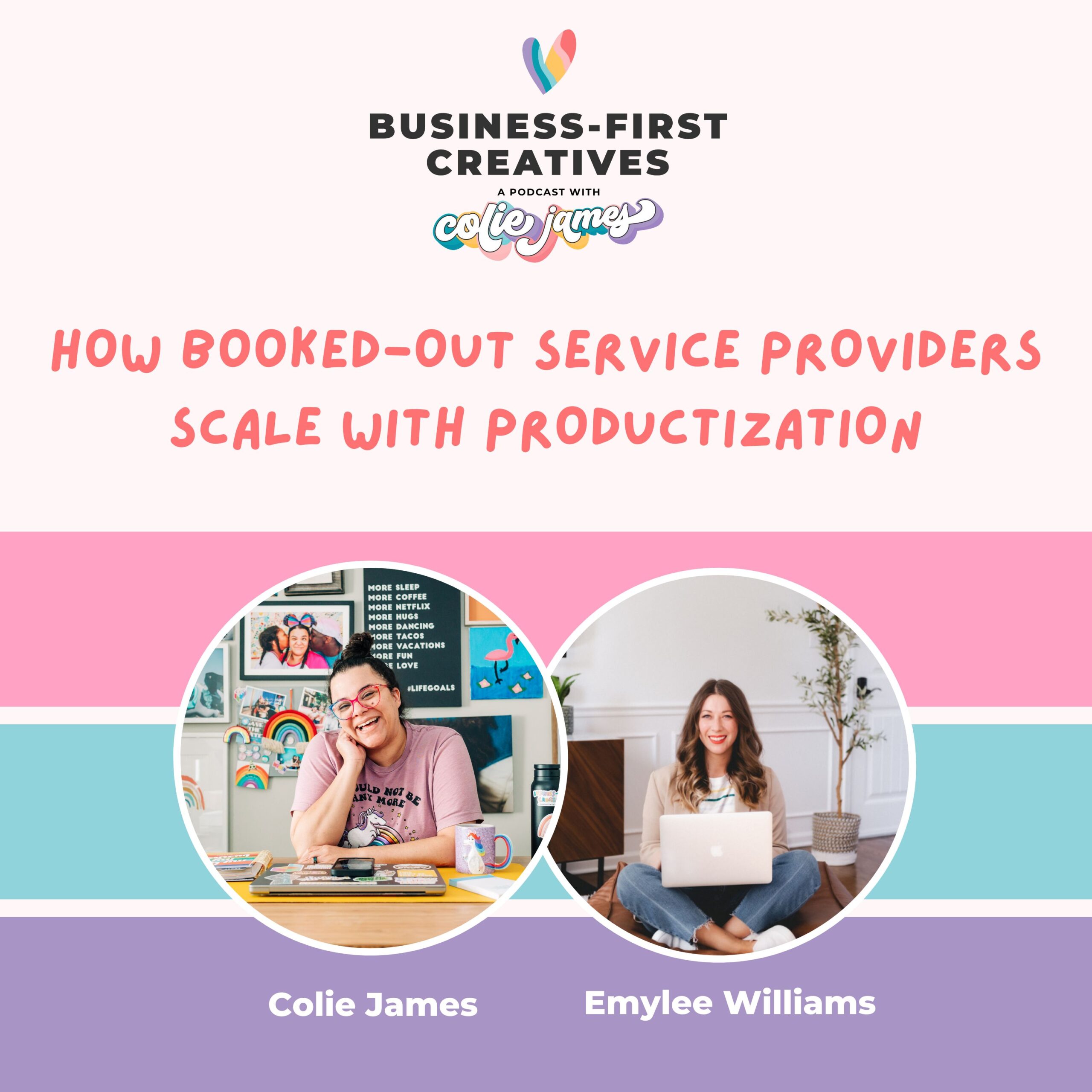





What happens when you’re no longer struggling to get clients, but you still feel like your business has hit a ceiling? If you’ve got inquiries rolling in, your conversion rate is solid, yet you’re still not satisfied, this episode is for you.
Emylee Williams of Sold Out Services and I unpack the business moment when “capacity full” meets “what’s next?” We dig into the strategy behind productizing your service, building an offer ecosystem, and unlocking more value from your best clients.
Review the Transcript
Colie: What happens when you are no longer struggling to get clients? Let’s say that the inquiries are rolling in. Your conversion rate is where you want it to be, but you’re still not satisfied with your business. You are looking for more. What does that mean if you are already at max capacity? That is what I’m gonna be chatting with Emylee Williams about today.
Now, full disclosure, I pay her to help me in my business and so I just wanna put that out there ’cause I know it’s gonna come up in this conversation, but literally I pay her money to help me with my shit. So now she is coming on the podcast to talk about how she helps people in general, and I just wanna say you’re welcome.
Welcome to the podcast, Emylee
Emylee: Hi. I am so excited for today.
Colie: So I also wanna, I mean, if you guys have listened to the episode where I recorded the last business Bestie Chat with Sabrina Gehart, there is a point in the podcast where Sabrina is giving me her best advice. Y’all like that good business bestie shit that she tells me in Voxer. She’s saying it publicly on the podcast.
And I’m literally laughing at her and I cannot control the sound that is coming out of my mouth. And I will admit I didn’t have enough coffee. But also she was basically reiterating some of the things that Emylee had told me the day before. And that day I just couldn’t stop laughing. So now you guys get to like hear this.
In person in real time. So Emylee I wanna start with the word that you keep saying that I know I’m gonna fuck up when I say it because I literally like stumble on the word when I say it and that’s productization.
Emylee: You did it.
Colie: Okay, I get a gold star guys when I mess it up later in this episode. I don’t
Emylee: We’ll turn it into a drinking game every time she messes it up.
Colie: Oh, do I have rum downstairs? Maybe I should pause this go get some, but Emylee has been talking about this word over and over again, and while I am one of her loving clients and I know that that is what she is helping me do, I sometimes struggle to explain what the fucking word means.
So, Emylee what is the word and what does that mean to service providers like me?
Emylee: Yeah. so happy to be here. I’m so happy to dive into this. And it, it feels a little bit of being like in front of, I’ve been behind the scenes in your business for so long, and getting to be in this portion of it is really exciting. So productization is a word that I, I obviously did not invent.
But I am making it hopefully, a new trendy buzzword in this space. But I also want there to be context around that and what, what the hell does it actually mean? When are you ready for it? How can you apply it to your business? All of those cool things. And so. I think the first layer of this conversation is to really uncover what productization isn’t.
And so if you are sitting here saying, I don’t need to know what this word means because I have a signature service, or I only sell one offer, so I don’t need to take it any further, you couldn’t be further from the truth. Productization is how you deliver it is the ecosystem of the system behind your actual service.
It impacts. Your marketing and your messaging, your conversions, your selling, your discovery, your vetting process, your delivery, your scope, your assets, your offboarding, your resigning, your reactivation, all of that is impacted when you implement productization. I like to think about it as. Different pillars in your business, and some of you might need to work more on your delivery asset and scope, pillar of productization and really streamlining what it is that you’re actually promising and what is the result and what are the milestones and what are the
Colie: we’re three minutes in and you said the word result. Guys, that needs to be the true drinking game today. Every time Emylee says the word result, everyone should take a shot. I’m sorry, continue.
Emylee: Yep. Uhhuh, Uhhuh, it is the hill I will die on. And it is the thing that if we can, if we can really nail down, I promise you, everything else gets easier in your business. But productization is the, the systemization, the structure of everything that happens behind the scenes and how you actually show up, convert, deliver, and, and resign, every client in your business.
Colie: That’s it in a nutshell. Okay.
Emylee: That’s it. That’s it.
Colie: So I wanna say I feel like my service systems in session, even though when I started working with you, it was rather new. I think I had four people in the container and I was already in the process of refining it, which I think is a. Part of productization.
I do spend a lot of time on working out the delivery, tracking what I’m doing with all my clients. I do all of the things that Emylee teaches. Her forcing me to look at it through the lens of my result, I think is why I ended up paying her. Because I do the things like I look at how much time it’s taking, how I can systematize, like them asking me questions and all of the things.
But I find myself now more than ever saying, okay. But what is the result that I promised them, and is this getting them closer to that? And if it’s not, I have actually been taking things out of the container at a faster rate than I would have previously. So I just wanted to tell you guys that, like that is what I am getting from
Emylee: Gonna your own case study in in your own podcast
Colie: And you know what? I will give you the transcript. We
Emylee: I would love it.
Colie: It’ll be all good to go. So. Recently, I do wanna say this ’cause I submitted it to you and you were like, okay, that’s interesting. Like we didn’t really talk about it, but I think that you were probably proud of me. I recently decided to do a time audit of my work with the first, I don’t know, was it eight people that went through systems in session and what that meant to me.
Was that I went through every support ticket that they had submitted. I went through every SOS call that they had booked, which guys, they’re supposed to be 20 minutes. Um,
Emylee: LOL.
Colie: one that I spent with someone I think was 63 minutes, and that wasn’t a kickoff call, so I had to double check it a couple times, but I ended up going through.
Like basically looking at all the time that I had spent with these people in the support tickets, on the support calls to figure out how much time I was actually spending delivering this container that I think everybody at this point knows that I love and I had some really like amazing eye-opening.
Things that came of this time audit. I was looking at how profitable it was for each of my clients and newsflash. I told my client yesterday the least profitable person, and her response to me was, but you knew what you were getting yourself into. She literally told me that yesterday, which is okay because I expected it from her.
Like I knew that she was gonna use every single resource that she could. And so that is like my new. Ceiling. Like I have to make sure that it gets better from there, which is a really good thing to have.
Emylee: It’s just information. Yep.
Colie: information and we use our information to make our services better.
Emylee: Exactly. Exactly.
Colie: Okay. But you’ve talked about it in terms of like a signature offer, which for me would be systems in session, but I think that the bigger part of what you help people with is also defining your offer ecosystem as a whole.
So. Where does productization come in in relation to the entire offer ecosystem? Because is it that you have to nail your signature offer first, and then you kind of say, okay, what’s your easy Yes. And then what is your retainer? Or is it that we look at all of our offers first and then you’re in a position to do more productization?
Emylee: I think it definitely depends on how much data a business owner is bringing to the table. I think if you have a, if you think you have an ecosystem, but you don’t have enough people who’ve gone through each of those individual containers and you’ve understood what result did they actually get, not what you wanted them to get.
Or what you hoped that they would get, but what did they actually get? If you have enough of that data, we can definitely look at the existing ecosystem. If you are, if you’ve been running an an offer and it’s maybe your signature service and you’re looking at adding new things, this is where I want us to pause and say, okay, wait.
Have we really productized and really nailed down the result? And the authority that this signature service is actually bringing to the table. The phrase that I kind of like to use in conjunction with result is your authority. Anchor the thing that you’re known for. The thing that other people can kind of introduce you in other rooms and tag you on threads or, introduce you at a networking event and connect you with someone because you do.
And you do what really well, right? You are the person they need to hire for this particular result. So I really wanna nail that down on Signature Service first and really making sure that that’s accurate. We make a lot of assumptions about the results that our signature service provides, but if we actually look at the data, make sure that we’re asking our clients how did they start?
Like how were they before they did this thing and went through this container, and what are. How is life or business or their happiness or their systems or whatever, like now. Then we can actually have a before and an after. Then we really identify, okay, if this is the result, am I promising too much in this offer?
And that’s typically what happens. The majority of my clients are over delivers. They, and, and they refuse to not be. And.
Colie: Uh, whatever continue.
Emylee: Forever. And, and I love that. And, and truly, truly, I think that the, the perfect. Service-based business owner for this industry is someone who naturally over delivers. We, we want to provide incredible results for our clients. And I love that, and I’m not saying that you can’t. What I am saying is that when we provide too much of a promise and a result and an outcome, it’s actually counterintuitive to the result that we actually want our clients to get.
If we’re providing too much and we’re giving too much, they might not get the result a week. Actually know is the most impactful for them. So what do we need to pull out? What do we need to add? What do we need to refine well in that kind of pulling stuff out that typically highlights what is something that could be the easy yes offer, meaning the entry point.
It’s typically lower price. It’s a a subset of a promise of a result that is leading them to the signature service and then what’s on the backend when someone graduates, so to speak, from our signature service. Is there any sort of ongoing maintenance advisory retainer that we could introduce to them, to the the level 10 people who went through that signature service, which is a whole other conversation.
And then now you’ve built yourself an ecosystem. Here’s how people come into my world. They get a taste of what it’s like to work with me, and they get this incredible result, one singular result, and then it makes sense for the right people to then move on to the next container and then the right people to then move on into some sort of maintenance mode.
Colie: So I feel like she glossed over level 10, and I’m gonna just highlight this because I think a lot of us talk about who our ideal clients are. To me, Emylee might disagree, but I think she’s just replacing the word ideal client with level 10, but with a very specific caveat. So if you determine who your level 10 clients are, the people that are absolutely perfect for the container that you’re offering and have the problem that you uniquely solve in the best way possible, those are your level 10 clients.
But if you’re not identifying. I really hate to categorize. I mean, I felt a certain kind of ick when I’m going through my clients and I’m labeling them as level 10 and not, and she has an Airtable hub that does it for you. So it does kind of take away some of the ick like, Hey, I’m not saying they weren’t level 10, the system
Emylee: the formula said
Colie: Yeah. I mean, and I don’t need to blame anything, but it’s kind of nice if you have that problem. But if you don’t look at the clients that are coming through your container and identifying, did they get the result that you promised? Did they get more of a result that you promised? I mean, that’s always good coming with the over-delivering, but bare minimum, did they get what you promised?
And if they didn’t. Why? The why is I think the most important part of like the level 10, because it really helps you clarify that if someone didn’t get the result that I promised, were they ready for the container in the first place? Did they need something different than what I actually offered them?
And so when you look at your. You know the specific offer when you look at your offer, offer ecosystem as a whole, and you start actually looking at the clients that are going through this container and you’re writing things down about where they started. Where they ended up, whether or not they got the result that you promised, that is helping you define who level 10 is for you,
it actually helps you identify. In your messaging, who you need to talk to to kind of bring those clients into your container. And I know lots of people talk about that as ideal clients. I don’t know why, but your level 10 just made more sense than someone who’s saying, oh, but who’s your ideal client?
Emylee: the difference is, is that for, for me, how I look at it is, your ideal client is the person who’s coming through your easy yes container. It’s your Level 10 client who’s moving to your signature service. It’s your level 10 of those level tens who’s moving into your retainer. Not everyone will move into the next bucket, and that’s fine because part of the formula of Level 10 isn’t just.
Did they get the result? Did they get it in the timeframe that you promised? Did they get it using the tools that you provided, or did they just happen to get the result? Did you enjoy working with this client? Did they enjoy working with you? Was the communication good? Like there are so many factors into that formula outside of just the result, because I believe in creating and designing a business of where.
I wanna work with people intimately that I really love working with. And typically an easy yes offer is a hands-off container. You are not doing one-on-one delivery. You’re probably not providing calls. Maybe it’s an audit, an assessment, a sprint, an intensive it. It’s different for everyone to depending on your business, but you’re typically hands off.
So yeah, sure, every ideal client can come into easy. Yes, that’s totally fine, but then at the filter gets put into place based on those results.
Colie: And identifying who your level 10 is. So I think that we’ve not mentioned this, and I’m surprised, I mean, it took you three minutes to say the word result, but the one thing that we haven’t actually talked about now is like lifetime client value.
Emylee: Yeah.
Colie: do feel like, see, it took us 15 minutes,
Emylee: Yep.
Colie: So one of the things that I think most impressed me about Emylee, when I initially worked with her and we were talking about, it was in a very small capacity. It was in her easy yes container. But one of the things that you know, I felt like we were really aligned on was the fact that you should be.
Trying to find a way to continue to work with your Level 10 clients for as long as you can bring them value. Now, does that mean that all of my clients need to stay with me for the rest of their lives? Absolutely not. But if they finish my first container and they still need something that I am capable of providing to them, what does that look like?
And if I have enough of my level 10 clients that all need this thing. Then that is how I’m creating my next new offer, if you will. And it might not be the same thing that you were initially known for, but that’s okay because if those people are gonna continue to work with you in this new capacity, as long as your filters.
Are working well. So in other words, you’ve got these people that are coming into easy. Yes. Those that need your, you know, signature offer, your core container, get there, and then only some of those people, which I think is the thing that you keep reminding me of, is that I don’t need to carry everybody from systems and session into the next level.
It is only for those people who are still in a position to get value. With working with me, and it’s not gonna be everybody, and you keep telling me this and I’m like, yeah, Emylee, I agree. But lifetime
Emylee: you cross your fingers behind your back.
Colie: know, but lifetime client value. Is a thing that I don’t think gets talked about enough because once you have kind of put in all of this time and cost of acquisition for a client, you should be making every effort to, I mean, I don’t wanna say, you know, get as much as you can from everybody, but in reality, get as much as you can from the effort that you have put in to getting that client.
And it doesn’t always mean. Working with the same client. It could be the referrals that they will bring you, or you know, the clients that will come to you simply because they read their case study, their review on your website. So what is it about lifetime client value that you find so sexy in particular that has made it like a core, I mean, I don’t wanna say result, but a core result of what should come from your offer ecosystem.
Emylee: Well, and it definitely is a core result for me. It’s something I talk about a lot in my program, sold out services of I I, and I don’t know what the average number is going to be at this point ’cause I need to go back and look at the data. But if I can double your LTV or increase it by 25% or whatever, right?
I gotta, I gotta identify what the math is there, but that is the most impactful thing on your revenue than anything else. Um, these folks are easier to convert, they’re easier to refer and building up that, that. Lifetime value of what they’re spending with you is, is your easiest lever and let’s pay attention to that.
But so what I wanna call to attention and really clarify too, is when we’re thinking about, okay, I served them in the easy yes. And now I have my level 10 clients who are in my signature offer, and then I have my level 10 clients into maybe something else, and I start to see, okay, what could this offer be?
Please like visualize this as like a line that ascends. Up or over. Most people when they’re thinking about defining or creating a new offer, they’re thinking about creating something on the front end and something for all of those ideal clients to come in through. And that is the one to many business model way of thinking and not the service business owner way of thinking.
And it’s so easy for service providers one-on-one, done for you. Init service providers to. Be infiltrated with a marketing of one-to-one and think that that’s what’s going to work for their business. It’s a similar strategy, but moved at a different point in the client journey. So where I’m coming in and saying, the easiest way to increase your LTV is not to create a new offer to sell your new people.
It’s to sell to your level 10 people. And yes, that number is gonna get lower and lower. Maybe 50 people come into your easy yes. 30 or 40 come into your signature service and then 10 of them come into this, this ongoing maintenance offer or whatever it is that we design on that backend. That’s fine. That compounds right?
That’s how money works, and that is the Then, then you get to do the math of, okay, well then how many people do I need to come into Easy? Yes. If I’m converting this mini into my signature offer and then converting that mini into this retainer.
Colie: Well, and I feel like it’s ironic that we’re recording this episode on a Friday and my episode on your podcast just aired yesterday. So for those of you that didn’t hear it is linked in the show notes. But this is a big part of the conversation that Emylee and I had on her podcast because we did talk about my struggle and you know, I had done for you.
It did very well. It had a very nice price point. I was paid very well for my time. But I was at capacity with nowhere else to go, and I took the route of trying to do one to many. Because I was already doing it. I had the course, but I wasn’t really selling the course as actively as I was selling my done for you.
But when people told me, oh, I don’t need your whole course, I just need this. I thought I was doing them a service to pull out the individual templates and sell them in a template shop. And I think everybody knows by now the template shop is gone. I went and turned everything off and I’m.
Happier for it. But in that moment when someone came to me and said, I don’t need your whole course, I just need this. I needed to take the perspective of, okay, I think you need my course, but if you don’t, that’s okay.
Emylee: You are not an ideal client.
Colie: an ideal client. That offer is not for you. That’s great. You don’t see the value in doing that offer.
That’s fine. Um, maybe I have an easy yes for you. Maybe you could get some value out of buying just a proposal template for me and setting up your five minute booking process. But I am no longer going to sell you. What you think you want out of the course because you don’t have enough information about the way that I built it to know that, to get that core result, which let’s just, let’s just point out the elephant in the room.
It’s workflows. Everybody thinks they need workflows, but your workflows will not be effective if you don’t do all of the other things that I’m telling you to do. And even if you think you already did them, I guarantee you, you didn’t do them right.
Emylee: Yes,
Colie: You didn’t do them to the level that they
Emylee: And you would’ve done them right if we had worked in the container that I intentionally designed for you to get this result, that that’s my whole beef with all of this, you know, this service economy of creating these, pulling out a template or pulling out a module and doing whatever because you’re actively doing a disservice and we are in the service.
Industry. That’s, that’s our world. And to serve, it’s to serve and, and to, for you to be the authority and the expert and say what is needed to get the result. And it would be unethical for me to provide you anything else other than that. If, if this is the result that you want, you might not be ready for that.
That’s a whole other conversation, right? And we can talk about that. But, but to just to then have to piecemeal something and then now to sell and what you’re piecemealing it for one person, three people, and then now you have to go market this whole thing. And then it’s confusing for your signature offer, which is where a lot of people come to me and they’re like, what’s happening?
Colie: And right now I’m in the process of getting ready for the launch of the blueprint, which by the time this airs, it will be very soon. And in that process, I’m rewriting the sales page, which is why I kept saying, okay, but what’s the result? Like literally in every section yesterday I was like, okay, but what’s the result?
Is this addressing this? And one thing is I had asked for a copywriter. I’m in one of her programs, and she had reviewed it and she had given me some feedback and I was like, okay, wait. I think that somewhere it’s getting lost, and I just need to say this out loud. The value of the blueprint is that I’m giving you the entire thing, which is why I called it Blueprint in the first place.
I am giving you the plans. To create entire systems in your business, and that is what makes it different. When you go Google, you know, Dubsado template for photographers, there are lots of people that will sell you templates. Some of them will sell you individual templates like I used to, but no one is really selling you an entire system.
And so after working with you. I just feel like every time I talk about it, I’m like, no, you need the whole thing. And the whole thing was put together in this way for a reason, and I need you to get the whole thing or none of it, and I’m okay saying that now. Whereas, you know, six months ago I was like, well, no.
I mean like I. If you’re gonna buy workflow templates, I want you to buy them from me because I have custom crafted them for photographers. But no, and I’ve said this a couple times by now, if you have shitty communication, your workflows are gonna be shitty. And that is why I’m on this. Like everybody needs to improve their communication, but, and in my expertise, I think that that should be my easy yes.
But you and I are still going back and forth on whether or not that’s a good choice, and
Emylee: Well, and the, the data ha we don’t have enough data to make that decision. Right? And the conversations of yes, I want that to be your easy S ’cause I resonate with that message and I agree with you, but if it’s not resonating with your level 10 people, then it doesn’t matter. And I remember even if, if we bring this back to, you know, ’cause I, so I started in business as a photographer as well.
I think that’s also why we resonate a lot. ’cause I get your audience really well and yes. Been a minute since I’ve been in that industry. But I, I was this person and to man, Dubsado did not exist when I was a photographer. And so like, I, I, my whole thing was a hot mess, but I had a system of selling, right?
My client experience was really reliant on in-person selling. I loved in-person selling. I made my money on the backend with products, right? And so I, I could absolutely be the person that was like, oh, you get a half off. Session fee or a free session fee. ’cause I don’t care if you pay me $250 ’cause you’re gonna pay for a $700 gallery wall or whatever.
But then I would have those clients who would approach me and say, I wanna work with you, but I don’t actually wanna do the in-person session. I don’t wanna need that. I just want digital images. How, how can I do that? And I said no to those folks because you would not get the experience and the result that I’m after, I’m after this much bigger emotional connection result and an experience for you.
’cause I worked with families and I worked obviously very closely with the mom of that family. And I want you to feel. Taken care of and seen and reflected, and there’s like a whole slew of things that I was like, this is the meat of what I’m providing and I can’t provide you that if I’m just sending you the digital images.
So that is not available to you.
Colie: It’s kind of funny that you say that because I don’t think I’ve ever realized that not wanting to give people digital images is the same as me not wanting to give you templates, and I never know if you do anything with them. I literally just figured that out sitting on this conversation because one of the things I recently, you know, got my human design and I’ve been working towards, refining my offers and my messaging and really like owning what I’m offering as a service.
Largely related to my human design, but one of the things that I realized is that I don’t like not seeing the end result. It is something that I have struggled with ever since I made the blueprint, self-study ever since I started selling templates. I know the templates are good. I know the course will get you where you need to go, but I was no longer getting the same satisfaction that I was.
When I saw my students figure it out, based on the tools and the templates and the information that I gave them, and then seeing them put it into practice, I really, I miss that. And so I think that’s why I was so drawn to creating systems in session because now literally my clients get on every one of their little s sos calls and they’re like, okay, Colie, this is what I did since we talked last, and I just have such joy.
Seeing my clients figure it out, and that is literally the only part that I miss about being a college professor, is seeing students’ faces when they actually get something that I just fucking explained to them for the fourth time.
Emylee: When it clicks, I’m telling you, I, it was my dream after I graduated from undergrad, I wanted to be a college professor, and I, I was headed to grad school and I was headed to go do all that. Two weeks before classes started. I was like, actually, this is not for me. I, identity crisis started my photography business and within about a year and a half when I had figured out, like in-person selling and, and the business side that I was.
Really addicted to learning. You and I have talked about this a lot where we are creative entrepreneurs and and can do the service and we’re addicted to the business side of things. So it definitely is, is unique. But I started talking to other photographers in my area about the things that I was doing that was working, and I would do strategy sessions and all of this stuff, and it was my absolute favorite of being, you know, either in person at a coffee shop explaining something and them just being like.
Oh, and then like everything falling into place, it is one of my favorite things and it’s why I miss, it is why I love group coaching. I know that we like calls. I know that you and I like have different feelings about that, of like having that as a component or showing up to those, or having it being a part of a, a curriculum.
But it’s one of the things where if, if people were more active. I would bring them back and have them more prevalent, but my, my community for some reason doesn’t love group calls, but I love group calls, so I need to find more people who like group calls.
Colie: Unite. You need to figure out how to split that balance. And it’s not that I don’t like group calls. I think that I just feel the need to say it is that I don’t think group calls work for the specific offer that I am giving because everything is so technical. I think that if we were talking about things like increasing, you know, lifetime customer value and how you create your offer system, if I got group calls and we focused on that part of running the business, oh I would love group calls.
I don’t think group calls are effective for helping people with their tech situations because everything is so specific to like your thing. ’cause one of the things you and I talked about was, well, what videos can you provide to your clients to potentially lower the number of. Support calls that they need.
And while I totally agree with you, there are probably a set, you know, number of videos where it’s basically explaining like just how to do something. I don’t think that I’m ever going to be able to create a set of videos that explain how to fix something because the reason that something breaks, yes, there are common threads, but in general it is so specific to each one of my clients.
Emylee: Yeah. And, and that’s the crux of this too, is like I, I am not the productization expert so that you get out of all delivery forever. I don’t like that actually. And I don’t love that language that’s being used in the one-on-one service based industry. Um, if you are a digital provider, yeah, get the heck out of like delivery.
I love that for you. But in the service space, we work intimately with clients and we understand the nuances and the context of their business so that we can best provide support. That is the nature of service business. When you productize everything that you can productize, you’re able to get to do more of that and get to show up in your expertise.
And I love nerding out about the specific nuances of people’s business. I wanna get to do that without being exhausted because I’m doing all of these other pieces.
Colie: Yes. So we brought photography into the conversation, and what you’re helping me productize is not anything related to photography. So for the people that are listening, what does it look like to productize a photography service? And we can pick any photography service that you want. I wanna make sure that we cover something that’s like concrete for the photographers because you know they’re not working with clients in the same capacity that you and I do in our
Emylee: sure.
Colie: businesses.
Emylee: Well, I, I mean, I honestly think a big part of the productization comes in working with you inside systems and session. Productization is systems, right? And so how, part of it is, what can we automate, what can we create a template for a canned response? Even if it’s, my favorite thing about automation is like the, the hybrid of manual.
Automation or automated custom work, you know, and I love personally setting up internal reminders. It’s, it’s just me, myself, and I on my team. And so, it’s just me, but. I like having, and I use Airtable for this, but you know, if something, or when something happens, I get an email notification that says, you know, Hey, this client just onboarded and they submitted this.
Now it’s time for you to send them this message. And I go, then look at their onboarding form and I customize that message. Yes, I’m writing it maybe from a template that I’ve already created and perfected, but it’s to that person, that part might not ever be able to be automated. That’s okay. Um, and, and so what I’m asking you to look at in your system.
Of the ecosystem of your, of your containers is what can you automate and systematize even if you have to come in and do something manual. And so everything from, well, like what you talk about in systems, your from your inquiry to your booking, what does that look like? How does that happen? Are you creating a proposal from scratch every single time when someone reaches out to you?
You need to stop that and create the system for it, right? Are you, but on the even higher up level, uh, zooming out a little bit from that, are you saying yes to every single type of client? Request. Right. I remember very early on, and this is, it’s so obvious, and, and I’m sure you guys have already gone through this part in your phase of your business, but,, I was strategizing with a couple of photographers and they were like, man, I, I, I really just wanna.
Really focus on weddings this year, and I don’t understand why I’m not booking more weddings and people aren’t coming to me for weddings. They keep coming to me for these dang senior sessions and I pull up their website and I go, well, your homepage hero has senior sessions on it. There’s ne a wedding like shown on your website.
You are not presenting yourself as a wedding photographer, therefore you are not going to get wedding inquiries. And so truly, sometimes it can be as simple as starting there. How are you showing up? What are you projecting out into the world of this is what I’m available to be booked for? Is that what you wanna be booked for?
And then when you take it kind of further and using my example from a, from above, if you’ve identified what is like, uh, you know, we talked about LTV, but there’s also a CV. So your average client value on average, what is a client spending with you? If you want that to be more, then you need to eliminate lower price.
Offers, right? And so if you want that to be more, maybe we take out the option of them just being able to buy digital, uh, images and you maybe throw digital images within your highest package. That’s what I did. I didn’t wanna gate keep digital images. We all love digital images that cost me nothing to send to you.
And so I will throw that in when you buy my highest package, no problem. But they’re not available a la carte. And so it’s stuff like that of really thinking about what is the experience, though I think the word for photographers. We trade result for experience. And what is the experience that you want each of your clients to get at the end of this?
What do you want them to feel? What do you want them to think? What do you want them to say when they introduce you to and refer you to other people? And are you creating that for them in your offer and your experience of working with you?
Colie: Yeah, and sometimes what you said about the digital images, that comes up a lot when I am coaching photographers because I can’t help you create systems if I don’t understand your offer. Systems will not cover up a shit offer. So I have to make sure it’s priced well. It’s profitable. You’re not spending too much time, you’re not promising too much.
Like
Emylee: Mm-hmm.
Colie: feel like you in that respect, like you don’t need to give somebody 150 images. How
Emylee: And, and if you’ve blocked 90 minutes for a session, why are you still there three hours later?
Colie: Woo, woo, woo.
Emylee: I’m just saying
Colie: I mean, as someone who takes her time, it’s funny when people, you know, when I am always discussing what I did as a photographer, I’m like, but this is not what most people do. I say, you know, no two was, my two hours was my minimum. It would go to three if I was also doing video. But like I would never spend that much time with someone if I was shooting them in front of the mountains, which I don’t do.
But that does not require three hours. It just doesn’t. Even if you’re walking through nature and you’re going to the different locations, like I
Emylee: There’s only so many a tree and.
Colie: Now, you know what? I’m sure some of the photographers are gonna come for us. Hey guys, you know where I’m at. Um, I mean, I just think there’s so much storytelling in a house and I also spend a lot of time getting my clients comfortable with me. But that doesn’t mean that that’s the experience that you want to provide.
So I just want to make sure that when you have crafted your offer, which let’s be honest, for photographers, it’s usually about how much time you’re spending.
Emylee: Mm-hmm.
Colie: What it takes for you to prep them for the session, how much money they’re spending with you, and then what they’re getting in the end.
There’s absolutely nothing wrong with just giving digital images if that’s what you want to do, but if you want to be responsible for like crafting the products that they’re gonna pass down to the next generation and all of those things, that needs to be part of your experience and it needs to be part of your offer, and you have to make sure that all of it together.
Makes sense and increases your a CV and your lifetime client value, like whichever number it is that you are, you know, I don’t wanna say worried about the most, but the one that can, the one that you’re focused on. Yeah. We wanna make sure that your offer makes sense for
Emylee: Yeah. Well, and, and going back to digital images, to me, if we, if we’re looking at the juxtaposition of photography businesses versus like what we do in this online space, selling only digital image packages is the one to many business model in the service world, right? You’re gonna need more clients.
If that’s the only offer that you have, session fee and digital images, you’re just going to need more clients. That’s just the root of it, because you’re probably charging less than if you were to throw in some product if you were to do an in-person session. If you were to do a, you know, a a year long package that offers something, right?
There are different options there. But I knew, again, every business model can be successful. There were plenty of photographers that I knew back in the day, and I mean, we’re talking 2011, 12, 13, 14 ish. Who, I can’t, I’m blanking on her name, but she, she taught people how to basically scale a one to many photographer business.
’cause all she offered were session fees, digital images she didn’t want to do in person selling and have the packages and have, she just did not wanna do that. That wasn’t her jam. Therefore she knew she needed quantity, so she had to switch up and focus more on her marketing game and getting in front of the right people and getting speeding up her actual session time and her editing time.
There are things that then she still had to focus on productizing, if that’s the business model she was after.
Colie: And I just realized, guys, it’s been a while since Anime’s been on the podcast, but I am gonna link her quiz in the show notes. If you have never heard me reference the quiz where you find out what business model works best for you, and it’s between a unicorn, a donkey, and a workhorse. Uh, just so that you guys know.
I’m a workhorse and that’s okay. I’m a workhorse that sometimes wants to be a unicorn, but, you know, say Levy. But I’m gonna put that quiz in the show notes, and if any of this is like vibing with you, like, you know, what is a good model for me, I would take that quiz so that you can figure out maybe what business model would align with you best, because again, it’s not the same for everybody.
Emylee: It’s not the same for everybody. And, and the conversation that I have, almost every kickoff call that I have with a client is, what is the business model you want? How do you want it to feel? What kind of revenue goals do you want? What do you wanna take home? All of those things, right? And. Are, are the things that you’re doing, selling, marketing, talking about in alignment with that?
Oftentimes we have, oh yes, this is the kind of business I wanna run, but what you’re doing over here is for a completely different business model. Those things need to be in alignment.
Colie: Yes. Okay. So the thing guys, is that I feel like Emylee has just opened like another little window, and I think that if I go down that trail, we’re gonna talk for another 45 minutes, so I just wanna say. That productization is not just for people who are running businesses like me. It is for everyone. If you are a service provider, figuring out how to maximize the offer that you’ve got, build an ecosystem that is actually bringing people in for your easy.
Yes, keeping them in for your core container, and then letting those true level 10 people ascend to the next level. Whatever that is, is Emylee’s jam. And she has a webinar that’s coming up. So tell us about it and tell us where people can go find out more information about you, other than the show notes.
Emylee: yes. So this webinar is coming up on November 11th, 2025 at Noon Central. It’s called the Productization Framework. And I’m going over the six pillars like I kind of mentioned today. We talked about a couple of them. But doing a deeper dive into what are those pillars? What do they actually impact when you actually productize it?
And how, when you get to the point when your revenue and your capacity have both maxed out, they’re hitting the ceiling at together. The only thing to pull to increase your revenue is to work with more clients. But you can’t because you’re at capacity. Productization is your answer. And so I’m definitely going over what does that look like, explaining it more in depth.
You can definitely head to sold out services.com/webinar to sign up for that. It is completely free. I will be opening the doors to my signature program, my core container sold out Services where you it, it’s a done with you container, where you get to implement productization across those six pillars in your business.
I’m hanging out on Instagram at Emylee says I post there a lot also on threads. I also have a substack where I am doing a lot of deep dives into the service world. I’ve been in this space for 14 years. I know some things. I’ve learned a lot of lessons. I used to be a photographer and I still help, you know, traditionally creative small business owners who are in, in these spaces.
So, if that’s your jam, you can head over to the service Playbook on Substack. It’s linked to my website as well. Sold out services.com.
Colie: And sold Out Services Guys is the program that I’m currently in with Emylee, just so that you
Emylee: yes. Oh, I also have a podcast. So clearly you like listening to podcasts. I forgot, I forgot. I had a podcast. You
Colie: what’s new. I mean.
Emylee: Yes, it’s new. Yeah, it’s new. Uh, you should go look for sell the damn service on Apple Podcast or Spotify. Episodes twice a week. There’s Tuesday episodes that are a little bit shorter where it’s just one kind of ranty episode from me.
I know you guys like those ’cause you listen to this one. And then Thursday episodes are a deeper dive interview with a service provider talking to service providers who want to stay service providers, and, and refine and, and streamline their business.
Colie: All of that is linked in the show notes. This is an episode where I do feel like you need to go to the show notes and you need to click the damn link. So if you are someone who usually just listens to me and is like, oh, I’ll go, no, actually, go click on the links in the show notes in this episode. Emylee, thank you so much for joining me on today’s episode.
Everyone, she will be back just as soon as it’s appropriate, to have another conversation with her that’s taped. So that’s it for this episode. See you next time.
Emylee: much.
About the Guest
Emylee Williams is a business strategist and founder of Creatives Catalyst, where she helps service providers simplify, scale, and sell out their signature offers. With over a decade of experience — including co-founding a multimillion-dollar marketing agency — she’s worked with 30,000+ entrepreneurs to turn messy, custom services into scalable, high-converting offer ecosystems. Known for blending data-driven strategy with a no-fluff, human approach, Emylee teaches service providers how to grow their business without adding more to their plate.
Find It Quickly
00:24 – The Struggle Beyond Success
00:46 – Meet Emylee Williams
01:56 – Understanding Productization
04:06 – The Importance of Results
07:50 – Defining Your Offer Ecosystem
11:32 – Identifying Level 10 Clients
15:11 – Maximizing Lifetime Client Value
20:10 – The Journey of Offer Refinement
21:59 – The Importance of Workflows
23:14 – The Blueprint Launch
23:46 – The Value of Complete Systems
24:39 – Communication and Workflow Effectiveness
27:38 – The Joy of Client Success
31:25 – Productization in Photography
40:52 – Register for the Webinar
Mentioned in this Episode
- Sell the Damn Service: Ep 12 with Colie James
- Annemie’s Business Model Quiz
- Productized Services Framework Webinar on November 11th, 2025
Connect with Emylee
- Website: soldoutservices.com
- Instagram: instagram.com/emyleesays
- Youtube: youtube.com/@EmyleeWilliams
- Podcast: soldoutservices.com/podcast


Top Categories








© 2022-2025 Colie James


Close
Start dates available for Q1 2026
Enter your contact information to join the interest list for Systems in Session. You will get early access as spots become available with a booking bonus!
