




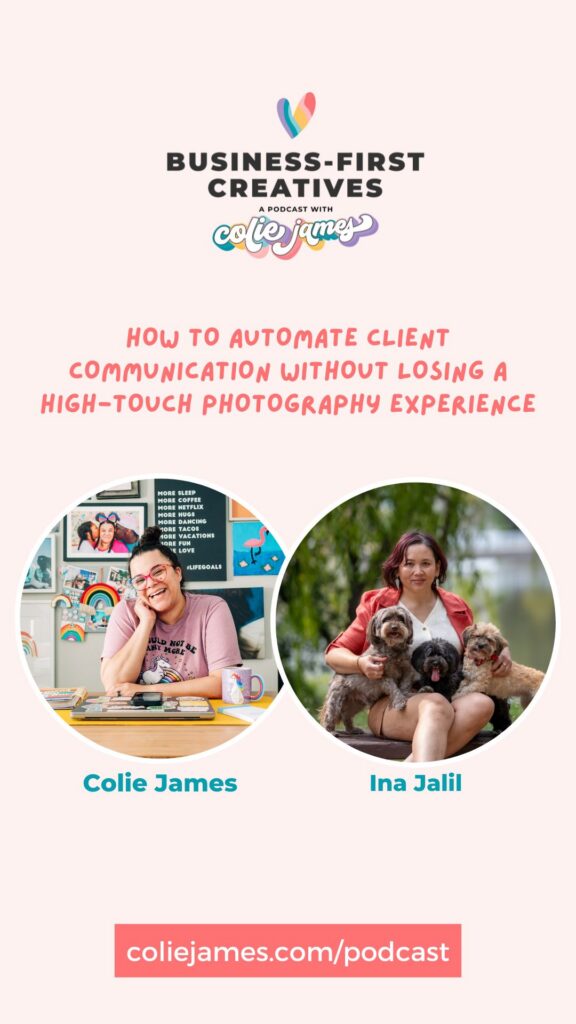
What if automation didn’t make your client experience feel colder, but actually made it feel more personal? In this episode, I’m sitting down with Ina Jalil, a pet photographer who specializes in high-touch, full-service photography for dog lovers. When Ina joined my Email Like You Mean It live sprint, it became clear almost immediately that her business was the perfect example of something so many photographers wrestle with: how do you automate communication when your process is deeply personal, intentional, and customized?
Ina walks us through how she built an in-person consultation model for her pet photography business, why that shift improved both client understanding and sales, and how email still plays a critical role in keeping clients engaged between touch points. We also talk about the “messy middle” of the client journey, the silent gaps that hurt momentum, and why even seasoned photographers need to revisit their workflows from time to time.
Review the Transcript
Colie: Hello. Hello.
Welcome back to Business First Creatives. I am gonna be talking with one of my clients from email, like you mean it today, and she’s a pet photographer. Australia. And so you’re gonna hear this accent as she talks, but when Ina came into email, like you mean it, I realized quite quickly in this last live run that not only was she like a very high touch, very personalized photographer with an experience that needed to match, it was very similar to several other people that were in this run.
And so I invited Ina to come on the podcast so that we can really talk about what it means to. Automate some of your communication even when you are really touching bases with your clients in person. So Ina welcome to the podcast.
Ina: You for having me Colie. It’s great to be on here and you know I was, you were on my podcast before and now I’m on your podcast. I’m really excited.
Colie: Yes. And guys, if you guys, if you missed that episode, I mean, I sent an email about it. I talked about it on threads, but my episode on her podcast is linked in the show notes, and it is going to go very well with what we’re talking about today. So kind of think about it like a two part series, if you will.
And I don’t. Think it really matters if you listen to this episode and then go listen to hers. They don’t need to be done in a particular order, but they do go very well together. So I really do recommend that you listen to both episodes, but Ina to welcome you to my audience, let’s get started and say what kind of photography you do.
I mean, I already said you were a pet photographer, but why don’t you introduce yourself so that when we can jump into the conversation.
Ina: So I’m Ina and I am based just outside of Canberra, Australia. So if you hear my accent it. F I’m Australian. Um, and I, I am a pet photographer specializing in photographing mainly dogs, but I do photograph other pets and my specialty is outdoor dog photography. But I also serve other clients in studio and also in home, depending on their pets.
And I do a very. touch, full service, pet photography experience. So I do the in-person sales model and also in-person consultation. So there is a lot of, I guess, very personalized and high touch service from start to finish with the pet
Colie: Yeah.
Ina: offer.
Colie: I mean, let’s jump in with that because I think that you’re one of the very first people that’s ever told me that you’re doing an in-person consultation before they’ve even booked. But again, you were on that call and email, like you meet it when there were like three other people that were like, oh, I, I do that too.
And I was like, I have never heard of this. Let’s talk about it. So you, when someone inquires about your services, I feel like a majority of the clients that I work with in systems in session and for done for you system setups, before this all did consultations that were either live phone calls where they’re actually calling their clients or they do like a video conferencing like Zoom, Google Meet, et cetera. But you actually invite. Your prospective clients to come visit you in the studio. So tell me about how you got started doing in-person consultations in order to get clients booked.
Ina: Yeah. When I first started, I didn’t have any of this in person. It was all via email. There was a lot of back and forth trying to work out the dates, trying to work out everything. And then the first time I would’ve actually met them was at the outdoor session like. When it comes to the session. So I’d be like, you know, standing there in the, in the park or gardens and just like looking around going, is this my client?
Who am I meeting? and then sometimes there might be one or two people that don’t show up and I find that I. I was working out going, well, I need to have a better client experience. There needs to be something there that’s better. I also found the model that I was doing, um, especially when I was trying to get clients first, I was offering complimentary sessions and the free print, so a lot of people just taking the free prints and didn’t understand the pricing.
Even though I do provide pricing upfront, I emailed them the pricing. About four or five times before their session, but then they come to the ordering appointment going, oh, I didn’t know I had to pay this much. So the disconnect created, I guess, you know, a thought in me going, well, I need to do something better.
I need to have something better to explain to them in, you know, in person. Or, I tried calling by phone as well, but I just still find that. There was still some kind of disconnect, so I thought, let’s try in person consultation. And so what I did was I changed my website where when you inquire, you can, fill in a contact form to contact me, but anything that says book now or book a consultation that just takes them to a scheduler to book in an in-person consultation with me and I just made it.
That is the standard way to do it. That is the. The only way you do it, if you do live further away, they can always contact me and schedule Zoom sessions
Colie: Yeah,
Ina: had people do that.
Colie: I mean, I love what you said. You’re like, this is what I decided was my model, and so I just told them, and this is the only option. I do feel like sometimes I work with a lot of business owners that are kind of. Scared is probably a strong word, but they don’t wanna risk offending clients that might not wanna come to an in-person consultation. And so they try to be as flexible as possible, but then you end up basically doing, you know. Whatever it is that the client wants, instead of providing the experience that you have designed that you know works well, not only for conversions, because there is definitely something to be said about in-person consultations, in-person sales, in terms of, you know, what actually comes out in terms of revenue, but. It also really comes down to the explanations and the client experience and making sure that you are on the same page. Because I’ve been, I’ve looked at your emails and I think you’re the first person that I’ve ever said, yeah, maybe you’re sending them pricing too many times.
I mean, ina.
Ina: I’m sending the pricing too many times because I’ve had, I have had people come in and go, oh, I didn’t look at the pricing. I even had a client where I handed the pricing to her, and then she still said to me, oh, I didn’t realize that was the pricing. And I said, well, I’ve given this to you in hard copy already, and I’ve sent it to multiple times, so I just wanna make sure that.
Everyone understands the pricing at every single stage, because I think now that I’ve implemented this, by the time I go to the photo session, I already know what they’re aiming for. Most of the time I already know what they want to buy. So at the ordering appointment, it wasn’t about selling, but coming back to that in-person consultation, when I wanted to implement that.
You mentioned that some business. People are scared about, some business owners are scared about implementing this because they wanna be flexible, and yeah, that came across my mindset for sure. I was like, oh, what happens if people don’t book? But then I thought, you know what? I’m just going to implement it.
This is the process. Every time someone asks me, what is the pricing I said. I don’t give the pricing via email. The best thing to do is to come in for an in-person consult. This is where I go through all the pricing, where I get to understand your needs because the pricing only makes sense when I understand what your vision is and what your needs are.
It’s very personalized, and that’s how I just approach it, and they book in for an in-person consult. Now I have. Sort of changed a bit in the last year to become flexible and started doing Zoom consult just to experiment again I started doing this in 2022, the in-person consult. And before that, when I was comparing the Zoom versus in-person consult, my Zoom average sale was a bit lower, so that’s why I was enforcing the in-person consult, except if they live two or three hours away, obviously I don’t expect them to come to my studio.
Colie: Yeah. Okay. So. You put forth that you wanted to do the in-person consultation and people are coming in, are you finding that people are not able to come in during the time? So like what does your schedule look like for in-person consults? Are you only doing them during the day or do you have, uh, spots, you know, open in the afternoon, early evening for those that are working, let’s say a traditional nine to five, if you will.
Ina: Yeah. Have Saturdays for those who work nine to five. And then I have Thursday and Friday as well. So I have day during the day. So I do have specific time blocks for those consultations so that I know that these days are for my consultations. And for the people who have a nine to five job, they can book in either, um, a Friday afternoon, I have Friday afternoon till the evening usually, and then Saturday as well.
Colie: Okay, so we’ve already mentioned the one touch point, which is the in-person consult. And let’s say that, you know, they come to your studio, I mean, bonus, they get to see all of the amazing wall art in your studio and actually touch the albums if that’s their thing. I mean, I always feel like. It’s great for sales, but it’s also great because some clients just don’t understand the high quality of what it is that you’re purchasing when you’re getting your albums, your prints, your wall art directly from the photographer.
So I think it definitely puts you at an advantage when your goal is to sell art and not necessarily just digital images.
Ina: Exactly, and I think that’s the advantage of it, is that. When they come in my. It’s at my home studio. So I’ve set up my home to basically be the consult slash sales, and then a little home studio as well. When they come in, there’s wall arts everywhere. There’s like, it’s filled with dog photos everywhere, so they can see, as soon as they come in, they, they’ll see the different wall arts, big wall collection collages.
And then on the coffee table there’s a portrait box and an album. And so they see it all in there. And when I go through. Pricing with them at the end, after actually getting to know them, getting to know their dog, understanding what they want. Why is it now that they’re doing a session, I actually then pick up some of the products and hand it over to them so that they can feel it and touch it.
Even some of the wool arts, the different finishes. When I talk about, you know, I love metal prints and I, I hand it to him, it’s like, this is the metal prints. They’re like, oh, we haven’t seen anything like this before. Um, and this is amazing. And a lot of the times they buy what they see. And so most clients go, oh, I want that one.
Can we get that one? Can we do photos that we can get that one? And it’s like, yes, of course.
I think it really helps.
Colie: Yeah. So the, the point of bringing you on is to talk about client communication, and I feel like there is this idea out there that if you’re talking to your clients, let’s say on the telephone or if you’re bringing them into your studio, that that might mean that you do less of what we would consider to be automated email communication.
But I know from looking at all of the emails that you ended up. Uh, designing and drafting inside of email, like you mean it. You actually had quite a few emails. I mean, you know, the average number of emails that people are creating for their entire client experience is somewhere between 25 and 40 emails just on average.
And you were still in that average range. Even though you are doing an in-person consult, you’re doing in-person sales, sometimes you are doing, um, delivery in person for their products. And so you have a lot of touch points where you are actually seeing your clients, but that didn’t reduce. The need or the emphasis on email communication.
So what do you see as the role of the emails to go alongside the in-person communication that you were doing with your clients?
Ina: I see the email communication is really important because it not only keeps them in touch. With me in between those in-person touchpoints that I have between the consultations and the session, but also it just emphasized this is what we covered, this is all the information. Again, if you need to review it again, this is all the things that you need to have a look at before the session.
And it just keeps that constant communication. And a lot of my clients say, oh, you know, that’s, this is really great that you’ve included this. So good that you’ve included the session guide all the information about how to plan for the session. The Google Maps link to the location, in your emails, and I think email communication is still important regardless whether it’s a high touch experience or not.
Colie: Yeah, let’s talk about the actual emails. So sometimes my clients are very surprised at the emails that they end up drafting, particularly between the touchpoints. And again, for most people that I work with, those touchpoints are online. You know, it’s sending a client communication, it’s having the Zoom call with them. What was the most surprising email that you wrote during our time together? An email like you mean it that you didn’t have prior to the five day sprint.
Ina: Ooh. I think there was, uh, one about that’s. In between, there were session and the consultation where there was a longer gap because sometimes I forget that if there’s a longer gap, there’s just silence. So sometimes I’ve got clients booking in three months in advance. So usually my autumn or fall sessions, people just wanna book in early.
So from December. I usually have already got people booked in for April and May, and that that leaves about, you know, a four or five month gap, right between when they first come and see me for the in-person consult and their session. And I didn’t have that previously in my email communication and. Going through your email, like your minute sprint, it actually gave me, gave me some thought going, oh, I need to include some touch points in between to stay connected with them so that they still know I’m here, their session’s still set and that, you know, they can reach out anytime if they’ve got any questions or maybe given some.
tips on how to prepare for their session or other tips of blogs that they can read and educational information that they can read.
Colie: Yeah, I find it so interesting ’cause as photographers, I think that you and I both know that it’s very common to get someone booked. You maybe have, I mean, and it honestly, it doesn’t matter how good the session guide is, but a lot of us take pride in, you know, how many details we’ve given them in the session guide, and so we deliver it. In an email, and then there’s absolute silence until like right before the session if you’re checking in with them for weather, for outdoor sessions and those things. But I think that we all have an internal expectation that we don’t actually voice to our clients where it is after they book, you give them the session guide that honestly might have everything that they need to prepare for the session. But once you’ve delivered it, you are making an assumption that they are basically going to read it from beginning to end and remember everything that was in there that was important for their session. So I know that one of the things that you and I talked about. In terms of taking your session guide and kind of sprinkling the information is, it’s really good.
If you have this session guide that covers maybe five things, you know that that’s very important for them to do for their session, but it’s more than just sending it to them initially. It is basically your responsibility to take the time between the book session being booked and the session actually taking place to remind them. As each of those items is important going forward because your clients are gonna come up to the session and no matter how excited they are, it probably doesn’t occur to them to remember that you sent that session guide like two months ago and, oh, I should go read it again. You know, while I’m sitting in the carpool lane waiting for my kids to get outta school or while I’m
sitting on the couch on a Saturday morning.
Like that just doesn’t occur to you.
Ina: Yeah, that’s so true. That’s so true. And I think we forget that because we just go, okay, well we’ve sent a session guide. We assume that they just read it, but people are busy and you need to remind them. And I think sometimes giving them a full session guide is a bit. A bit too much as well. And so as you said, and you suggested to pull out some bits of information and sprinkle that through emails is really important.
So that’s what I’m going to be doing in the email. That’s what I’ve draft drafted in my email templates as well.
Colie: Yeah, and I mean if the information is in the session guide, I actually recommend that you continuously send a link to the guide. It’s like you send it to ’em initially and you’re like, Hey, if you’re feeling really excited because you’ve just booked and like basically promised to pay me a lot of money, here’s your session guide. It has all the information that you need to prepare for your session, but then as you start to think about, you know, at this point, what are they thinking about? What is it that I can put back in front of them to highlight and make sure that they’ve actually read this one particular section in the session guide?
So you put information. The email, but at the end you’re also saying, and remember, there’s a lot of other really good, you know, tips for preparing for your session. Here’s a link to the session guide again, in case you need it. And so that’s what changes. The email from being like a reminder that your clients kind of tune out because if all you’re doing is saying, Hey, don’t forget I sent you this session guide.
Here’s the link. The third time that you send that, they’re gonna just tune you out because
they’re gonna be like, oh, I’ll get to it later. Or, oh, I already read it. Not thinking that they’re not gonna remember anything that they read in there.
Ina: Mm-hmm. Yeah, for sure, for sure. And I think there’s a lot of things that I still need to sprinkle through throughout my email. I need to review some of the email again and really make sure that I cover all the little points as well. And also not just the session guide, but there are some blog posts that I’ve got on my website that talks about specific sessions.
So if it’s an autumn session. There’s a specific things that you, you wanna include or you wanna plan for, and I can guide them to those blog posts as well in addition to the session guide.
Colie: Well Ina, it sounds like you’re talking about customizing an email, so let’s go there.
One of the things that I get from people is, oh, but I have a high touch experience. Like I can’t automate it. My clients won’t feel taken care of. But what you just said is that you probably have a blog post that talks about Autumn sessions, and you have a blog post that talks about a different kind of session that they can have. And so the idea of writing email templates is not writing one email that you’re gonna send every single one of your clients, regardless of what kind of session they have when their session is taking place. The point of writing these templates is so that you can have a ready-made email to send to your clients that gives them the information that they need. And so maybe you have a task inside of your workflow that says, Hey. So-and-so’s session is coming up on this date. Send them an email specific to the location that they’ve chosen or the time of year for their session. And then you could look at it and be like, oh, okay. They need this blog post. It would be most helpful, but you’ve already got an email. That talks about what was in the blog post and gives them a link to go read the information. So it’s not that you’re writing the email in the moment, you are giving them a customized experience because you’re looking at the, the time of year or the specific location, or maybe something that you’ve learned about their dog that’s different than how you would conduct a session otherwise.
And you’re sending them a pre-planned, pre-written email, but that feels very customized to exactly what they’re getting from you.
Ina: Exactly, and that’s it. And that’s what all of the email templates it’s all about For me, it’s to make it easier for me so that I’m not really writing all of this again, even though yes, there’s different, you know, seasons, it’s still customizable and you can customize all these different templates for different locations, different seasons, different.
Types of clients, whether they come in from a gift certificate or a special offer or organic client. I’ve got all the different workflows and all the different canned email templates so that when they do this, I can then just use this email template. It’s still customized to them. It’s still personalized.
Just because I’m automating it doesn’t mean that it’s sounding like a robot or it sounds like a. Oh, hey, blah, blah, blah. This is it. Like it still sounds like me.
Colie: And I will say you are also a little different because you work with a virtual assistant. So how do you find having email templates helps you when working with a virtual assistant that’s actually inside your business, managing part of your client experience?
Ina: Yeah, so having those email templates means that she can just use those email templates and build it in, and build it in the workflow and when she’s responding to emails or if clients. Are inquiring about something. I’ve already got those email templates in there most of the time.
after I did your email, like you mean it, and you know, listening to your podcast about the three Ps
Each email needs to always have a purpose, has have my personality, it sounds like me, and it has have a preview of what the next step is.
Colie: I feel like this is the first time that my guest has actually spit the three Ps back at me without me saying them first. So Ina you get a gold star for today.
Ina: Yay. I love it.
Colie: So during email, like you mean it, and I actually went and I counted just now you wrote 34 emails for your photography business is how many ended up being inside of your client experience. Now, I’m just curious because. You know, actually putting the emails inside Dubsado and creating the workflows, that’s not something that we do inside email, like you mean it. That’s what we do in systems in session. And so I’m curious, how are you storing your client’s information that you get maybe in the in-person consultation so that your virtual assistant has access to it? Are you putting it inside of Dubsado or are you using something else to kind of house that information? Yeah.
Ina: So I, I use the Dubsado notes in the client, and so I. Generate a meeting summary as soon as we finish a consultation and I put all that summary in the notes and then there are some custom fields, for example, pet’s name, age, read, locations. Then she can use all of those information that I’ve included in the notes to populate those custom fields.
Colie: Yeah, I mean, and I, I love that you don’t have to do it, that your virtual assistant does it. You know, Bravo. I mean, working with a virtual assistant can be amazing, but also just wanted to give that shout out to Dubsado, or if the listening audience has a different CRM. If you have a notes section, chances are that is for you.
And you only, so whatever notes you are putting in there about your clients, about their pets, about their children, about their wedding is for you and your clients don’t see it, even if they have access to like, let’s say a client portal. And so if you are a Dubsado user or a CRM that has this capability, I would highly recommend that you start putting information that you gather. On phone calls through consultations in person at the session so that all of that information is housed in one place so that you can use it to customize and personalize your client communication for the entire client experience. And ina also mentioned custom map fields. I mean, if I was gonna give out an award for someone who has the most custom map fields, I do believe that Ina would win the prize out of any portrait photographer that I’ve worked with.
Now ina you don’t take the cake for wedding photographers, because when I tell you that some of those create a list of like 30 custom fields, everything from like reception, location, planner name, florist, I mean, I’ve seen some really elaborate custom map fields, but. All of these custom map fields are, you put it into the client’s project one time and then any email where you want to reference in IN’S case the dog’s name, you can do it without even having to look up what the dog’s name was.
Ina: Exactly, and that’s what I love about having this custom map fields and you’ve gotta use it to your advantage so that way you know, you don’t have to work out and type it in. And yes, if there’s sometimes more than the limit, there are sometimes where I have to manually add it and change it and. The email, but those are the, you know, occasional here and there.
Colie: Okay. Let’s talk about another phase of the client experience, because I figure that we have talked a lot about what I call the messy middle.
That’s after someone’s booked you, but before the actual session, a lot of us just tend to go silent. There’s not a lot of communication in’s already talked about how she is writing client education, emails that pull information from the session guides, her blog posts, et cetera. I would say the second phase where people tend to drop the ball is right after the session. I mean, and this is when they are like super excited. They or their pets have just been in front of your camera and they have no idea what’s happened. Especially if you are one of those photographers that doesn’t constantly show your clients the back of your camera as you’re shooting. They have no idea the magic that you’ve captured. And so I feel like where you spent a lot of time. Was between having the session and then when they actually do their ordering session. So are there any emails in that phase of the client experience that really stand out to you that you wrote an email and you were like, well, I haven’t done this before, but like, this is the email that, I mean, if anything was, you know, worth it, it was writing and including this one.
Ina: Well, I think I’ve already included it in my current email, but I know I need to tailor it slightly. But right after the session, I will usually send an email saying, Hey, we had an amazing session. Just to reinforce them if they thought, you know, the session didn’t go well, I just wanna tell ’em. It went well.
We got lots of great photos and I can’t wait to work on it. And now you can start thinking about how you would like to display these photos. And I start getting them to start imagining how they want these photos to be. And then I’ll be in touch shortly with all your order appointment details. So that’s when I basically, it’s kind of like getting them excited.
And then also usually send. A text saying, you know, if you enjoyed your experience, your session. Yeah. Don’t forget to leave a review. And I know it might be, it might be too early to ask for a review, but I ask that for a review at a few different stages. And depending on when they do leave a review, they do say different things and I like having those different types of review where they talk either about the session or the photos or appointment, coming back to that.
After the session in between when they see their images. Yeah. Having that post session email I think has really helped kind of getting them excited about seeing their photos and start thinking about how they’re going to enjoy these photos after the session, and then start thinking about, well, what are they going to buy at the ordering appointment?
Colie: Yeah. I feel like, and you and I both agree on this, this is where a lot of people drop the ball. I often hear from photographers that they’ve put a lot of effort into creating their online. I mean, you know, they don’t do in-person ordering like you, they’re putting in an online gallery, but they, they do all this work.
They choose these amazing products. They price them, they put them in the online store. They send out the gallery, and whether the client gets like a print credit or not, they usually end up telling me, okay, Colie. But like they didn’t buy anything. They didn’t buy anything beyond the digital images. And my first question to them is, okay, well how well did you educate them on what they could buy?
And they’re always like, well, no. I mean, it was just in the online gallery store. And I’m like, yeah, but. I mean, how well did you prepare them to actually purchase products? And they’re like, oh, well I didn’t. And I’m like, that’s why they didn’t buy any products.
So one big thing that client communication gives you specifically for photographers, specifically for those of us that are trying to sell products, is kind of. Sprinkling in the information about the products that they could purchase when they get the images. Because when your clients actually see the images, particularly if you have already included images, downloads in your session fee that you charged, when they get to the gallery, they are so excited about the images.
All they want to do is download them. You asking them to think about making an album in that moment? No. All they wanna do is get those images and share them with family and friends. They’re not thinking about anything in your store buying any physical products unless you have planted the seed. Earlier, or in Enis case, you’ve invited them to your home studio to touch the products, but you doing this after session email, even if you didn’t do in-person consultations where they could touch it, this is a great way to make sure that your clients are in the right frame of mind to think about what they’re gonna do with their photos other than look at them on their phone.
Ina: Yes, exactly. And I think, as you say, educating them and sprinkling ideas as well. For example, in that post session email, you know, I think about, well think about your decor, think about your home. Also think about what gifts you wanna. Gift to other people. Consider, you know, other people that maybe they want some gifts as well from the photos of your dog or grandparents, from the photos of your children portrait session.
So I’m also not only getting them to think about what photos or what products they wanna get, but also maybe consider other people in their life who you would love to, you know, who might love to receive a gifted printed product from your session.
Colie: And one of the things that you and I discussed specifically, I remember there was an email that you wrote and you were asking them what they had in mind, and I wrote you back in the comments and I was like, okay, ina, but like, do you already have this noted from when you did the in-person consultation or do you already have it noted like a product that they’ve mentioned? Why don’t you get really specific in this email and instead of telling them. Have you decided how you want to print your, your products if that particular client has given you any indication of what they were interested in? Maybe they saw a metal print on your wall when they did the in-person consultation, or maybe when they were at the session, they happened to mention that, you know, they’d been thinking about the album since they held it. Any piece of information that your client gives you like that if you go put it inside of Dubsado, let’s say, product consideration. As a custom map field, you could actually then send them an email that says, Hey, just checking in. You may have mentioned at your in-person consultation how much you love the metal prints.
Is that still where you are thinking you will do your product purchases during your ordering session? Because that then makes them remember, oh, I really did like that metal print. That is probably something that I would love to buy.
Ina: Exactly. I love that. Yeah, I, I need to implement that customer as well in, um, in Dubsado So there’s a lot of things that I still need to. Update and change, but having that whole email, like minute sprint and working with you has really helped me even like narrow down and, tailor those email and really personalize the already high touch I have and incorporating the conversations I have with them.
Colie: Yeah, and since you just said personalize again, I wanna make sure that everybody knows what we’re talking about. Ina wrote these emails and they’re probably 80 to 90% of the way ready to go. We’re talking about taking an email that she wrote during a five day sprint and like adding one or two sentences to personalize it.
We’re talking about. Two minutes per email. We are not talking about her taking 20 minutes to think about what to say. Write the email, personalize it, and then send it. I am all about nothing that you personalize inside Dubsado should take you more than five, 10 minutes for a proposal or like two to three minutes for an email.
Everything that you did should be pre-planned for in anticipation of you just taking a few moments to personalize it, to give it that really high touch feel. Before you hit, approve or send.
Ina: I love that. Yeah, and I think the great thing is doing that email like a minute, I already have my client journey set up, but having. To actually review it again and review what that client journey looks like from start to finish, from inquiry to delivery or post, even post delivery really helped me get a better overview before creating all of these emails and updating all of these emails that I already have.
Colie: Yeah, and I’m actually not sure, so I’m gonna ask you, and I don’t know what you’re gonna say. Um, did you make any adjustments to your timeline while you were writing the emails? ’cause you know, you already had a pretty good customer journey. We were really just looking for the gaps and we were filling in with some additional client communication where we could, but did you find that the actual timeline. Of your touch points or your client communication changed while you were reviewing your customer journey, or did it basically stay the same?
Ina: No, it didn’t really change. It stayed the same, but there were just those touch points where there may be. A longer gap between the consultation and the booking. So that was mainly the, the main timeline change. But other than that, there wasn’t really a big timeline change at all.
Colie: Okay. So I’ve got one more question related to like customer journey, client communication. What is the most exciting part about having done this within five days? Like if you didn’t join the five day sprint, if you had tried to tackle your client communication on your own, would there have been anything different?
Ina: I think I wouldn’t have known where to start and I would be like looking at. My client journey go, oh, I need to do this, and then I need to do this. And then I would get sidetracked and then it wouldn’t get done. So being able to like do it right then and there, and also all of your chat GPT tools were really, really helpful as well.
And I could just put in, you know, the things that I have and go, okay. It then suggested how about this and how about that? So that was really, really helpful.
Colie: I mean, and I loved that you joined because someone like you, I will say, I mean, I didn’t know it was gonna be you, but someone like you is why I did the daily calls at noon. Because for anybody listening to this podcast, they know as the day goes on, my mind is more and more scattered. So like, honestly, noon for the live calls is a really hard time for me, but it’s the time that I have decided.
To do most of my like, live webinars, live calls for, um, done with you offers for people on the other side of the world because noon is like early in the morning for you, but it’s not so early that I’m dragging you out of bed. So guys, I just wanna put it out there that Ina was a real trooper. I mean, she was out of bed every day, five days in a row before 6:00 AM so that she could join these calls.
And I really enjoyed having you on every single call.
Ina: I really enjoyed it. It was like, I need to get up and I think my dogs are now used to it now they wake me up before 6:00 AM and I was like, guys,
Colie: sorry,
Ina: we don’t have that call anymore. We don’t need to get up. But Rosie, Rosie enjoyed getting up because she was getting a treat before the call and now she’s
Colie: that she didn’t interrupt our call. Yes.
Ina: yeah, so now she’s like.
It’s before 6:00 AM Where’s my treat? It’s like, no, no colds with Colie today.
Colie: Aw. So if someone was on the fence, let’s say that someone was like, Hey, I’ve been in business for a few years, like, my emails are fine. Is there anything, any wisdom that you would impart on them after having, you know, looked at your emails in a five day live sprint to improve them? Is there anything that you would tell them to kind of consider, um, before they decided if they were gonna join email?
Like, you ain’t it.
Ina: I thought my emails were fine too because I have all of these email workflows and all these kind emails, but, but then having spoken to you and listening to some of your email, like immediate case studies, I thought, you know what? I haven’t updated this in a while, and I think there were some emails. That I maybe would’ve been more clearer or created a bit more structure in them, and I thought, you know what?
I need to update it, and I probably didn’t need to do the course, but I’m so glad I did it because it did help me find some touch points, some gaps, and really make my process even more refined to suit my high touch client experience. So I would just say don’t be on the fence, just go for it. Like the chat, GPT, even like looking at the client journey, looking at the, the emails, and also the structure of the emails as well with your three piece framework.
That just gave me a new perspective. And yeah, I would definitely sign up for it if you’re on the fence.
Colie: Well, thank you so much. I do feel like I tend to get like very different people. There are people who have been in business forever and they feel like they have a really solid set of emails. And so for them it’s filling in the gaps and refining the emails that they already have. And of course, I think everybody needs to apply a three P framework to every single client communication that you write.
I mean, and do you know ina that I wasn’t even teaching a three P framework a year ago.
Like I literally created that. Oh yeah. I only created that in April of last year. I mean, it was something that I did when I wrote the emails for my own clients when I was doing the Done for You setups, but like I had never really sat down and thought about what it was that I was doing.
When I wrote the emails, I was internally doing the three Ps, but it wasn’t until I decided, hey. I should probably make this a course that I sat down with, like, you know, my framework hat. And I was like, okay, if I had to tell other people what I’m doing when I’m writing my client’s emails, what would I tell them?
And then that was when I came up with the three P’s.
Ina: Well, I think it’s gold. Um, like from there I’ve been like quoting you and the three Ps to all my clients too. So, and, and I was like, guys, when you’re writing your emails, you need to have the three Ps. If you haven’t listened to book podcast with Colie, listen to it. And. And I, I just, yeah, I think it’s a great frame we have, and now every time I write an email that’s always in my head, and I think doing this course has been helpful because not only it helped me refine and really updated my current workflows for my photography, but also it then also helped me created a better onboarding and client experience for my mastermind clients as well.
Colie: I feel like I should kick that in because she said when she tells her clients to write her emails and guys, she wasn’t talking about her pet photography
Ina: Oh yes, sorry.
Colie: She was talking about her photographer clients that are inside of her mastermind. I, you know, if you didn’t bring that up, I was certainly gonna bring it up for you because I was thinking to myself, someone’s got to be thinking, why would people who hire her to take pictures of dogs, be writing emails?
Ina: Yes, that’s true. I forgot to mention that at the start. So I also help other pet photographers with their business.
Colie: Yes. So actually ina that is a perfect place for us to conclude because if anyone in the listening audience is a pet photographer and they are really looking to elevate their client experience, either in person touch points or just make the entire experience for their pet photography business better, you have offers.
And so tell them where they can find you on the internet so that they can learn more about your mastermind.
Ina: Well, the best place to come through is through my school community and at the moment it’s free. It might not be free for a long time, but at the moment it is free. I share a lot of content tips there from about marketing and the client experience. I will. Send the link to Colie, and she’ll include it in the show notes, or you can also find on my website, nj photography.com/for-photographers.
You can find me there and learn about, either one-on-one coaching with me on my group Mastermind and my podcast as well, the pet photographer’s journal.
Colie: the pet Photographer’s journal. And again guys, in case you need like a recap, I’m gonna have a link to my episode on the pet photographer’s journal. Inside the show notes, I’m going to have a link to Ana’s Mastermind and then also her socials because you know you might wanna go follow her on socials
Ina. Thank you so much for coming on the podcast to share your experience with, even like you mean it. Um, I know that you were, you know, extremely happy with how your client experienced communication and just revamping your journey, adding in additional touch points really helped. And so I was super excited for this conversation and it has not disappointed.
Ina: I, I was so excited on jumping onto your podcast because I really enjoyed working with you, so it was great to see you again and catch up because I do miss our daily calls, even though it was very early.
Colie: Alright guys, so what I hope that you’ve gathered from this conversation is that email, like you mean it is for you if you are brand new and trying to figure out your customer journey and what and how you should communicate with your clients while they’re working with you. But also it’s for very seasoned photographers like Ina, who just have. Maybe neglected your client communication for a while. You think that it’s good enough, but it could always use a little time on your calendar for a refresh. And so if any of this was like, okay, I wanna learn more about email, like you mean it, you can go to Colie james.com/email for additional details.
And the next live five day sprint is happening April 6th through April 10th. And again, the live daily calls will be at Noon Mountain, which is friendly. For people across the globe.
Alright, that’s it for this episode, guys. See you next time.
Meet the Guest
Ina Jalil is a full service pet photographer and pet photography business coach based in Canberra, Australia.
After losing her heart dog, Mac, to heart failure, Ina made the decision to stop treating photography as “just a hobby” and build a business that honoured the depth of the bond people have with their pets. What started as a side hustle has grown into a multi six-figure, full-service studio known for calm, guided experiences and heirloom artwork designed to last for generations.
Ina specialises in working with anxious and reactive dogs, blending her lived experience with behavioural knowledge and over 1,000 photographed dogs to create sessions that feel safe, intentional, and deeply personal.
Alongside her photography business, Ina now coaches pet photographers around the world, helping them move from inconsistent bookings and undercharging to building profitable, sustainable businesses rooted in clarity and confidence. She’s known for her honest approach to pricing, marketing, and sales, teaching creatives how to build a business that supports their life, not consumes it.
When she’s not photographing dogs or mentoring photographers, you’ll find her travelling somewhere new, searching for the best matcha in town, or at home with her three Havanese, dreaming up her next big idea with a cup in hand.
Find It Quickly
01:49 – Meet Ina
02:50 – Why In Person Consults
08:52 – Scheduling and Studio Sales
11:43 – Email Automation Role
14:09 – Filling the Messy Middle
19:31 – Custom Templates That Feel Personal
22:03 – VA Workflows and CRM Notes
26:15 – Post Session Education and Sales
35:45 – Sprint Results and Three Ps
Mentioned in this Episode
How to Transform Your Pet Photography Client Experience with Colie James
Connect with Ina
Website: inajphotography.com
Education: inajphotography.com/for-photographers
Skool community: Pet Photographers Collective
Instagram: @inajphotography
Instagram: @inaj.thepetphotoceo
Podcast: The Pet Photographer’s Journal


Top Categories








© 2022-2025 Colie James


Close
Start dates available for Q1 2026
Enter your contact information to join the interest list for Systems in Session. You will get early access as spots become available with a booking bonus!
