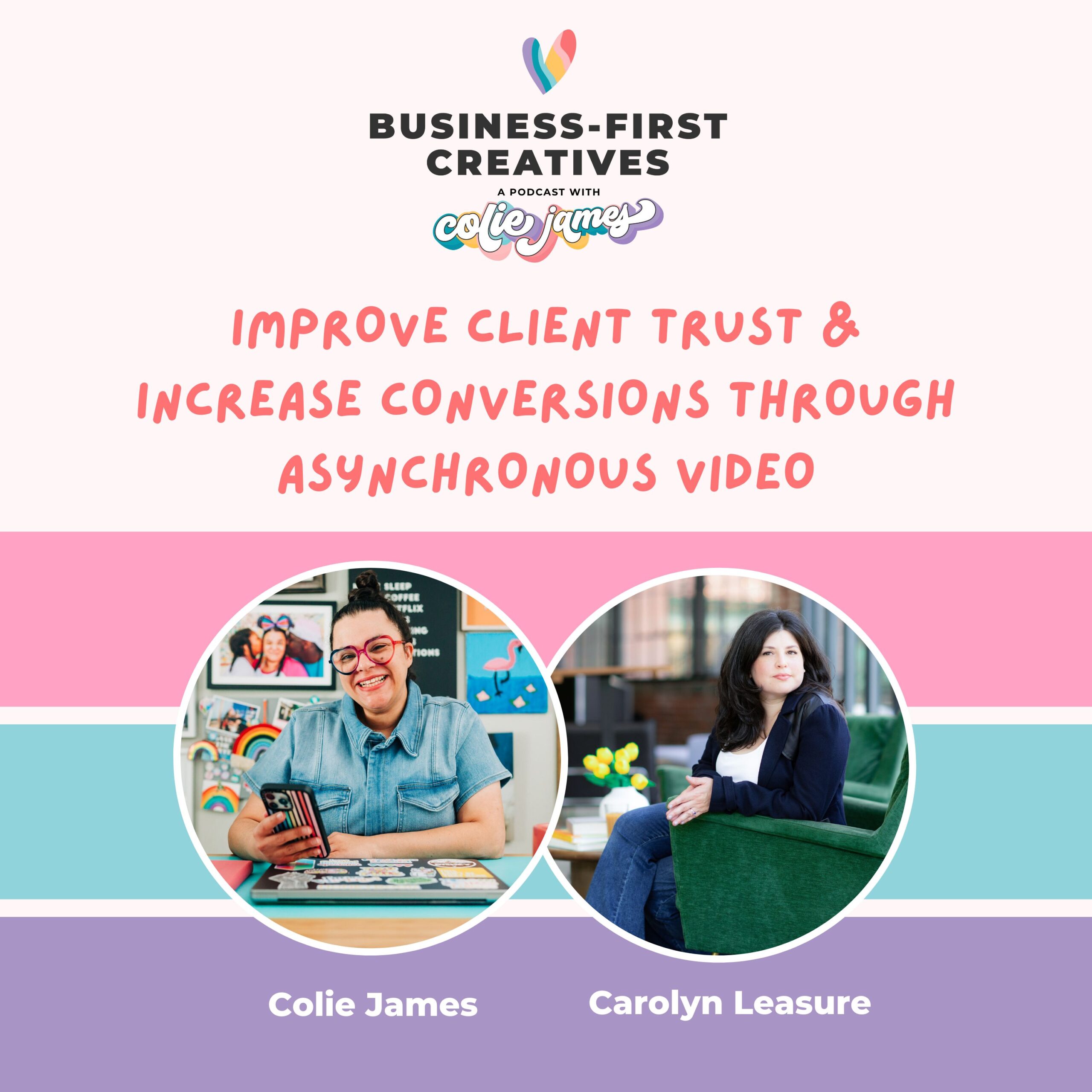


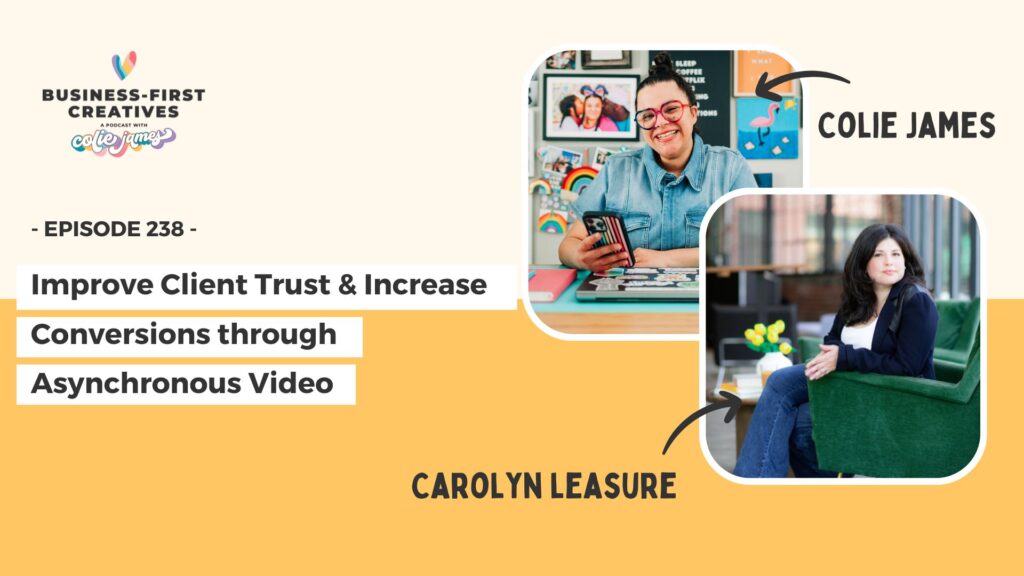
I’ve been shouting from the rooftops about using video in your client experience—and today, I’ve got backup. In this episode, I’m joined by Carolyn Leasure, a website evolution expert who turns scrappy Squarespace sites into smooth, branded systems. We’re diving into the magic of asynchronous video and how it can transform the way you connect with leads and clients.
Carolyn shares how she first implemented asynchronous video for a client and the three powerhouse ways she uses it in her own business: dynamic FAQs, interactive sales pages, and streamlined testimonial collection. We also talk about buyer behavior, zero-party data, and why personalization it the most impactful asset.
Review the Transcript
Colie: Hello, hello and welcome back to Business First Creatives podcast. Today I have Carolyn Leasure with me today, and she is going to help me talk to you guys about a topic that you know I am super passionate about.
But before we hop into today’s topic, ’cause again, it’s juicy and you’re gonna wanna get a pen and paper, I promise Carolyn is gonna tell us a little bit about who she is and who she serves.
Carolyn: Thank you so much for having me. I’m. Super, super sick to be here. I love your podcast. I
Colie: Oh, thank you.
Carolyn: So my name’s Carolyn Leasure. I’m a website evolution expert. So I turn scrappy starter sites in Squarespace into, seamless branded systems. I work with solopreneurs, service providers, coaches, and my goal is to create websites that charm the pants off visitors and work their butts off behind the scenes.
Colie: Yes. And guys, we’re not really gonna talk about websites today. I mean, we are, but we’re also not, and you guys know website designers are like some of my favorite people because I think that every business owner needs two things. A website and a CR rep. And if you have those two things, you can make anything happen.
Carolyn: For sure I use both.
Colie: I know so. What Carolyn is here to talk with us about today is asynchronous video. Now, at the time that this episode airs, it actually hasn’t been that long since I got on here and did a rant about how you can use videos inside of your client experience. But when Carolyn sent in her submission to be on the podcast, I was like, absolutely yes.
When can you come talk about this? So, Carolyn, I want you. Kind of take me back and talk to me about the very first time that you introduced asynchronous video into your business.
Carolyn: So I actually used it for a client before myself. And I think that. For me, helping my clients through creative problem solving is like my favorite thing ever. In time and time again, I saw a few conflicting issues with the way that we think about websites and with my client’s website redesign. So one is that a big problem is web and websites don’t convert, right?
Another big issue is that audiences want customized content and people are concerned with data privacy and business owners don’t have a lot of time ’cause they’re doing too much manually, as you know, because. We’re all about automations. Um, So for my client, she was having trouble converting on her sales page and I saw an opportunity to have a more engaging sales page to build trust and authority with her visitors, to help, her visitors have a more kind of customized journey.
And so that’s the first time I ever used it and it’s, uh, still up today.
Colie: Okay, so I have a question about that because you and I know that we’re gonna talk about video ask, which is a tool, but I want. I specifically ask for the client that you initially put asynchronous video on the website, was it a static video or was it something like video? Ask.
Carolyn: It was video s Yes. We were looking for an alternate pathway to talk to the different types of website visitors, which we can get into. For a lot of my clients and for a lot of people talking with them and having a, a conversation is a much more effective way to like build that trust than to just have a static page.
So yeah, we had a video asking, it’s working really well to this day. Yeah.
Colie: Yeah, I mean, I like to think of it as all of us introduce our offer. To clients in some way. And even if they’ve, you know, been on your website and they’ve seen a pricing page, investment page, services page, whatever it is, you still have the opportunity to kind of introduce the offer to them when they inquire about your services.
And so that was where I was talking about asynchronous video before, whether you have, you know, a static process where everybody gets the same video. Or if you are actually taking the time to make like a very quick, customized video to all of your leads, which not all of us have the time and capacity to do that, but. Doing that can help you eliminate a sales call if that’s, you know, where you’d like to go with this, but it also helps you build trust. So now I wanna talk to you about how you are using it in your business.
Carolyn: So I use it in my business in so many different ways ’cause I love it so much. Um, one is that, on my sales page, for my signature offer, I have like a little mini FAQ. And so it kind of, I, I have my regular sales page and then I have a VIP tier. And so when you go to the VIP tier, you can click it and see me talk and find out information about your specific needs.
So I can ask, what are you struggling with most? And I have four options they can choose from. And based on what they choose, I can give them another video of me. Describing how we can fix that and what might work best for them. And then we can go from there to them answering me with the video, answering the email audio.
So that’s one way. Another way, which I have a, a link for, the audience today to take my quiz, which I love. It’s other interactive content, but at the end of my quiz, the ending page actually has a video ask embedded based on the results that they get.
Colie: Oh.
Carolyn: They’ve taken the quiz, we know what their answers are, it’s providing value.
And then on top of that, the video will explain even more information about their answers and then give them opportunity to ask me questions, whether it’s multiple choice, whether it’s, you know, audio, video typing, what have you. If people respond, there’s the ways that you can use video ask where it’s multiple choice, which is a lot an easier lift when you have a cold audience. But in emails to my clients, or if they’ve responded already once, then we’ll start getting into a video conversation that is almost like a pre-discovery call.
It gives them information they need to. Get on a call with me or to understand what they actually need in their business. And it gives me information about what my audience is actually looking for. So there are three ways that I really see video ask being super effective for the people that I work with.
And that’s dynamic. FAQ pages, interactive Sales Pages. And then also the other way that I use video ask, which is for gathering testimonials. Because I can make it really easy for my clients after they’ve worked with me to provide information in a way that’s super engaging to people who, visit my site.
And I don’t use reels, but you can then use them for reels. You can use them for stories and, that video testimonial packs so much of a bicker punch than just reading text. And I don’t think it should replace a written testimonial. I think both have their purposes. But, the video testimonial collection is.
Super helpful with video ask because you can use logic to kind of send someone on a different path based on what their answer is. I love it.
Colie: So I wanna recap the three ways that you just said. ’cause I wanna dive into each one of them individually. So the first one that you mentioned was a dynamic FAQ page. The second one that you mentioned is a dynamic sales page, and then the third one that you mentioned is testimonials.
And the really funny thing is those three are not the ones that I’ve talked about on this podcast before. So I want to dive in to this idea of a dynamic FAQ page, because I. Recommend that everybody have FAQs all over their website. I mean, you can have them on each of your services page. I actually tell everybody, you should have FAQs in your Dubsado proposals, your HoneyBook Smart files, and I always get this, but I have FAQs on my website and I’m like, yeah, they don’t serve the same purpose.
FAQs are important, but mine are static. And so I’m really excited to hear more about this dynamic FA Q page. So what does this look like, in context? Like I go to your page and you have FAQs, but what does it mean to be dynamic and how are you specifically using video Ask?
Carolyn: This is, this is a great question. I do not believe that a dynamic FAQ should replace a static FAQ because people like to consume information in different ways. But I think it can be a great. Alternate pathway of people who want that customized experience. So a lot of websites you’ll find chatbots, but I hate chatbots.
I find ’em really impersonal. When I go to a website and there’s a chatbot, it automatically seems super corporate and. Impersonal, even if the other person, even if somebody answering it on the other end. But people expect like real time info. Traditional FAQ pages, I also use them all over my site and I also use ’em in my proposals.
I love them, but they’re one way streets and people might not actually be able to find the information that they need, especially because people don’t read websites. They just give them. And people might have follow up questions that static pages can’t answer. And on top of that, there’s a chance with video to build that rapport through answering calls.
So. How dynamic FAQ works is that you have interactive multiple choice FAQ, where somebody, you have a video of yourself talking that’s prerecorded, and then they can use buttons to go on their own journey to ask the questions that they need to. They don’t need to use video, but they can. And then you can use built-in logic to allow them to ask follow up questions based on their initial responses.
So it’s. Again, a pre-discovery call. You can have your little widget right next to your FAQ or at the bottom of your page and allow people to kind of go through their own customized content you can use an ending screen to direct them to book a call, sign up, ask more questions, whatever it is.
One thing that I really love about Dynamic FAQ is that it is market research, right? So someone comes to your website and they look at your FAQ, you have no idea what’s actually important to them to find out about. But with the data that you can get from video ask. You can use that in your emails or social media.
Create additional static F aq you’re gonna address where your audience needs more info, which I think is super helpful.
Colie: What is super interesting is I did, I had absolutely no idea where you were going with this dynamic FAQ, but I realize now, that is what I do using Convert Box. So I just wanna give an alternative for anyone who’s listening. So video ask is very video driven, even though you can, you know, have multiple choice and you don’t actually have to have a video.
Like, literally it’s called Video Ask. And so I feel like some people are like, oh, but I don’t wanna be on video now. No, no. But convert box is like a pop-up software and you can do the same kind of logic pass that you are talking about. And while it isn’t created to have video, you can embed videos. And so ultimately the final result can be the same.
And listening to you, I was like, I should have videos on those. So how I’m using it is not for like dynamic FAQs, but on my podcast page for example. I have a little popup that says, you know, what are you interested in learning more about? And I have categories and one of them is websites. Hello Carolyn.
This will probably end up on there, but if they click that websites are like the topic that they wanna learn more about, the next page or the next screen rather shows them episodes. From the podcasts that are related to that now, I could just as easily, if they choose an episode, I could actually have the next screen pop up with a specific Apple Link Spotify link and have a link to the YouTube video.
So that’s one way that I could use it, or it could be videos of myself, but I wanna come back. Because you said that, you know, when they click on it, it’s a video of you talking and then they’re choosing multiple choice. So I wanna get like real specific here, Carolyn, when someone first clicks on that button, what is the content of the first video?
Like what is it that you are asking them to answer with the multiple choice answer?
Carolyn: So this is a great question and there’s many different ways that you can do it, but I have my own recommendations. I think that a video of you or of me, whoever it is, the business owner, is really impactful because it’s creating that relationship, which I believe is what truly. Moves the mark, you know, creating those relationships.
That’s what I love in my business is creating relationships. So the first thing they see when they pop it up, it can either be a little button that they make bigger, it can be a little screen that everything is lined up and they see it all to begin with. They’ll see my face, they’ll see your, your face, they’ll see us talking.
And then you can say simply as, what would you, what questions do you have? And then you can give multiple choices. Now, we want it to be, there’s a couple reasons that people leave websites, and one of the big ones is when it’s not. Mobile friendly. So we want, you don’t wanna give, you know, 10 options in multiple choice for that first video because it’s not gonna be mobile friendly.
I usually give like the main categories of like, I wanna know more about pricing, I wanna know more about timeline, I wanna know more about deliverables. And then from there they’ll go to the next screen using logic and we’ll get more granular from there. We’ll answer questions as we go along through talking. And again, you can direct ’em somewhere else at the end, be like, here’s more information. I like these to be somewhat static because I do not have time to go in and edit everything and put new content in there.
I, of course, like when an offer changes, you have to mix things up, but I try to have my videos be more evergreen. Just rerecord when I’m answering. When the answered your questions changed for the FAQ.
Colie: so I wanna hop on pricing and here’s why. I have recently done an episode on this podcast listening audiences linked in the show notes where I basically said, the worst thing that you can do is present people with pricing and no context, whether it’s in an email or on your website. Like I personally hate pricing.
Pages like I think your pricing should be on a services page where you are talking about the value, you’re talking about the process when you’re presenting them with these prices if you choose to show your prices. But this is really fascinating to me because what you’re saying is the first screen of your video ask is, you know, how can I help you today?
What would you like to learn more about? And if they click pricing. It goes to a second screen where there’s another video about you. What would you be saying in that video, and what kind of options are you giving them? Because this is so fascinating to me, because yes, you’re gonna give them the pricing, but they’re hearing you talk and you have the opportunity to present them with whatever it is that you think is important before they actually click and see an actual number.
Carolyn: Yeah, and I completely agree with you I would not necessarily have this kind of FAQ unlike my contact page, for example, but on a specific services page, it makes so much sense because they’re there to learn about that service. They’re gotta learn about that offer. And you can really tailor your FAQ to the specific, you know, service offer, whatever it is that you, they’re on the page for. And again, people consume information in different ways, so you might have this question answered somewhere else and somebody doesn’t see it. So when they ask about pricing, using video gives you an opportunity to not just say a number, but to give them background about what they might find elsewhere. Why it might be worth paying a specific amount for this service. The deliverables that included the timeline and some of it’s intangibles. One of the things that my, and in testimonials and video testimonials I find out that my clients like most about me is that I make the process very easy to understand I don’t use tech language.
I take a lot of the overwhelm away, and that’s really an intangible. But when you’re talking about pricing and saying. How much time are you gonna get back because of X, Y, z you. It gives you an opportunity to really dig into not just a number, but everything around that number. And again, on my regular contact page, I wouldn’t have an F AQ about pricing there unless it’s a specific offer.
So I’m with you on that.
Colie: Okay, so I mean FAQ, like check. The second one that you mentioned is a dynamic sales page, and. I have quite a few sales pages because I have quite a few offers. You know, of course it’s one-to-one done with you, whatever.
What kind of video ask would you place on a services page or on a sales page, and what kind of impact do you think it makes on the person who is reviewing that page?
Carolyn: So I think that we have to talk about the different buyer types for a minute. And the way that people might use a website and a sales page. So one, there’s readers who want every single detail, and that’s like, that’s me. I’m gonna read every single thing on your sales page, as long as it’s not fluff.
Then you have skimmers who are focusing on headlines, little call outs, bullet points, et cetera. And there’s visual learners and those are more the kind of visitors who want like examples, charts, previous work, like if your portfolio and then watchers and listeners who want .
Video explanations, testimonials,, et cetera. They want like more of a, vicarious experience. So again, I don’t think that a video ask or any other platform you find that does this is going to replace your sales page, it’s gonna replicate it. So it’s gonna take your existing sales page structure and put that in the logic-based interactive video.
And again, those multiple choice options can guide visitors to exactly what they need. Straight from your beautiful face. It’s personal connection. It’s building that trust and they can self-select their journey. So Based on one person’s path. What they’re looking for. You can personalize your follow-up communication. So I, I was listening to your podcast about, proposal follow-up sequence.
I updated mine ’cause you, you said
Colie: Yay. I like when people take action.
Carolyn: So you personalized an email to talk about how you can solve their specific problem, what things will look like on the other side. Right. But using it on a sales page gives you great pre-discovery call intel. To what they need specifically, so you can personalize the emails that you send maybe prior to a discovery call or if they haven’t booked a discovery call yet.
And I, I wanna pause for one moment because this is all about using data and using information that people give you. I am a big fan of what’s called zero party data, and it sounds very cold and boring, but basically all it is is when people give you information that they’ve chosen to give you. And I think with data privacy.
Concerns which are a rising higher and higher. I would much prefer to get information that someone willingly gives me and we’re creating our relationship, through them asking questions and me providing value rather than like a Facebook pixel and like no shots. People have to use Facebook pixels.
I get it, but I think that this is the future,
Colie: So let me take you way back, Carolyn, to like 2012. When I first started my business as a photographer, I was one of those people that built my very first website very intentionally. And I would look at what people did individually in the backend of Google Analytics to see. And so if someone got on my website.
I saw that they then checked out the newborn page and then I saw that they checked this out and then I saw that they clicked the contact page. I would literally just be counting in my head, okay, so how many days is it gonna take before they, you know, fill out the contact form? So I was one of those people who, you know, data privacy, I get it, but I stopped the shit out of my clients back
Carolyn: I use Google Analytics, please. We need it.
Colie: Well, but now with data privacy, you can’t get that same level. Like if someone fills out my contact form, I actually have no way to see what kind of path they did on my website because of data privacy now. And so this is absolutely fascinating to me because I can actually see. What were their responses to these questions?
And like you said, it will help me make a more customized experience if I get on a sales call with them, you know, a consultation call, whatever it is that we’re calling it today. Um, I will have information about what they need. Without them having to actually detail it to me, because sometimes the person doesn’t know what’s important to communicate, and so if you are very thoughtful and very strategic in the way that you are answering these questions. Yes, you’re giving them guidance, but it is also giving you guidance that they may not have been able to communicate to you if you just straight up ask them a question and ask them to answer it.
And so we do have a lot to learn from, like the path that people are taking on these video asks. My email course actually came from something very similar. I told you about that popup box that I had. I have one on my homepage that says, what’s your biggest systems headache? I have options and I can tell what people, and of course I get drop off, like, you know, if it’s four questions, five questions, not everybody gets through all five questions, but knowing how many people were clicking and saying that they were struggling with ke, keeping up with their email communication with clients was what prompted me to make a whole course.
So this kind of data is
Carolyn: yes, yes. If somebody were to email me back something very specific about the pages they saw me, or like using their Facebook pixel or using whatever it is. I would be creeped out.
But if I give them that information, I want them to give me customized information. Same results, much different relationship. And I also, yeah, people are gonna drop off. Not everyone’s gonna do this it, but people do choose to take this path, it is just a wonderful resource for both the client and for me as a business owner.
And I can feel like I’m offering consent to my website visitors, rather than just, you know, peeking on what they’re doing. All the information that you clean can be used in developing your business as well as customizing. And I, sometimes, I don’t customize what I send to, a quiz taker or in, in terms of an individual email.
Like I have customized sequences. You don’t have to, everyone’s busy. Not everyone has time to do all that, but you’re still getting information from the potential client. And I can respond with a quick little video, much more easily when we start the conversation through. Video, whether it’s sales page FAQ, what?
Yeah.
Colie: talk about that third use now customer testimonials because, I feel like if you are not currently asking for testimonials in your business, you’re really missing the boat. Not just for. Using it for social proof. I think that collecting feedback and testimonials and reviews is like the best thing that you can do for your marketing materials.
Not in sharing the testimonial, but in knowing the language that your customers are using. When you’re putting the copy on your websites, when you’re putting, the copy inside of your Dubsado proposals, your booking templates, if you’re using language that your clients are using, they are going to be more likely to convert, but you won’t know.
What they Googled. You won’t know what they’re saying about you. You won’t know their language if you don’t ask. And one of the things that happens when you ask somebody for a testimonial is they have absolutely no idea to say what you know, what to say in response except, oh, Colie was great. You should hire her.
Yeah, that doesn’t help anybody. And so creating this kind of customized experience I can imagine can only get better when you do it in video ask. Now I’m gonna admit I have a video ask for testimonials, and I don’t actually remember the last time that I sent it out. So again, Carolyn, I need to, you know, do as I say.
Mm-hmm. Uhhuh so well, and you know what it is. I like you. I was like, oh, these videos are a little outdated. I need to update them. Because originally I stopped sending them because it was asking about their one single VIP day, and then I wasn’t doing that anymore, so I stopped sending it. But now I’m back to doing single VIP days.
So maybe I can just start sending it again and pretend that I never had a pause. I don’t know. But. Let’s talk about how you are using the customer testimonials in your business. So, um, what’s your process in order to send them out and what kinds of questions are you asking them inside?
Carolyn: So you’re spot on with just asking someone to write a testimonial isn’t going to help other people understand how you can help them. It’s not gonna help you get information about how you help them, all those things. So, I use Notion for my, client dashboards. I actually integrate Dubsado and Notion together, it allows me a lot more freedom.
So in my, client dashboard, they’ll have a timeline of everything that needs to be done. And I have a page in there that first asks a couple questions just to let them write out their answers first about working with me, and then there’s a, I embed my video ask in notion, but you could do this a million ways.
You could embed it in an email wherever you want. And then that allows them to. Give me a more to to use video and not everyone’s gonna do video. Some people just write it, it’s fine. Some people don’t do testimonies at all because they’re busy. I’m not saying it’s gonna be a magic solution, but some people will prefer it and it will help in multiple ways.
So I wanna, I talked about how I deliver it. I wanna talk about what I ask, and then I wanna talk about what I do with afterwards because that’s also really important. I use guided questions. One thing that is important in testimonials is showing the before and the after so that someone else who is reading the testimonial or watching it can imagine themselves in that situation.
So I always ask them, and again, for my own information, what made you choose me? Did you have any objections? And then what helped you overcome those objections? Although I ask it in. More lay person’s
Colie: A nicer way. Yes.
Carolyn: yeah, exactly. I ask them what the experience is like working with me, what results they’ve seen, and I don’t use logic with this necessarily.
But it’s a very, structured, guided way of giving feedback.
I think that it’s really helpful when I share it on our website or in emails because it, again, it builds trust like we have. So much fake stuff online. Seeing a person actually talk about the services they receive from you is a trust builder. It captures the emotional connection that they have, and it serves both readers and watchers and listeners.
I, once I get a video testimonial, I do a couple things. So video ask comes through in like. I if I, if you ask a question and someone responds, yeah, it comes through in chunks. So I actually have it con, this is advanced level. I actually have it connected to a database in notion where it all comes in as written copy as well, so that I can then use that.
Text, written text in a testimonial version. And then I’ll edit videos where I’ll make a short form testimonial and I’ll make a long form testimonial. And you can create a library of repurposable content. You can use a longer video testimonial on sales page, a short one in reels, et cetera. So I, and I’m able in notion with my database to, to mark where I’ve used that video, if I haven’t used it yet, what date it came in, et cetera, et cetera.
Colie: Yeah, so for myself, one of the reasons that I actually stopped using video Ask as well is because I just started inviting my clients on the podcast.
Carolyn: Oh yeah.
Colie: Once the podcast was like my thing, I was like, Hey, do you wanna come on? And when I invite them on, it’s not just, Hey, I want you to come on so I can, so you can gimme a case study.
Some of my episodes were like that, but others were like, no, I mean, I wanna talk about your expertise and I’m also going to talk to you about working with me at the same time. So that, you know, the podcast is not just a, oh my gosh, this is how Colie helped me. You know, for the whole thing. You’re still learning something.
From my clients, but also at the same time, there are chunks that I can, as you said, take out to put on my sales page, to put in a reel to do all of these things. And so that is like.
Carolyn: It is so
Colie: But I can only do it because I have a podcast. Now, before I had a podcast, I did actually do Zoom interviews. They were only like 15, 20 minutes.
And I think part of it is that was really beneficial for me in the beginning because I didn’t quite know what to ask them. And so in the interview, like when they said something, it would prompt me. To ask a different, you know, to ask a follow up question. And so now I do feel like, you know, after I’ve helped over a hundred people do these things, um, at least for my one-to-one services, I now know what questions to ask and maybe what the logic would be if I was gonna create something like that on video ask that was a little bit more in depth.
But in be in the beginning, doing the interviews live really did help me get a sense of, oh, well, I asked them this. And I expected them to say this, but oh, they said this and no, let’s follow this trail. I’m, I’m all about breadcrumbs, Carolyn. I
Carolyn: I, I mean, that’s such a great approach. That’s such a great approach because it really is, it’s a literal con, literal conversation. And that actually, even if you’re using video, ask if you’re using written testimonials. If your client hasn’t. You know, jumped on and gimme the testimonial. You gonna schedule a Zoom, be like, Hey, let’s just talk for 15 minutes.
It might be easier for that particular person to just like, you know, shoot the shit for 15 minutes instead of doing something that’s like, requires them to, you know, go through a process. Everyone has different ways that, giving information, getting information, they, everyone processes it differently.
So I think that I love that approach, especially when you don’t know questions to ask yet. Uh, and then moving to video ask or. Offering all of them. There’s one thing I forgot to mention that I do have at the end of my testimonial video ask. So I am a big, you know, fan of SEO.
And at the very end and the there, I use logic for one thing I’ll say, if you wanna do a little extra, here’s the link to my Google business page, and it’s not the link to the page, but it’s the specific link that Google Business gives you for the review. So at the end of the testimonial video testimonial, they can press that button and it takes them right to my Google business page, which, any kind of reviews there help your SEO.
And responding to those reviews there helps your SEO. Having that as an automation that I don’t have to manually do is huge. This shows that automation can make it more personal. It doesn’t have to be cold and impersonal. It can make it, you, you can build trust and make that connection through automation.
Colie: Yeah, and I mean, as you were talking about it, I was thinking, the way that I currently use video ask on my website is I have a button on almost every one of my individual offer pages, and it’s basically a, Hey, I would love to answer any questions that you have. It’s really open-ended, but. I just realized that instead of scheduling a podcast interview or you know, an individual, interview to do the case study, you can actually conduct it in an asynchronous way through video ask.
Like if you ask them a question and they respond, and then eventually you listen to it and then you’re like, oh, well this is my follow-up question, and then you can send that back to them in video ask, and then they can answer again. I mean, I love the idea. Of having it done with logic, but for those people that are like, okay, I don’t know what to ask, something like this can still be used to do it asynchronously to where, you know, not everybody has to figure out a schedule and get together, but you can still get that really powerful voice of customer data, so that you can use it in your marketing, you can improve your own services, you can slap it on your website, whatever it is that you’re gonna do with it.
Carolyn: Yeah, and I think that, to your point when. When we’re talking about having clients respond via video, when they’ve already worked with us, you have a much higher level of buy-in. But if you’re using something like, interactive AQ or a dynamic sales page, something like that, and someone is a cold, for lack of a better word, a cold lead, they’re much less likely gonna be like, oh yeah, let me send this person a video.
I mean, I have seen video ask from people’s websites and I’m like, no, I’m not gonna send them a video.
Colie: You
Carolyn: no, no, no. Don’t perceive me. Um, so, but, but having that multiple choice and having you answer with video with a cold lead is like a great start. And then with someone who’s been a client or a warmer lead, like they’re gonna make that jump to responding with video so much more easily.
Colie: Yeah, and I, you mentioned a chat bot at the beginning of this conversation, and I wanna make sure that everybody knows the difference between like a video ask and a chat bot. ’cause you and I do, but I will say. One of the really nice things about video ask, we kind of alluded to it, but neither one of us actually specified it.
In video, ask the person who is sending you the question, the request, whatever it is that you wanna call it, they have three options. They can write you a text. They can leave you an audio voice note or they can make you a video. And so one of the really great things is that there’s all three of those and everybody has their preference on what they like to do.
But what I have found absolutely fascinating, is almost everyone sends me their first message as a written message. Then when I respond with a video, I would say that it’s about 60 or 70% of people respond back with a video. Some of them do an audio, some of them still choose to write a text, but like 60 or 70% of them.
The second interaction, they’re sending me a video, and then we’re just kind of, you know, volleying back and forth with these videos where I’m just making sure that they are getting all of the information that they need in order to decide if they want to take the next step. Whatever that would be. So if you are scared of video or if you don’t think, uh, no, that’s not for my clients.
They’re not gonna wanna send me a video that is not required.
Carolyn: Right. And I think for in my, in the work that I do, I feel it’s really important to meet people where they are. So whether that’s like the way that we onboard, whether it is how they’re going to view a website page, how they wanna respond to. The video ask to give them. You can determine when you’re making it if you only wanna offer one option, but I always offer all three, or again, that multiple choice, which is just makes it really easy
Colie: in a button.
Carolyn: forward.
But yeah, I think that, um, I’m, I’m with you. Most people don’t respond via video at first and then eventually do, and it’s creating a relationship, but in a way that work to people’s schedules. Like that’s the wonderful thing about asynchronous. Communication like this. And we use a asynchronous communication all the time.
Email is asynchronous. Communication like slack, you know what I’m saying? But I think that video is, something that would make something that makes businesses stand out when they do start incorporating that asynchronous video.
Colie: That is such a good point, Carolyn, because I feel like yes, email is asynchronous, but there’s a lot of tone and context that gets lost in the written word. And so that is one thing that I wanna say about me feeling comfortable sending these videos or even sending voice notes, that gives them one more point of like connection and I think.
I think I’m a pretty good communicator when it comes to, you know, oral and making a video. I don’t think that you misunderstand my intentions. Now, I also take a lot of time to make sure that, all of my emails that I’m sending for client communications, you know, are even keeled. And if I am feeling a little hot at the moment, I make sure that the email doesn’t include, you know, that, so that it could be misinterpreted, but.
That is so much easier when you are doing voice notes or videos because they can see you and even if what you said may have been perceived as rude or curt in an email, if you’re smiling while you’re saying it, it’s very hard to misinterpret tone.
Carolyn: Yeah. And I think that. You know, I can be very direct and sometimes in the written communication it comes off as direct. And the video, again, like smiling and laughing, you can make jokes that you can’t make in an email because can’t tell tone. And building that rapport is something that I really like.
I like to make sure that people that I’m working with are aligned with me. We have a similar, we have a communication style that works. We want the same things, and it’s just a shortcut to that. Um, and again, I don’t think it should replace. All the written word by any means, but I think as an addition.
Colie: It is, it’s an awesome addition. Carolyn, this has been an awesome, awesome conversation and I’m so happy that you dropped into my inbox, to invite yourself on my podcast. So.
Carolyn: myself anywhere.
Colie: Uh, if you could tell the listening audience where they can find you on the internet, because I mean, there are bound to be some people who are Squarespace people or just wanna see your whole video ask process, you know, live.
Carolyn: Yeah, that’s, and I should say that because I am a website evolution expert, I work with businesses that have kind of outgrown their current web presence. I take a lot of people from other platforms that they’re struggling with, like. This is my second career. My first business was at brick and mortar. I had a WordPress site and it made me wanna tear my hair out.
So, not to say that everyone’s having that experience, but if they wanna move from Wix or WordPress or whatnot to Squarespace, that’s something that I do regularly.
Colie: Didn’t say show it.
Carolyn: I have a lot of opinions about show it.
Colie: I’m sure you do. I
Carolyn: But
Colie: die hard shallot fan.
Carolyn: you know what, everyone has what works for them and I love that. I love that because so many people, I mean, I, I was talking to someone who’s a social media expert and like I personally really do not like social media because of what it does to me internally.
But other people love it and that’s great for them, like no shade. Um, okay, so you can find me in my website, which is may pop creative studio.com, or if that’s too hard, you can go to May pop.studio. I actually have a special page for your listeners, which is may pop creative studio.com/ Colie. And you can find there, I have a website evolution quiz, which helps you figure out your next website move, whether it’s like strategy design systems, how you wanna start, if it’s template, DIY, all those kinds of things.
It asks you, I think, eight or nine questions on multiple choice to help come up with like a plan for you. And if you take that quiz, first of all, you don’t have to get on my website because I am all about consent. I believe in consent wholeheartedly. You can just get the results, but you might, you’ll be able to see video ask at the end of my quiz so you’ll be able to see it in action.
Which is pretty cool. Um, yeah, so you can find me there. May pop creative studio.com/ Colie.
Colie: Okay guys, I’m about to go take the quiz, so just so you know, you should too. Carolyn, thank you so much for joining me today. I super duper appreciate it.
Carolyn: This was a blast. Thank you.
Colie: All right guys, so what I hope that you have gotten from this episode is that I am not the only one that loves using tools like video Ask asynchronous video inside of your client experience.
I think that as we progress. To using more AI to write our content for social media and our emails and our website copy, and all of these things. Video is still like a way for you to personally connect with your clients and your leads that are visiting your website each and every day. And so I just want everyone to consider what can video do for your client experience.
All right. That’s it for this episode. See you next time.
LISTEN ON YOUR FAVORITE PODCAST PLAYER
Apple Podcast App | Spotify | Amazon | Youtube
Meet the Guest
Carolyn Leasure, Website Evolution Expert, turns frustrating starter sites into sexy systems that work better for everyone. At Maypop Creative Studio, she creates beautiful, seamless sites that do the heavy lifting. Because she believes that your brand, design + tech should work *for* you – not the other way around.
Carolyn calls the mountain town of Charlottesville, VA home. When not constructing seamless automations or copy-driven web design for clients, she can be found playing Himalayan Sound Bowls for a meditation shortcut, or splashing and whooping down the Rivanna River in an inner tube with her husband and two sons.
Find It Quickly
00:27 – Meet Carolyn
01:30 – The Power of Asynchronous Video
04:24 – Implementing Asynchronous Video in Business
06:59 – Dynamic FAQ Pages: Enhancing User Experience
15:40 – Dynamic Sales Pages: Personalizing the Sales Journey
20:11 – The Value of Client Feedback
21:36 – The Power of Customer Testimonials
23:20 – Collecting and Utilizing Testimonials
26:13 – Leveraging Video for Client Interaction
31:14 – Asynchronous Communication Benefits
Resources Mentioned
Connect with Carolyn
Website: maypopcreativestudio.com
Quiz: maypopcreativestudio.com/colie


Signature Series


Your business works, but your backend is costing you.
A 4-Part Audio Series for service-based business owners who are ready to upgrade their “just fine” client experience, unlock higher pricing, increase referrals, and grow more sustainable revenue—without overworking behind the scenes.
Get the FREE 4-part audio training series
Systems That Sell


© 2022-2025 Colie James


