
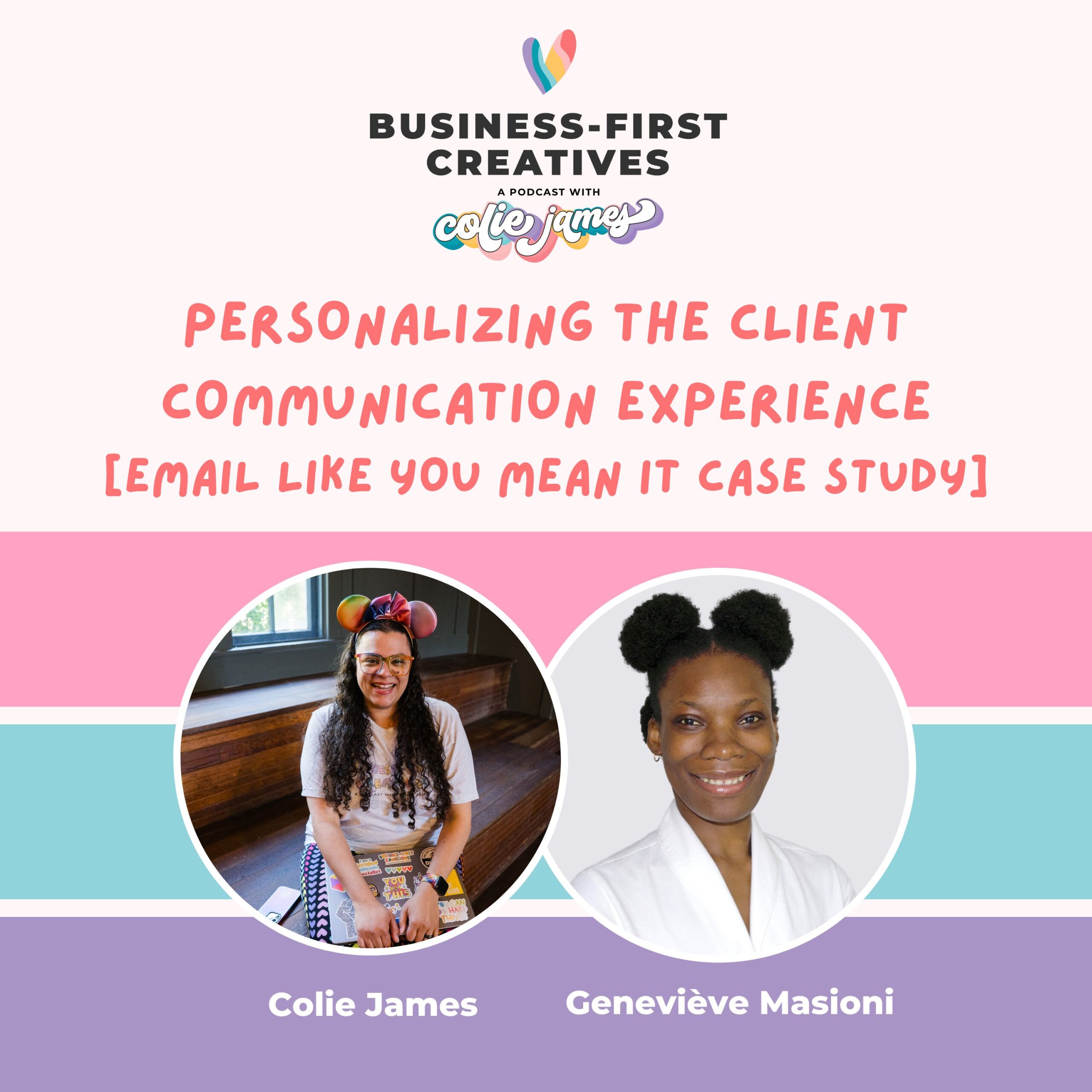




Genevieve didn’t know this when she said yes to coming on the podcast… but Email, Like You Mean It was basically made with her in mind. 😂 Because here’s the thing: she’s been in my audience forever, she’s wildly smart, and she wasn’t using the tools I normally teach (Dubsado or HoneyBook)… which meant I had nothing to sell her. And then I built a client communication course, and suddenly I was like, “Ohhh. Now we’re talking.”
In this episode, Genevieve breaks down exactly how she went from writing emails from scratch (like… 50 minutes per email, which is truly unhinged) to building a mapped-out client journey with 27 strategic emails, better boundaries, and an offboarding process that quietly prints money. And the best part? This isn’t theory. It’s a real-life case study of what happens when your client communication stops being an afterthought and starts doing the heavy lifting.
Review the Transcript
Colie: So you may or may not know, I have a client communication course called Email, like You Mean it. And while today’s guest, Genevieve doesn’t quite know this, I literally created this offer for her. And let me explain. Genevieve has been in my audience for quite some time, but she is not a Dubsado or HoneyBook user.
And so for the longest time. I had absolutely nothing to sell her, and when I started this focus on everybody needs better client communication, I did get really excited because I thought to myself, yes, I’m finally selling something that Genevieve can buy. Genevieve, welcome to the podcast.
Geneviève: thank you for having me. Hello everybody. And hello Colie.
Colie: Hello girl. So I’m going to admit this guys. This is a case study episode. She is gonna be telling you basically how she took what I offer in the email, like you mean it and revamped her entire client communication library. But I wanna say we’ve actually already had this conversation one time before.
When people enroll in email, like you mean it, in the beginning people got a 30 minute audit call where you could hop on and you could bring your emails and I would, you know, give you feedback and help you write some more and fill in the communication gaps. And when Genevieve got on her call. She literally took the entire 30 minutes to tell me how awesome the course was, and unfortunately, the audio quality on that call was so bad I could not reuse it.
Now, don’t get it wrong. I took the transcript of what she said and wrote the current case study that’s on my website, but I am excited to actually talk to her because Genevieve brought up things that like I thought. We’re like the smallest parts of the course, and they’ve actually ended up being the parts that she loved the most.
So, Genevieve, let’s talk about your client communication before the course. What was your biggest struggle with communicating with your clients? I.
Geneviève: Um, honestly, I think, yeah, just, just like everybody, it was just writing the same emails over and over again and I had like a really long, note like Apple notes, like file with like all my kind of templatized, emails. So, because I was trying to still, make them. To systematize like
it, uh, a little bit more.
But yeah, it was, I was just writing everything from scratch. And I actually timed, myself uh, you know, writing emails and current communications. They were taking me so much of my time when working on projects, and I noticed I never spent less than 50 minutes writing an email, which is crazy.
Colie: Mm-hmm.
Geneviève: like 45 minutes because I’ve, I’ve been over overthinking stuff or trying to find the links that I need to send. It is just, yeah, it was all MA manual and quite, um, time consuming.
Colie: So you had information centralized in an Apple Notes, but you didn’t actually have them organized, like they weren’t written as templates inside of A CRM, which is usually what I recommend.
Geneviève: No they weren’t. So it was still better than, because before I was like usually trying to, to write from scratch. I didn’t even, attempt, you know, to had an idea to centralize them in at least Apple Notes and have like a, okay, this is what I typically say to this kind of messages. But then I did that, it was already like a big step for me. So like it was, already like, improving and, my interest experience communicating, communicating with clients, and also being consistent in the things that I, I send, because I would forget before I had even just up note, I would forget, oh, I need to, you know, how many links or what I need to send them, or like the information that I need to, to tell them. So it was already like the, the, just the first step, but then yes, it was still not, quite there yet, you know?
Colie: So before, let me ask you, did you actually map out your customer journey, which is what I teach in the course. Did you do that first or did you just automatically jump in and start writing any email template that came to mind? What did you do first?
Geneviève: What did I do? Like, you know, to be, to be honest, I did exactly what any student would do and I, I jumped right in and tried to, to write, you know, my, client communication, like emails, and then I kept, I get hitting a roadblock because you can’t write when you don’t know where you’re going, when you don’t know what you’re supposed to send.
And so. After some time, wasting some time, you know, trying to do that. I just went back and followed your recommendations, start with the client experience first. So I, I used your GPT for that, the client experience, GPT, and yes, we went through the entire, process, with the, together and into the very end of the conversation.
And I was actually quite surprised where the, you know, GPT sub told me, oh yeah, that’s it. You know, we’ve mapped everything and I had like the. The list of 27 emails that I needed to write for every single ca, you know, um, use cases. And from then I used another TBT to write those emails.
So yes, I end up, you know, following your recommendation, but I started, by jumping right in.
Colie: That’s okay. Genevieve, you saw the air of your ways. Now this is part, we didn’t talk about this before, so I was curious. Okay, so you used Clara, which is the client journey GPT and you, you mapped out 27 emails. Was there anything that was surprising? Because I know when you and I hopped on that initial call.
You were like, you know, you were mentioning emails that were in that messy middle between like, booking and when you actually, do the service and then after you started the service to delivery, you were like, you know, you have really good examples in there for photographers, but like, I don’t know what to do.
So after I gave you the additional suggestions on, you know, telling your clients how to prepare. For reading their quiz results, I think was one idea that I gave you. Did you come up with additional touch points or was it only those ones that you and I discussed on the call?
Geneviève: I absolutely did, and it was actually, yes, the most surprising, like emails I didn’t even know existed. And they really like enhanced the experience for my clients and for me as well. I mean your GBT told me, yeah, hey, you know, this clearly has this, uh, concept, you know, about filling gaps, when you have the, a gap between two events happening, two points of your customer journey, and usually it’s, yeah, when. People are waiting, clients are waiting for something so when waiting for, even if they book the call, they, they fill out, you know, they fill the, uh, the intake form and then they’re waiting for the call. And typically for me, it’s like at least 48 to 72 hours to get, you know, to jump on a call with me. So I had an email, I. Now write an email for that. And also, yeah, when I’m working on a project, like a mid project check in, I had emails for that. I was able also to break down my, survey like feedback. Usually I have them at the end of the project, but with the GPT and I mean, first the customer journey, GPT be mapped up.
Oh, actually, because it’s kind of a long. Thing to fill out at the end of a project. So now it’s broken down to three,
like, um, mini forms. And actually they fill out the form after, you know, book. They book with me. They fill out a form to review, oh, gimme feedback about, you know, your inquiry process and booking process.
And then mid, mid project, they fill out another form and then at the end they fill out a, a form. And now I have like three testimonials from the same clients and you know, like reviewing different things and it’s just easier. Uh, and those testimonials are also more like, um, how say. Natural
sounding and less like, oh, I liked working with Jen.
She’s so, you know, it’s less like, um, academic because they’re really all, first of, especially like the very first run, I guess, it’s like, oh, I’m so excited. This is the best, you know, booking in inquiry. It’s just, we are so easy to book and, and it’s just, you know, I have a testimony before we even start working together.
So it’s really like a highlights of, um, my customer journey now and I really enjoy like receiving those, uh, feedbacks.
Colie: I am so proud of you for breaking that down into three different forms because you know a lot of us, we want testimonials. We want case studies, and I’ve said over and over again that getting your customers to talk about what they liked or even didn’t like about working with you throughout the process really helps you figure out how to talk about the process.
Strangers because, you know, a lot of us need to be able to get strangers to convert. We’re not always lucky in that the people that are hiring us know us and they’re familiar with us. And you know, we have to do a lot of discussing what it is that we do and what the value is. And so one of the benefits of breaking your feedback process down into three different like stages, if you will, is.
Nobody is gonna remember exactly what they Googled exactly what they thought. Exactly. Why they were so impressed with you when they booked you after you’ve delivered the thing. They’re gonna be like distracted by the thing. And in your case, you’re handing them a quiz funnel. You’re handing them, you know, email sequences like.
That’s the shiny object. And the moment that you give them the deliverable, they’re probably only going to remember how they felt when they got the deliverable. So one of the other benefits of breaking down your feedback process is as service providers when we deliver our clients are usually not getting immediate results. It’s not like when I was a photographer and they got the photos and they loved them and they shared them everywhere.
And that was the thing, like when we’re doing business to business in, in your case, when you’re delivering a. Quiz funnel. It’s not like you deliver it on a Monday and all of a sudden they’ve had a hundred people go through by Friday and they can actually tell you how it’s working out. You do have to check back in in order to get those additional, touch points of what happens when they actually put your deliverable into practice.
And so I love that you have three stages. ’cause I didn’t tell you to do three stages, so good job.
Geneviève: Well, your judge, your GPT told me, so
you, you kind of did.
Colie: I mean those GPTs, I, I cannot say enough good things about AI Systems squad, and honestly, I think most of the, uh, testimonials that I have on my website, I have had to not put Genevieve’s face on like every single page because, let me ask you this, Genevieve, which GPT is your favorite from email?
Like, you mean it.
Geneviève: My favorite is like the email improvements. The one, yeah, I’ve used that. That’s the one I use every single day,
uh, for
Colie: use Ruth. So guys, Ruth is the response strategist, and I told this to Genevieve last time we talked, but I created that GPT like 15 minutes before I published the course. I I, all of a sudden I was sitting there and I was like, you know what? I’m really helping them pre-plan these emails and like write these email templates.
I was like, but maybe they need a little help like in the moment, like writing those really difficult emails where a client has asked you something. You’re so frustrated with them that you don’t trust yourself to write them a response. Then as a professor, I used to do this. I had a 24 hour rule when a student wrote me a nasty email and my response to them was gonna be cuss words.
I would close my computer for 24 hours and then I would come back when I was calm. So it was like a last minute decision to create Ruth and put her on the course because I was like, I do hear from photographers when people are like. Can I get a discount? Can I get the raws? Can I get this, this, and this?
And you’re frustrated because you know that you’ve already answered that question and like they’re asking you and they’re making you say it again, and you don’t wanna be rude. So when you told me that you were now using Ruth every day, you, you say that she’s like a, a permanent tab. On your browser. Um, and that every client communication that you have written in the six months since you took the course, you use that GPT to write them.
And I was like, wow. I mean, if that’s not a great testimonial, I don’t know what is
Geneviève: Yeah, I mean, I talk to Ruth every single day and the first
thing, she helped me kind of yeah. Do was yeah, to set boundaries. And like you said, to respond in with without emotion and to also in a clear way. And in a way that’s also how to say, like you say, nice, not maybe nice, but you know, just, uh, to protect the relationship with the client while setting boundaries.
So it was the first thing because I used to be like, you, I don’t know how to respond. And then you just ways you just sleep on it. But then with now that, the first, thing I used her for was for that. So I could respond actually pretty, pretty quickly because, you know, she knows all my boundaries and, you know, the, the, my services and stuff. So just, okay, this is, oh, I received this message from a client, what should I say? And then she said, okay, this is, send this, because we’ve already discussed so many, you know, use cases together. So yes, I used the, that was the, the first, yeah, the first, thing she helped me do like to just, respect my own boundaries with clients, and not feel any kind of like emotions around like writing emails or spending too much time, you know, trying to, um, explain myself, overexplain myself when I say no specifically to requests.
Colie: Yeah, I mean, she does three things, so she makes sure that you actually answered the question because I feel like a lot of the times, sometimes we write them back an email and we’re not actually sure that we answered the question that they asked. You know what I mean? Like, they asked this and you’ve given them this explanation, but did you actually tell them no?
Did you actually answer the question? So that’s the first thing that Ruth does, is she makes sure that your response addresses their initial question and it, you know, it identifies it, says, Hey, this is what they wanted to know. It checks your email response or it suggests what you should say to make sure that the actual question was answered.
And then the second thing that it does is it checks your attitude. It makes sure that if you were a little emotional and you were a little hotheaded when you wrote that response, that it tones it down into something that still sounds like you, but is professional and is not like laced with emotion that your clients might read, incorrectly.
The last thing that it does is what I tell you to do in every email, which is say what comes next. And in a lot of those emails, there’s not actually a what comes next, but if there is one in response to this, it makes sure that you have indicated to them like, ’cause if they’ve asked you for like a revision or they’ve asked you for some other deliverable and you intend to do it, you need to tell them when they can expect it.
Otherwise you’re just gonna get another email two days later that’s like, Hey. Where is this? So I, I love that GPT and I am so happy that I made it and that I put it in the course because you aren’t the only student that was like, no, that GPT is pretty awesome. And I was like, man, like a last minute decision.
15 minutes and she is getting an overhaul in January. So I have some new ideas that I plan on putting inside of her, and actually let’s talk about that one client where, you had that one client who came to you and he was asking you something and you know, normally you would’ve spiraled, but tell me what happened after you used Ruth to write your response.
Geneviève: Yes. So I book, if I remember correctly, I booked the, the clients that that’s, that’s the
one. Yeah, that’s the story. Um, because so many good over good things happened, uh, in the meantime. But yeah, I think a client came to me. And, you know, inquired about the service, and I think it was, I don’t really remember.
Oh my God. It, it was about, it had it own objection. I think it was about my pricing or something. Just, oh, it’s too expensive. I think that that was the thing. And normally I, yeah, I just, I don’t know how to like, answer or like in a way that’s, you know, like optimized, you know, for conversion, but, or like, not, not over explain and then just, yes, I would typically, I, I was spiraling.
So I put like, oh, my draft, because usually I always give like a GPT, like a draft at at least this is, you know, the outlines of what I want to say. Uh, but it’s a bit messy. Can you help me just clean it up, make it like easy to read, to digest, and to sound confident, that, you know, I’m answering the question like you said, and setting the boundary, but also like just a peer confidence.
And I booked the client, after I sent that email and it was just. It made me feel calm when I, you know, the gps I generated the email for me, it’s like, oh yeah, this is it. This is so clear and easy. I just, you know, copy, paste it, send, and then client said, okay, let’s, let’s book. And then it was just, it was so easy.
Colie: Now guys, there’s a ba I’m laughing at her, but there’s a background story to this. When I, when I had a call with Genevieve and she first told me this story, you guys can tell she lives in France. She has a very happy accent, right guys? She said that the client booked her. And I thought she said 50 K, like five zero, and it actually took me a minute to realize that it was 15 1 5.
But regardless, I mean, guys, can you imagine using a GPT to write you an email that is calm and confident and puts forth your boundaries and still invites the client to book you? They do it and then they pay you $15,000. Like I think everybody that listens to this podcast knows, I don’t like using revenue as like a marketing your comment.
That time was the first time that I ever felt compelled to go write something and actually list. Money and list revenue. ’cause I was like, if, if that’s not something, because in the past I, you, you disclosed to me that you probably would’ve hemmed and hawed, you would’ve taken you days to get back because you had a lot of anxiety about what to say.
And in the meantime, you probably would’ve lost that client. Like if you had just sent him, you know, an email that wasn’t as confident and didn’t, you know. Display what your prices were and didn’t like, attempt to negotiate and those kinds of things. But like the fact that you wrote the email in less than five minutes is what you told me, and then you sent it and then he was like, okay.
I mean, sometimes we negotiate with ourselves when there is no reason to. And so that is part of having like good client communication is if you’ve written these things or you have like a GPT that’s helping you display confidence even if you’re not feeling very confident. This is. A lot of the times what helps you get, you know, whatever it is that you’re trying to get, you’re trying to get the booking, you’re trying to get the testimonial, you’re trying to get whatever it is that you need from your client.
Geneviève: Exactly.
Colie: Okay, so we talked about Ruth and we talked about your 27 emails. Um, let’s talk about those 27 emails. So. Were there any that you wrote besides the messy middle ones that surprised you, that like you were like, oh wow. Like I never would’ve thought of that email, but now that it’s written, it’s really pulling its weight inside of your client experience.
Geneviève: Yes. A few emails that I really like, even just in the, like, auto automated reminders
because I had those already, you know, in your scheduler, like you remind people, oh, we have a meeting, coming up. And also even those, they have so much more personality now. And they, they really also use in the same like. Not just, Hey, our meeting will be, you know, this time at this date, this time. It’s really okay. First reminder, we are going to say this something when, and I give them like resources, like a blog post, or depending on what they, they booked as a service. And it’s really like, something to, just to, to do in the meantime.
It’s not just, you know, automated and just kind of, emotionless. So those ones are really, I, I love them now, like my automated reminders for my meetings. And another one I like also, when the client is not a good fit, a after a sales call, and I’ve booked and not booked, but, I’ve had so many new, email subscribers because when I tell them, oh, I don’t think we are a good fit, but you know, let’s stay in touch, essentially it was at less touch. Join my email list and my newsletter and stuff, and it, this email brings me so many, like new email subscribers and so like, it’s really like. I, when I mapped up my customer journey with the, you know, the, the first GPT, it really helped me, you know, I guess make the most of, out of, the most of, every touch point.
You know, not just send them an email to send an email, but really to, to make it do something for me. And, and even when it doesn’t work, like the relationship doesn’t work out and we’re not going to work together, but like they still get a good experience and I get something out of it. Even if, you know, it was, my decision, or maybe I say, oh, they’re not bad fit or red flag client or any, anything, but still okay. It, it doesn’t show, like you said, you just keep it, professional and always enjoyable for the prospects wherever they go with me, you know?
Colie: Yeah, Genevieve, I’m gonna check back with you in six months because I feel like a lot of people don’t know what to do when someone is not a good fit. It’s like, oh, you know, we have the sales call and yeah, you’re not a good fit. And it does take a certain level of confidence to say no. There are a lot of cases where I have seen my clients, my students fellow, you know, business owners say yes.
Because they don’t know how to say no, and then they really regret it. But by adding them to your email list, I wanna check back with you in six months because I’m wondering if you end up with any referrals from those people. Because I feel like everybody looks at their leads and it’s like a yes or no.
If they book you, then that’s revenue. If they don’t, then you know nothing is ever going to come of that relationship again. And I guess I don’t necessarily mean. Somebody that’s just not ready to work with you, but someone that it’s just unaligned period. Like for example, not that I’m saying this Jen, but like in a lot of ways that would be you, right?
Because I offer Dubsado, I offer HoneyBook, and you don’t use either one of those. And so if I had just been like, oh, well, you know, speaking with Genevieve, it’s just a waste of my time. She’s never gonna pay me for one of my services. But you know, you get on my email list. You listen to all of the other things, you apply it to whatever CRM you had, but I’m gonna be interested to see what you get from these people that you have told no that have decided to join your email list in six months.
In one year. Does that end up producing? Any other kind of, benefits to you other than just keeping the relationship going? Because in some cases I do think some of those people might eventually be ready to work with you, like maybe their business changes, maybe their revenue or their budget changes, like whatever it is.
But I’m gonna be curious.
Geneviève: Well, I already have like,
Colie: Oh.
Geneviève: to tell you. Yes, I do. That’s what I’m telling you. Those emails are doing, like they are doing the heavy lifting. For me, I would have like, one. Like good like case study example for that I had like clients, again, it was, it wasn’t a, like you said, like red, red flag client essentially necessarily.
It was someone who wanted more, um, in the project and just to, to expand the scope. And for me it was no map services package, you know, it’s, for me, you know, just to, to keep it tight. And he wanted to add stuff that it just wasn’t, I wasn’t ready to, to offer. So it was more like a misalignment. So he preferred to work with an agency, but this, it’s actually, that’s now I, now I get testimonials from prospects because it, it is, I say clients, but it’s not a client.
He’s never worked with me, so it was okay. Not a good fit. Too bad, you know, the. The timing isn’t right, you know, essentially that’s what my email say, join my email list and fill out, you know, this, uh, feedback form. Just tell me about your experience in inquiry with me, because I also send the, the s form to prospect.
So now I have like, feedback from prospects and this guy. So he, I give me a testimonial best that, that’s the, I say best, just inquiry experience I’ve ever had with, you know, someone like service provider. It didn’t work with me. But then a month later it was like around, it was this summer, a month later, one of, I got, you know, a new lead booked with me, et cetera.
And then I actually, actually signed it was, a website, um, redesign for like a web Shopify redesign for nine k, let’s say 10 k. And this. Person. This other guy told me, the, my first, the the first person who contacted me and didn’t book, that’s his friend. And they were at unit together and he actually talked, spoke about, you know, the, the experience he had with me.
Oh, I cried with this, service provider, just like she saw organized and the process was just so, so smooth. And that’s how Iwi he got to know me, kind of. And then he booked with me and he works with For Never Brandand. So I already have, you know, just. Proof that, yes, my new customer journey, those emails really, they’re really doing the heavy lifting for me.
Colie: Okay, I’m gonna ask you a follow up specifically because I know so everybody, Genevieve doesn’t use DBS, auto and HoneyBook. She used to use a different CRM, but recently she has switched over to using a custom Airtable hub as her CRM. And you guys know I love it. I think it’s a great idea, but for most of you, I don’t recommend it because when things break, you don’t know how to fix them.
And it, it’s not for, it’s not for everybody. It’s not for the faint of heart. But what I wanna ask you now, Genevieve, is are you tracking when your new leads are related to your old leads? Kind of like a referral affiliate dashboard, if you will. Are you tracking that because
Geneviève: Um, not yet.
That’s such a good idea. Not
Colie: we’re gonna have that conversation when we finish recording.
So like, literally I want, you’re gonna add in another field and under the referral, if it’s somebody that you know inquired with you in the past, you’re just gonna link it to their, to their original, record so that you can actually see, ’cause like, think about it. If this guy, okay, let’s guy number one, let’s give him a name.
Dave. Dave. If Dave didn’t hire you but his referral to someone else ended up bringing you that 10 K website project and then that guy ends up giving you one to two leads who end up booking and let’s say each of them is 10 K, that’s actually $30,000 that you can attribute to someone who didn’t even book your services like wow.
Geneviève: yes. That’s such a good idea. I need to do that.
Colie: I mean, I’ve had such a hard time convincing people of the value of improving your client experience emails. You know, every time I’m launching the course or I’m trying to convince people, I talk about client communication nonstop, and people still come back to me and they’re like, no, my emails are fine.
I just really need to work on workflows. So Genevieve. If someone told you that, what would you say in response to really wrap up how much effort someone should be putting into their client communication?
Geneviève: Honestly, I would say no client experience is just, it’s not even just the cherry on top. It’s really like the, the foundations. And in, of course, your service, your service provider, you do your job well, but that’s just not enough. Even with the repeat clients, I get, you know, retaining my clients.
It’s the client experience. They, they come back because they had a good experience. Because I’ve worked with clients where we put like, you know, yes, I deliver something and we don’t maybe get the result that we. We’re expecting and they still come back. And it’s because of the, because working with you is so easy and enjoyable. And now I have testimonials, so many more, so many more testimonials, not just about all my skills. Oh, she’s really good at her job. It’s like, it’s a pleasure to work with her. It’s easy. I never have to think about, yeah. Best, uh, like testimonials. I love, like feedback I love having is. I never had to think about where, what you are doing, what was going on, what’s going to come next.
I always knew, like at all times, you know, feeling confidence, like, you know, I’m investing in someone and I have confidence that you, you are taking charge. You, you are in charge of things that that’s what they say. And now even have testimonials. But, you know, prospect who didn’t work with me just to, to, to show how much I think. We are very sensitive to, the way we are treated. And people remember that. And there there’s a famous quote about that. You know, people, you won’t remember what you say or what you did, but they will remember how you made them feel.
And if you make them feel bad, the, the, the, like, the buyer regrets, the regret that comes right after the book with you, you just, it’s very hard to fix that. So you need to work on your client experience really.
Colie: Mm-hmm. Let’s, let’s talk about one more thing before we wrap this up, Genevieve, ’cause I, again, I haven’t asked you this. you already talked about repeat clients. So before you took email, like, you mean it, did you have a consistent way of getting your clients to rebook your services? Which I realize we are 30 minutes into this conversation and you kind of said what you did, but not really.
So everyone, she is a client experience strategist, very similar to me, but in a different way. And she also does quiz funnels. Quiz funnels and email sequences. So I mean, I find it really ironic that she helps other people write emails for quizzes and for their sequences, but she wasn’t doing the same thing inside of her business.
So that’s like another layer of like, I am just so happy that you know this one. Idea, course. Me screaming it from the rooftops. I feel like if I don’t get wins from anybody else, I’m so happy that I created the course just so that I could talk to Genevieve about what she’s gotten from improving her client communication.
But to come back around. Did you have a consistent rebooking process before you did email? Like you mean it?
Geneviève: No, I did not.
Colie: Okay. Do you have one now?
Geneviève: I didn’t before, but now I do because I, when working with my. On my customer journey with the GPT, we really expanded my offboarding process.
It was barely, oh, here, here’s your deliverables. And literally like, goodbye. But now I have so many like touch points after, like, so I can seamlessly, sell now, like extended, uh, tech support because, you know, I’m a Shopify expert. So send it tech support. Support. Also, I didn’t mention earlier, but every my emails is when I set boundaries to say no, to scope creep essentially. All of those have like, oh no, Nike, there’s only like three rounds of revisions for this, email sequence. But hey, you can book new ones through these links. And just so many like little upsells now and just little, yeah, $300 here, we need a me 500 Euros. But just because it’s like upselling seamlessly and yeah, checking in with clients.
So that’s what helped me stay top of mind because now I, I also sell like, website refresh or you know, uh, SEO refresh, all those stuff. It was just so seamlessly because, and it’s all automated, honestly.
Colie: That’s so great. And you know, I’ve recently been on a repeat buyer kick. I mean, ’cause Genevieve listens to this podcast religiously. Like if I can count on anybody to have listened to an episode within like a day or two when it comes out, it is Genevieve. But it is, it is so like. It makes my heart so happy to know that Now you have this process, and what I want you to do is, ’cause I want this number, I want this number in like in after Q1.
Genevieve, I want you to tell me how much money you’ve made off of just the additional emails in your offboarding. Like how many people return to rebook you, how many people bought your little upsells for tech support and like all of those things because again. If you sit down and you pre-plan what you’re gonna say when someone asks you to do something that is not included in their original services, that you actually charge money for, if you take the time to pre-write that email, it’s not that you’re telling them no, you are providing them with the vehicle that they need to actually say yes.
Book the service for that. So I mean, if we could just reposition that, like if people could just hear nothing else out of this conversation, except every time you pre-plan how to tell somebody how to add on a new service that is not included, you are not telling them no, you are telling them, well, that’s not in your original service, but here’s a link and this is how you can add it on.
And then you give them a timeframe. I can have that done for you in the next week. That is how you treat your customers. Well, that is how you don’t feel negative about telling people. No, no, no, no, no. ’cause nobody wants to be like a Nancy. No. Nobody wants to just keep telling people no all the time. That’s fabulous to hear.
Genevieve,
Geneviève: And oh, and those offers,
they, I created them from scratch. I didn’t have them before, so it’s really like extra revenue out of nowhere, kind of, because I wanted like working on the, the customer journey and then the, the, the emails. Yeah. With the gpt, like, hey, we can. Like offer them something and say, oh, don’t you have like a something tech support they can extend to say, oh, I want Yes.
Because they, they’re going to inquire about, oh, I want, can you fix this? Oh, I’m sorry. It’s, you know, outside the, you know, tech support like you, it, your, your tech support is, is expired. But the answer is, but you can extend it by this and it’s enough. I, I didn’t have the full, so I just created the checkout page and then, and so it’s really. Honestly, it was like kind of hidden revenue. I didn’t know where they are and those, yeah, upsells, you know, are so easy just to, to, to offer to clients. And like you said, it’s not, no, it’s like Here’s your option.
and you can say no to, to the offer, but I’m not saying no to you, you know, to your request essentially.
Colie: Yeah, you get to make the choice whether you pay me to do it or not, but I’m not telling you, no, I’m just telling you how I can do it for you. Genevieve, one more question. ’cause again, like I feel like we could go down this rabbit hole forever. You’re using Airtable. When clients are sending you their requests, are you using a support ticket system?
Geneviève: For now, yes. Yes. But yeah. Yeah.
Colie: You know what you could do? You could actually make those emails automatic. So when someone inquires with you, like if they’re filling out a support ticket and they’re not actually emailing you, if you have a date in your Airtable that is like their support ends on this date, and they send you that email, you could actually automatically send them a response that says, oh, your support period has ended.
If one of these is what you’re looking for, here’s link number one for additional tech support. Here’s link number two to book your website refresh. Here’s link number three to whatever, and you could just automate that. You could just have Airtable look at the date when their support ended, and automatically send that so that you aren’t even having to like send them that email.
It could just be automatic.
Geneviève: Yes. Oh my God. I love your brain because I didn’t even think about that. Yes. Oh my
Colie: I love Airtable Girl. I mean, if I could, I, I would honestly, I think that the benefits of using Airtable as a CRM are endless, but the problem is, again, using that for lots of people like. I am trying to simplify people’s lives with a CRM and there are just a lot of instances where that is just too much.
But no, if you are using Airtable as your CRM, I mean, my goodness, there are so many things that you could do, especially since you love the automations. Like you took all those things that you were doing by, you know, from scratch before and now. I mean, if I had to ask you what percentage. Your processes are now automated.
After mapping out your client experience and writing all of those communications, like what percentage of all of that is automated now?
Geneviève: It’s 80%
and if I, yes. Yeah, I, I looked, I looked it up because
before the other, yeah. 80% of all of my communications are automated.
Colie: Genevieve. That’s amazing. Okay guys, again, Genevieve’s someone. Every time she says something, I think of a new question. And so I am gonna end this now. Uh, but you know, Shopify expert quiz funnel expert, y’all know where to find her and listen, her client experience is amazing. She is gonna communicate with you nonstop.
Like she’s got all these pieces and. Place to make either of those services amazing for you and so you can learn more about her and her services. Everything is linked in the show notes. Genevieve, do you have any closing words that you wanna say before we wrap this up?
Geneviève: no, just thank you for having me. It was a joy to talk to you and to share my experience, you know, working on my customer journey. And yes, I wouldn’t just want to say to tell everybody who’s still on the fence that, you know, client experience is one of my selling points now, so I talk about it on. On in my marketing on LinkedIn when I on sales calls. So it’s one of my like, yeah, the thing just, just highlights, about working with me and even to kind of justify or enter like press objections to say you are also paying for the experience. And here also like the, this is testimonials about people who worked with me.
’cause it’s just, just about the skills because you can get, a developer or someone to set up your website anywhere, but the experience is really both like the money, so. Client experience is a selling point and you should invest in it.
Colie: Yeah. And especially for those of us that have a relatively high ticket. I mean, you, you’re even more high ticket than me now, Genevieve, but like when you have a high ticket service, you really need a premium client experience to go with it. There’s nothing worse than paying a lot of money and getting shitty service, let’s be honest.
Like that’s the worst feeling in the world. And then it’s that you know, people, your clients are giving others feedback on you. Whether they tell you or not, because like if someone hired Genevieve and they’re like, oh, well, you know, I’m looking for a quiz funnel. Who did you hire to do yours? And they respond with, oh no, that was the worst experience ever.
Like, I don’t even have anybody else to recommend to you. But not her. Like that’s not what you want your clients saying. You want your clients talking about you so well, like her prospective client that didn’t even hire her. Like that’s what all of us dream of. So Genevieve, thank you for coming on the podcast and sharing that.
Geneviève: Thank you so much
Colie: everybody, listen. She came on here. She talked about how awesome my course is, and bless her. I mean, she has just gotten so many wins after she sat down and really focused on her client communication. This is the part of the conversation where I tell you email like you mean it is available on the website, but I honestly don’t even care if you buy it. I have a freebie called emails that convert that you can get at any time, and it walks you through my three P framework on how you can write these emails that build trust and confidence for your clients throughout your whole customer journey.
And that is enough for you to get started. One thing that I need from all of you in 2026 is a recommitment to your client communication and your client experience so that everyone that talks to you, whether they hire you or not, has nothing but good things to say about you because it will come back to you tenfold.
Alright, that’s it for this episode. See you next time.
About the Guest
Geneviève is the person to call when you want recurring sales without exhausting yourself constantly seeking new customers.
She’s a customer experience strategist and Shopify expert who helps purpose-driven brands personalize their customer journey to build lasting loyalty and sell with integrity.
She has worked with over 15 well known French brands, including Favrichon, Prosain and oOlution. And because loyalty is her specialty, her own customers work with her 3.6 years on average.
Her specialty? Creating a quiz that guides each visitor and automatically feeds a personalized sales funnel. The result: repeat customers and a memorable customer experience that sets your brand apart from the competition.
Find It Quickly
[00:00:00] – Why Email, Like You Mean It was basically created for Genevieve
[00:02:00] – Spending 50 minutes writing a single email
[00:04:00] – “You can’t write when you don’t know where you’re going”
[00:04:28] – Mapping the client journey (and discovering 27 missing emails)
[00:06:00] – Filling the “waiting gaps” in the client experience
[00:07:00] – Breaking feedback into 3 stages (and getting better testimonials)
[00:08:00] – Why clients only remember how they felt
[00:10:40] – The 24-hour rule for emotional emails
[00:13:00] – The 3 things every confident client response needs
[00:15:20] – The email that booked the client
[00:16:05] – Booking a $15K client without spiraling
[00:19:00] – Emails that still work even when a client isn’t a good fit
[00:23:00] – Getting referrals from people who never hired you
[00:26:00] – “Client experience isn’t the cherry on top — it’s the foundation”
[00:29:00] – Turning offboarding emails into repeat bookings and upsells
[00:35:00] – Automating 80% of client communication
[00:38:00] – Final takeaway: client experience as a selling point
Connect with Geneviève
Website: https://genevievemasioni.com/en/
LinkedIn: https://www.linkedin.com/in/genevieve-masioni/?locale=en_US
Free 15-Minute Audit: https://genevievemasioni.com/colie

Check out my case study “Can Writing Better Client Emails Make You $15k” where I recap my work with Geneviève. It’s pretty badass and you should totally check it out.


Top Categories








© 2022-2025 Colie James


Close
Start dates available for Q1 2026
Enter your contact information to join the interest list for Systems in Session. You will get early access as spots become available with a booking bonus!
