
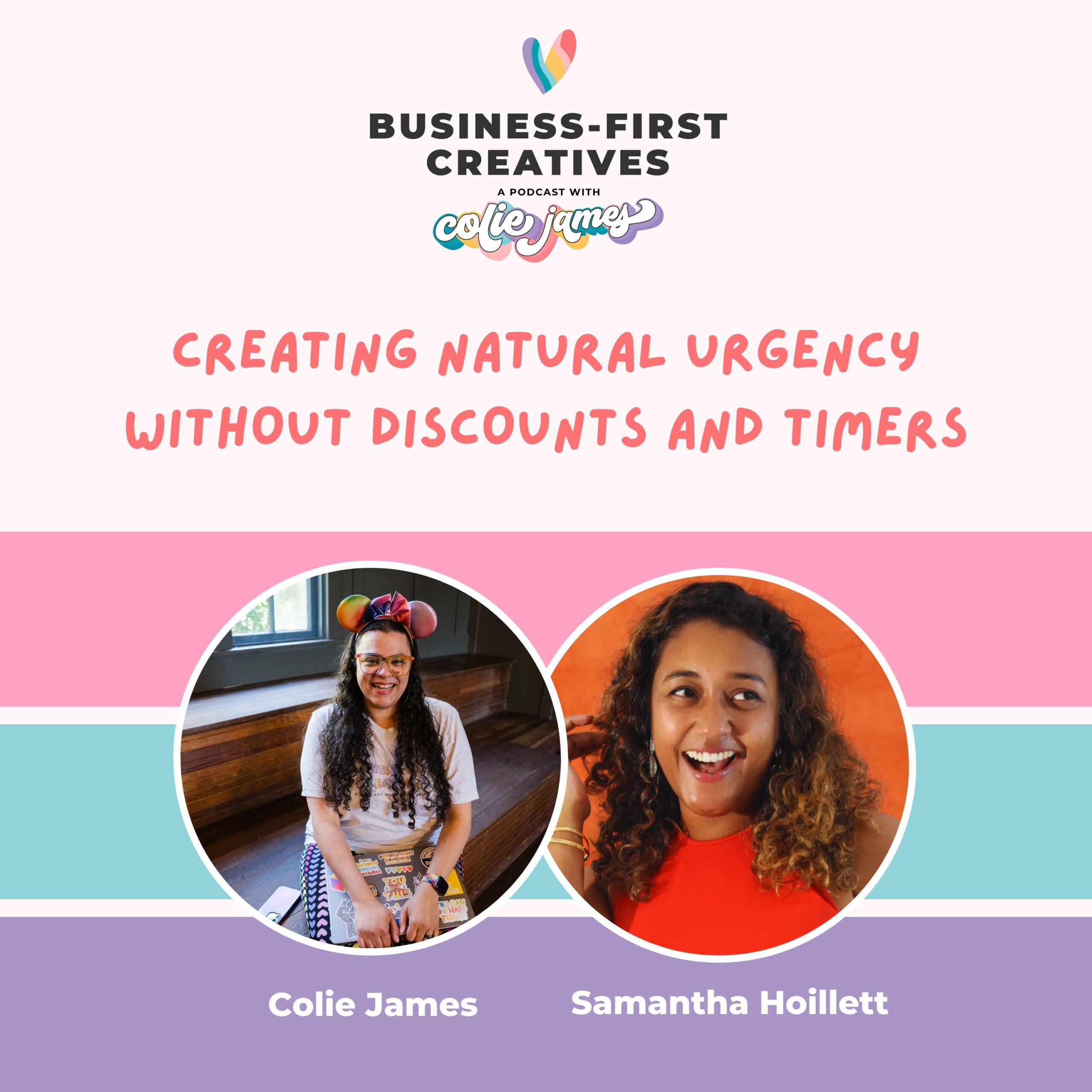




Do you dread the word launch, because you think that “doors open/doors close” structure feels icky? We’re flipping the script in today’s episode with Samantha Hoillett! She’s showing us how to build urgency into our launches that doesn’t feel pushy, but it does feel aligned.
Listen in as we explore what urgency normally means in marketing, why so many of us do it the usual way (limited spots, price‑going‑up soon, and hurry), and then how you can shift into urgency rooted in your client’s real internal motivations, not just your business timetable.
Review the Transcript
Colie: Do you guys know? I hate launching programs. I hate launching services, but it’s mostly because I always feel like when people talk about launching, they’re talking about all of that ickiness that comes with limited five spots. Doors closing soon, you know, get your discount for the next week. And so when Samantha pitched the idea of coming on the podcast and talking about urgency that had none of that ick, I was like, yes, please.
Because I’m gonna be honest, even if you guys don’t care what she’s saying. I do. And so this conversation is for me, and I’m just gonna let you listen in. Samantha, welcome to the podcast.
Samantha: Thank you Colie. I’m so excited to be here and I love that you feel that way about urgency. ’cause honestly, me too.
Colie: Yeah. Okay, so first let’s talk, I mean, I think I just dove into it a little bit, but like, tell me what urgency typically means when people are thinking about marketing, whatever it is that you offer your product, your service, and then we’re gonna dive into how you think about it differently. I.
Samantha: Yeah, so I would say typically, especially in like the online world, it’s all about offering your course product service program by talking about, you know, I’ve got. Limited time, limited spots, prices going up. I don’t know when I’m launching this again. And we feel like that’s really necessary to get people fired up and ready to buy. But like you said, there’s other ways to talk about urgency and put it in your copy, your marketing and how you sell your offer so that people like feel fired up for themselves and not
because you’re putting this like deadline on them.
Colie: Well, and I feel like when I first created, I mean I’ve actually, let me back up. I created my first online course way back in 2013. So I’m definitely like not one of the new people. Well, and actually what I did before that was 10 years of a college professor in the online space. So like I’m not new to online education.
When I made that first course, I really did have urgency because I was teaching something that was not available every day for sale. It was very small because of the level of support I was giving, the level of feedback. I ran it in live cohorts, so I mean, there was a legitimate, I only have 20 spots. Here you go.
And I sold off of my wait list every single time for the four years that I ran that course, but then I retired it because there were a lot of people at that point that were talking about documentary family photography, and I began to feel like I was just one of many in this space teaching this thing.
But fast forward to 2020, I created my second online course for photographers, which was how to use Dubsado as a photographer and basically have a business that runs itself in the backend.
Samantha: Yeah.
Colie: I did not have any kind of limitation. I don’t want to have open doors, closed doors. The course only available once a quarter because when you need systems, you need systems.
But what really felt icky to me at that point is again, all of the marketing advice was, doors are opening, doors are closing. Grab this $200 discount, and I’m not someone who really likes to give discounts. So all of that was just like, there’s gotta be a better way. But then when you sell your course all the time, if you don’t give people a reason to buy, they won’t buy.
So let’s talk about your idea of urgency. For those kinds of people who aren’t trying to do like large launches, they want a more calm feeling in their marketing. So what does urgency mean to you? That is not all of those kind of icky sales feelings when you put it on a sales page.
Samantha: Yeah, and I, I wanna go back to what you had said at the beginning of like, I genuinely had urgency. I wanna say that like, I’m a launch copywriter, so I literally specialize in helping clients use. Bonuses, deadlines, discounts, and we use them because they work. I have absolutely nothing against it. It’s just that if that’s all you’re relying on to bring in clients and sales, then it’s not sustainable for you.
Because like you said, it requires a big sales push. It requires like, you know, yeah. Like you said, maybe having to run a discount or a bonus. Like how many clients can you do that for? How long can you run a discount on your services for? Right? So then it’s like, okay, what are our other options? And so. For me, I feel like you know. It’s not that we can be, I like you have to choose between like never running those special things because again, sales psychology, I’m not gonna upend like centuries of proven sales strategy, but it’s about the combination of like, how can I more powerfully connect to what’s important to my dream client?
And the way that I think about it is that. Basically all these things where we’re saying like, oh, the deadline is happening, price is going up, spots running out. These are all external urgency. These are things that we are putting onto our clients from like the business perspective of like, here’s what’s going on with me, which is why I need you to join. Whereas internal urgency is like tapping into. Their problems, their desires, their like most burning, most urgent challenges, goals, like thoughts, feelings, fears, all of that so that they can sell themselves on getting started now instead of us trying to like get them in.
Colie: Yeah. I mean ’cause as as people who are selling products and services and courses, I mean, you have what you need. Like if I am running my current launch and I need a five figure launch and I need 20 people to join, that’s on me. So I’m trying to convince you to join even if you don’t think this is actually the best timing for you, which is where I kind of feel like.
You know it, like you said, external versus internal. I actually love that, but giving people internal motivation, I think is what actually does them a better service. Because if people are internally feeling why this is the best time, why this is the best service or course for them. They are actually going to get better results because what happens if someone ends up buying your course, let’s say, because you are giving them a deadline, you are giving them the motivation of saving the money now versus waiting until they actually have time to fully go through your course and implement the amazing strategies that you are probably teaching.
How they feel at the end is not gonna be the same if they were internally being pushed to, oh my gosh, like I really feel like this is going to help me move my business forward. I’m all in, and they actually make it a priority versus joining now, not having that internal motivation and kind of working on your timeline instead of theirs.
Samantha: No, I love that you said that because that is honestly. I mean, I think we all see that for ourselves in our business, but we never quite tied it to like, maybe it’s because they joined ’cause they had fomo or you were offering such a good deal, they didn’t feel like they could say no or whatever.
Like, but exactly what you said, the like level of commitment that someone brings when they feel that internal urgency changes everything because they show up, they. Actually get the result. It’s better for you as a business owner because you get a bigger, better testimonial and people are more likely to resign or refer you because they actually got what they came for.
Colie: Yeah, and I mean, I see it a lot when people, ’cause I mean, I will be totally admit I have bought more than one offer because I was feeling FOMO or because I was like, oh, but the next time that it’s offered, it’s gonna be $500 more and I know that I want it, so why not just buy it now? Even though I know, and I would even say it’s a little voice in the back of my head, but sometimes it’s not.
Sometimes it is actually screaming. Colie, you have absolutely no time to do this. I have bought more than one program and been like, okay, in two months it’s on my calendar for me to do it then not now, but if I wait, it’s gonna cost me more. And so what happens to me is in those two months, maybe something else becomes a priority.
Maybe that isn’t actually the thing that I need anymore because I’ve actually shifted something in my business. And then what happens to the person that I bought the program for? Maybe I took a spot that someone else. Might have needed at that time. I’m not doing it. I’m not getting the result. So like you said, I’m not giving them a transformation that they can share and that they can, you know, internalize as, okay, like this thing that I’m selling is actually doing what it’s supposed to do.
Because like, we all need that kind of validation for ourselves. I love it when my clients immediately take what I give them. And implement it and get a result. And I think that we overlook that in terms of what we get from selling our offers and our services and our products to people. Because we’re just like thinking about the money.
And don’t, don’t get me wrong, all of us need money. We run a business, we have to make sales, but let’s focus on making the sales to the right people at the right time so that they can get results and transformations that you can then shout from the rooftop.
Samantha: Yeah, definitely. And I feel like you know this, everything that we talked about, about like calling in the right people who are committed, who are ready to make the most of it, like this is part of why having such crystal clear messaging around who your offer is for how it helps what’s included, and also sharing all of that information upfront is so essential to calling in the right people because. They’re able to make that like informed decision and that’s part of where urgency can build is not just the problem and the, you know, the big promise. It’s also like you can’t feel urgency for something you don’t feel clear about. Right? Like I see like at least personally. If I don’t know the price of an offer, I like can’t get excited about it.
’cause I’m like, it’s probably out of my budget. Or like, oh, maybe now’s not the right time. Like, I don’t know like how much I need to set aside for this. So I literally cannot get excited
without knowing like, well, how much is this going to cost? And it’s just a practical planning thing. But there are things like that, not just price, but also like. Just details about the offer and like, what are the signs that I’m a perfect fit for this? Not like an okay fit, but like an actual, like this was made for you. And so, yeah, like a lot of urgency also just comes back to having really clear, transparent messaging around your offer too.
Colie: And I feel like that clear and transparent messaging is easier if you are clear about what it is that your clients get on the other side. So again, like whether this is a beta run or something that you’ve sold a lot of times, if the people that you’re selling it to. Are not actually going through the program and getting the result.
I don’t know how you communicate that result to future people who will buy so that when I’m reading a sales page and I’m like, oh my gosh, like Samantha got this result. I mean, how would my life and my business be different on the other end if that would happen? I’ve got an offer. It’s my new signature service.
I’m constantly talking about it gives you time back in your business, like you can market better. You’re not spending as many hours managing. But recently I interviewed one of my clients for the podcast and I was so excited with her interview and it was because she was telling me. A different result than anybody else had.
I mean, don’t get me wrong, at the end of the day, she has a business that’s working better. Her client experience is where she wanted it. But she talked about how she took all this time that she’s saving and she’s like out there, reading, she took up reading as a hobby. She’s spending more time with her kids.
And I was like, that is something that I need to highlight on this sales page because I’m constantly giving and talking about the results that most of my clients. Want and are doing, which is more time to pour back into their business. But that’s not the only result that you get from what I offer. And so again, making sure that your clients.
Getting the result that they want and communicating that back to you helps you make better and clearer messaging for future people who are reading that sales page. Because if I’m in a place like Kelly and I’m like, oh my gosh, like I can’t, I can’t remember the last time I went to Chloe’s volleyball game and just enjoyed it.
But I see that, you know, this one person on the sales page is now talking about all this time that she’s spending with her family and her kids. Like that’s a result. That’s talking to me. And depending on how badly I’m feeling about missing time with my child, that’s creating internal urgency for me that maybe this is an offer that’s going to get me The thing that, I mean, I knew that I needed, but that wasn’t front of mind when I was initially reading the sales page for this offer.
Samantha: Yeah, I love that example, and I feel like it’s just such a powerful reminder of how. Important it is to look at the words that our clients
use, because I think like we can also very easily as the expert get kind of like, of course you need copy and messaging. Of course you need systems. Of course you need a lawyer.
Like whatever it is. And it’s like, well. Yes, but how can we communicate that in a way that they can understand and they will resonate with? And one of the best places to look for that is like conversations you’ve had with, I’ll clarify ideal clients. A lot of people will look at just everybody, and it’s like, don’t look at Jane’s like response to you if she’s not an ideal client, but looking at like how, like what?
Like. Where is the value for them? And you know, your example was perfect of like, yes, you know, we save you time, we simplify things in your business. But like, where is the other emotional urgency, that internal urgency of like, you know, wind does not having systems sting the most.
Like you said, it’s because you’re, you’re court side, but you’re not, you’re actually looking at your phone instead of watching the game.
That is like, ouch.
Colie: so I think one of the things that I struggle with as someone who you know, writes her own messaging, has messaging all over her sales pages is I’m constantly hearing that you should do two things. You should basically push at people’s pain points. Like what are you currently feeling that you know is.
Forcing you to think about this offer, like what will it solve for you? But then the other part is, you know, the results. What happens on the other end? What is it that I’m hoping that I will have differently after doing it? Where’s the balance? Because I recently was looking at some of my messaging and I think that I’ve been hearing too many voices on threads, you know, podcast episodes that are like, no, don’t just hit pain points.
You shouldn’t make people feel badly for like, you know. Messing up in their business or needing this really badly. But then I think the opposite is I take out all those pain points and now it’s just basically idealizing what you’ll have on the other end of the offer. And it’s like, okay, but like they don’t really know what they’re struggling with when they’re reading the sales page anymore.
And so I think there should be a balance. But is that something that we can do with our internal urgency that we’re trying to put on the sales page? Is that a thing?
Samantha: Absolutely. And I feel like, I mean, going back to what we just said about using your client’s words like. There are ways to kind of call it out in a way that might feel more gentle than being like, you know, you are struggling with this, or if you are stuck on this, it’s like literally, like you can tell past client stories of like, I had a client, Jane, and she came to me and she was, you know, feeling stuck on this and worried about this, and this is what we worked on and here’s where she is now.
We can do that for you too. So there’s one way. I think another thing is just like the way I see it is. You know, what you said about not, making it so like, just the pain points. I feel like with, you know, it’s still almost just, to me it’s like being realistic. It’s like, you know, we’re not trying to like poke down on it and be like, you know, that means you’re gonna be stuck forever if you don’t buy my offer.
Definitely not. I hate that. And I feel like that’s where it starts to veer into. Feeling like, okay, like this is a little icky and a little bit like too much. I think when you are just speaking from an expert perspective of like, if you have this problem, here’s how I’ve solved that problem for past clients. And it’s an option for you. And maybe it’s not the one you want right now, or it’s not the best one for you, that’s okay. But at least I, the expert have communicated like how I would go about solving that problem for you. And I think like, you know, no matter, like let’s say you help businesses, a lot of businesses wanna make more sales, but maybe you wanna make more sales by improving your branding or working on your copy or working on your systems.
It’s like we all have answers to that problem. So then it’s up to us to communicate that and let the client kind of. Again, with our clear messaging, decide for themselves which way is the best. So
that’s how I see it.
Colie: It’s interesting that you phrased it that way because as business owners, we all have problems and there are so many ways to make our business better. And how you describe and you define better is of course completely up to you. But a lot of people would describe that as making more money.
Spending less time in your business, having more clients that are, you know, getting the result of the service that you’re offer. I mean, all of these are improving your business and there’s many ways that you could go at that. I always talk about the fact that if you don’t have enough clients, if. It’s either a systems problem or a marketing problem, and just because I can help you with your systems doesn’t mean that’s your biggest pain point.
Now, if you have a lot of people who are inquiring about your offer and you are unable to handle them, that is a systems problem. If you don’t have enough clients and enough people inquiring about your offer and your services, that’s probably a marketing problem, and so which one is going to help you most?
Well, that’s something that I wanna help you decide, but I will totally tell you if I think you need to start with your marketing or if your website is really the problem. Because if your messaging, it’s not actually converting people to inquire about your services. I’m not the person to help you first.
Like I’m the person you come to. Once the leads are coming in and you’re struggling to convert them. It is not if no one is like inquiring about your services off your website or your audience is not bigger or like those things. So I do feel like. Sometimes I hear messaging that’s like, my way is the only way, and I automatically start turning that off because I’m like, you’re not giving them a perspective that’s helping them figure out what their actual biggest pain point is and what the, I don’t wanna say the right path because that makes it seem like there’s only one, but like what path?
What service is it that you are going to currently hire for that is going to give you the biggest ROI, or at least is gonna solve the problem that like right now is making you cry at night, like that’s the one that you should solve first.
Samantha: Right, and like exactly like you, you know, you were just saying like helping you decide. I feel like that’s really the key is like. You’re like, as experts, we are diagnosing the problem. So like, think about you go to the doctor’s office, so your, your doctor’s not trying to make you feel bad when they ask where does it hurt?
How long has it been hurting? But like, they know it hurts and like, that’s how I see it, like calling out pain points. It’s like I know that. If you are having these problems, like I have a solution, I have like a way forward. And I think there’s also just a level of discernment required by the business owner to realize, like I’ve seen this said on threads in like a negative way of like, oh, you know, a copy expert is always going to tell you copy’s the problem.
And that systems experts always going to tell you systems is a problem. And I don’t think that’s a bad thing. Like that means that we’re staying in our lane and talking about what we know about and it’s up to you as a business owner to. Like, look at, you know, the copy, the messaging and look for those signs of like, okay, diagnose, like, what is the top problem in your business?
And then go that direction and then choose like, okay, now which systems expert am I gonna work with? Or
which, like, you know, copywriter.
Colie: Yeah, I do feel like a lot of us are like, my expertise is this, and this is how I can help you. But that is like an internal thing to figure out like, which one is it that I’m gonna do first? And it’s funny, I’ve, I’ve noticed that when it comes to people who used to hire me to do done for you, they were often like getting an entire brand makeover at the same time.
They’re getting a new website. They’ve hired a copywriter for new messaging. They’re redoing their systems. And so, I mean, you’re doing all of these things at once because you know that all of them are going to improve your brand. But once you’ve decided to hire a copywriter or a website designer and you’re looking at sales pages, you should be finding someone that is.
You know, making you feel the urgency besides just saying you’re not making enough money, or you know, Hey, buy my service because I’m currently offering you $500 off. So it is about making good decisions, but the best way to do that is for people to have very clear messaging. On their sales pages for the services so that their ideal clients read it and are like, oh my gosh, they know exactly what my problem is.
They’re gonna help me solve my exact problem right now. Like basically, where do I sign? How do, where do I enter my credit card number? That’s what you want people thinking. If they are your ideal client when they read your sales.
Samantha: Yeah, definitely.
Colie: Okay, so besides the deadlines and the launches and the discounts, we’ve talked about urgency in terms of making people feel it internally, reading a sales page, being really clear about what the details of the offer are showing. Previous client transformations so that hopefully your ideal client sees themselves in one of these mini case studies, you know, quotes, whatever it is that you are choosing to have on your sales page.
Is there anything else that we should be talking about when we are trying to bring urgency to our sales messaging and copy writing in like a very natural way?
Samantha: Yeah, I would just say like urgency is really all about answering the question why now for your audience, right? And so if people don’t have the answer to why now they can be your ideal client. They can love your offer, and they might just spend weeks or months, you know, not actually taking action. So. Again, it’s like thinking about like those different angles of internal, so we talked about internal versus external, but even within the internal side of things, there are different angles we can kind of look at. so one of my favorite places for clients to look at is what quick win does your offer promise? And the reason is because we often look at, you know, in 12 months, here’s what happens. Or by the end of working together, here’s what happens. And although they might want that, it can feel like hard and far away.
And oh, well. You know that’s gonna take time. So what I recommend is like look at like what is a quick win that you can get people fired up and excited about? And I wanna be clear, this is not promising overnight success. It’s just picking out like one quick, exciting, like sexy milestone that they’re going to achieve. Like either, and it depends on your offer. It could be by the end of module one inside your course, by the end of your first call inside your first inside of your program.
If you do one-on-one coaching, it’s like by the end of our kickoff call or you know, done for you service, by the end of your onboarding, you’re going to even feel more clear on X, Y, Z. Right? So like, just giving people those like milestones they can get excited about, can also build that urgency beyond just like, here’s what you do and what will happen weeks from now.
Colie: And I mean, I also feel like for you, it is good for you to communicate that because those are the results that you are gonna be able to like check a box off of. So like in my case, I tell people when you come to me for systems in session, like we are gonna figure out what your biggest pain point currently is and we’re gonna.
Craft a plan around that, but I would say 80% of my people, it’s that your booking process, the five minute booking proposal that I think everybody should have, most people don’t already have that in their business. And so we start there because that is like the one thing that the moment that you send it to your client, you don’t have to have all of these other systems built around it.
If you just have a high converting proposal where. They see the offer, they sign the contract, they pay the money. You are going to see the first win when you send it out. And like, you know, you’re say something like, oh my gosh, that was the fastest that I’ve ever gotten paid previously. Ding, ding, ding.
That’s a new result to put on your sales page. Um, and I’ve seen that very effectively done on a couple of sales pages that I looked at in the last few weeks. It’s like within the first 24 hours. You will have this within the first seven days, you will have this. And it got me thinking, like what would I tell somebody would be the result after our first one hour kickoff call?
Because it’s not enough to just walk them through the process and tell them, okay, I start this with a one hour kickoff call. You always want them to see, okay, but what do I get from that kickoff call? Well, I go behind the scenes and plan your entire client experience journey, and then I give it to you for your approval.
That’s what you get. That is the result. I mean, I’m, I’m promising it, it, it is a result because I’m gonna do it. But, you know, you should be careful and cautious when you’re promising them client results on their end. But, making sure that people can like, see that they’re gonna pay you hundreds if not thousands of dollars, and that they’re going to get something if not immediate, like.
Almost immediately because Microwind are like, I think they’re the new, the new thing that everybody needs right now. Like no one is really thinking of, like you said, 12 months down the line. It’s like, okay, if I buy this, I might not get the total result in a week, but like literally, what can I expect in a week and how am I going to be able to validate that that was a good decision for me and my business?
Samantha: Yeah, 100%. And like, oh, there’s so much I could say about this, but like, yeah, when you identify these, like, I love how you said micro wins. It’s like. You are also helping your clients see the value that you are delivering, right? So for example, if you’re just like, oh, you know, we do a kickoff call and then we do a check-in call, and then, you know, you come into Slack and then you see a big win six weeks
Colie: That’s so.
Samantha: It’s like, yeah. And it’s like, okay, but if instead we talk about. Okay, this is what happens every step of the way. You are going to have clients coming back to you and saying, I saw that win. Or Here’s what happened. And like that shows them the value of everything you’re doing, not just like the big result, which again, you know, results may vary.
So only promising the big promise can feel like, well, what if I don’t get that? Does that mean this was all for nothing?
And so I agree that like, you know, we were talking about. What feels like good and honest. I feel like these micro wins are, you know, part of what we can guarantee in the sense of what you said.
I’m gonna do it now. Like what you go on to do with it. We’ll see. But like I can promise you here’s what’s going to happen when you buy.
Colie: I mean, the other part that I will say related to this specifically is I think that one reason that people have trouble identifying the micro wins is they are not properly documenting their client’s journey through their course, through their offer, service, whatever it is. I’ve literally bit my tongue so hard recently that I, I bled, like I bled on one of my,
check-in calls with a client because they came to the call and they said, oh my gosh, Colie, I have to tell you what happened this week. And then they just word vomited every win that they’ve had in the last week since I talked to them. And of course, I wanted to ask questions. I wanted to say congratulations.
I wanted to give them a big virtual hug, but I sat there. In silence because number one, the call was being recorded. So I was getting all of this goodness to remind me of what my client’s wins are while we’re going through the process and not just at the end. So, I mean, this is just my little tip for everybody.
If you are not figuring out a way to document the wins that your clients are having. Throughout the entire service or offer, that is what you should do like tomorrow, like next week. You should make sure that you’re asking your clients questions that will help you know what value they’re getting along the way, and not just when the service is complete, because then.
All you end up with are testimonials that are about the big win and what happened at the end of the process, and you don’t have any voice of customer to kind of lead them through the micro wins that they got. ’cause like my container is 60 days. Like I don’t wanna tell them only what happens at the end of the 60 days because that’s gonna feel really long.
Like that’s gonna feel like it’s. Really far in the future, but if I can say, you know, 70% of my clients have a five minute booking process in the first 10 days of working together, bam, that is a result. And guess what? For every client that comes through systems in session, I can basically check a box, did you have your five minute booking proposals set up in the first 10 days?
Yes or no? And that makes sure that I am giving the result that I promised on my sales page.
Samantha: Yeah, and I would, I would add to that too, this is something I call like value stacking, and I recommend every client to do it because it does build this urgency also, is that just go through your offer and. Think about like how does each step of this process of my, you know, done for you service of my coaching, how is each step worth the value? Like alone?
Like if you had to say, you know what, my onboarding call is worth the 5K investment alone. What would you say about it? And of course, don’t make it up. Like, look at what you’re actually doing and why it’s important and what breakthrough they have, et cetera. But like, just at like, it’s more of a prompt to get your brain going of like. What value am I delivering every step of the way so that I can like. Pull that out and showcase it and be like, oh yeah, like that’s what we cover in module three. Or that’s what we work on in the fourth week of working together. Like, you know, you’re gonna walk away knowing X, Y, Z. And I think even just taking time to like do that exercise, write it down, look at it, it’s going to change how you show up and like talk off the cuff about your offer, maybe on like your podcast or Instagram stories because you have this like language that you’ve like looked at.
And I think this is just a critical step. That people don’t do. You package the offer. You slap on a promise, you get to going start writing emails and creating content, and it’s like, but if you unpacked that value, you would be able to better communicate and sell that value to your clients too.
Colie: And I feel like sometimes we just need like a check on ourselves because it was funny, I was interviewing somebody else for the podcast and she was saying that she knew that it took about 50 emails for someone to say yes to something. And I was like, wait. Like, are you tracking that somehow? Like how do you know it?
And she was like, well, you know, no, I’m tracking like when they join my email list versus when they make their first purchase. And I was like, oh, okay. I’m doing that too. I just wondered if you had some, some magical way that you were tracking emails for that one person, but like what does that tell you?
That means that if someone inquires about your service. And they ask you questions and they don’t book right away. As long as they’re not telling you a no, this is not a good fit for me. This is totally not, you know, where I wanna go with my business. It’s like you think about that timeline of how long it takes somebody after they’ve inquired or they’ve seen your sales page for the first time, or how many times they’ve had to return to your sales page over and over again.
Or maybe like if you are tracking what people are doing in your email marketing program, maybe you can see that this person has reopened five emails every day for the last five days. I mean, you can see that they are feeling some kind of urgency, whether or not the urgency that you’re communicating is hitting with them in that moment.
But if you know the timeline of how long it takes for people to kind of. Internalize what you’re talking about, your messaging on your sales page to actually feel the urgency to take care of the problem in buying your service or your course. That kind of helps you make sure that you’re staying on track and that if you get a no, like during a launch this month, if you know it takes somebody 60 days and you have a launch in 90 days, hey, how many people.
Were on your email list that didn’t buy in today’s launch are actually going to convert in your next launch. So I also think that it grounds us into not thinking that, you know, we’re failing because you know, I had this great offer and no one bought it. Maybe it’s your timeline. Maybe the messaging that’s on your sales page just takes a while to internalize and then they’re gonna come back and buy it down the line.
Samantha: Yeah. No, I love that you said that because I feel like at the end of the day, we can talk about all these urgency strategies and they 100% work, but at the same time, it’s like. We can’t control if and when people buy, but we can control how we show up so that they,
when they do feel ready, they are clear.
They, you know, the messaging is compelling, the copy is high converting, and it’s an easy yes
for them, like from that moment.
And so, yes, absolutely it does. Like me teaching urgency strategies is not like, oh, like this is how people buy overnight. It’s also like. Yes, people may very well buy like they find you on Monday and buy from you on Friday.
That has absolutely happened with my clients, but like it’s still also staying committed and like you said, staying grounded and being like, I need to do what I can do to make that Yes, easy. Every day, every time they do see or hear from me.
Colie: Yeah, and I feel like we should also like, just for a moment, talk about your email messaging versus your sales messaging on your sales page, because I also think that people, you know, they send that link out. Every day, all day when they’re in a launch or you know, when someone first joins their email list, the welcome series shares that link two or three times, and then they don’t see that link from you like again for like months.
And it’s like, well, no, I mean. They, they got the message the first time. They may have looked at your sales page, but it’s up to you to continue nurturing. And so like, I always, I’m always a little hesitant when I hear somebody say, oh no, you need to grow your list constantly. And I’m like, yeah. But when you bring somebody onto your list and you walk them through your welcome sequence, if you’ve got one and it’s pitching an offer and they don’t buy.
What are you doing two weeks from then? What are you doing 60 days from then? Because the idea is not to just continuously bring people onto your email list and try to sell them, and if they don’t buy it, you’re just like, oh, okay, well now I need another a hundred people to go through my funnel. No, you just got a hundred people.
They didn’t buy in the first seven days. That doesn’t mean they’re never gonna buy like again. How can you not only communicate the urgency on the sales page? How can you keep that messaging going in your weekly, biweekly emails that you’re sending to your email audience?
Samantha: Yeah. I think for me it’s just about continuously answering the question, what do you do?
Like, how do you help? Are you the expert? For me, just answering that over and over again, like last year I made six figures selling on Evergreen. I had like a done for you copy service. I did not have. A strict marketing calendar.
I was not trying to hit on different buyer types. I was literally just like, what does my audience need to hear from you today? That would help them know who I am, what I do, how I help, and why they should buy now.
And like I think people should definitely take advantage of the fact that email is 100% not just a nurturing platform.
It is a conversion platform. Probably the best available to us. And so definitely using that as like, you know what I just said, showcase what happens in module one. Like talk about like, like talk up your offer. And of course you can, you know, still be educational, you can still be valuable, but you can still absolutely 100% sell your offer. I have a sales CTA in literally
Every email.
that I send, every single freaking one. And like, I just, I don’t have, you know, this is also how I feel. It’s like I’m a business owner. Like I wanna, I wanna yap, I wanna to have fun. I wanna, you know, do all the things. But I also am here for a purpose. Like, I’m here to do the thing that like being in business keeps me happy, right?
It’s like, it’s, it’s so purposeful to me and I care so deeply about the work that I do and I know so many business owners do. And it’s like, that’s what I’m here to do. I’m here to tell you. Like how I can help you. And that’s like, I think it’s also like when you’re selling on Evergreen or you’re trying to accept clients anytime and bring them in any time, it’s like, you know, we have to kind of keep that energy and keep that momentum and belief that my expertise is needed every day.
Colie: Mm-hmm.
Samantha: you should point people to your sales page every day because that’s how you’re going to help them. Not just with tips and tricks, but like genuinely change their life, their business, their health, whatever your niche is that comes that true bigger transformation comes from working with you.
Colie: And I think that you’ve said, you know, you’re constantly telling people who you are, how you can help them, and why they should buy now. But that doesn’t mean that Samantha is actually repeating the exact same words every single time, like Right. She’s varying it. And I think that. When you just said, oh, I have a CTA in every email.
I think that people immediately associate that with like that three ways to work with me that a lot of people have at the bottom of their email. And I just wanna make sure that, at least from my perspective, that is not what I do. Because yes, that having that at the bottom, always make sure that somebody has a link.
But if you just put that in every single email and it’s just part of your footer. People are just eventually going to ignore it. That’s why I love, I mean, like a four by four offer where, you know, the, the blocks at the bottom of your email changed. Yes. One of those blocks could be constantly pointing people towards your signature offer, but it doesn’t have the same language.
It doesn’t have the same words in every single email. So, yes. I mean, communicate these things over and over again. In every single email that you send, make sure that there is a clickable link and a CTA in every single email that you send. But for the love of Jesus and everything holy, please vary it.
Please don’t just, yes, like don’t put your elevator pitch in every single email, guys. It’s gotta change.
Samantha: Thank you for clarifying that because 100%, like I know this is true for, I like, it’s important to pay attention to how you engage with other people, right? Like if you notice, oh, I love reading, like, you know, Jane’s emails. But I always, you know, zone out on the her CTA ’cause it’s always like in a purple block that looks exactly the same with the same words.
I’m not gonna
even look at it. So what I recommend is. Think about how can I tailor my CTA to the topic of my email? It’s very simple and it’s, but it just makes it feel fresh. It, and it makes it feel more relevant to like the message and like your reader because it’s not just like, oh, this CTA that’s been slapped on at the end.
It’s like, if this resonated with you, if this was important to you, if you feel pulled or moved by this, here’s what you do next.
And that is going to actually get them to like click and want to buy.
Colie: And I was recently on a rant. I was saying, your hottest leads are not on Instagram. They’re already on your email list. And I was specifically talking about, not really email marketing, but like reselling to your current clients. Like the people who have already paid you money are the people that are most likely to pay you money again.
And so I was talking about segmenting your emails and your messaging based on that, but. Because you just mentioned it. I wanna say this is definitely like a more advanced trick for people, but most of the email marketing programs that we’re using, you can use liquid. So in other words, you can put a specific like CTA or a specific piece of messaging in an email.
Based on what people like the tags or the segments that they have inside your email marketing program. And so one of the things that has been working like the best for me recently is if I know that you were really interested in working on your workflows because you got my workflow freebie, you are seeing like a CTA, that’s basically pitching my signature offer based on the fact that you are probably currently trying to figure out your workflow.
Versus if you got on my email list or you recently downloaded, like my email client communication freebie. It’s talking about how my offer is the next step from working out and writing your pre-written client communication library. Like if you don’t know what liquid is and you’re like, Colie, you’re talking way over my head, that’s okay.
Just write two different versions of the email and send one to one segment and send one to the other. I feel like urgency is great, but also specificity in the people that you’re talking to. If you know that you could talk to them in a different way about why their urgency is different than someone else’s urgency.
On your email list, do it. I mean, even if it takes just a few minutes to like send a slightly different version of your email to two different segments in your email audience, I would just encourage everybody to do this because your open rate on each of those is probably gonna be different. The click through rate on each of those is probably gonna be different.
And then you’re gonna learn something about like a particular segment of your audience. Maybe they are way hotter than you thought they were, and then what can you do? You can tailor more of your messaging to those people and try to get them to convert versus focusing all of your energy on like your email list as a whole.
Samantha: Yeah, no. I mean, I don’t know if anyone else is like an email nerd like we are,
Colie: Yes.
Samantha: but you can absolutely like look up the statistics on like the power of personalization in emails. And I don’t just mean saying like, Hey, Samantha, like at the top of the email,
I mean, what, you know, Colie is saying about. Actually personalizing the email based on what you know about them and what’s important to them. And yeah, I would absolutely like classify that under urgency as well because you’re, like you said, you’re getting more specific to the things that matter to them, and that is, you know, back to that internal urgency of like, yep, this is relevant to me.
I care about this, I want to do something about this. So yeah, any, any opportunity you have to personalize your message and get it more close to what you know they care about, the more urgent that message is going to land for them.
Colie: And I mean, don’t overlook the power of just asking your audience where they are or what they need. I know a lot of like the social media marketers, if you will tell you, you know, ask your audience on Instagram. I don’t, I don’t do that often. I think everybody knows. I ignore my social media half the time, but my email list, like, no, I actually got a new little widget thing where I can ask.
Polls and I’m all about it. Like, let me ask you, I did the other day, I asked a question and I was like, you know, can you help me solve a slight argument that me and my business coach were having, like out of these three systems problems, which one would you want fixed tomorrow? Like, which one is feeling more urgent to you?
I mean, over 80% chose eliminating friction in their booking process. Now I feel like that is something that I talk about over and over again to the point to where I feel like I am annoying myself. But clearly if 80% of my people said that was the problem that they needed fixed immediately, I’m not talking about it enough.
It’s not clear enough on some of my sales pages, my, you know, social media content, whatever it is, I need to speak to that because my audience just told me that was their biggest problem. So if you’re stuck on how to write about the urgency and what your clients and your audience needs to know, just ask them.
Ask them.
Samantha: They have the answer,
Colie: They do.
Samantha: they always do.
Colie: All right Samantha. So I feel like we’ve talked about all of these things and you and I could talk, I mean, ’cause we’re email nerds, we could talk about urgency and sales messaging and emails and all of the things forever, but we do have to cut this off at some point.
So I know that by the time this airs, you will have launched your new group program, helping people write their own sales messaging and. Finding new and inventive and interesting ways to put urgency inside of your messaging. So tell me about it and give me the link where people can find out more.
Samantha: Yeah, so it’s going to be called Urgency on Evergreen, and the idea is it’s a six month program where I will show you how to build desire, urgency, and certainty into your
marketing so that people can come into your world and buy it now, not someday. And if you are like, okay. But can you, can you point me somewhere else?
What else do you have? I also have a free, training, three part training called the Urgency Upgrade, which really just spotlights like, okay, like how can you add urgency to your messaging, your offer, and your like daily content. So if you’re like, okay, I’m curious about the program, but where do I start?
Definitely
start with the urgency upgrade. ’cause it’s free, it’s there for you. Thank you so much for having me on today.
Colie: Yeah, so guys, those links, as you know, are always in the show notes, so. I always tell you guys, okay, but what are you supposed to do after today? So if you have a sales page, a services page, an email sequence, whatever it is that you feel like needs the most help or that you are sharing the most, I want you to go look at it and I want you to see if you are actually already including some urgency that does not include.
Deadlines and discounts, and if you don’t, I highly recommend that you go check out that free training that Samantha mentioned so that maybe you can find a way to communicate with your audience so that urgency is internal and they decide to buy your service and your offer on their timeline, which again, will give you better client results and people who actually do the damn thing.
All right. That’s it for this episode. See you next time.
Find It Quickly
00:24 – The Ickiness of Traditional Launches
00:59 – Introducing Samantha and the Concept of Urgency
01:08 – Redefining Urgency in Marketing
02:03 – The Evolution of Online Courses
05:12 – Internal vs. External Urgency
09:40 – The Importance of Clear Messaging
14:36 – Balancing Pain Points and Results
19:35 – Diagnosing Business Problems
24:42 – High Converting Proposals: The First Win
26:01 – The Importance of Micro Wins
27:37 – Documenting Client Journeys
29:44 – Value Stacking and Communicating Results
33:21 – Email Marketing Strategies
40:16 – Personalizing Email Campaigns
Mentioned in this Episode
Urgency on Evergreen: samanthahoilett.com/urgency-on-evergreen
Urgency Upgrade: samanthahoilett.com/urgency-upgrade-2026
Connect with Samantha
Website: samanthahoilett.com
Instagram: instagram.com/samanthahoilett.writes
Youtube: youtube.com/@samanthahoilett
Theads: threads.com/@samanthahoilett.writes


Top Categories








© 2022-2025 Colie James


Close
Start dates available for Q1 2026
Enter your contact information to join the interest list for Systems in Session. You will get early access as spots become available with a booking bonus!
