





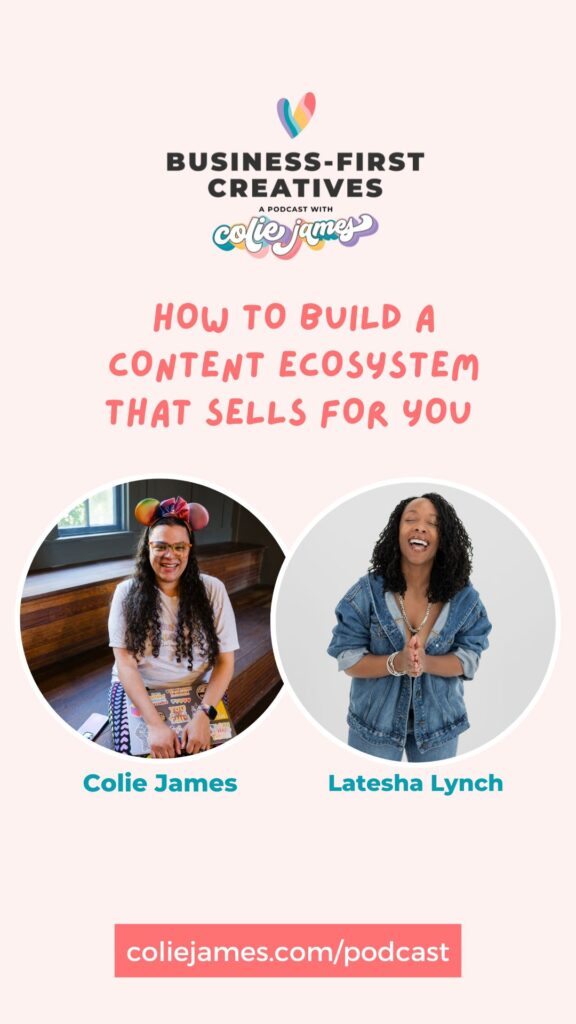
What if you could create just one piece of content and let it do the work of fifty? That’s exactly what we’re unpacking in today’s episode. Latesha Lynch joins us in today’s episode to introduce us to her concept of inception marketing—the idea that you don’t need a million pieces of content to drive engagement, conversions, and trust. Through smart structure and intentional seeding, one high-value piece can become the engine of your entire ecosystem.
Review the Transcript
Colie: Hello,
Hello, and welcome back to Business First Creatives Podcast. Today we’re in for a real treat. So when Leticia Lynch pitched herself to be on the podcast, you guys know I have a thing. Like I usually don’t let people who pitch themselves on the podcast, but I have been following her for quite some time and the topic is fire, and so I am super excited to chat with her today.
Leticia, welcome to my podcast.
Latesha: Thanks for having me. I’m so excited.
Colie: I mean,
so I feel like what we’re gonna get into today is a real hot topic for lots of people right now, because what I see on my side is everybody is doing like a mass exodus from social media. It’s like maybe we did a little bit too much social media during the pandemic and now everybody is like, okay, there’s.
gotta be a way
To run my business when I’m not online. 24 7.
Latesha: 7. Yeah. Yeah. I’ve been seeing that a lot too. Or even just like a lot of clients, they’re like, I just have no energy for this. I’m tired. I need a break. And I’m like, oh no, you can’t just disappear, come back.
Colie: So the idea is that
you can create one piece of, content and it does the work of 50. So as a math person, I wanna know why one in 50. like did you pick that outta thin air?
Latesha: thin air. I did pick that outta thin air. But the concept is like the movie Inception, it’s like a piece of content that’s within a piece of content that’s within content, basically.
And I feel like, I mean, if you thought about Inception, it really can do the work of so much and. For too long. We were trying to overproduce content anyway with the short form thing, and it became you producing 50, literally 50 pieces of content. And I wanted us to reverse that because we literally can and you’ll see why, what we get into the conversation.
For sure. Yeah.
Colie: Yeah.
And so I know that you’re a
rather new mom and newish. Define for me what newish is.
Latesha: new It’s, well, uh, yeah, I shouldn’t even say that. ’cause my kid’s nine. I still call him a baby, but I mean, you know what I say that every stage of motherhood, and you’ll probably understand this too, is completely different.
So he’s now in elementary school, which is completely different than when he was a toddler like elementary. School and the schedule has really messed me up with me having homework and having to pick ’em up on the elementary schedule versus daycare schedule where they’re in there until five, and now he’s done at two 15.
It really messed everything up from my schedule and just my productivity. I also have a DHD, so knowing that I have something at two 15, I’m distracted because I know something’s coming at two 15 all day long. So it’s just been a really big, rude awakening for me as a mom and I thought. Every stage. I think it’s gonna be over that I’m worried about something or distracted by something and then every stage there’s some new thing.
So what’s coming in middle school? I don’t know.
Colie: I mean, as someone who
just had a kid who left middle school, I felt like middle school.
was pretty low key.
You know, as long as they have activities after school, I feel like my day got a little bit extended, especially, we’re currently in volleyball season. and While Chloe has transitioned to high school, she has two hours of volleyball practice every single day.
And she has games twice a week. And So Yeah. I mean, Right now I am completely alone in this house, from 7 45 until at least five o’clock every single day.
Latesha: day. I, I can’t wait. I just, I don’t know what I’m doing anymore. My day is not my own.
Colie: No. And a few years ago, my kid was going to two different schools, and so I was a lot like you.
I couldn’t start like any activities because I was like, oh my gosh, at 11 o’clock I have to get her from school Number one. and take her to school number two. And then I only had two and a half hours before I had to pick her up at the end of the day. And then again, during Volleyball, season, I was taking her back to school, number one for volleyball practice.
So I was just an Uber driver for a solid year.
Latesha: 1000%. He just started riding the bus. So I get it. It being a mom is just a whole scam. So I’ve been
Colie: So, I mean, but it is a scam that most of us like, I mean, I do embrace it. I I
Latesha: I love it. Oh, I love it. I love it so much, but it’s a scam.
Colie: I’ve always felt like those of us that have businesses that we can kind of build around our life are lucky in that respect.
Because like with My husband.
he is a biochemist. He’s in a
Lab. He doesn’t have anywhere near as much flexibility as I have. So I mean, At least I am able to kind of build my schedule and create marketing, which is what we’re talking about today. To kind of fit
the
season of life that I’m in. and The capacity that I currently have.
Latesha: Exactly. Yeah. We are very fortunate and I know I shouldn’t talk junk.
I’m just spoiled.
Colie: Well, let’s get into this idea of inception marketing. So how did you come up with the idea and like just give me the big overview of what it means.
to have inception marketing.
Latesha: So the overview is, when I think of inception marketing, it’s like you creating, um, one piece of content that really connects from. An idea of like, you’re rightfully planting the idea of you want them to buy the thing, right?
You want them to connect with your, your concept, your methodology, but you want that one thing to lead them to, you know, your email list, but you also want it to lead them to working with you. You want it to lead them to being curious about exploring what other things you have going on. Feel like a lot of times we’re hoping that one piece of content is going to do, one job.
Like one call to action is supposed to be the thing that makes us the most money. It’s like, no, this one piece of content needs to be striking up, conversation, striking up, curiosity. So that’s kind of what the concept of, of inception is. It’s building an invisible conversion system so that there’s enough trust and.
Searchability that they can do their research, get all their questions answered, and kind of go down a rabbit hole is what you want people to do. You want people to be able to go down a rabbit hole of curiosity with you if you do your job well with a piece of content.
Colie: And I feel
like people are gonna be open to this idea.
because Repurposing has been like
that key word throughout the entire
pandemic. But, so Tell me how this is different than repurposing. because I know Yes.
Latesha: I hate the word repurposing. When I hear people talk about repurposing why it’s stressful to the average working mother or just the a solo entrepreneur who doesn’t have a huge team, especially that’s helping ’em with marketing or sales activities.
Is that you’re telling me that now that I made this. Really long thing that I have to turn it into 72 other pieces of content. When that was all I had, that one idea was the time that I had mental capacity to come up with some creative idea. And why this is different is because that one thing, if you structured it really well, will do the job that you were hoping those other 72 pieces were going to do.
So I’ll give an example. If I create a YouTube video, if that’s my channel, how I’m structuring how I even talk throughout that video, at the very beginning of that video, I am going to say something that I’m gonna talk about my program like, yeah, I’ll say something like an intro. We always have some hook and I’m gonna say, and in my program we actually work on this exact thing.
So now I’ve planted a seed and mentioned my program’s name and what we do, and that if you wanted this thing that I’m about to teach you about, you could just skip the line and go straight to this. Program, then I’m going to give you the value. I’m gonna introduce myself. So now you get to know me. I built a little bit of trust.
I’ve introduced myself in all of the 20 years of experience I have in marketing. So now I planted a seed of trust, then I’m gonna start talking, and in the middle of me talking, I’m going to then come back and talk about that program again or that offer again. So now I’ve seeded that program another time, and in between there I’ve talked about other things.
So multiple times, and at the end, I’m going to then do that hard call to action. Like there’s multiple times that I give you an opportunity to. Learn how to work with me to get to know me. If you’ve just come across that for the first time, I’ve talked about something that you can now go and research, there’s a description to that video that has links to other things that are connected to it.
So if you didn’t learn enough in that one thing, I’m not going to create a new piece of content. I’m telling you, go watch something I created a a year ago that’s already about the same topic. That’s what I’m talking about instead of me. Expecting to create 50 more things from this one thing. I’m going to connect this one thing to things I’ve already done.
And that’s the thing that I wish we would start teaching and helping people with rather than setting them up to continuously be producers and content creators.
Colie: And I
love this because one of the things that I have in my business
is a pretty robust content hub, um,
in Airtable. Those of you that Are.
listening, if you don’t love
Airtable. Find somewhere else to put this. But one of the best things about my hub is that I have all of this content that I’ve created in the past, and I have information about those different pieces of content so that if I make a new piece of content this week, I can look very quickly, to get the links, to get
the information.
to Figure out what the hook was last time so that I’m not reusing the exact same hook.
This time.
I mean, It takes some planning. It takes some organization, but what I hear you saying is that I don’t have to double how much content I’m making. I just have to be really strategic about the content. I’ve already.
created.
Latesha: Exactly. And the fact that you’ve done that makes it so much easier instead of you having to remember, which, I mean, I don’t know about you, but I forget what I wore yesterday. I forgot what I wore this morning. So if I can’t remember, having something like that is brilliant. But for the average person, even if you don’t have that, like what did you talk about?
Go look back at like what were you launching before? The same offer. What did you talk about the last time you talked about this thing? ’cause something already. Like stop recreating more and more things. ’cause you’ve already done this work and you’ve been doing it for however long.
Colie: One of the
things that I just assigned to my virtual assistant, literally this week, was to go back into script and pull every transcript from every podcast That I’ve done. and Put it inside the Airtable hub. because I’ve been really good about being organized, but I’m realizing now that Airtable has its own little AI fields, I can actually use those and the search capabilities to actually find content if I didn’t, specifically label it or organize.
it the first time. Like
maybe there was a concept that was in a piece that I did 3, 3, 3 weeks ago, three years ago, whatever it may be. And I didn’t know that that little bit was important until it came back up. Now,
and I’m like, oh man, you
know, I’m searching and I can’t figure out what piece of content that is, but if I have the actual copy.
The actual transcript inside of this hub, I’ll be able to search for it.
Latesha: Cool. I did not know that because I’ve been using Airtable for years that this is, this is new.
Colie: Yeah. Uh,
and honestly, I haven’t been using AI in there. I’ve only been using it this week. One of my business besties is doing a presentation soon on how you can use the AI inside of Airtable. And I was like, Oh, and I did some research though, because when they first came out. It was like you did one thing and all your tokens were gone like immediately. but it has Gotten much better now. so
Latesha: I’m excited.
Colie: Something you should explore.
Latesha: should explore. Mm. Put me on.
Colie: But, so, Okay. Let’s come back to this idea because. I hear you saying this and I know the first objection that we might get is, okay, but I don’t have a YouTube channel.
Does
Latesha: It doesn’t matter
Colie: mediums?
Latesha: it does. When I said YouTube, I mean anything that you have yapped and like you just brought up a great thing. So I have a membership and I do these sessions. It might be 60 minutes, might be 90 minutes if you coach, if you have one-on-one sessions. As a strategist, I do strategy as well.
I have these long, 90 minute strategy sessions. I pull those transcripts as well. You are constantly talking through things and saying things and podcasts. Your blog, the lives that you’ve done, whatever you have done that was long enough for you to, and you’ve done in the past. You have enough stuff somewhere that you can reference in other places, but it’s not even just these big pieces of content.
When I say inception. When someone goes to watch whatever, or read whatever piece of content your LinkedIn post, even what else is on your LinkedIn? You have a profile, you have a bio, you have featured posts. Do you have your account even set up because that is part of inception when you make a post somewhere, there are other things that they’re looking at.
Once they’ve checked out that one post, they’re gonna be nosy. What are they gonna see if they’re on their Instagram? Did you, do you have your, um, little highlights set up and besides your bio, did you use one link or did you use all 50 of the links that they give you now? Like, do you have the highlights?
Did you do any of the extra feature? Did you have the pin posts? All of those things create that ability for them to. Be nosy and stay there for a second. And you kind of are guiding their thought process that is inception as well, because you are taking them down a mini rabbit hole and that is guiding the conversation.
What are you guiding them to? So when I’m launching something or focused on a particular service at the time. Those are the things that I highlight. I pin and change my pin posts all the time. They’re not the same. Like, welcome. This is my name, introducing myself, and here are the three services I offer and here’s my lead magnet.
I don’t keep those same pin posts, I change them all the time. I change them out based on what I’m focused on because I’m guiding the conversation because I know that I’m creating this specific pathway that I want them to be dragged down without me actively being involved.
Colie: I
mean. Yes. I, I
just wanna say yes to all of that.
And One of the things that I just realized when you were talking about this idea of the content and mixing in the other places that you have it is I feel like so many marketing gurus or people who are giving marketing advice are like, you know, you need to drive everybody to your email list. You need to get them off Instagram.
and get them on your email list.
And I know.
in case you’ve got, she, she sighed really
Latesha: I’m sighing and rolling my eyes as hard as possible,
Colie: but what I really love about this inception concept is that you’re actually not trying to push them is what it seems to a different channel. You are trying to make sure that no matter what channel they feel comfortable, following you on, that they’re still getting the same messages, the same information.
The same opportunity to consume your content, but in a way that makes sense to them. Because if I send an email. I have people who just read my emails. If they’re interested enough, they will go watch the YouTube. Or they will go listen to the podcast. Or they will read the additional blog posts that I linked. but all of them are kind of giving them the same concept.
It’s just in a different format that they may have a preference for.
Latesha: for. It is 100% that, but I’m also thinking about the person that’s running the behind the scenes. You as the the service provider, as the coach, if you do not like email, but then people keep telling you, well, you gotta build this email list.
Now. There’s yet another pathway that you have to build all of this content for. And if you’re. Really highend demand right now, and you have a lot of deliverables due, that’s the last thing that you’re going to really commit to. So now you’re, I don’t know if you, I won’t say any bad words, but you’re
Colie: Oh no. Lots of cussing. Go ahead.
Latesha: okay, good.
Well, you’re half-assing yet another marketing channel. So now this one isn’t working and now you’re thinking, well, marketing doesn’t, email doesn’t work either. It’s no email does. Work, it’s not working for you because you’re not doing what you were supposed to do there. But if I simplify how you market wherever you’re going to actually really give your whole ass, then it makes it so much easier for you to get the job done.
And that’s why I’m saying, and also think about fast buyers. I’m not the kind of buyer who’s going to follow you all over the internet. I, I’m going to, I don’t wanna talk to you. I don’t wanna get on your I don’t want to, I don’t want you DMing me. I don’t wanna. Talk to you on the phone. If I, if I stalk you, I’m gonna stalk you personally.
I don’t, I’m gonna stalk you, post about your offer. I wanna go on your website. It better be there or better be a link and I wanna look at it, do my research, then I’m gonna buy it. I’m gonna pop up and just buy it one day. I don’t wanna talk to you. There’s a lot of buyers like that. So if you make us have to get on your wait list and then get your 52 emails, and then on the 20th is when the door is open, then you lost me ’cause I was ready yesterday.
And we are not thinking about the quick buyers or this. Silent lurkers, which is really popular right now. Everyone’s talking about people are silent, lurkers. That’s why no one’s liking or engaging with posts. It’s because they’re silently watching. ’cause they’re over, they’re overdone, they’re tired of all of this engagement.
It’s just too much right now. Think about how you engage. I, I look at stories on Instagram and that’s it. I’m not on the feed. So
Colie: I, I personally read All the threads. That’s my
current thing right now, threads
and then podcast. I am someone.
that, if I’m interested in what you have to say, I love listening to people talk, so I will go binge. I mean, the
last person that I considered hiring, I think I listened to 35 of her podcast
episodes, and I
mean I did that in a span of, I don’t know, a couple weeks. I would admit. I would hate to admit to say it was a couple of days, but I don’t think I listened to that many in a couple days. But like every podcast episode, I’m consuming it.
And then I went back and I read some more on the website and then I went back and listened to some more Podcast. episodes.
But like that’s my thing. I don’t wanna be On your email list and have to wait for you to email me and all this. I want there to be a library of content that I can go look at and make my decision.
Latesha: Now, make that easier by saying, okay, now you listened to this.
If you still haven’t made your decision, you probably need to hear this. Send me, put the link right in that same thing I just read, walk me through the path, please hold my hand and just guide me. Don’t, don’t call me, don’t, don’t DM me. Just walk me to the path. I
Colie: I feel like a lot of people have gotten away from that, maybe because people are not writing blog posts in the same way that they used to, but I feel like when I first started as a business owner, which I’ve been in business for, I think 14 years now, I was really good about when you got to the end of a blog post as a photographer, I was like, okay, here’s two more examples of exactly what it is that you’re looking for in this blog post.
And then like, here’s my sales page or my services page, or whatever it was. I do feel like, because everybody’s on Instagram now and no one’s
Latesha: they forgot
Colie: additional Instagram, yes. They just don’t have that mindset anymore.
Latesha: Yeah. Like any, I’m telling you, when I do a podcast episode, like in the very beginning, I’ll say, actually in the last episode, it’s called blah blah, blah, or episode number, blah, blah, blah, blah, blah.
You can, and it’s also linked in the show notes. I make sure I’m constantly seeding the other piece of content and seeding the offer. If I’m on Instagram, I might post and like in my stories today, I’ll talk about X, Y, and Z, or check the highlights. Like you gotta, you gotta remember that. People when they’re ready to binge.
Also, nothing’s chronological anymore on any of these platforms, so you gotta just say, Hey, I don’t know when you’re gonna see this, but here it is. That’s why it’s like, comment this keyword. I’ll just send it to you whenever you get there because you just. Don’t know if I’m, if you’re on my YouTube, wherever you are going, I’m seeing this information.
’cause who knows when you’re gonna catch it. Who knows when I recorded it, honestly. So yeah, it’s not just for blogs, but blog. I think we’re the best people to do that ’cause they were so used to, you know, back linking and all that. But it should have always been the case no matter where you chose to market, because you always wanted people to go to the next.
Thing in case they, if they didn’t convert yet, go on where you need to go to make your decision.
Colie: And So I’m gonna say, I don’t think I’m one of these people, but maybe kind of sorta, um, it sounds like I just can’t get up one day and just be like, I’m gonna create this piece of content and just go record it.
It does seem like I do have to do a little bit more planning For my marketing, which again, I feel like a lot of people are doing fly by the seat of their pants marketing. They’re not actually sitting down with a plan. But so because I’m envisioning that this is how it should be done properly and correctly, how much time are we dedicating to like sitting down and making the plan, and how far in advance are you suggesting that people have this plan?
Like, is it that I have this idea and that I go and I figure out what other pieces of content I could do to seed it? Or am I building the entire web? For maybe a couple of different pieces of content at one time. Does that make
Latesha: is a great question. It does make, makes perfect sense. So I like to think of my accounts first so that those are set up properly.
So I call the profiles and all that stuff that I kind of mentioned earlier, like, oh, did you already make sure that your highlights and they’re featured and whatever, whatever set up, I call that core content because I treat. Every social media profile, if I’m using a podcast, whatever tools I’m using, that is always a website to me.
I’m doing air quotes. It’s a website, so I think of how websites have a menu bar and a homepage. I treat every profile that I create like that. I don’t even use my LinkedIn, but you bet, you bet you that. I have my featured posts. I have my little quick link so that when my, whenever I do post something, you see that link because I set my profile and my core content up in case.
If someone’s there and I don’t have to be there. So that’s set up. So always set up your profiles to kind of be the thing that seeds people for you before you get a chance to do it. ’cause you’re not gonna always be on it. Like you said, some people are flying by the seat and I am lately flying by the seat, but sometimes I plan in advance.
So I’m not expecting you to always be able to pre-plan. But I would expect that if you are in, in a launch or if you’re the kind of person who wants to focus on a particular service for a period of time that you are thinking, okay, is there any other thing that I’ve covered that’s relevant or related to this topic that I want to talk about right now?
And you would have to do a little bit of research to see if you’ve talked about this, things that you can reference it again, especially on like. The longer formatted pieces of content, like a YouTube, a podcast, or a blog, you would want to be able to link back to or put it in the show notes or put it in the description of one of those things.
So I just think that it’s minor research. Everyone can’t be like Colie and have the air table thing with all of this, the content. But I do think that it’s negligible amount of time to look back and say, okay, I talked about this topic today. What other things did I kind of talk about recently or in the last year or so about the same topic.
It doesn’t take very long. It’s 20 minutes max for you to go and look real quick, and half of you ain’t posting that much content anyway, so go back and look.
Colie: So you don’t have a lot to go
Latesha: Yeah, ain’t got that much to look back to.
Colie: So if someone is gonna sit down and they wanna start with inception marketing, what is like the first task?
Latesha: The first task I would say is to have a flow for your longer pieces of content so that you are making sure that you seed your program or your offer your service in the midst. So I at, if it’s a blog post or a podcast or a, YouTube video, no matter which one of those, I do it three times In the very beginning, I’m going to mention my offer and my service.
In the middle, and then at the end, every time at the end it’s the harder cell. At the beginning it’s like a little casual mention in the middle. It’s like a little bit of a longer one. So I do that because I don’t care if you kind of listen to me and then you bounced or you listened all the way through.
I’m gonna get you on one way or the other. And then I would. Plan out, do the outline for that piece of content. So that’s number two. And then the next thing would be then what can I connect back to this? So what other things is relevant to this? I mentioned this word, or I said this word, did I talk about this?
So I did kind of talk about this. So then you can kind of fill in those blanks. So those are like, I think that’s a little three easy steps that you can follow. Simple outline and simple seating, simple outline, and then what can you reference? And in that way you know that you’re kind of covering your bases every single time.
Colie: Now when
you say that you’re outlining your piece of content, where do you plan? I’m just always interested in asking.
everyone like, where is it that you sit down? ’cause I’m assuming
it’s not on a piece of paper.
Latesha: paper. No, it is not. So I actually have this huge, I made this CMO, it’s called a CMO dashboard. I made it a long time ago in Notion, and it has the templates built and with Notion you can make templates for anything that you use.
So I have templates for, if it’s a podcast, it’s a thing that I can click and it says podcast. But one time I ho, I used to host this workshop back in the day and. For that. I made it in a Google Doc. So I also have it technically in a Google Doc. And it’s the same thing. It has the layout and it’s like, it gives them a flow of like, here’s your intro, then you better introduce yourself and then you better mention your offer.
So it’s the same thing. It’s very simple. But yeah, I can’t, I got a plan somewhere I need to know and I, I need reminders. I’m not gonna remember to do that stuff, but I need threats. Mention that offer. Mention your offer again. Yeah,
Colie: no, I like asking other people about.
their tools because again, I talk
about Airtable a lot, but I Always say the best tool is the one that you’re gonna use. And there are so many out there. I mean, there’s people, who use Trello and Asana, and a regular Google Doc, like you said. and There are still some people who are using paper planners. which, Hey, shout out to you. I, mean, there’s nothing wrong. I just want you to have one central location. And it should be a repeatable process.
for you to
Latesha: That’s why I actually made that dashboard. And originally it was because I was the paper person. It’s like a sticky note on my desk and then I’m like, where’s that sticky note? And then it’s a notebook from a conference that I got and I was like, I need a central location so I can find it. Because the more you put in between you and actually execution like you, the harder you make it for yourself, the least, the the less you’re gonna do it.
So I was like, I have to have one place.
Colie: So when it comes to actual pieces of content, how much time Because this is that thing, you know, you ask somebody how much time should you market? And most of the responses that I hear is as much as you can dedicate and not give it away, but like truly, in order to put this inception marketing in, you know, into place.
Um, how many pieces of content should someone be c creating like every week?
Latesha: week? I would say one long form, a a week would be great. Or every other week. Every other week is what I need you to do. People get nervous, like, oh my God, every week? Well, no, not really. Not for long form. So yeah, one every other week for long form and like two, two short form things a week if you, if you can, because then that kind of keeps you like.
Present top of mind, and when I say short form for a lot of service providers, I just recommend whatever you’re working on that week, like you have to do the work. So just. Talk about, share behind the scenes of what you’re doing, because now that kind of just keeps you present. I share these three types of posts, actually it’ll be really helpful.
So one proof post, and I’m not saying in a week, but this is just the types of posts, a proof post so that people can kind of see that the what you’re doing works. So whether it’s a case study or a client when, or something showing that what you do works a presence post. So that’s you actually showing up and talking about.
Behind the scenes or what you’ve done that week or something that you worked on with the client or something that you taught. And then perspective. So help them like reframe, um, a belief for, teach a new way to think because this way you get a little bit of them kind of seeing you as like a thought leader.
So those three types of posts, I find a way to kind of like get those in, um, at least, you know, throughout the week.
Colie: Okay.
Latesha: Yeah.
Colie: So we’ve already talked about how you get started, how you make a plan to outline that one piece of content. You tie it back to the
previous. We’ve now got three kinds of posts that we should be working on.
Maybe not every single week, every other day, but like making sure that we have a good variety, which again, is something that a lot of marketers will tell you to do, don’t just do the same kind of posts. every single day, all day. It gets boring. Are there any other things that we should keep in mind in order to put Inception marketing?
into practice?
Latesha: No, it’s really simple. I hate for people to feel like there’s so much that needs to be involved with marketing, and that’s the problem. I think we have made marketing this big, scary overdone over complicated, do 1000 things. It should take you two hours or you’re not spending enough time. I feel like we’re spending too much time on the marketing and not enough time selling and not enough time.
With the part that, like the conversion piece of it, like I think the marketing was supposed to help. Show people that we exist, but then most people forget to actually do the selling piece of it. So I want you to let them see all the stuff that you’ve spent all these years, overproducing, point them back to the stuff that you have already done and do a better job of connecting them back to and then pointing them in the right direction and.
Show them that you work every week already. You’re already doing work every week. That’s why I’m simplifying it when you asked about the time. Honestly, I’m not spending more than maybe. If I gave it a total amount of time, 40 minutes to an hour max on marketing in a week, the rest of it is honestly, I should be selling.
By selling, I mean following up with people who are actually engaging with all these posts I claim I’m spending all this time on, they, they’re engaging with the stickers that I pose. You actually even talked to the people who voted on your little polls that you put on your Instagram stories or the threads.
They’re not saying anything, but did they engage with it? Did you go and. Check in or say anything. Those are the things that I have been focusing on telling people to actually spend their time doing is talking to people, actually networking with people, following up with these relationships and these replies and like checking back on ’em, past clients that probably still need help from you.
Those are the things you should be spending your time on. The content should be the thing that you should be spending the least amount of time on because you probably already did something that had value that no one saw because the algorithm didn’t show it, so you probably need to remind them that it exists.
Colie: No, I love the fact that you just separated the marketing and the sales because I feel. like too Often we conflate those because people say you need to be selling on Instagram, but that is different than the actual marketing activities.
Latesha: activity.
Colie: Sales to me. And it seems like to you, is actually engaging with your audience directly.
in order to push
them towards a buying decision, not necessarily purchasing, but like making a decision about whether or not you and your product, or your offer, or your service.
is right for them.
Latesha: Exactly, and they’re showing you micro decisions like they did vote on that poll when you asked them if this was a struggle, A, B, or C.
Well, when they answered, you just were like, cool, sorry, what? Respond to it now. Like you didn’t continue the conversation. So I think we need to get better at conversations and we’re fa, y’all are already fantastic content creators. Now get better at. Actually selling. Selling and engaging with the people who are engaging with you in even the smallest ways.
Colie: So I’m
assuming now that we’ve talked about how you do your marketing, are you tracking who is replying to your stickers and your polls and
who’s dmd you? Like?
are you just kind of running through your marketing channels to look for these things? Or are you actually organizing it in some way? to Where you also have a repeatable system for following up.
Latesha: up. I have a trackable way to do that now. Am I gonna tell y’all that I’m doing it all the time? No, because. I’m a marketing professional, so you know, I have a lot, I do all my marketing for inbound activity. I hate to have to go out and get people. A lot of my leads and sales come from inbound, like people will DM me and say things because that’s what I teach.
But I do have professional trackers who. Every one of those leads, and I teach all my clients to do it. ’cause I know that they don’t always have those inbound leads coming in like that. So yes, I have trackers, I have a tracker in Airtable actually, to track those leads and to say, oh, these people have been engaging.
But I also have a process where I just. Every week I’ll just go back and look at who engaged with my story. So it’s kind of just a process, not necessarily like a physical, this was the person’s handle. You should have a process and know every single week what you’re doing, like people who engaged with your stories, people who commented, people who DMed you.
You should have a process of the typical markers of interest, and then following up with those markers of interest every single week.
Colie: Yes.
Keeping Track of your hottest leads, I literally, I’m gonna do. have a podcast episode I just recorded a few weeks ago. I’m gonna link it in the show notes, see I’m taking Leticia’s advice. I’m gonna link it. But I was basically saying, I think a lot of us are spending way too much time on our general audience instead of segmenting people.
so that we Are going back to the hottest people. first.
Latesha: You know what? My favorite thing to do, a quick tip if this is Instagram, but you can also do this on most of the social platforms. I make a little saved list. I know you can do it on TikTok as well. I have a little saved list of my warmest people because I hate.
Traditional little trackers, even though I make them, I save them in a little list called warm leads or like warm leads for this offer. I even organize them based on the offer. So if you’re engaging with me, I probably have you in a little save little folder. Mm-hmm. I make it really organized so that I can just go and engage with them or go and say something to them.
And then on Instagram you can also make tags for them. There’s a tag that’s leads, there’s a tag as uh, close or like customer, like you can tag them and change that tag. Marker for them in your messages area. It’s really cool. I’ve been tagging people with little, yeah, yeah. It’s a
Colie: I mean all these, all the ideas, all the
Latesha: yeah. It’s really cool.
Colie: I feel
like you have said a lot of things where people are gonna come find you on the internet and
perhaps drop into your dms, so
this would be a great time to tell us about the membership and also just where people could come and engage with more of the content. that you Spend so little time. creating.
Latesha: Well, you can come and see me on stories because I don’t have to post that much on my feed.
I’m kidding. I’m on Instagram and threads the most at her Marketing coach. That’s also my website. My membership is called Revolutionary Society, where I help you to not have to do the most with marketing or launching. So you can check out Revolutionary society@revolutionarysociety.com.
Colie: Leticia, thank you
so much for dropping in and suggesting this conversation because I really feel like this is something.
That will help people get out of their head. and reuse
more of the content that they’re already creating instead of constantly creating more and
Latesha: and not repurposing it
Colie: Yes.
Latesha: and not having to repurpose it, but actually just pointing people back to what’s already done. Yes. Thanks for having me, Colie. I’m so excited you accepted me.
I feel very accepted.
Colie: All right,
everyone, you know, I give you like a list of things that you’re supposed to do at the end of every episode when I remember, but literally if you don’t have a database of your previous content, what you talked about, when I don’t need you to build it for everything but the most important pieces of content, make a list, get the links. Create a list of
the content and the topics that you talked about so that you can start purposefully linking back to old content instead of constantly creating new.
Latesha: new. I love
Colie: Okay, that’s it for this episode. See You next time.
About the Guest
Latesha Lynch is a Marketing Strategist for service providers who want clients — not constant content.
She’s the founder of Revolutionary Society (a membership where service providers generate daily leads without burnout), and host of The Revolutionary CEO podcast. From corporate VP to solo entrepreneur, Latesha knows the power of strategy done right — and now she teaches service providers how to market in a way that makes sense and makes sales. Since 2020, she’s supported over 750 service providers to generate more than $1M in client results in their first 90 days of implementing their strategies.
Latesha’s a believer in slow mornings and sold-out offers. When she’s not strategizing or storytelling, you’ll find her hiking, traveling, skating, or singing ’90s R&B with a matcha in hand.
Find It Quickly
00:50 – The Social Media Exodus
01:27 – Inception Marketing Explained
02:12 – Balancing Motherhood and Business
05:07 – Inception Marketing Strategies
09:12 – Content Organization and AI Tools
11:59 – Adapting Marketing to Different Channels
15:39 – Understanding Different Buyer Types
18:10 – Content Consumption Habits
18:37 – The Importance of Guiding Your Audience
18:45 – The Shift from Blogging to Social Media
19:19 – Seeding Content Across Platforms
20:32 – Planning Your Marketing Strategy
21:27 – Setting Up Core Content
22:44 – Connecting Content for Better Engagement
23:42 – Creating and Tracking Content
26:50 – Balancing Marketing and Sales
30:12 – Engaging with Your Audience
32:28 – Tools and Tips for Effective Marketing
Mentioned in this Episode
Connect with Latesha
instagram.com/hermarketingcoach


Signature Series


Your business works, but your backend is costing you.
A 4-Part Audio Series for service-based business owners who are ready to upgrade their “just fine” client experience, unlock higher pricing, increase referrals, and grow more sustainable revenue—without overworking behind the scenes.
Get the FREE 4-part audio training series
Systems That Sell


© 2022-2025 Colie James


