




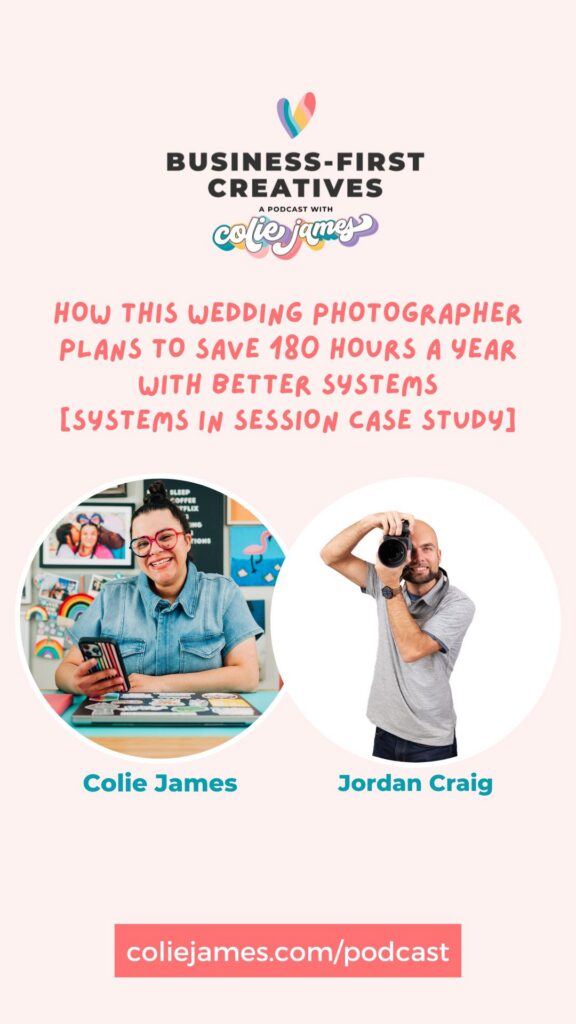
What if the biggest thing holding your business back wasn’t marketing, pricing, or lead generation, but the fact that everything lived inside your head? In this episode, I sit down with Jordan Craig, a wedding photographer who joined Systems in Session after years of managing inquiries, contracts, invoices, reminders, and client communication manually. Together, we unpack what happened when he moved from a patchwork process of Gmail, reminders, QuickBooks, and memory-based workflows into a streamlined Dubsado system designed to support both his business and his life.
Jordan shares what surprised him most about the experience, how automation improved his client experience instead of making it feel robotic, and why he believes he’ll gain back more than 180 hours every year because of the systems we built together.
Review the Transcript
Colie: Hey y’all. Welcome back to the podcast. Okay. I have yet another case study from Systems and Session. Are you guys tired of these yet? I feel like I’m showing you what my clients are doing when working with me, but I certainly hope that you guys are really taking something away from each and every one of these episodes, because the people that I work with are amazing.
But I also think that it’s really interesting to share their experience of setting up either brand new systems in Dubsado. Which is what I’m gonna be talking to Jordan about today, or really revamping the systems that they have already been using for years. And so today, Jordan is my guest. He was the first 2026 client inside of Systems in session, and so I am gonna be asking him a few questions that are very different than what you’ve heard before because things have changed inside of the offer.
Jordan, happy birthday and welcome to my podcast.
Jordan: Hey, thank you, Colie. It’s been really fun working with you the last few months, and happy to be here.
Colie: Ah, I mean, and it’s also such a delight that it is your birthday and we get to chat, on your birthday. I’m so happy that you made time for me. Let’s get like the elephant in the room out, if we will. Let’s talk about where you came from. So Jordan, what did your systems look like before you came into Systems in session?
Jordan: Great question. So the system was me essentially, and my Google Workspace email inbox, my Gmail inbox, and, um, I don’t wanna say scraps of paper, they were a little more organized than that. But yeah, it was, uh, you know, delivering galleries through Pixie set and then saw they had a studio manager. Technically it does keep track of things, but there are just about zero automations and,
I became my own.
reminder. Me and snoozed emails and apple reminders and kind of spread all over the place and then doing invoicing and QuickBooks, so having to copy paste lots of info to different items in the tech stack.
Colie: Yeah, so it’s really funny. This episode is airing and next week. They’re gonna hear from a case study client, Danielle, and she also came from Pixie Set, which I actually did not know until I interviewed her. And so I did give you a shout out inside of that, um, podcast episode. But what was funny was I told her the story of when you started telling me verbally on one of our calls.
All of the steps that you were doing to like book one of your wedding clients. And I’ve never told a client to just shut up, but I remember telling you yet, no, Jordan, you can stop talking. That’s way too much manual labor for me. Don’t worry, we are gonna automate as much of that as possible.
I.
Jordan: Yeah, that’s it. A lot of manual steps and the amazing thing is, you know. People from outside of my business who, who learn about what my process looked like, they’re like, how did you make it this far? And so the, the amazing part of that is I do deliver a very high touch, high level client experience. Just my backend is a mess, and it’s constantly me having to be tied to this desk for more hours than I care to admit.
Colie: Yeah, and I mean, I’m wondering, did I actually ask you the number of hours that you were spending? If you had to guess, Jordan, how many hours were you spending managing one client before and now? ’cause I know that you have had some booked clients inside your world using your new Dubsado systems.
How much time are you spending now managing that same client?
Jordan: Yeah, I know your, one of your monikers is the five minute. Booking proposal
And that’s really what it is now. It took, you know, some hours of work on the backend, but now looking forward, every wedding I book that proposal process is five minutes. And so, you know, I will earn back the time we spent setting that up within this calendar year.
And then every year thereafter is just. Time back that I didn’t have, but yeah, before it was anywhere between an hour and a half to two hours just during the proposal phase,
of that initial invoice, getting the initial questionnaire sent out, and the contract.
Colie: Yeah, I mean. You know what, I was gonna go somewhere with that, but I I, we’re just gonna, we’re gonna continue on because I know how much time you were spending before and it is just lovely now. ’cause I will say, Jordan, one of the most amazing things about having you as my client is every time you got on one of our weekly calls, you were so excited about.
Everything that you had done the week before and sometimes you had inquiries to talk about and exactly how awesome it was that automations just happened and people were getting emails. And then I remember it wasn’t even on a call, you specifically sent me a feedback ticket, a support ticket, and you were like, I don’t, I don’t have anything to ask you, but I just wanted to let you know that someone just booked my highest package ever and this process is so amazing.
And I was sitting next to my husband and I was like, oh my gosh, this is so great.
Jordan: That’s so true. Yeah. And, and really that came out of, hey. I need to build this proposal because I’ve got this inquiry. So they were an engagement client, but thinking about wedding. And so, oh my gosh, it was Super Bowl. It was the Super Bowl
Sunday. And
Colie: I was sitting next to my husband.
Jordan: that, there you go. And they had the call booked and um, we’re not big, you know, huge football people here. I booked the call ’cause that was what was convenient for them and, it was great. You know, the call went well and I was able to just be present and answer their questions and let them, they almost led that call essentially. And then I just pulled up the proposal page and within, they had viewed it that same day, and then they had signed the contract within a few days and I just let the automations run.
And then within a week they had done the first payment toward the
invoice. Officially booked. Yeah.
Colie: And I just wanna note guys, it took that Jordan doesn’t require immediate payment when they book. I mean, he does have a couple days Grace on there, so it’s not that they, you know, piddled through and that he had to harass them for the deposit. Wedding photographers tend to have a nice little buffer sometimes between.
When the contract is signed and then when the actual first payment needs to be made. So I’m, I’m just, I’m so happy that you know that you were still in systems in session when that happened because I sometimes don’t get to see, if you will, the fruits of my labor because, or our labor together, rather, because we’re working together inside this 60 days and not everyone has.
Inquiries that are coming in, or they finish the process early enough to where they actually get to see it go completely through with like multiple clients. So that part was awesome. I wanna pivot now because as my first client of 2026, you were one of the first people inside of the offer where I moved all of the email.
Like you mean materials in there for you to go through, you went through on your own. After that I started making the other systems and session clients do it inside of a group sprint. But you actually went through the materials on your own and so I want to say what did going through those trainings do in terms of what you ended up creating for your client communication.
Jordan: So the client communication was a bit of a surprise to me. I don’t know why, but I think in my mind I was like, yeah, it’s about the systems, it’s about the automation. And then like the light bulb came on going through the email, like you mean it and really like. It’s my own voice. And then, but using the, um, what are they called?
The chat g the GPTs that
you’ve, that are in there have been so helpful. I mean, even just yesterday I was responding to a client request and I wanted the wording to sound a bit more dialed in. And I ran it through your response strategist, GPT. It’s so helpful, but what I realized was. My old system, the one that depended on me, I was doing the bare minimum of communication because any additional incremental communication with each client, I would have to remember whether in my brain, in a snoozed email, in Gmail, or in an Apple reminders, you know, talking to Siri and I was like, man, it was so bare bones, but. What was it like 33 emails, I think by the end, and I was like, this is a lot, and it felt like a bit of a trudge for like three or four days. I kept whittling away at it, but coming out of that I was like, wow, I have been leaving my clients a bit in the dark for long stretches of time, and just having that whole framework of the right communication at the right time, whether they respond to it or not. I know I’m delivering an experience to them that’s more dialed in and, that trust feedback loop, you know, continues to build.
Colie: Yeah, and I mean, one of the things, ’cause when you went through email, like you mean it, I mean I gave it to you, but I didn’t actually assign it to you as a task. So I remember being so surprised when you sent me the first batch of emails that you’d written because you and I had had a conversation. I mean, we talked about the importance of client.
Education, emails inside of those gaps where you would normally not be communicating with your clients. You’re not actually asking them to do a task, but how can you communicate with them so that they still feel cared for and they know where they are in the process? And so. You came to me, I think that out of the 33 emails you ended up writing, 11 of them were what we would consider to be client education, and I remember having so much fun going back and forth with you about those emails because you.
A wedding photographer, you also offer many other things, including videography. And so I was like, okay, but when are you asking them to book your videography services? And then I went through your offers with you and I was like, okay, does everybody get a second shooter? Is that an a la carte thing that they book?
And so we were really taking a deep dive into your offer. To look at what was included. And in that space, we were like, how can we educate them on the additional services that they could book from you without actually asking them to pay you? Then, because the purpose of the education emails wasn’t to be like, and if you wanna pay for this, now, here’s a link.
It was more. Educating them to that. By the time you got to the point where decisions had to be made and like finalized about whether or not you wanted to add videography or drone coverage, or a second shooter that you felt like you had not only presented those offers to them. At booking, but also later down the road when they might have had like an opportunity to actually think about them a little bit more clearly than the beginning.
Because I mean, when you’re getting married, you’re like, I need to find my wedding photographer. I need to nail them down for my date. And I don’t really think that a lot of couples like think about the entire experience at that point versus later when you know. The ease of knowing that your photographer has been booked, and maybe now you really can consider what else you are able to book because maybe your budget’s changed or maybe other line items ended up costing less than you thought they were going to when you got into the wedding planning.
Jordan: Yeah, that’s exactly right. And it’s more of an ongoing conversation rather than a. Okay, let’s get the booking done. And I would always verbally say that whether it was on a, the intro call, um, or a follow-up, you know, timeline review call with them, I would always mention those things verbally, but it wasn’t written down in communication.
And it wasn’t in communication that was going out automatically without me having to sit there and literally write the email from scratch just about every darn time.
Colie: I love that for you, Jordan. I mean, here’s my question to you, because when I interviewed one of my other clients earlier this week, and I asked her what her favorite part of, and I guess I, I’m giving it away because her episode comes next, next week, guys, but I asked Danielle what her favorite part of the process was, and she was like, I.
Approving things while I’m at the park with my kids. She’s like, literally the things come across in her Dubsado app and like she can approve an email to be sent. She can, you know, click off that she did a task and she doesn’t have to be on her computer. So like, what is your favorite part of the process now that everything is said and done and I mean, Jordan, have you been out of, has it been 30 days?
I don’t even know that it’s been 30 days yet.
Jordan: I think it was mid-March, I
think was when we wrapped up and uh, it’s now almost mid-April. I can relate to the being in the park with my family and seeing things happening in Dubsado and it’s a notification sometimes and I’m just like, kind of nodding my head like, yep, okay. Awesome. That’s sweet. It, you know, it’s moving along and I didn’t have to be present for it, so to speak. The favorite thing for me is really. The reason I bought into Systems in session was I knew I needed that overall, really a, a system to run the business because keeping everything in my brain, the business would start to leach into other days and times, of the week for me. And, and that just, you know, that’s not why I got into business,, to let the hours kind of expand like that.
But the biggest takeaway for me is. Because I’ve now systemized the process from the very start to the very end, and identified all the steps, and they’re all contained in one place. I can really just walk away from that knowing, okay, there’s nothing undone here, and if there are other things I want to do that is more of a business development or a marketing task. That I can invest time in to build into the future, but I don’t have to do it right now in terms of taking care of my clients. The real operations or the production side of the business, it’s really, it’s all there. There’s all the steps, right in Dubsado, right in each project. Easy to look up and.
Colie: I love that for you, Jordan. I seriously, I love that I give you guys time back and more importantly, I love that we are taking. The mental load of running your business out of your head. Now, I’m happy that that’s what your favorite thing is. I think my favorite thing is that you’re never gonna charge somebody in QuickBooks again.
I gotta be honest, every time I get a client. That tells me that they’re charging in QuickBooks or at the Venmo. Oh, God. I can’t even believe I said that out loud. Every time I get a client that tells me that they’re, you know, charging people outside of CRM, I’m like, okay, but then you’re, you have to chase people down for your payments because, I mean, there’s not automatic reminders in the places.
And then when you collect payment in one place and you’re sending them a confirmation or next steps or whatever it is in another place like. Yes, it’s awesome that Dubsado will do things automated for you, but I also really think that we overlook the value of having things centralized and organized.
Because the one thing that I remember, I had a business that ran for. I mean about a year and a half with no CRM, and the worst part of the whole thing was I had to look in multiple places in order to keep track of one client. Like I was invoicing them in PayPal. I was collecting a contract and questionnaire in jot form.
I mean, things were all over the place. I was sending my emails in Gmail, and so if I was like. Oh, did I send the questionnaire to the client? Well, I would look in Jot form to see if there was a completed questionnaire, and then I would go to my Gmail and I would be like, oh, let me type in this client’s name and see if they were there.
And it was just all of the time that I wasted going between the tools. And so it’s like the one thing that. Doing your systems gives you is yes, you get this big picture. Yes, you really make sure that you are not leaving your clients in the wind, that you have kind of filled in all the gaps between the beginning of the service and the end of the service, but also you get peace of mind that if you need to find out one thing about your client, now you can just go to Dubsado and the payments, the questionnaires, all of the communication, you can see it all within one project.
And so I love that for you, Jordan.
Jordan: Yeah, no, that’s exactly right. And I’ll piggyback with kind of a second thing there, which is the service has occurred, the deliverables have been delivered, whether it’s the digital gallery, prints, the album, everything’s done. And then I was not really doing an offboarding, other than haphazardly, you know, as I would, would remember. Um, in fact, I had one like saved email draft that was asking for a review that I would just copy paste into a new email in the Gmail. And, and just like haphazardly, right? But I didn’t realize. The value to the client, but also the value to future prospects that I was missing out on by not systemizing the review, ask the opportunity for a testimonial, and then really parlaying that into a blog post, which is huge for getting found.
And also, like my wife is a huge, I’m the pictures person and my wife is the, the words person, and she would much rather stumble upon. A blog post talking about wedding photography and hearing someone’s story of their day and, and how the photography was done and, and how important that was, to go back and relive that most, one of their most important days. But I was missing out on all those opportunities because again, it was all just in my head and not in a way where it’s like, okay, here’s the steps that I do with every client. Some are automated and some get kicked out to me, you know, as a reminder or as a to-do in the CRM.
Colie: Yeah. So how do you feel about the balance? Because you were not one of those people who was actually scared of automation. I feel like you were asking me, is there anything else I can automate? But how are you feeling about your balance because not for yourself. But I get a lot of clients that are really concerned about automating things.
They feel like it’s gonna be too robotic. They feel like they’re gonna lose control of the process with their clients. And like you said, you were delivering a very high touch experience, but you were responsible for every single step that was happening before you moved your systems into Dubsado and join systems in session.
So I think my question to you is. Like, did we find a good balance? How are you feeling about the things that are currently being automated for you? And is there anything else that you wish that you could automate that I guess you’re not doing currently?
Jordan: I’ve come a long way with. The automation and it’s not really robotic because of going through the email like you mean it series and having that intentional time to, you know, go through and really write the emails in a personable way, that is my tone of voice. Um, so it really doesn’t feel robotic.
Um. I don’t even really see those emails, you know, unless a client replies to them.
Colie: Well, and I feel like once you start sending ’em out, your clients are going to reply to them. I mean, it, it has been lovely. A few of my systems and session clients have come back and be like, you know, Colie, I didn’t really think anybody paid attention to the emails that I sent. And they’re like, now that I’m sending these emails that I guess are walking my clients through the steps.
Always informing them what comes next. They were like, you know, the number of clients that are actually replying to emails and saying, thank you so much, or, you know, I really enjoyed reading this, or, oh, this got me thinking about this. I don’t think that anybody. Ever wrote emails expecting their clients to respond, unless it was an email that said, please hit reply and tell me this.
But like now my clients are getting responses. And again, it’s building trust. It’s like keeping the lines of communication open, if you will. And so, yeah, I love that for you, Jordan.
Jordan: Yeah, no, it, it’s really amazing. I’m looking forward to the day when that’s a more regular thing for me, and you asked if there was anything else I would automate. And really it’s. I’m in this, this moment where the wedding photography service is now fully built out in Dubsado. But as you know, there’s other services that I offer, like family portraits, engagement portraits and real estate. A little bit of a side turn there, but, I’m based here in Lake Platon, New York, and I’m a local go-to resource. I love what I do. I offer that really high touch. Fast turnaround service that I don’t see others doing in this area. And, so what would I automate? It’s the other service lines.
Because
when I go to onboard a client in these other service lines, I’m like, oh boy, here I go again. I am, what’s the definition of insanity? Doing the same thing, you know, over and over
again, even though you know there’s a, a better or different way to do it. And, So that, that’s the next thing for me to automate and, uh, you know, looking ahead in, into May and going into the summer,
Colie: Yeah. And Jordan, you know what I’m gonna tell you, right? Even though you don’t see my lovely face every week, uh, you should probably put time on your calendar. Every single week to get in there. ’cause one of the things that you experienced that I wasn’t doing in systems and session before was I required you guys to have the four weekly calls that were pre-scheduled and then you got a hold of the scheduler where you could book Friday calls if you needed them.
And yes, guys, Jordan was the first client in 2026 and he’s also the first client that booked a Friday call. ’cause when he booked it I was like, oh, I forgot that link was even out there when he appeared on my scheduler. But. What I would say, Jordan, is I want you to try to keep the same habits that you had when you were working with me in that shit doesn’t get done, Jordan, unless you make time for it.
And I feel like you know that. And so this is me putting on a little bit of my coach hat, my accountability hat, and saying. If you’re gonna automate all the rest of your services to the level that we got your wedding photography to, you are going to have to make the time. So put some time on your calendar.
And you know what, you should totally just send me updates when you do them so that I can give you your gold star for the week or for the day. But you and I did talk about. Real estate, and the opportunities for automating not only the real estate bookings that you were getting, but specifically because if you’re getting real estate bookings from like the same people over and over again after you’ve worked with them one time, there are opportunities to shorten the inquiry and the booking process for those after you’ve already like, you know, talked to them, made sure that it was a good fit, done at least one service for them.
And so. I mean, you and I discussed your volume and I, I don’t know if the other ones would take priority, but if I get a say so, I would say, you should probably do your real estate next. And you know, if you sat down and you did it, Jordan, you could knock that out in less than a week. So I need you to do that.
Jordan: Yeah, I, I totally could. And the real estate clientele is very different than, it’s more of a B2B relationship. whereas I see more like crossover or corollaries from the wedding photography going into obviously engagement photography and family sessions, because it’s more of that, you know, consumer facing. mem, you know, documenting and interpreting family memories really
is what it comes down to. So, um, but no, I’m excited and, uh, yeah, it’s, but the amazing thing is like back, I looked back and we had first, I had first become aware of you back in like
September, which was, is the height of my busy season here.
Right? The end of summer, going into September and October. The leaves change colors up here in the northeastern US and it’s beautiful. And that’s when a lot of people want their weddings to, to be, and when a lot of people want their portraits to be, which is amazing. and I just kept telling you, Hey, Colie, I’m interested. I’m in the middle of my busy season. I’m not ready. But thinking back to there, like I did not see a way, a way out of my very manual process without. Some either long process or dropping a huge, you know, five figures worth of investment into some kind of a system. I didn’t realize that there was a way to have a a done with you type of solution where, some yourself would be able to teach me, but also not just the teaching. These little tools that make such a big impact, like the custom GPTs where I’m like, I don’t like to write these emails every time. Every time I do, I feel kind of clunky and like I have two left hands, you know, but the GPT took my two left hands. And, um, developing that like voice snapshot
and then running all the emails through the voice snapshot, it was like, oh man, like this got 90% of the way in a few seconds rather than me toiling away for half an hour.
And, you know. And trying to come up with the perfect word Yeah.
All of that.
Colie: I mean, sometimes we just all need a little push. And you know what, Jordan, I forgot how many times I followed up with you. So everyone listening to this podcast, I just realized, I think I followed up with Jordan four to five times. I mean, and now I’m gonna go look just so that I can be sure. I had honestly forgotten that Jordan, but Jordan had joined a wait list.
You know, I was checking in with people on the wait list as I had an opening, and Jordan didn’t actually join Systems in session, I believe, until October. So I mean, I That makes sense though, like you were done with the height of all of your sessions and then you were finally able to like, think about what you were gonna do.
In the off season. And the funny thing is, you know, you decided to join for January, which everybody wants to do their systems in January, which is great. But I feel like we really picked the absolute perfect time to work on your systems because our goal for you as a wedding photographer was to get most of it in place before Valentine’s Day, which is when we thought you would be getting a lot of inquiries.
But guys, Jordan, he created his contact page in Dubsado. He put it on his website, and was it four inquiries the next day?
Jordan: Oh yeah, it was like that night and then one or two more. The following morning. It was, yeah.
Colie: And I remember you being like, is this, is this normal? Like, or is this just a coincidence? And I was like, Jordan, I have never had anybody turn on their contact form and wake up to four inquiries after not having one in Dubsado. No, it’s definitely not anything that we’re doing. It just happens to be a coincidence.
But yes, um, let’s also take advantage of this and get your system set up as quickly as possible. And it’s funny. This is a really great segue to kind of talk about how you spent your 60 days inside of systems and session, because everybody goes through the program at their own pace. You don’t need 60 full days to do one offer.
I say that often. It is to give you space and time to where when you need a little extra, you know, time, a break, whatever it is that you can take it. And I will say you went really hard for the first three weeks. Jordan finished almost everything for his main wedding photography offer in 30 days, including switching everything to a brand new CRM, writing those emails, creating his proposal, his questionnaires, like all of it, and getting it in there ready for me to test, but then.
There were about two weeks after testing where you went really silent and then you came back on the backend. And so I’m only bringing this up because Jordan did amazing things in systems in session, but like also his life was Lifeing and he had like a lot of sessions and work during those two weeks where he sent me a note and he’s like, Colie, I’m so sorry.
Like I really wish that I could do these things right now, but like. I have all of these sessions and I was like, no, it’s great. Like that’s why I give you 60 days. But I mean, did you feel like the 60 days was enough to get the wedding photography done at a pace that you were comfortable with? I.
Jordan: Oh yeah, definitely. And that was part of the reason I booked it was because I knew there would be some flexibility. And yes, in the summertime I’m doing a lot of weddings, a lot of portraits. That’s my my primary jam. But in the wintertime I do more commercial winter sports. Media production and there are world cups that come through Lake Placid all the time.
And I’m honored to, you know, be asked by different entities to go and provide coverage for those, uh, high level, you know, international events. And those are long days and I’m like, I am not building a workflow right now. I am delivering a service at a high level, um, to, to my corporate clients. And, um. But yeah, that 60 days provided enough margin, uh, to where I, I knew, ’cause I started mapping out the 60 days and I was like, okay, the middle and the end, there’s a couple of world cups in there. So these first three weeks I need to go hard to really, you know, get the value out of what I’m investing in here.
Colie: Okay. I asked you what your favorite part of your system was. What was your favorite part of systems in session? I’m pretty sure I asked you this on the offboarding call, but I don’t remember your answer, and so I’m gonna ask you again, what was your favorite part of the actual service?
Jordan: There are two things that jumped in my mind. The first one is my favorite part. Of systems in session is being able to, as a first time Dubsado user, go in and start creating assets and putting things together with someone shoulder to shoulder with me, who’s been through it dozens, if not hundreds of times with the setup.
So knowing that I was dialed in. Getting it done correctly the first time. That was my favorite experience because that
was what had kept me stuck in the manual processes for so long was, okay, I know I can go get HoneyBook or I can get Dubsado or whatever, but I would read on the forums like, it’s really complicated and you wanna make sure you set it up correctly so you don’t end up, you know, creating more problems for yourself and more work for yourself. And I was like, okay, well. So I guess I’m not gonna do that. Um, so that was the biggest thing, was having that kind of shoulder to shoulder relationship of like, Hey, I would like virtually elbow you and say, Hey, clink, I need help here. What, what do I do with this? Or, you know, why is this a public link versus a private link?
What does that
even mean? Um, what does the terminology? So that was my absolute favorite. And then the second thing was turned into a favorite that I didn’t even realize, which is. I had kind of dabbled in chat GPT or like using it to help me formulate email responses, but it wasn’t really in my voice.
And there were always like five hyphens, you know those long hyphens where you’re like, no one uses the long hyphen. And then I didn’t even realize, I’m sure it was in your sales page somewhere, but I didn’t realize I was going to get access to. The custom GPTs, and I didn’t realize like how powerful that was to leverage to help me get where I wanted to go, but without feeling like I was back in English class, having to write essays again. It spits out a pretty good 90% of the way there. First draft, and then tweak a few things to make sure, and then your, your three Ps process, you know, is kind of the check and balance at the end to say, Hey, is this email actually, you know, doing what it needs to do? So
I gave you two things instead of one.
Colie: Oh, it’s okay. I appreciate it. I think I’m gonna ask you a follow up question because I think I know the answer, but I wanna just make sure. When you said that you knew that you could pay somebody five figures to set it all up for you and you just didn’t wanna do that, was it just the budget or was there another reason that you didn’t actually want someone else to set it up for you?
Jordan: yeah, the, the, the, you know, larger investment was part of it, but the other part is like. don’t want this software or this process to feel alien to me, or if I go and, you know, right now I’m looking at onboarding a virtual assistant, I, I have always felt that as the manager, as the owner, I don’t have to be involved in the nitty gritty per se, but I need to understand how to do it and understand how it works. And so. I just wasn’t aware of an offer, like what you do, Colie until, however we ended up connecting an Instagram ad, or I forget where it was exactly, but
Colie: Oh, I can tell you that ’cause I looked it up recently. You joined my email list off of a training that I did last summer called Charge More, stress Less, uh, with my friend Maddie Peschong. And the thing is, I didn’t market that at all. Maddie did. So clearly you found it off of her Instagram feed, which is hysterical ’cause I don’t really post on Instagram anymore.
Um, so no. I mean, I’m gonna have to, you know, give Maddie a hug when I see her next week and be like, yeah, my awesome client Jordan came from you posting about me on Dubsado. ’cause it was really funny. She was marketing, you know, that webinar, which was all about systems. And yes, Maddie has awesome systems because I built them for her, but she also had systems before that.
But if you looked at her Instagram feed. When she was marketing the webinar, you would’ve thought that she was the systems person. And it was actually funny because I had a conversation with her coach just off the cuff for a different reason and she was like, yeah, I was looking at those, those posts that Maddie was putting out.
And I couldn’t figure out why until I realized that you guys were doing a webinar together. ’cause it was, I mean, it was really out of left field, but also. Note to self, I need to go back on her Instagram freed and just like steal all of those posts because they were really good. Clearly they brought me you.
They were really good.
Jordan: I had even forgotten about that, but you know, obviously it was a felt need for me to, to invest in, in systems and because of that, I became aware of your offer, which I’m so glad I did.
Colie: I mean, and it’s really funny because think about it, if I wasn’t tracking. Where you came from or the first opt-in that you did in my world or any of those things, I wouldn’t actually know that that was how you found me. So I mean, you know, listening audience, it is very important for you to track where your people come from because.
It helps you with your marketing efforts to know what is actually bringing the clients in, because a lot of us waste time doing a lot of marketing activities that seem like they’re doing a lot. ’cause you know, Instagram likes are super awesome. I mean, they give you a little, what is it, a dopamine hit.
But at the end of the day. If you’re not actually getting people who pay you that find you on Instagram, you might need to find some other marketing activities to do, which you don’t have that problem, Jordan. I mean, and I can’t wait to see what happens with you now that we’re gonna have some blog posts up and like you, you did some updating on your website.
I mean, that is also the problem with updating your systems is then you have a bug to update everything.
Jordan: Oh, I got that bug so hard. Like multiple bugs of, because the system touches everything. Like a good system does, right? A holistic system. And like I kept on going down the rabbit hole of like, yeah, creating new pages on my website and all these things that like, so. There’s a, been a backlog of essentially, and Colie, you know, we’ve got, my wife and I have a five-year-old and a three-year-old, and when that second child arrived on the scene, it was like, yeah, building of systems and stuff is on the back burner.
I’ve got plenty of clients this year and I reasonably have enough for next year. And so we just keep going. But going through systems and session kind of, yeah, that bug of like, oh, all these things that were on the back burner that I had wanted to do to uplevel my positioning and better serve my clients with better information had just fallen to the wayside in, in the throes of, you know, parenting two. Little ones and, um, systems and session helped kind of reignite some of those thoughts and, and motivations and, and not just that, but like actually during the 60 days, even doing some of that, some of my first blog posts in a long time, so.
Colie: Absolutely. And it, it’s really interesting that you brought your business and your children both into the conversation because when I’m trying to tell people, when you do your systems and you do them well. And you, you know, ma, you, you get rid of all the manual things that you’re doing and you replace it with some streamlined systems that are semi automated for whatever makes you comfortable.
Every hour that you spend comes back to you tenfold, but then you get to decide how to spend that time. Like for you. If it means that you have more time to take the wife on a date night or spend time with your children, that’s great for you. But on the flip side, if you have this backlog of things that you’ve really wanted to do in your business, whether they are systems related, uh, your website, or if it’s marketing to get more clients.
Setting up the systems is what buys you back your time in order to do those things. And I personally don’t care what any of you do with your time, as long as you get it back for something that is meaningful for you. And I would say for, for most of my clients, it is like, oh. Almost a 50 50 split. Some of them say, oh no, I really wanted to enjoy more time with my kids.
And the other half is like, no, like I really wanna grow my business. And now that the client experience is streamlined and I am not personally responsible for every single step, I finally have time to do these other things that I know need to be done in order to help me grow my business.
Jordan: That’s it. And you had asked me earlier how much time I did like kind of a back of napkin rough sketch. It was at least 180 hours this calendar year that I was anticipating getting back, um, you know, assuming that the system was fully built out. Yeah.
Colie: Hundred 80 hours and wait, that’s just on your wedding clients or are you already anticipating for the
Jordan: that was as, that was assuming that the other service
lines had been brought in except for corporate. ’cause that’s, that’s a different kettle
Colie: That’s a different ball of wax.
Alright.
Jordan: was, if I had brought all of my portrait and real estate service lines, when I do bring them into Dubsado, that’s what I’m projecting to get back every year.
But not just this year, but like next year and the
Colie: Yes. And the year after. Yes. I, oh, I, I do know what you mean. Um, I feel like it’s funny, I had a call earlier with someone today and I was like, I’m gonna make sure that I email you on this day, Jordan. I’m gonna make sure that I notify myself to send you reminders because right now it is mid-April.
It is your birthday again. Happy birthday. Uh, I imagine that you’re really not gonna get into the. Throws of your sessions in terms of weddings and families this summer until at least mid-May, late May, right? That means you have a month, Jordan, you have a month. I really want you to nail your other systems in this next month so that you really can get 180 hours back in the year.
I’m so glad you gave me that number. That’s amazing.
Jordan: yeah. It is
Colie: Well, Jordan, is there anything else that you found surprising about systems in session that we haven’t already talked about?
Jordan: Uh, I am sure there’s other things, but the biggest surprise, like I already said, was leveraging the custom GPTs with the lessons through your, uh, portal,
and then having you there for those weekly calls for accountability Just. Um, the surprise was the custom gpt, I think, and understanding how much leverage that can give me to quickly, more quickly write these emails while still being in my own voice.
Colie: It’s so funny that you’re mentioning this Jordan, because it’s literally on my backlog to add the information about email, like you mean it to the sales page of systems and session. ’cause the thing is, even before I fully moved the entire trainings on emails into the resource hub, I was always giving my clients access to the gpt.
They just got the gpt, like I didn’t load the videos and the private podcasts. That wasn’t done until the beginning of 2026. And so after you did it on your own and then I had a bunch of clients that went through the February sprint, it’s been on my list of things to do to kind of highlight this on the sales page so that everybody knows that, hey, we are gonna nail your customer journey and your client communication before we talk.
Or take any steps towards anything else in your systems. And so now, I mean, I’m gonna give myself homework. Jordan, I am gonna make sure that I told you you have a month to work on your systems. I’m gonna give myself two weeks. Then I’m gonna make sure that the sales page talks about the gpt because you know, it is a, it is a surprise and a delight, but I don’t necessarily want it to be a surprise.
I want you to know that you’re getting them. I want you to know the value of them and how it helps you when you are creating your systems, because there are still some people that are very, they don’t really want AI in their world. That’s okay. I always say using those tools is completely optional. We’re gonna get your systems done regardless.
Jordan: Exactly, and I think you’re so smart to include it in systems and session because basically you’re, I’m excited for your future students because they can do a lot of that pre-work. And then, like I did in those first 30 days, really focus on building out the workflows. Um, kind of having that, that jumpstart with knowing, okay, this is actually the client journey that I’m currently providing. Then let, okay, I’m gonna optimize it and this is the client journey that I really want to provide. And now I feel like I can because I have a system that’s helping me keep track of it all.
Colie: Jordan. Thank you so much for coming to talk about your experience in systems and session. I will admit, like I wasn’t sure if it had been 30 days because I miss talking to you every week. I mean, so you’re gonna have to send me updates, you know, and actually, maybe I should put that as part of my process.
I actually have a form that I intended to send you guys every week when you left, and it’s ready. And I think the automation might actually be created, but I’ve never turned it on. So I don’t know if I’m gonna send you guys forms or if I’m gonna just send you emails that are like, Hey, I would love to know how your systems are treating you.
If anything you know has made you super excited, please let me know. But I do really cry in a corner every time one of you leaves. But I know. That at least you left systems in session better than you came, at least in terms of making sure that your business is working in the way that you want it to and getting back the time in your life to spend it as you see fit.
Jordan: A hundred percent. I really enjoyed the experience and, and the progress and transformation that it’s made in my business so far.
Colie: Ugh. All right guys. You’ve listened to Jordan talk all about systems in session. If you are like, Hey, Colie. Like that sounds pretty interesting. I wanna hear more. If you would like to read about systems in session, and by the time this goes live, there will be an entire section talking about the gpt. Go to Colie james.com/systems.
Uh, I’m gonna end this episode because I could literally sit here and ask Jordan questions for like another hour, but unfortunately, I booked lots of calls today. And also I wanna let Jordan go and enjoy his birthday. So that’s it for this episode. See you next time.
About the Guest
I’m Jordan, a photographer and filmmaker based in picturesque Lake Placid, New York. My hometown inspires the imagination of all who visit and live here. I work with local and international clientele and have captured hundreds of adventurous moments and meaning life moments. I’m for those drawn to meaningful moments and this wild, beautiful place of the Adirondack Mountains. In my downtime, you’ll find me adventuring in the High Peaks with wife and our two young children.
Find It Quickly
00:24 – Meet Jordan
01:32 – The Chaos Before Dubsado
03:38 – Five Minute Proposals
07:15 – Email Like You Mean It
13:39 – Centralized CRM Wins
17:14 – Offboarding Reviews Blogging
18:54 – Automation Balance
21:08 – Next Services To Automate
24:33 – Timing Inquiries And 60 Days
30:17 – Favorite Parts And GPTs
Mentioned in this Episode
Systems in Session: coliejames.com/systems
Email Like You Mean It: coliejames.com/email-like-you-mean-it
Connect with the Guest
Website: jordancraigmedia.com
Instagram: instagram.com/jordancraigmedia


Signature Series


Your business works, but your backend is costing you.
A 4-Part Audio Series for service-based business owners who are ready to upgrade their “just fine” client experience, unlock higher pricing, increase referrals, and grow more sustainable revenue—without overworking behind the scenes.
Get the FREE 4-part audio training series
Systems That Sell


© 2022-2025 Colie James


