
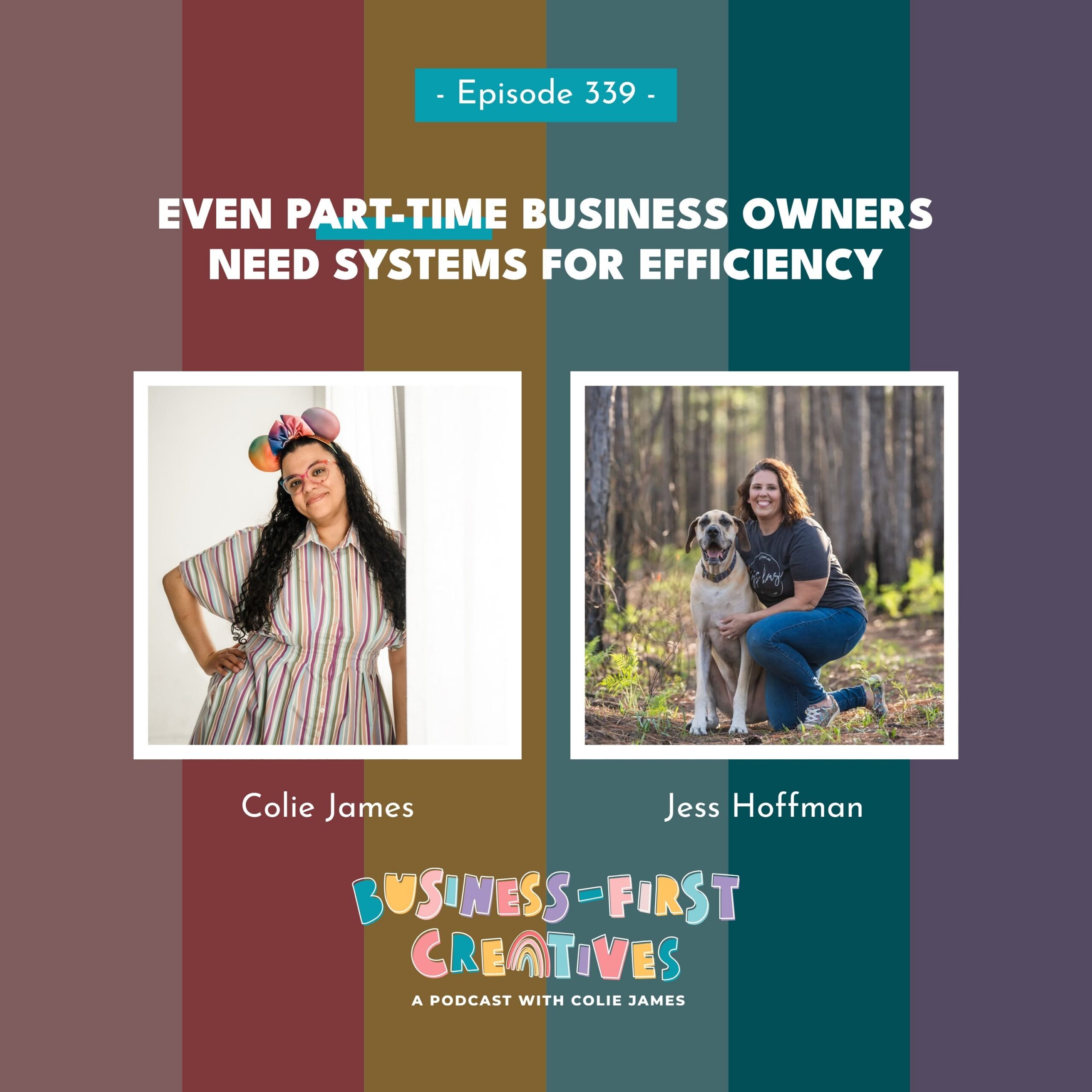



If you think you don’t have enough clients to need systems in your business, this episode might completely change your mind. Whether you’re balancing a business with a full-time job or running a part-time side-hustle, you don’t have less need for systems—you have less time to operate without them.
In this episode, I’m chatting with my client Jess Hoffman, a Florida-based pet photographer who runs her photography business alongside a full-time corporate job. Jess and I have worked together on her Dubsado systems and client communication, and we’re digging into what changed when she stopped trying to piece everything together and built a client experience that could actually support the way she works.
We talk about replacing required discovery calls with a book-first process, using video to educate potential clients before they book, and automating client communication without losing personality. Jess also shares how making one simple change to her booking process led clients to prepay for her highest collection—before she even photographed their session.
Review the Transcript
Colie: Hey y’all. Welcome back. So it’s extremely rare that I get to meet my clients in person and give them a physical hug, but today I am interviewing Jess Hoffman and she is one of my clients many times over and a few months ago, she came to Colorado and I got to take her to brunch at my favorite place.
Snooze. We are gonna try really hard not to just talk about pancakes and brunch this entire episode. But Jess, welcome to the podcast.
Jess: Hey, Colie. Thank you. It’s exciting to be here
Colie: Ah, I mean, it was super exciting to meet you in person and I mean, don’t get me wrong, I will just about take anybody that I don’t hate to brunch at snooze because I’m always looking for an excuse to get some good brunch. But also I love you and I was so excited when you came to visit so that we could go and like sit and have a meal and just converse about not all things business.
It was amazing.
Jess: Yes. It was so fun and definitely a great, uh, food choice
Colie: See, everybody loves snooze. And it used to be that I would tell people, oh, it’s like a Colorado treat. ’cause it is like founded in Colorado. But I mean now they exist. I mean, I think they have one in DC and Chicago now. I mean, they’re in Texas, they’re in California, so it’s no longer. Like a Colorado secret.
So everybody listening to this episode, if you don’t know if you have a snooze in your location, their logo, their color palette is like orange. So you will definitely know it, but like, go look on the internet and see if you have one near you because the food is amazing.
Jess: No doubt.
Colie: So Jess, you live in Florida. And you are a pet photographer and you run your business also having a full-time job. So tell me a little bit about why you started your pet photography business. Like what made you pick up a camera?
Jess: So at the time, I had moved to a city for my real corporate job where I absolutely knew no one, and then COVID happened. So I had had a camera from years before and I had my dogs, and that was the only thing I could, uh, do. So I was just out playing with my dogs, picked up a camera again. After many years I had done land scape like in high school.
and yeah, Then I realized that dog photography was a thing and there’s this whole community and, um, I just kinda dove into that and it was, it’s been fun ever since.
Colie: So what made you actually start charging people money for it and though, and photographing other people’s dogs? Because, I mean, I feel like you’re a little different. I feel like when it comes to like mothers picking up their cameras and taking pictures of their children, that’s what we hear all the time.
And I don’t often hear it from a dog mom. So I mean, was it the same feeling like you were photographing your dogs and you were like, okay, they’re cute, but like I need some variety. Like, is that how it went?
Jess: Um, sort of, it was like definitely, yes. They’re cute. My oldest dog at the time, she was getting older, so yeah, having good pictures of her was really important. But honestly, taking pictures of your own dog by yourself. It’s really hard, um, especially when they’re not really well trained, which mine are not. So it was honestly is I wanted to take pictures of dogs, but I thought it’d be weird to just be like, Hey, can I take pictures of your dogs? So I made a business and then it sounded more legit, like, Hey, I have a pet photography business. I’ll gift you a session. ’cause really I just wanted to practice. I didn’t think, um, you know, I needed to learn how to work with dogs in that capacity and everything.
So yeah, I kind of did it backwards. I started charging pretty much from the beginning. I mean, I gifted some sessions, but then I charged for prints and, and stuff like that from the beginning, pretty much. I might even did two or three, like completely free practice shoots, but yeah, I was just like, yeah, here, here, this is what it is and this is how I’m doing it.
Colie: So,
Jess: someone to hold the leash.
Colie: you just wanted it as a creative outlet and you needed somebody else to control a dog so that you could photograph them, and so you literally just charged money, so you were more legit. Okay, guys, I did not know this origin story. That is not where I thought this was going, and this is. Fucking fabulous.
Jess: Yeah. I thought I’d look like a crazy person just walking up to a, a person at the dog park being like, can I take pictures of your dogs? I didn’t think anyone would say yes. ’cause that’s just strange. I.
Colie: Legitimately I have, I, I, I don’t think I’ve told you this before, but I used to have those thoughts in Target. I mean, I don’t shop at Target anymore, guys. No one come for me. But years ago, like I would be on the aisle and I would see like a mother to be with a big belly or like somebody holding a baby.
And I would think to myself, I mean, I just wanna go up to them and hand them a business card and be like, can I photograph you for free? Literally, I used to think that before I started my business, and so it’s so weird to hear you say that about dogs at a park, because I definitely felt that, I mean, I started my photography business because I didn’t wanna go back to the classroom and I didn’t really know what else I wanted to do and I was like, oh, photography.
I love it. I wonder if I can make enough money doing it. That was literally how I started my business. But also it was, I love babies and I just wanted to photograph everybody’s baby. And if you’re gonna pay me money to do it, uh, game on. Let’s
Jess: I seen on the cake. Yeah.
Colie: So how long were you photographing? Actually charging people running a business.
Before you started feeling like you needed systems, like how did you first approach creating systems for your business? Because you are very part-time, um, I mean, you’re not being overwhelmed with leads. So what started your journey on systems?
Jess: I think I’m a very, just from my corporate background, I love spreadsheets and systems and things like that. So anything that says systems in the name or organize or whatever, I’m like, Ooh, yes, let me read. So pretty much from the beginning, I think I’d found, the, , simple sales blueprint with anime. And so I went through her course because I did one like in-person sales. And I, I don’t like this. And I was like, if I have to do this, then I’m just not gonna do it at all. And then I found her and I found her method and I was like, okay, I can. Work with this. So from there that kind of gave me a good basis of systems.
And she talked about Dubsado and, you know, pick time and the systems she uses. So I kind of just, I was like, yeah, sure, why not? Let me go that course. And it just seemed, like I said, I just want everything organized and laid out. I mean, you’ve been in my dip, you know, I like deleted you as soon as you were out of there.
You’ve like, you’ve like, no one’s
ever done that before.
Colie: that reminds me the other day I was telling that story and I literally did not remember who it was, and now I
remember it was you. So guys, I do this thing where when you’re my client or you hire me for an audit, which Jess is both, she did hire me for an audit. She’s also a. Student in a couple of my courses, but when I did, uh, an audit for her, what I do is you add me to your account as an admin.
I go in there, I create a project as a fake client, and I run the whole way through. And usually I go through and I delete my projects at the end or I do these things. But what happened in Jess’s case is I went in there to create a new test project because she was in the blueprint in the last run and I was trying to show her something and I was like, oh, okay.
I don’t have any archived projects. That’s cool. And then I went to make a new project and you go to the client list and I typed my name. And I was nowhere to be found. And I was like, wait, you deleted me out of the address book. I was like, no one’s ever done that before. So she’s someone who cannot stand digital clutter.
Jess: Yeah. No Uhuh. So yeah. Sorry.
Colie: That’s okay. I mean, I, and then I went back in, I’m sure you’ve already deleted me again, which is okay. I’m not gonna take offense, but, okay. So you wanted systems from the beginning and that was leaning more towards, you have a corporate job, you know you are familiar with systems there. So you created simple sales.
Did you feel better about collection purchases and selling and all of that after you implemented simple sales versus that one and only time that you tried in-person sales?
Jess: Oh yeah, definitely, because, um, I’m not one of those people who likes to like, feel someone looking over at the car. Sh like on my shoulder. Like if I walk in the store, in the mall and you come and say hello to me, I turn around and I walk out. Like, I don’t wanna talk to you. Like, I wanna make the decision on my own.
I don’t wanna feel pressure. Um, and if that’s how I feel, I’m sure there’s other people that feel that way too. So I was just like, you know what? This gives him a little bit more time. But it’s still guided. Um, they can still contact me with questions. So yeah, it was just like, I’m not gonna be the, not that you’re a car salesman if you do in-person sales, but that’s just didn’t feel good to me.
And I was like, no. But yeah, just having that simple sales through pick time really worked well.
Colie: No, I mean, I do feel like everybody should really lean into what feels good to them, and I know there’s that stupid saying, you’re not your client, I get that. But if you feel very strongly about not doing something like in person sales or feeling like someone. Is like looking over your shoulder. You certainly don’t want your clients to feel that way if you feel like you are attracting like-minded clients inside of your business.
Jess: Right. Yeah, definitely.
Colie: Yeah. So let’s talk about the systems that you actually implemented. So first you created Simple sales, which for those of you that are not familiar, I, I don’t understand why you wouldn’t be, but the whole premise of Simple sales is you are charging them a session fee upfront. So it is a pay in full. For those of you that are thinking about like Dubsado, HoneyBook.
Terms, they pay a session fee up front. It does not include any photos, um, any products. You are presented with a slideshow after of the entire gallery. Then you choose to purchase one of three collections. At that time, all three collections include a certain number of digital prod, uh, digital photos for download, and then a certain amount of print credit.
So how did you go from simple sales to knowing that you needed to implement the inquiry and booking process, if you will, inside of A CRM? Did you already have Dubsado when you got simple sales or did you choose Dubsado after?
Jess: I chose Dubsado after. But I, I pretty much implemented it all at the same
time. So as I was going through the course, I was just like, okay, this is what she recommends. Let me just, you know, go through that. But I didn’t, until I found you. I didn’t really utilize Dubsado as well as I could have or should have.
Like I wasn’t afraid to get in there and. Make a workflow, but we learned as I, or I learned as I worked with you, that, yeah, the way I had the workflow, um, working or set up was never gonna work the way I thought it was gonna work because of the nuances of Dubsado and stuff. So I’d been kind of struggling with the workflows, quote unquote, not working. , For a couple years and then it was like, oh, okay. I just didn’t know what I, how it worked and should work until I started working with you and learned, you know, your methods and rec recommendations.
Colie: Yeah. So Jess was a student in email, like, you mean it. But as I mentioned earlier, she hired me for a workflow audit, which is basically where I go entire client experience from beginning to end.
And I give you an action item list. Like I go through and I’m like, Hey, this trigger will never work the way that you have it set up, you should probably choose this. Or, here’s an alternative if you wanna think about this. I mean, what I give you is. Basically a list that you can check off one by one, but some people still want, you know, help handholding a full system to implement.
So when I gave you your action item list from your audit, did you attempt to fix those things before you joined Blueprint or did you just decide, Nope, I just want Colie to give it all to me in a box. I’ll just buy the course.
Jess: I think it was just like, Nope, I’ll just jump in on the course. Um, it would just be if I’m gonna pay for Dubsado, I wanna be using it right into like its full capability and Colie knows what that is, and so why waste my time trying to figure it out and piecemeal it together. It hasn’t worked this long, so let’s just jump in and do it.
Colie: Jess, you are definitely my kind of person. So let’s talk about one of the things that we implemented when we actually did jump into your systems, because I’ve already mentioned you have a full-time job, like you don’t have a lot of time to be wasting on people who are inquiring about your services and perhaps are not ready to commit to a session or just in general, just making the space on your calendar.
So what. Prompted you to consider like making the sales call or the discovery call the second option instead of immediately requiring them to book a call? Like what? What brought on that shift? Had you been thinking about it before I mentioned it, or was it my suggestion that pushed you to kind of go a different direction?
Jess: I, I mean, I thought about it, but you always hear of the whole, you need to be personal, you need to talk to, on videos, not where it’s at. Well, that was like two or three years ago when I started, and now things are shifting. People wanna do things when they have time at 2:00 AM to do things. So when you mentioned the video, I think it was just that final push I was like. That would be better for me. Again, if I were my client, I would like the video. So yeah, I was just like, yeah, let me go ahead and do that. And um, it seems to be working pretty well,
Colie: I was gonna say, it’s actually been a few months now at the time of this recording, uh, how has the videos gone? Like, have you seen any di, I mean, ’cause you had a great, uh, conversion rate anyways, but how are your clients feeling about that initial video that you’re sending them instead of getting on a discovery call?
Jess: It seems to have not really made any difference in the conversion. I think it clearly lays out what to expect. I don’t think it’s as short as it could be, so it might be a little too long. I still need to cut down some words
there, but I, for me, for the most part, I think it clearly lays out what they’re looking for, and then if I have a client that has any more questions, it’s really not that hard to jump on a call or pretty much they’ve just emailed me, I’ve answered it, and it’s, it’s been from there. So I, I think it was time saving for everyone involved.
Colie: How are you feeling about not having to be available for the calls? Because I know, you know, working your full-time job, you’re trying to do it over lunch or you’re trying to do it at the end of the day. I mean, has it, have you felt any different about not having to make the time for the discovery calls anymore?
Jess: Well, it’s nice ’cause I would try and keep them pretty much after work. So then it’s like, okay, well we can’t do anything tonight because I need to, like, I’ve got a call at, you know, six o’clock that’s kind of like in the middle. You can’t do anything before. You can’t do anything. I mean, I guess you can do something after.
But I’m an early bird so I was like, yeah, it just
Colie: I like my sleep.
Jess: Yeah, it like ruins your whole evening. ’cause you can’t go anywhere after work. You’re like tied to your computer. Yeah. And so now I don’t have to think about it. I can go take the dogs for as long of a walk as I want. And you know, too, I was doing sessions at night after work or I do sessions at night after work a lot. So I can’t do a call the same night. I’m gonna have a photo session because it takes me an hour to drive. So by the time I get off work, get to the location, I mean, I don’t have time to throw a call in there too. And, yeah, so it’s just cuts down so much stress of thinking about when I need to carve this out.
Colie: Yes. Okay. So I wanna kind of go backwards because before we set up your full systems, you did email, like you mean it. So in general, how do you feel about client communication in your business? Like. Do you think that it’s important, or do you think that it’s just something that has to be taken care of?
Jess: No, I think it’s really important. You give your voice through your emails. To have it clearly laid out. So there’s no questions in your email. Like you mean it, you have, you know, your PS and the purpose for every, and it made so much sense. It was like, oh yeah, I would feel like, oh, I don’t wanna send them an email.
Well, it was because I didn’t know why I was sending them an email. I felt like I needed to, but I wasn’t really sure what the purpose of the email was. And there’s so many people who are like, oh, I’ve got 90,000 unread emails. I didn’t even see it. Um,
Colie: Are you calling me out right now? I thought we were friends.
Jess: I don’t have that digital clutter, but I hear that that’s a thing I, I couldn’t imagine.
Colie: Look, I’m, I’m literally looking in my Gmail right now so that I can see how many emails I have. No one. Oh wow. It’s 116,995 emails.
Jess: oh my God. I, I have heart palpitations.
Colie: It’s okay, guys. I promise she still loves me. Okay. Let me put my, let me put my phone back in podcast mode in case someone tries to call me. So out of all of the emails that you now send to your clients, do you have a favorite.
Jess: Oh, probably via first initial contact. I feel like it’s much more, clean but personable and still straight to the point. Like I feel like I get my personality in there. I think that was a lot about the email. Like you mean it is like still conveying your personality. So I can still convey that in the email, but it also, again, has straight to the point, adding the video in there too.
I can be a little bit more personable with the video. I don’t do a custom video for every single person. I’m just stuck with the, you know, one kind of generic video. But I, I, it just conveys, and I don’t think I’m any different through that than I am whenever I meet the, the people. So I think that’s been pretty good.
Colie: And just for clarification, so when you’re sending the video, you’re sending the video and a proposal after they inquire, like you’re not doing any kind of qualification, discovery call, any of that, you are presenting them with the offer to book. With the video and then if they have any additional questions, then they can hit reply or schedule a call to have a quick chat with you.
Jess: Correct. Yes. So I lay out the E in the email, you know, a little introduction, tell ’em I’m attaching a video. Watch the video, the video’s embedded into the, Proposal form so I can see if they opened it at least and watched it and go from there. Yeah. So it’s all, it’s a pretty one click, one email kind of situation if they want, if they’re ready to commit.
Colie: Yeah, and you, I know you love that simplified version. I mean, you are someone that wants to be able to see it. You don’t wanna go back and forth. It is like, Hey, I sent it. They either book me or they ask me questions or, I mean, so how many calls do you think that you have actually had since we implemented this new, what I would say, book first mentality for your inquiries.
Jess: Um, I think one, but that was because it wasn’t a person, it was a local business that wanted me to come to do a doggy daycare thing at their
business. So I did. My proposal wasn’t really. Applicable
to their situation. Yeah. So that was a custom thing,
Colie: Jess, so let’s back up. ’cause I mean, you know, now my system’s is, is going, how many of these kind of event things do you do and do you think that we need to take the question that’s asking them what they’re interested in and break it up into like personal. Pet photography, corporate pet photography.
That way the corporate people don’t get a proposal immediately. They get an email that you’ll be contacting them. You know, maybe you have a corporate version at some point, but I mean, do you think that that’s worth exploring, or do you think that maybe it was just a one-off and you can just handle them like you did this one?
Jess: Well, no, I think it’s worth exploring. Um, I have it separated out on the inquiry form on my website, so it does start like a different workflow because I didn’t want those people I have. Several different like scenarios that wouldn’t be a normal client. So I wanted those to come to me before the video.
So because it wasn’t a vid, like I knew it wasn’t gonna
be a normal video. So that’s when I didn’t even offer the video for that. That one I just had a default to. Let’s just jump on the
Colie: Gotcha. So they, so that person didn’t actually get a proposal that wasn’t for them. They didn’t get one at all. Excellent. This is systems working guys.
Jess: Exactly. Exactly.
Colie: So other than cutting down on the time that you have spent on discovery calls, are there any other changes that you have noticed when using your new systems or your new client communication library that’s kind of like, this is how it is now versus what it was before?
Jess: Probably my favorite thing is before I used to offer a discount on the top collection package. If you went ahead and booked that at the time of booking, and I mentioned it in the PDF that I would send, but no one ever took you, took me up on it because it was like, email me if you wanna do this. So people would just pay the session fee and never. Do the upgrade right there and to get the discount, and I’ve had at least two people go ahead and pay for the top collection package through that. Form now, because it’s at the bottom of the thing. It’s like, Hey, if you wanna upgrade, if you know what you want, let’s go ahead and lock in that discount. And that way it’s just easier for everyone. Like whenever I go to shoot, like I know I’m gonna be editing a full gallery. I know what they want. Like it’s just so much easier. And it’s nice to have all the money upfront.
Yeah,
Colie: guys, just in case you haven’t picked up on this, Jess, is not cheap.
Jess: no.
Colie: I mean her, her top collection is not cheap at all. I am so excited that two people have paid you for that because, you know, I feel very strongly that you should always offer people the opportunity to upgrade, add on additional things.
I mean, I recently had a client in systems in session, uh, last year. She actually sent me a support ticket and was like, Colie, like I thought it was broken because the money that they paid me was more than the session. She’s like, but then I realized that they added on two of the add-ons that you told me I had to put into the proposal.
She’s like, I just. I didn’t know that people would pay for them. I’m like, yeah, I mean, not everyone is going to choose additional services, but I mean, for Jess, like we’re, we’re talking about like four figures for them to add on and prepay for this collection. A and I mean, she’s offering a discount, but guys, it’s just 10%.
Like, it’s not like she’s giving them $500 off if they do the top collection. So I’m excited. Two people have already taken you up on this because you’re right, I know from your perspective you shoot it differently if you know that they’re gonna get the whole gallery and like those kinds. And for me, I like to reduce my anxiety, like simple sales is great, don’t get me wrong, but like also the not knowing.
Drives me a little insane. Like you’re sending it to them and then you’re waiting. And it’s not that they’re not gonna give you money, it’s that you’re like, okay, number one, when are they gonna pay me? Number two, which collection are they gonna choose? Like it’s a game that I just, near the end, I just didn’t feel like playing it anymore.
So I’m really excited that this is working for you.
Jess: I love the pay up front. Um, so I can’t come in there. Uh, that was definitely an improvement. I like the simple sales, but yeah, paid up front is, is quite nice.
Colie: It’s quite nice. So is there anything else about your client communication, because I’m actually not sure. How many of your emails you were automating before we worked on your systems versus after.
So how are the emails feeling and are a majority of them automated or are you approving them as you go along?
Jess: I would say a good. Mm. 75% are automated. The, there’s a few final ones that I have to approve, especially like towards the end, after I’ve actually done the session because I’m sending them a walkthrough video to how to use pick time gallery, and I wanna make sure that I’m sending that. I don’t wanna say, Hey, your gallery’s almost ready if it’s not.
Colie: If it’s not.
Jess: So that one. And then, probably after they’ve made the purchase through pick time, I have another one of like, Hey, your order’s been placed, you know, keeping them updated on stuff like that. So I, that is all dependent on when they actually place their order and
all of that stuff, but.
Colie: let’s talk about that email though, the one where you’re walking them through how to use the gallery, because not all of my listeners are photographers or even pick time users, but. If you are a simple sales user, I highly recommend that you send this gallery education email, is what I call it, to show them what is going to happen when they get the gallery.
Because if you try to educate them when you send the gallery, no one is gonna pay attention to your walkthrough. Like they, they wanna get to the gallery as quickly as possible. And so the time between the session or the service. And then the actual delivery people are paying attention to you. So if you’re not a photographer, let’s say you’re a website designer or a stationary designer, there are other things that you can send them.
To prepare them for their deliverables that they will pay attention to because they are eagerly anticipating getting whatever it is. But for you specifically, Jess, I wanna know, were you getting questions about how simple sales worked before and has that video or that email, that walkthrough, has it lessened the questions that people have or did it just not make a difference?
Jess: No, I think it made a difference because the way pick time’s laid out when you go to pick your collection, there’s not like a button that says like purchase. So people are like, okay, I see it. I know which one I want. What do I click? I so that question’s completely gone. And I mean, I still have a lot of back and forth with my clients because I do mockups, for them to be like, this is what this size would look like behind your couch.
This is what this size, because most people don’t know, they think of 11 by fourteens, a huge print. And when you put it on an, you know, a regular eight foot wall, it’s, it’s a postage stamp. So I, when I leave the session, I tell them, you know, send me a picture of your wall with, you know, an eight and a half by 11 piece of paper taped up and I’ll do a mockup for you so you can see sizes.
So I do have, I feel like I provide that like luxury handholding experience when it comes to the artwork portion of it, even though I’m not doing in person sales. ’cause that’s what a lot of you would be doing in person sales. So that part. That’s kind of when I go to text messaging or, you know, back and forth of like, Hey, here’s a picture, you know? Um, but that’s okay, because I don’t mind do, I don’t mind text messaging. I just don’t wanna be on the phone, like talking on the
phone.
Colie: and let me ask you, are you doing this before they’ve bought their collection or after?
Jess: after the collection,
so when they’re
Colie: yeah. You are more motivated to share this when you’re like, Hey, here’s what it’ll look like. Can I interest you in a 20 by 24 instead?
Jess: Exactly. You’ve paid your
collection, you have your product credit to spend, but if you wanted to spend a little bit more, this is what this size would look like behind your wall. I mean, I had one lady who, the print was so big that she ended up wanting, I couldn’t get it framed with my vendor, so I had to get it shipped to me and then find a local vendor to frame it, which was fine, until I realized I could barely fit it in my car to take to the framer. So wonderful sale. Huge. It was like a six, almost like a six by six piece of artwork. Beautiful. But she had a home that had 12 foot walls. So whenever I was showing her the mockups and we were looking at what I have on my, you know, typical offerings, it looked like a postage stamp. And she wanted a big statement piece behind her couch. So that was great. But see, that’s where I’m like, I can still provide that luxury service without doing the in-person sales. And it’s so much easier with the systems set up because I don’t feel like it’s, , like random. Like I knew what was coming. I knew where we were, and I have the instruction. I, I mean, I send them a product guide and I talk about sizing and stuff like that too. So they’re not blindsided and there’s so much education throughout that portion that I can send through the systems that I’m not even thinking about it. So while they’re waiting, they’re getting information about wall size and what to send me and I can do a mockup for them.
Colie: Yeah, so you like the other two pet photographers that I have had on the podcast in the last year, all have these client lounge, website pages and, you know, it’s giving them the information about this. Are you sending clients timed emails that tell them to go back and read certain sections at certain places within the process?
Are you re linking them to that or is it just that you’re giving it to them the one time and then you’re educating them in a different way going forward?
Jess: Uh, I think it’s educating them in a different way going forward. I pretty much, you know. Mention it before we book. While I’m at the session, I really talk about it as we’re like packing up. I bring samples to the session and so that way they can see I’m like, I love metal prints. That’s not something most people have seen.
So I do sell a lot of metal prints just because I love them, and that’s what I talk about a whole lot, but. Educating them at the session cuts down too on how much you need to do on the backend. And then, you know, three or four days after the session, I give them a product guide with all of the, you know, sizing details and stuff like that. So, yeah, I don’t ever really reference, you know, go back to your email and look at that. At that point it’s more of like, what, what’s your wall look like? I’ll, I’ll,
help you from there.
Colie: I mean, but also I have a question for you. So do you just bring small samples in your car or do you have like a full 16 by 20, 20 by 24 that you’re bringing in the back of your car? Because I. Used to do this with albums. Um, when I had a, like, what I would say, a low cost book versus the upgraded signature album and I was doing a newborn session, I would bring both of those into the house when I did
the newborn session and at the end when I was taking detailed photos of the nursery, like let’s say, you know.
Things that they had on the wall, the crib, the stuffies, all of those things. I would actually give the parents the two books and I would say, Hey, this is the one that’s included with your session. This is the one that you’re gonna see for an upgrade. I just wanted you to see the difference and hold them so that you had an opportunity to physically touch them before your gallery arrives.
And when I tell people that I did this, they’re like, well, isn’t that hard? And I’m like. No, I mean, books are easy to carry, but then people are like, okay, but what about all wall art? Colie? Like, would you take that with you? Well, clearly if Jess takes it with her to the beach, then it’s possible.
Jess: Yeah. I think my biggest sample I bring is a 24 by 30.
Colie: Okay.
That’s pretty decent.
Jess: I was gonna say it’s not huge, but you know, a lot of people, depending on their houses, aren’t gonna really want that much bigger. Um, so that’s a pretty common size. Now. I do a lot of in-person events at dog, friendly, you know, events that we have around town. And I think my biggest one I’ve ever brought, I’m looking at it now, I’m trying to decide how big it is. It’s probably a 36 by. Yeah, 24.
24 by 36. That’s probably the biggest that I bring, to my, like, events. And I have several big pieces. I ’cause and I bring the albums to the events too, or to the, the session and the little, or things that I, offer because I really find that if I don’t bring them, people are more likely just to wanna buy like a print and then frame it themselves.
But if I bring it,
Colie: is what they buy. Yes.
Jess: And then when I explain to them the differences between a canvas or a print, a framed print, a metal, the other things that I offer, wood prints and stuff like that, they can see it. They can,
and yeah, it. makes a huge difference. Otherwise they’re just like, well, I’ll get some eight by tens and I’ll, you know, spend my whole product credit on eight by tens.
And it’s like, unless you’re doing a gallery wall, I mean.
Colie: Don’t you want it to be bigger? Don’t you wanna be able to see it across the room? I mean, I’m sitting in my office and most of the things that I have hanging on the wall are 20 by 20 fours. Um, I don’t have anything, but I do have a couple bigger ones in my bedroom. But I mean, yeah, I, and literally, I used to talk to my clients and when they’d ask me a question, I would pull, I used to have client art behind me instead of pictures of me and my family, but I would just literally pull one off the wall and show it to them.
And now, I mean, at the end when I. Still showing things, I would be like, oh no, like that’s a 20 by 24. And then I would pull it off the wall and I would show it to them and you can’t see it. But I do have two examples on my wall. One is a matted framed print and one is just framed and it has acrylic in the front.
And so I would show them the two differences. And again, I wasn’t doing it in person with the actual photos, but I could pick it up off the wall on a call and show them. And so I think a lot of people just. Underestimate how powerful it is to share the actual products with people that they are potentially going to buy.
People think that it’s enough to just throw up an online gallery and make it available, and that is not what pushes people to purchase products.
Jess: No, no, and I always give the example the, like my wedding photos. I have one wedding photo printed and hung in my house. I did that years later. And the only reason I finally printed it was because it had my dog that had recently passed away and I wanted to have our family like portrait hanging on the wall.
So she was in the wedding. Um, could I, do I look at my wedding picture? I mean, that’s something most people are like, oh, I’m gonna look at this forever. No, if you don’t do something within the next three months afterwards. It’s like anything before you know it, it’s three years and you’re like, oh yeah, I haven’t done
anything with that. So I tell people like physical items, like yes, this is a fun experience. You want the photos for socials and whatnot, but get the printed art too, and you’re not gonna do it on your own. So that’s why I’m here to make sure you do it.
Colie: Man, Jess, if there is someone out there that is like you, that has a full-time job and runs their photography business, or I guess any business, um, part-time, and they’re like, no, I don’t have enough clients to make systems worth it. How would you respond?
Jess: Um, you don’t have enough time to not make it worth it. It just streamlines the whole process. Like, I don’t have any question. I, I mean, knock on wood, like I don’t drop the ball. Like I might be busy with work, but I know like I’m gonna get a reminder email from De Sada like, Hey, this is when this email either needs to be approved or, you know, I just, I didn’t even have to think about that email going out.
Like, I don’t have to touch it. It’s just like. Oh yes, I finished your gallery. It’s up. Oh wait, you paid me. Okay, cool. Oh, now I get an alert. You’ve ordered your product. Alright, perfect. I’ll follow that through. Like I don’t have to think about the process. The process tells me where I am pretty much. I mean,
Colie: Oh my gosh, that’s, that’s gonna be a quote. I don’t have to think about the process. The process tells me where I am, girl. That’s about to be on my website. Jess. Okay. Can I just say, first of all, I miss you. You should come back and visit. Your brother needs a visit. IEI need a visit, number one. Number two, I wanna say, I mean, thank you so much for coming on the podcast to talk about your process in implementing systems and better client communication in your business, because I do feel like the thing that I hear often is.
I don’t have enough business in order to use A CRM because I’m only doing this part-time and I always come back with yes. But even if you’re part-time, it means you need systems more because you are not in there every day making sure that everything is running like clockwork. So, I mean, thank you for coming on the podcast to share your experience.
Jess: Oh, thank you for having me. It was fun.
Colie: All right guys, I, this, this conversation actually took like a right turn. Like I thought she was gonna come on here and talk about systems and client communication and they’re great. But I really think for those of you that are photographers, I want you to hear what she was saying about client education.
Not worrying where you are in the process and also the value of showing your clients the products that you actually want them to purchase. Like if you’ve taken anything away from this conversation, I want it to be that I want you to not be fearful about bringing products with you on location or to someone’s house to actually show them what is going to be in the gallery on the other side of delivery.
So. If you are motivated, I would love to hear from you about any changes that you make, either in your systems, your client communication, or how you are presenting products to your clients for purchase. Alright, that’s it for this episode. See you next time.
About the Guest
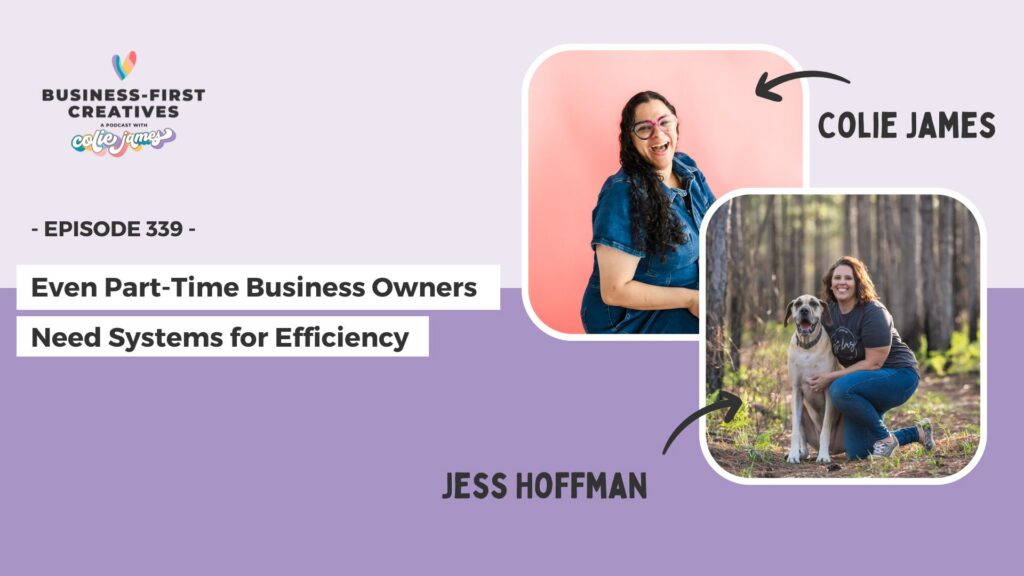
Jess is a pet photographer in Pensacola, Florida where she specializes in capturing the bond of pets and their people on the gorgeous beaches of Florida!
Find It Quickly
02:00 – Why Pet Photography
02:55 – Charging From Day One
05:52 – Systems Mindset Begins
09:58 – Simple Sales Explained
10:53 – Dubsado Workflow Struggles
11:50 – Audit to Blueprint Jump
13:00 – Video Instead of Calls
19:49 – Handling Corporate Inquiries
21:06 – Upsells and Pay Upfront Wins
25:06 – Gallery Education and Mockups
29:05 – Selling Wall Art With Samples
35:00 – Why Systems Matter Part Time
Mentioned in this Episode
Connect with the Guest
Website: hoffhousephotography.com
Instagram: @hoffhousephotography


Signature Series


Your business works, but your backend is costing you.
A 4-Part Audio Series for service-based business owners who are ready to upgrade their “just fine” client experience, unlock higher pricing, increase referrals, and grow more sustainable revenue—without overworking behind the scenes.
Get the FREE 4-part audio training series
Systems That Sell


© 2022-2025 Colie James


