
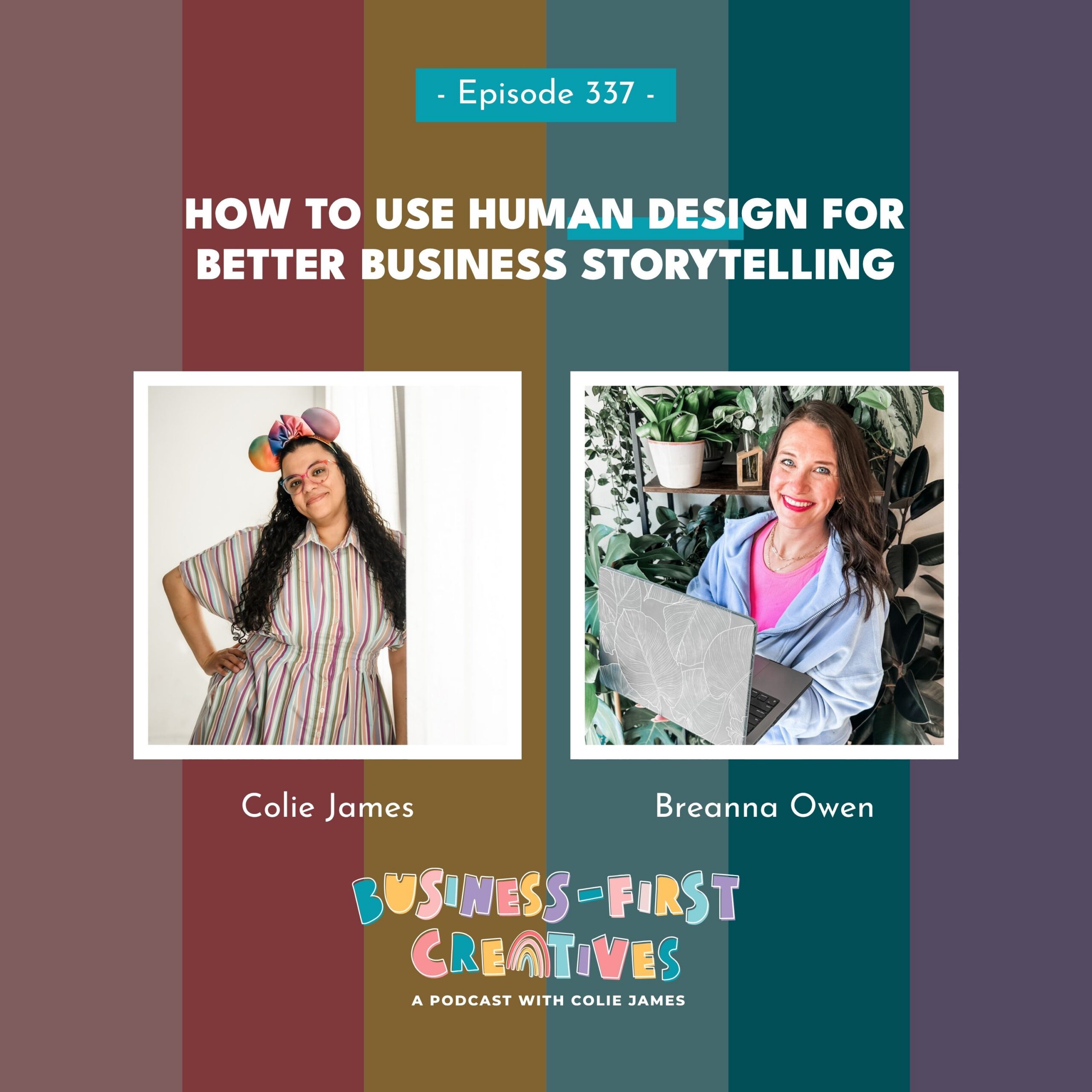


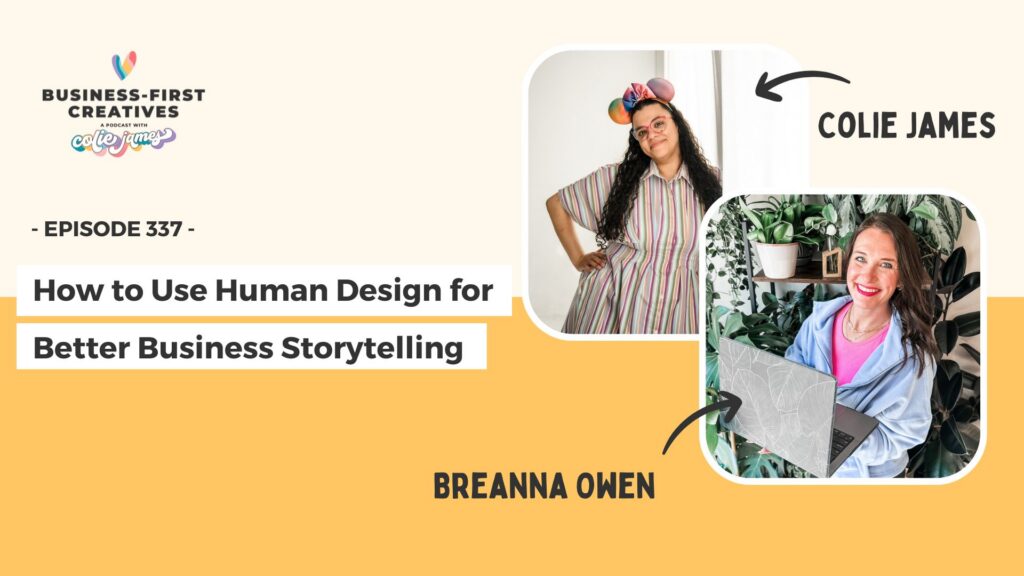
Have you ever wondered why some stories feel effortless to tell while others never seem to land? In this episode, I’m sitting down with Breanna Owen to explore how Human Design can completely change the way we approach storytelling in our businesses.
Instead of trying to tell every story or following someone else’s content formula, we’re diving into how your Human Design can help you identify the stories you’re naturally meant to tell—and why those stories create stronger connections with your audience.
Review the Transcript
Colie: Breanna’s back. Do I need to say anything else? Um, this is gonna be another episode brought to you by human design. I mean, it should be like an ad or something. We gotta figure that out.
Uh, welcome back to the podcast girl.
Breanna: Thanks for having me. I feel like this is a second home.
Colie: It’s so awesome. This is your third appearance in less than a year.
Breanna: It’s so great.
Colie: So guys, I said we’re gonna talk about human design and I will say the episodes that I have done that cover human design with both Brianna and Sabrina have been y’all’s favorites. Like the number of comments that I get from people telling me, oh my gosh, Colie, like that was fascinating. I went and figured out what my human design was and of course, just to bring it back around to like that hole. Kerfuffle that I had when I was trying to find mine. These people are having a much easier time with their place of birth, day and time of birth than I had. But, um, let’s get right into it. What are we talking about today?
Breanna: We are talking about how to use your human design for storytelling. The best stories for you to tell, whether that is as a podcast host in your business, in your emails, like it’s just a treasure trove goldmine of storytelling for you.
Colie: I mean, and this is gonna be a really unique perspective ’cause I’ve had people on this podcast before that have talked about the power of storytelling in your email marketing on your social media and those things. But like this is taking that to a different level where you are going to be looking at your human design and perhaps considering who your ideal clients are and what their human design is so that you can decide what stories you should tell. And how you should tell them.
Okay, so how do we get into this conversation, Brianna? Like what’s, what’s the first thing that we wanna consider when we are trying to bring together storytelling and human design?
Breanna: I think the first thing to consider is the fact that you don’t need to tell all of the stories, like you don’t, and that’s one of my favorite things about looking at human design is because they’re. You have infinite possibilities. And then when you look through the layer and the lens of your human design, those possibilities go from like all of them to, Nope, just focus on these.
And hopefully that takes just a huge load off of like, oh, I don’t have to tell all those other stories that other people are telling. I can just tell my stories and that’s good enough.
Colie: Okay, so let’s jump into me.
What’s my human design?
Breanna: Colie, we know this now, thankfully, officially you are a three five manifester.
That is, those are the things that most people talk about when they talk about their human design.
Colie: So what does it mean to tell stories as a manifester? Like, you know, me,
you, I think you know all, all my stories that I, I mean, you know, you read my emails, you know what I like to talk about. Is there anything that I have done? In like telling a story that you were like, Hmm, Colie, I wouldn’t have said that in that way.
Or maybe that’s one of those stories that you should have just kept to yourself. Have you ever thought that way? Reading one of my emails.
Breanna: No, I don’t think there’s anything that you should keep to yourself because of that three lies. And so the, you asked how, as a manifester, how do you tell stories? There’s. A lot of being a manifester is just you, you declare it, you make an announcement, you are just saying the thing, and that comes out from you.
I think naturally that is just what you do, which is great and lovely. But really what I would look at more is like your three five line. Like that’s where I would say I see these stories come out for you. So your three line is your trial and error line. I call it the fuck around and find out because you are always doing things hands-on.
You learn through hands-on experimentation. You are going to test and you are going to adapt, and you are going to pivot and you are going to figure out what works and what doesn’t work and you are gonna move on. Like you don’t get stuck. And so what we see in your stories is you talk about the things that work well and don’t work well.
You tell us what are you experimenting with and how did this go, or, I tried this thing and it didn’t go the way that I wanted it to, so I changed and I no longer sell that thing. I pulled all my stuff off the the slide. We like to see your messy middle. We don’t want the polished version of Colie and you don’t give us the polished version of Colie, which we love so much.
You’re also really good at calling out the bs, which is what a three line does. And so I guess if, I don’t even know if I could say maybe do more of that ’cause I feel like you already do it well, but definitely don’t shy away from it. If you’re ever wondering like, do I say this? Do I not say this? Say it.
Colie: I had to quickly go look and figure out when this episode is gonna air because you saying that was very intriguing to me because back in February I actually started creating solo episodes where I was like, guys, I really like listening to people’s episodes where they give you like the behind the scenes look of what people are doing in their business. And I was like, these are things that I mentioned to you last month, which was January when I recorded them. I was like, but I just wanna give you an update. And you know, if you don’t find this interesting, feel free to skip this episode. But for those of you that are like nosy as fuck, here’s how that shit turned out.
And the first one was. I had hired somebody to give me a, to design and create a custom notion dashboard so that I could manage my team better. And the second thing that I did was I hired a fractional CMO to like help me do all of the shit that I don’t wanna do in my business related to creating content.
I love recording podcasts. I don’t wanna do the rest of. And so the first kind of update that I gave was related to that. And then I turned around and I was like, oh, this is fun. So then the very next week I published an episode that was like, Hey, do you guys remember how I decided to take email? Like you mean it from a DIY course into a five day, live client communication sprint. Uh, this is what happened, this is how well it went. These are the things that were, hmm. Maybe we don’t do that again, and this is what it looks like for April. And so I feel like I did these things and this was before you even told me to do them, so
I I just like talking to you because a lot of the times you say the things and I’m like, oh my God.
That’s why that felt so good. I also wanna bring AI into the conversation just really briefly.
Breanna: Sure. Yeah.
Colie: I think you saying that is why I have such a problem with how AI kind of gives me emails. I’ve done a really good job of training my AI assistants to write like me, but I still feel like they hedge too much.
They’re, you know, they’re giving too much of the backstory. They’re, they’re writing things in a really nice way, and I find myself constantly saying,
you are talking too much.
Just make the point and move on.
And so.
Yeah.
Breanna: Yep. Yeah, no, I, and rarely do I ever tell someone something they don’t know about themselves or that they aren’t aware of. And the thing that I hear most often from people is how confirming or affirming our conversations are because to your point, like, oh, that’s why that felt good. That’s why that worked.
And also it tells you what to do more
of. Like, it, it, you still get to experiment. I’ll never tell, especially a three liner. I will never say, you don’t have to experiment anymore. Just do these things always. Because that is like, well then what’s the point? But I will narrow your focus of experiment over here.
Experiment with this experiment in this way. Um. And that, that’s nice. Like you can Great. I’ll just do more of this. I’ll do more of the calling out of the bs. You, what you say about AI is interesting, um, because you’ve got your three line, which calls out the bs. You have your five line, which is a bold, visionary, no holds barred leader.
Like the worst thing a five line can do is dilute themselves. And so what you’re talking about with AI is also because of your five line, your five line doesn’t like just say the damn thing. Don’t try to make it nice. Don’t try to make it soft. Just fucking say it.
Colie: Agreed. And I will say I don’t use the AI that much anymore. So I mean, Kara
writes a lot of my
emails and so that takes the pressure off. And honestly, when I’m, when I mean this, you know what I just realized, I’m gonna take this episode. And get the transcript and go send it to Kara so that she can
know the additional things. But it’s like sometimes I have these thoughts and I wanna hurry up and send an email and I don’t really wanna take the time to like ideate it and send it to Kara and be like, Hey, can you, you know, create this for next week? No, I wanna send it today,
like right now, in the next hour. And so, you know, I kind of word vomit into my AI assistant. And it always tries to package it up nicely. And I’m like, no, I just wanna be blunt. I wanna be short. I don’t wanna take my time to kind of, you know, walk them through this path of why that’s important. No, I fucking said it was
Breanna: Mm-hmm.
Colie: is what they need to do. Close it.
And in a lot of cases I’m like, and pitch systems in session, and then let’s move
on. So I do feel like I’m using it less, but I do feel like maybe a little bit of this kind of training. I mean, ’cause you know, when you think of training your AI assistant, I don’t know that a lot of people are like, oh, let me tell it all about my human design and they should do this and not do this and do more of this. But what I hear you saying is that I really do need to get way more specific, even if I’m not telling the AI assistant we are doing these things because my human design is a manifester three five, um, I do feel like I need to get in there a little bit more and just tell it to be more blunt. Tell it to get to the point faster. Because as a manifester, again, you don’t have to ask for permission. You’re not looking for anything to respond to. You need to ask for their permission or wait for the invitation. Generators and Manny gens are looking for something external to respond to. Reflectors. Take a whole lunar 28 day cycle to really like sample everything before they say it.
Breanna: As a manifester, you don’t need anything from anyone else. You say the thing and people either get on board or get out of your way. That’s it.
Colie: Brianna, I’ve never asked you, what’s your human design?
Breanna: My personal human design is a five one generator.
Colie: Okay.
So how does, how does be, no, we’re gonna get to your business
one in a sec. I know where you’re going, but first, let’s start with you
because, and actually, let’s start with you as a generator. How would you tell stories differently than I would as a manifester?
Breanna: So a generator is gonna be a little bit more friendly. Conversational generators have a really just like friendly, widespread aura. They just walk into the room and can be become friends with a lot of different people. And also I’m looking for something to respond to. Generators are also talking about what they’re, what they’re building and what they’re doing.
So as a manifester, you would say like, this is what’s happening. This is what’s going on. Again, pitch systems and sessions. Here’s where you can get on board. As a generator, I would be more of like, Hey, this is what I’m building. This is what I’m doing In response to some sort of external. Prompt or request of my energy.
So and so said this, which led to that, and now here we are. Feels different, doesn’t it?
Colie: It does, but also, so I wanna bring this in because people are constantly asking me, okay, Colie, you’ve had this podcast for almost four years. Like how do you decide what content. To put out there. And I’m like, honestly, I’m usually scrolling on threads, you know, like we do and like, and someone says some shit that I either really love or I really hate and then I go respond to it on my podcast. I was like, because that’s where I feel like I can come and just give my opinion
and you know, I’m often finding myself, uh, rage typing. Then I, you know, realize what I’m doing and then I backspace and don’t actually post. And then I’m like, Ooh, that would make a really good podcast episode. So how is that different than what you would do?
I mean, I’m not, I guess I still feel like in a lot of ways I respond to external stimuli, but maybe it’s that I don’t need somebody’s permission to respond to it. Like. It’s, it’s almost a visceral response, like literally. And if I see something on threads where someone did something super awesome, I’m immediately in their dms, Hey, would you like to come talk about that on my podcast?
And half the time I am thinking to myself, if they say no, that’s fine. I’ll just talk about it myself.
But I would love to invite them so that I can get another perspective. Um, yeah.
Breanna: Yeah, there’s what you were just talking about though, of the like, I’m just gonna go into their dms and invite them into it. That’s initiation, right? You are, you are initiating it. You are doing it first. So yes. I’m not saying like you don’t, you never respond to things. I’m just saying that. You don’t have to respond to something you don’t.
You don’t require something to respond to in order for it to work well. You can have an idea in your head for yourself and be like, yeah, I’m gonna do that. Or that’s sometimes also like, remember a manifester, like the idea of manifesting. Sometimes it’s just like, this is gonna happen. I don’t know what it’s gonna be.
I don’t know how it’s gonna turn out. I don’t know what that’s gonna look like, but I just, I’m going on five Disney cruises this year.
Colie: I
wish.
Breanna: like, like I talk,
I
don’t know if I’ve told this story right. I don’t know if I’ve told this story on your podcast before or not, but, so I am the oldest. I actually have seven siblings, but under my mom, on my mom’s side, I’m the eldest of four siblings.
It’s me, I’ve got two brothers, and then the baby is a, is another girl. My baby sister is a manifester. The other thing about our siblings is now that they are all adults, we do a siblings only calendar. A few years ago, my mom Requi asked if we would do family photos for as her Christmas gift. You know, again, we’re all adults.
She doesn’t like get to force us to take family photos anymore. And so my siblings and all were like, yeah, sure. We’ll do family photos. She was not specific about the type of photos that she wanted. So the four of us done booked ourselves a siblings only day, where we met at our local Goodwill to find the most ridiculous outfits we could.
And then we went across the street to a mall that has a JC Penny Portrait Studio, and that was the first year that we did Awkward Sibling Photos, turned it into a calendar. Gave it to my mom for Christmas. She loved it. It’s now since become a thing, well, two years ago, I think it was two years ago. thing three.
So my second brother was stationed in Biloxi, Mississippi. We’re all in Iowa for the record. So, and he was gonna be gone when we were supposed to get our photos taken and we were thinking like, I guess siblings only calendar is not happening this year. But Abel, miss Manifesto was like, no, it’s happening.
We will go to Biloxi if we have to. We’re going to Biloxi. These photos are happening. And I just, I remember turning to her. And being like, oh, F you, because the manifester done declared what was happening. She initiated it like, this is what’s happening. We’re going to Biloxi. And I knew that the generator, eldest sister would be the one in charge of making it happen.
And what do you know? We, we had, it was a four day trip, 18 hours down, 18 hours back. But we, we went, we drove all day. One day we did our photo shoot. The next day we had a day together, and then we came home Monday. But the, by golly, the photo shoot done happened, and it was because Miss Manifesto done manifested the fuck out of it.
And so sometimes that’s what you do as a manifester too, was just like, I don’t know how it’s gonna happen. I don’t know what it’s gonna look like, but I know this is going to be a thing.
Colie: I mean, she sounds amazing from a manifester about another manifester. Uh, I wanna circle back around because you started to say something and I cut you off, which, Hey guys, I’m sorry. It’s my podcast. I had to do what I want.
You mentioned, or you started to mention
that you have your personal human design. And then you have your business human design.
And I distinctly remember the first time that you said that. I was like, wait, what? My business has its own human design? And you were like, yeah. So what is your business? Human design.
Breanna: My business is a three five mental projector.
Colie: Okay. And so when you are storytelling
Breanna: Mm-hmm.
Colie: on behalf of your business, you are using your business’
human design.
Okay? So. How did you determine what your business human design is? Because here’s the thing, I think all of us have very convoluted stories of how our business came to be. And for myself, I’ve had my business since 2012 and if you asked me like when my business was conceived or actually born, I guess it would be born, I would say it’s probably the day that I declared it to the state of
Colorado and created my um, DBA, but technically. I had been running it as a in quotes business for about 10 months before that, and the reason that I hadn’t officially made it a business yet is we weren’t planning on staying here. I mean, I think it’s super ironic that, what is it, 16, 17 years later, I am still here in the state of Colorado. But this was supposed to be two years, and then it was supposed to be four years.
And then it wasn’t until my husband finished his postdoc and he got a job at a local biotech firm. I was like, oh, good, we’re staying. And so that day I went on to the, state of Colorado’s website and created my DBA, but, so is that when my business was born or was it when I actually started the process?
Created my website. I mean, I feel like there’s so many touch points. How do you decide when your business was actually born? I.
Breanna: That is such a personal decision, honestly, like it, it, that is a very fluid decision. So I personally go based off of, I had a marketing internship one summer because I have a fashion degree, and then when I was in school for fashion, they were like, Hey, by the way, if you take three more classes, you can get a dual marketing degree.
I was like, done. I loved. Like more, I will take more. Thank you very much. And so, but you had to have an internship for every degree you pursued. And so I had to have an internship and I started getting real desperate. So I just finally like coerced a friend’s husband to hire me for the summer. And so the first day that I.
Walked into that internship is the day I decided, or the day that I used for the start of my business, because that six week summer internship actually lasted eight years.
Colie: I feel like we told this story last
time. I don’t know which episode though,
Breanna: Yeah, well you have a couple of ’em. Yeah, so that, because that internship lasted, you know, turned into the thing that led to what I’m doing now.
I’m like, that’s really where it all started. That’s really where it all began. Now, I have had clients, when you file your LLC is sometimes the easiest thing because you usually get an email. So you, you’ve got a date and you have a time,
Colie: And you have a time.
Let’s say that one more time and you have a time.
Breanna: Yes. Yes. And so that is often what people use. I’ve had people go based off of when their website went live.
I’ve had somebody, I talked to someone recently who used the first time somebody paid him. Like he, he could remember like, actually this was the first time somebody paid me for the work I do. The business technically wasn’t started until later, but he’s like, no, that’s when all of this was born. So it is subjective and it is up to you.
The other thing I would do is like, you know, even as you’re talking, which, and earlier when you were like, but I feel like I respond, my thought was, well, maybe your business has its own energy and maybe you’re, you’re channeling the business energy. But I didn’t wanna complicate things so I didn’t say it.
But even like what you’re talking about with having two different options, that’s when I would say, well, let’s look at both of them. Let’s look at, you know, when do you feel like it really started and when did you, submit your LLC? Let’s look at both of those and then we can kind, when we talk through them, you’re like, no, it’s not that.
It’s this over here.
it’s, it’s cool. But then again, like when you know these things, you’re able to go, okay, so what kind of stories does this business tell and how does this business tell stories? How do I tell stories? Not everybody has, like sometimes people really are their own business and therefore using your personal chart is great.
I used my personal chart for a whole year before I started feeling like my business had its own energy. So sometimes like it does happen that way.
Colie: just to kind of look it up really fast, I ended up going on a website and I put in the day, which I know is a hundred percent correct, the location, which absolutely. But I kind of just picked a time
out of thin air. Um, and it says that my business is a manifesting generator. Um, and that my profile is a five one.
Breanna: Mm-hmm.
Colie: I feel like. Yes, it’s, it’s interesting to know what your business human design is, but I also feel like everything in my business is driven by me and what I want, and I often make decisions based on me and maybe not necessarily what’s best for the business.
So I feel like if I had to make a choice, I would probably choose to go by what I am because I am what makes my brand now. I mean, if I ever decided to, you know, package it up in a way to where I could sell it to other people, maybe then
I would wanna consider what the business is outside of me. But for now, I feel pretty comfortable using my own personal human design to kind of make all these decisions.
Breanna: and that’s great. Yeah. It’s always subjective and the only time I would ever encourage you to be like, well, let’s look at the business instead is when we use all of your personal stuff and it’s just, it’s not working.
Colie: Hmm.
Breanna: If it’s not going the way that you want it to, if it’s not working, if it’s not feeling right, if all of a sudden people are not responding or engaging, that’s when I would go, okay, well what’s different about possibly, what’s different about your business?
How does that energy change? And then how does that look a little different? I mean, based off of what you said, you know, if it’s a Manny Gen. That manifester element is still at play with the Manny Gen, the five line, which is the practical solution. Messenger is still a, is going to be a crossover strong thing for you.
So like there are, there are things that are probably very similar. There’s a whole lot of similarity between my personal chart and my business chart. Um, but yeah, for sure there are people who are like, Nope, I am my brand. I’m going to use my personal chart. I’m like, great, then let’s do that.
Colie: Well, let’s be real practical. ’cause you know, on this podcast I like to like tell people, Hey, this is what we talked about and this is what you should do with it. But if I think like to the stories that I want to tell my audience. I would say, you know, right now I just got that Notion dashboard built out and it’s amazing and it has an idea bank that I have not added anything to since it was created. So I’m wondering if I was gonna make like a table and I was gonna put like, this is the prompt, if you will, this is the story that comes to mind. How would I structure it so that I could tell the best story based on my human design? And I’m gonna throw an idea out there. ’cause
you, you like to be very practical. Brianna, did you see on Threads or did you hear on a previous podcast? Podcast episode that I, for the first time in my life, went to Denver International Airport and did not have my wallet?
Breanna: Yes, I
did see that story.
Colie: from a human, from my human design perspective, if I was going to tell that story again, how might I tell it? As a manifester to make sure that it’s like really grounded in my energy and it comes across in the best way possible.
Breanna: Yes. Okay. I love that so much. So. One, you are an observer. This is not something I think we’ve talked about yet in this episode. I don’t recall if we’ve talked about it in either of the other two episodes I’ve been on, but your chart says that you are an observer. So we wanna see stories from your point of view.
So I bring this up because this is going to set the filter through which we see the story. We are. We are looking at things through your eyes. We are not seeing you in action. So kind that sets up like, how are you telling the story? You are the observer of what’s going on, first of all. Second of all, again, that going to your three line, the trial and error, we like to see the messy middle.
We like to know what doesn’t go well with you. We like to laugh with you, um, where it is a possible and so. Being able to talk about like, well, this didn’t go the way that I wanted it to. Like giving us that frame of, uh, so this happened. Here’s what I learned from it. You’re going to give us a tangible takeaway because that’s what the five line wants.
But then we can also look at your, your throat, because you have a defined throat. I look at the throat. I think of the throat as a, a radio. Think of it like a radio box with 11 possible radio stations. Depending on which gates you have active, those are the radio stations that you can access clearly. And so like, we just wanna play the music that comes naturally to your radio box.
Right. so getting to your throat, gates. You have lots of options. You have five options. So then we go through and we go, is there another like way that you wanna tell this based off of your options? So like you’ve got, um, gate 23 is known as the clarity dropper and you speak your bind.
So is there something here that, an innovative idea that you wanna share about this? Maybe, maybe not. Um, let’s see. 31 is speaking about the future. People like really lean into you when you’re, you’re sharing like a vision for the future. Maybe, maybe not for this one. I was gonna say, I think it’ll be, gate 33 will be one of your strongest for this particular story because Gate 33 is, um, is the timed storyteller.
So you. Take in stories, whether yours or others. You process them and when you generate the meaning of them, like what is the lesson learned here? What did I get from this? That’s when you share that story. Sometimes that processing might take weeks or years, and sometimes that processing is gonna take like 10 minutes of like, ugh, here’s the thing that I learned.
And you’re gonna weave some wisdom in there with that story. Um, just because we’re like quickly going through your radio stations, the last one, because I did mention that you have, this one is the gate of being a. A generous resource share. It is like the most tribal gate out of all of the gates that are possible on a human design chart.
And so it is the one that is like, I’m bringing this thing together. I’m bringing people, resources, whatever, form those resources might take, and making sure that collectively community, our, our people can access them and use them and benefit from them. Like, you’re really good at doing that.
Colie: I think that’s my favorite. ’cause I think every time I’ve told this story, and again, I was like ranting on threads live, I believe when it happened, because I don’t really have. Have a fear that TSA is gonna find me on my threads because my legal name is not the same as my, I mean, there are reasons that, anyways, so the one thing that I wanted everyone to walk away with was, number one, I spent five days in California with absolutely no physical IDs, no driver’s license, no credit cards, just my phone, which I walked around with, like my precious from Lord of the Rings, because holy shit, I can’t let it die. I can’t break it because normally I take the perspective of, oh, if I drop my phone on a ride or whatever, I’ll just go to at t and get another one. The problem is even if you go to at and t and you get another one and you like put your backup iCloud, all of my saved credit cards, my digital id, which is what I used to get into the Denver airport, you know, eventually those things don’t just pop back up on your phone.
You have to add them again
and Hello? I didn’t
have
Breanna: can’t do that.
Colie: to add them. Yeah, so. I think what I walked away from most from this story was I wanted everyone to know it is possible for you to actually get on a plane and fly somewhere else. If you don’t have an a, a license, you don’t have a physical id, which. I’ve actually told people that before because like years ago, my sister came here from Dallas. She was here for a few days and when I took her back to the airport so that she could go to Vegas, she couldn’t find her license. So I knew, even back then, 10 plus years ago, they do have a process where they will take you, you know, away from the line and they ask you all of these questions now. The second part of how I, I got into Denver International Airport with my Colorado Digital id, but I had to transfer it to my Apple Pay wallet. So I shared that with everyone. I wanted everybody to know, Hey, that might be a possibility for your state. Go look it up. But then in Orange County, that didn’t work, even though they had the machine for me to tap my digital ID from Apple Pay the same way that I did in Denver. Their machines didn’t work. So then if you’ve been listening and paying attention, there’s a new $45 fee that they charge you if you don’t have a real id. So if you happen to live in one of those states and you haven’t renewed your license to get a real ID or you don’t have a passport, you now have to pay $45 when you fly for them to verify who you are now.
I had no idea. I think what pissed me off most about this process is I paid $45 and it took the TSA agent seven seconds to look up my passport.
’cause I have a passport, so I get charging a fee if somebody doesn’t have an ID and they’re not already in the database and you gotta do all these things to verify them. But literally it took me longer to pay you the fucking $45 than it took for you to look up and verify who I was like, that’s ridiculous.
But again, I want everybody to know if you show up at an airport with no id, this is what you’re gonna have to do in order to get on your plane and blah, blah, blah. So I mean, I do like future, you know, telling the future.
Also, if you’re not paying attention on YouTube, I’m holding up my passport. I’m not showing you my details, but I am holding up my passport. Brianna, did you know that two years after your passport expires, it is still a valid ID for the purpose of TSA?
Breanna: No, but that’s great to
know.
Colie: Exactly. So when I renew my passport next month after my cruise, I am going to put my expired passport in my backpack or in my suitcase, so that once again, I never end up at an airport with absolutely no id and are
forced to pay them $45 again to look up my fucking passport.
Breanna: right. All of that is aligned to your human design? All of it. Yeah, because you’ve got the trial and error. You’ve got the tangible like. Here’s something to do with this. You’ve got the, like, again, to your point, the resource you, it, it does have that 33, that, that storyteller, the, the meaningful storyteller in there, and you’ve got the resource of never be this way.
Like everybody needs to know these things. Everybody needs to be prepared in these ways. Like I need my people to have this
perfection.
Colie: around to what I originally asked you if I was going to start putting these things in my Idea Bank, and I wanted to make sure that I was kind of considering. My human design when I tell the story. ’cause it’s one thing for you to just kind of slap the prompt in there,
but I’m wondering if there’s any way that we should be organizing our thoughts based on our human design to make sure that we are hitting like the marks that we need to, to make the story most effective based on your human design.
Is there any way that you can think to organize that?
Breanna: when I was first putting all of this together, like all of the human design, I used to create content guides for people. I would say, like, I would give them the, the reasoning, the human design reasoning, and then I would say like, so do this with your content. But the, the inverse of all of that would be, I mean, if you like a table, you could certainly have the, something, you know, you go through like the high notes of your human design on one side and then.
Any piece of content just needs to hit something within your design. It doesn’t necessarily have to hit everything. And so then you can, if you’ve got like a story in place, maybe you, maybe you’re starting with a story, you just can then go through and go, well, what, what is the angle that I’m gonna take with this?
Colie: Because, you know, I like a good
table, you know, I like a good Airtable hub. Or in this case, the ideas are now going into notion. It’s, it’s really weird. I’m trying to get used to it. It’s been a week, like exactly a week, Brianna, since I got my Notion dashboard.
And I will say it looks so different now than
it did when she gave it to me a
week ago. I really do want to make sure that before I put my new first idea in my
bank, that I’m considering the, the marks that I could hit, if you will, with my human design. So. We’ve, we talked all about the storytelling. We’ve talked about how you look at your chart and it kind of helps you frame and share the ideas inside of the storytelling. Is there anything else that we should kind of mention to someone that they should think about before they share their next story to their audience? Either in email or on social media, or, you know, via a podcast if they happen to have one.
Breanna: The other thing I would encourage people to be able to look at would be their ideal audience. Now, this is something we talked about in the last episode with you. We looked at your ideal audience and who that is. Not everybody knows this about their their people.
Yes, it’s in your chart, but if you do know who your people are based off of your chart, you can take that into consideration too. You’re gonna tell your stories in a way that. The way that you’re meant to as a three five, but speaking to your four six audience and the things that they care about.
Colie: Okay. We’ve gotten to that part where I feel like I could open another doorway, but if I do that, we’re gonna be talking for another 20, 30 minutes. Uh, in case you guys haven’t figured this out yet, Brianna’s just gonna come on the podcast whenever we have something to say. I mean, we had a call like, what was it, two or three weeks
ago? And on that call, we were like, oh, she’s gonna come back and talk about storytelling, because that was what my call was focused on. I’m gonna wrap it up now because I do feel like this has planted the seed. On how it, you always hear out there, Hey, you need to tell more stories. You need to bring your audience in.
And this is just another layer of how you could do it effectively. But if the audience wants to actually learn more about their human design. We’re working with you to uncover how they can use it effectively in their business to make decisions, which is what we talked about on the last episode. Actually, I’m gonna stop talking right now because if you did not listen to the last episode where she was on here, like do that immediately after this one.
I feel like it will help you. Understand the things that we talked about this time so much better than just listening to this episode once. But if the listening audience wants to hear more about working with you and exploring their human design and what that means for their business and making effective decisions, where can they find you on the internet?
Breanna: To go to get all of that in one spot would be the energy type email playbook, which is a freebie I have on my website because it will tell them, once you put in your information, you can download it. It’ll give you a guide, five tips on writing better emails for your energy type. Your legitimately will write a better email in like 10 minutes.
It happens so quickly. But that will also lead you direct to me if you wanna have. The one-on-one sessions, which your people are so great at coming to me and being like, well, I heard you on Colie’s podcast and now I need to know more. So thank you.
Colie: They all rave about it. And the funny thing is, every time one of them tells me, I’m like, I know it’s so woo, but isn’t it also super awesome? Because again, I’m not a woo woo person, but
I feel like you make me a woo woo person. And I just wanna clarify guys. She’s not saying that you have to come knowing your human design.
The freebie asks you for the thing, the three things that you need, which is where you were born. The day you were born and the time that you were born. And her freebie will actually give you your human design along with
how to write more effective emails using it. So I just wanna
make sure that I cleared that up because you know, you don’t have to run around trying to figure out what your human design is first.
Breanna: No, as long as you know those things, you’re good.
Colie: Okay.
Well, oh my gosh. Thank you so much for coming back on the podcast yet again. I love our conversations. Oh, I didn’t tell you. I actually had an episode with Brittany recorded last week, and that is gonna air just a couple weeks before this one.
So, you know, listening audience. The, I feel like these two are like, you know, they come in pairs. Um, but if you didn’t listen to the episode that I recorded with Brittany about talking about done with you versus done for you, you should definitely go listen to that because I thank Brittany every time I talk to her about introducing me to you.
Breanna: Me too. I’m so grateful for it.
Colie: All right, everybody. That’s it for this episode. See you next time.
About the Guest
Breanna Owen helps entrepreneurs write emails that feel good to send—and impossible to ignore. As an Email Energetics expert and Human Design strategist, she blends intuitive insight with sharp strategy to transform “meh” messaging into magnetic aligned content that converts with ease. Her gift? Identifying exactly what needs to shift—so the emails you send start working for you (even when you’re offline).
Find It Quickly
00:24 – Brianna Returns
01:26 – Human Design Storytelling
03:03 – Colie’s Human Design
07:04 – AI And Bold Voice
11:24 – Generator Vs Manifestor
17:57 – Business Human Design
25:06 – Airport Wallet Story
34:26 – Idea Bank Framework
36:38 – Audience Human Design
Mentioned in this Episode
Episode 254: Using Human Design to Transform Your Business Strategy with Breanna Owen
Episode 216: Energetic Email Strategy for Connection & Conversion with Breanna Owen
Episode 277: How Human Design Is Influencing the Way We Do Business with Sabrina Gebhardt
Episode 299: Done-for-You vs. Done-with-You: Which Model Fits Your Business? with Brittany Herzberg
Connect with Breanna
Website: owenyourmark.com
Grab the Email Type Freebie: owenyourmark.com/energy-type-email-playbook
Instagram: instagram.com/owenyourmark


Signature Series


Your business works, but your backend is costing you.
A 4-Part Audio Series for service-based business owners who are ready to upgrade their “just fine” client experience, unlock higher pricing, increase referrals, and grow more sustainable revenue—without overworking behind the scenes.
Get the FREE 4-part audio training series
Systems That Sell


© 2022-2025 Colie James


