

Raise your hand if you’ve ever stood at a local event, had a genuinely great conversation with someone who would be a perfect client, and then handed them a business card — and never heard from them again. Yeah. The business card isn’t the problem. The missing piece is having somewhere to actually bring them that keeps the connection alive after you walk away. This episode is going to fix that for you.
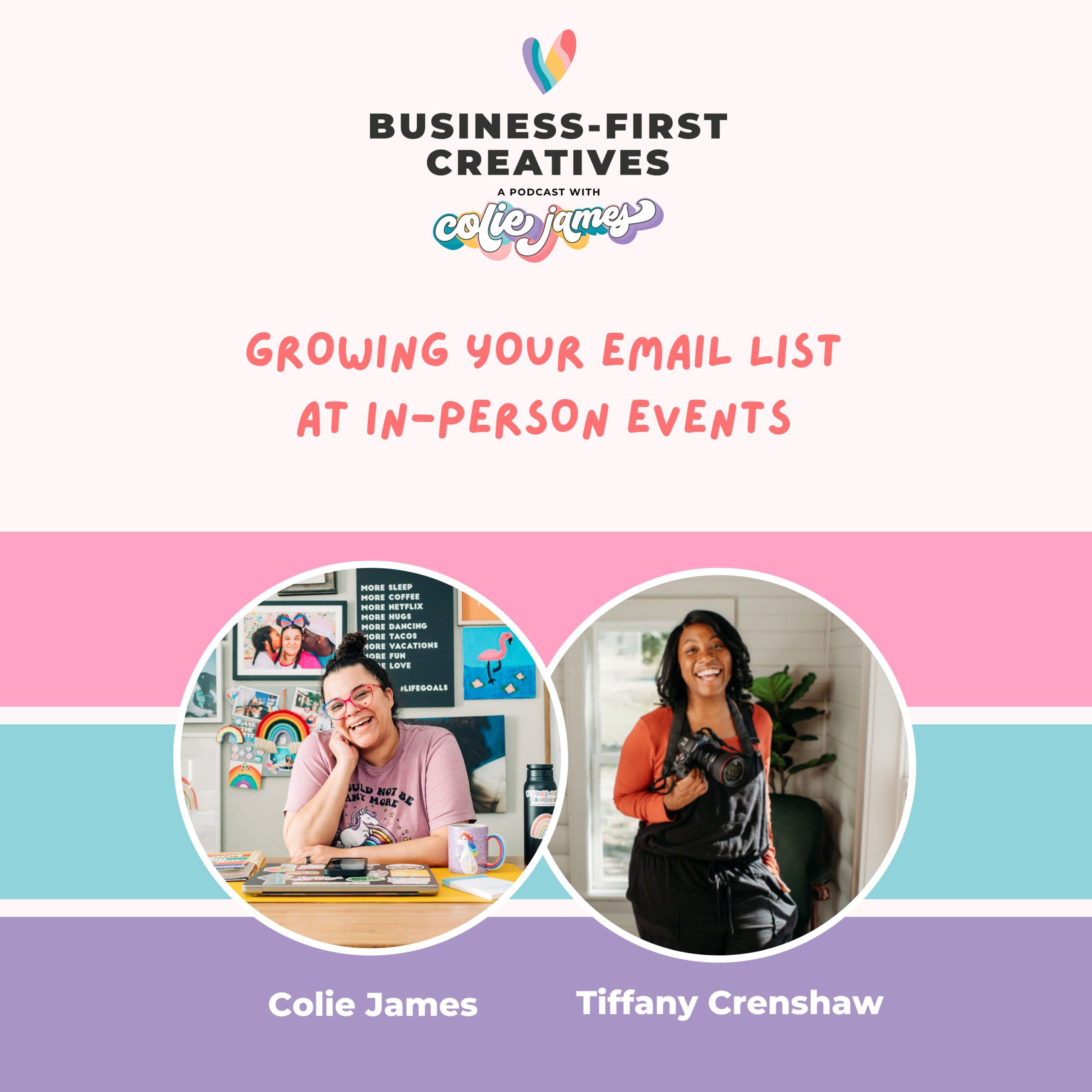
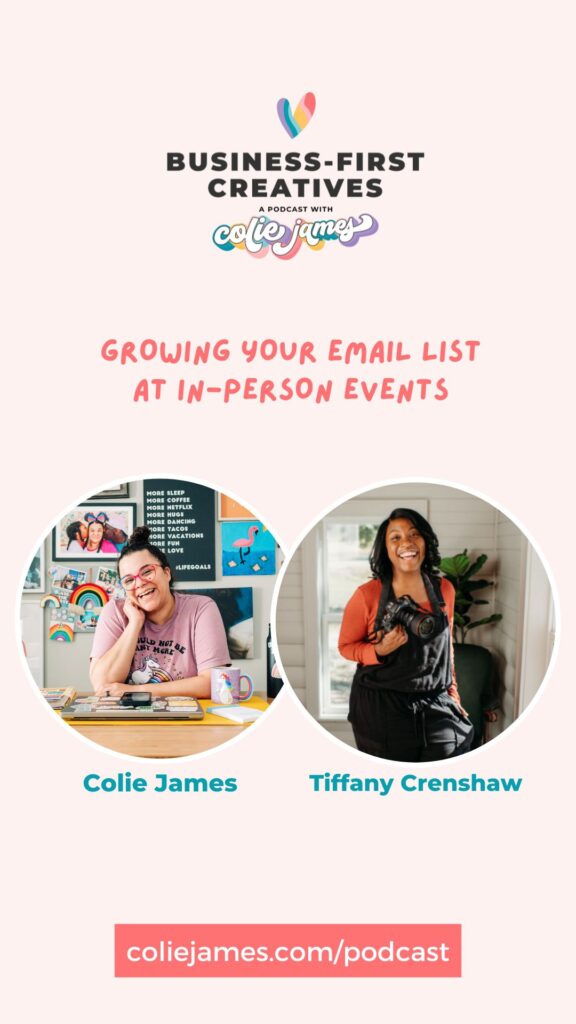
In this episode, I’m chatting with Tiffany Crenshaw — a photographer turned educator who left her seven years in the classroom to help women entrepreneurs build businesses that are actually sustainable and profitable. Tiffany is the creative mind behind Animal House Photography and Tiffany Crenshaw Education, and her approach to email marketing is one of the most refreshingly doable things I’ve heard in a long time.
We’re talking about how to grow your email list in person — at expos, community events, local workshops, and even just everyday moments where your ideal clients are already gathered. We dig into QR codes, email segmentation, analytics stalking (the good kind), the $1,600 email Tiffany sent to a guy named Sam, and why one warm local contact is worth more than 4,000 Instagram followers you’ve never actually met.
What You’ll Learn in This Episode
- The “lazy marketing” approach to email welcome sequences that meets new subscribers exactly where they are, using content you already have
- Why a small, warm, local email list will out-convert a large cold Instagram following every single time — and what to do about it
- The “QR code at the event” strategy Tiffany uses to grow her list in minutes, not months — including exactly how she sets it up in Canva and Flodesk
- How to create event-specific email segments so you know exactly where every subscriber came from and can market to them accordingly
- The $1,600 email: what Tiffany noticed in her analytics, the three-sentence message she sent to a subscriber named Sam, and how it turned into a booked session plus a full family session by end of day
- Why sending one personalized voice memo to a client who missed your emails is worth more than six more broadcast emails — and how to make it feel natural, not pushy
- A realistic email cadence for photographers: how Tiffany structures her four emails per month so she’s nurturing without constantly selling
- How your existing blog posts can do triple duty — SEO, email newsletters, and client experience automation — without writing a single new word
- Five types of in-person events photographers should be attending (and one sneaky hosting idea you probably haven’t considered)

Review the Transcript
Colie: Hello, hello and welcome back to Business First Creatives podcast. I am gonna chat with a new friend, Tiffany Crenshaw. Now we have been in many of the same circles. We even attended Creative Educator Conference together this year, and I didn’t actually get to sit down with her and have like a good conversation.
So y’all, you’re hearing this conversation now. Live on the podcast, Tiffany. Welcome.
Tiffany: Hi. I am so excited.
Colie: So guys, let me tell you why Tiffany’s here. I am in the email growth membership by Kylie Kelly, and Tiffany was recently on a private podcast that Kylie launched, and when I heard her talking, I was literally driving between Boulder and my house. I pulled over and I made myself a little note, invite Tiffany to the podcast, sent her a little Instagram note, and here she is.
So when I tell you guys that sometimes I see something on threads. Or Instagram or I hear somebody on my podcast and I’m inviting them, like literally I’m doing it at like a red light or I pull over and do it to be safe. I only pulled over this time ’cause there was construction. I mean, I couldn’t even find the thing to hit the voice note on that particular day.
But Tiffany is gonna be talking about like a really juicy topic today. You guys know I have been in an email mood. I have my new chorus email like you mean it, which is out now, but. That is your client experience emails, and Tiffany is gonna help us with our email marketing today in a really unique way that I hope helps some of you guys.
So Tiffany, why don’t you just tell me a little bit about how you started Animal House photography, and now how you are kind of migrating over to your new education brand? Tiffany Crenshaw Education.
Tiffany: Yes. So that’s, I’m also glad I’m not the only one that sends random voice memos to myself, like at traffic lights,
Colie: All the time, girl. All the
Tiffany: all the time. Um, but yeah, so Animal House started when my daughters were very little. They were three in one. And I just wanted to be able to take pictures of them. I think that’s how a lot of moms start, you know, we’re like, oh, we have these cute babies, let’s take pictures of them.
But over time people start asking, and, you know, oh, are you taking pictures? And I was real resistant for a while, but I finally decided, you know what? Let me just try. And it just, it took off. And I really like Dove strong into. Storytelling and trying to really capture those, like authentic, just make you feel something, moments in your, in your images.
And so that was going really well. But my roots are teacher. I came from the classroom. I taught second grade for seven years. I was a reading specialist for a couple years, and I always knew that I would somehow end up back in the classroom. I did not realize it would be teaching
Colie: photographers,
Tiffany: But I just feel such a passion specifically for women.
Entrepreneurs that they need to be profitable. Like I feel so passionately that women shouldn’t just be out here working for pennies and trying to balance their, their family lives. Like we’re trying to balance marriages maybe, or children, other things. And then we’re also getting burned out working for so little.
And so my heart just really became to help inspire women that you can do both. You can have both, and that there are ways to do it. So.
Colie: Absolutely. I mean, I don’t, I haven’t really told this story on my own podcast very much, but when I first started out, I kind of grew my business as I sent Chloe to school a little bit more at a time. Like she only started in preschool two mornings a week for like two and a half hours. That is not enough time to grow a business.
And when people asked me, you know, well, how did you do your initial pricing? Because I was never cheap. Like my starting was 700. And I said, well, what I did was. I figured out how much money my husband was making and I figured out how I could make the same amount of money per hour. And that is how I created my initial prices because I didn’t want to undervalue the time that I was spending to grow my business compared to what my husband was doing to go to work every day to, you know, essentially pay our mortgage, if you will.
But I like you have a very soft spot. I want everybody to be, I say sustainable and profitable. Because there’s nothing worse than, like for photographers. It ends up being like the first two years I think, where you know you’re working and you’re working and you’re working and you’re really not seeing the fruits of your labor.
And by the time year three pops up, it’s the biggest statistic that I think I’ve seen at year three is where a lot of people, it’s where they put up or they shut up. Like they either start moving towards making it an actual business and not a hobby. Or they end up quitting and actually just doing it as a hobby.
So that’s like an important milestone, if you will, for most photographers.
Tiffany: Yeah, absolutely. Sustainable and profitable. Like my favorite words.
Colie: I mean, I feel like they should be branded on my, on my forehead. But let’s get into today’s topic because I. I’ve had quite a few people on this podcast talking about email marketing. Most of them were not photographers. I will say that most of them were outside of our industry, but when I heard what you were doing to grow your list, I was like, oh my gosh.
Like I think everyone needs to hear this. So Tiffany, tell me a little bit about how we should be growing our email lists at in-person events.
Tiffany: Yeah, so I think really where my passion for email marketing and. Growing it in person came from was just realizing that I have such limited time. Right. And so a lot of times we’re on social media so much and we’re posting and we’re, you know, we’re reaching just a few people. And we’re kind of in a sea of all these other online people versus when you are in person, you really are becoming the face of your brand.
People are connecting with who you are as a person. They are engaging with you, and it’s a great time to be able to point them towards this email list rather than just pointing them towards like, oh, just follow me on Instagram. Like, because they follow, you know, however many other people, but being able to say, Hey, come join this little private community that I have where I’m sending out things that I know are nurturing you right where you are.
Colie: So first of all, let’s talk about the kind of in-person events that you’re actually talking about. So what kind of in-person events are you attending? Because like I said, you and I were at Creative Educator, but like you weren’t actually talking about like conferences.
In particular, you were also talking about just being in person with, like the people in your community. So what kind of events do you look to go to?
Tiffany: Yeah. So I’m always looking for events where I’m going to be able to connect with either my ideal. Client photography wise, or I’m looking to connect with other creatives that serve the same clientele as I do. So those are kind of my two gauges whenever I’m deciding. And we really do have to decide, right?
Like we only have limited time. So being really intentional about where you are spending your in-person time, I think is important. Recently. Uh, just an example, I found this we have like a mom baby social club. Situation here in Huntsville that opened recently and I was approached by the owner to do some headshots for some of the moms, so I was like, great, this is gonna be a great opportunity for me to be able not only to.
Serve in this way, but also, let me get email addresses while I’m here. Let me talk to the moms while I’m here. Find out what is it that you do, what is your brand like? What kind of things are you looking for in terms of growth and pointing them towards, oh, I have a resource for that. Here’s my email list.
Like, let’s hop, let’s hop on there. I taught a in-person photography class there, so moms with their phones. It was like, Hey, here’s a free class. Come, I’ll show you how to use your iPhone to take better pictures of your kiddos. And you better believe, like, while I’m teaching, I’m passing my phone around that has my inst my little QR code that scans them right into my email, into my email list.
So now I have a whole other little segment of people. That I can specifically target with the materials and the offers that I’m putting out there.
Colie: Let’s talk about this QR code, because this is literally when I was like, I’m gonna pull my car over and write this down. So I have done that, kind of like to activate people on my podcast, to maybe get them on my email list at things like creative educator. I. I, I never thought to do that when I was at in-person events for like photography clients or like mom events.
Like, it just, it never occurred to me. Now, when we talk about getting somebody to join our email list online, I’m gonna specifically say that because online I feel like you always have to entice them. You’re specifically giving them some freebie that’s caught their eye, whether it’s a video training or a PDF download or whatever it is.
Like that is what’s drawing people. To actually join your email list. And more and more recently I’ve been seeing people say, no, but your email list is the freebie. Like you don’t have to offer them something as an incentive. Being on your email list should be awesome and amazing, and I feel like that’s what you’re doing.
But when they scan the QR code, are they in fact getting a freebie that you have preselected or are they just joining your email list and do you have some kind of like welcome series that kicks it off?
Tiffany: Yeah, so it really depends on the event. I’ve done both ways. I’ve done where I have a freebie and I can share about another event where I used, where I’ve used that and it’s been highly successful. But I’ve also done where it’s just you being at this event that I’ve hosted, this free event. This is an exchange.
So you’re here. And so in exchange for that, I’m gonna ask you to, to join my email list. And it never feels salesy. I keep it in conversation, I keep it light. I don’t make it this big. Like, oh, now you’re gonna get all these spam emails from me. But it does trigger a welcome series and I cater it to whoever, whatever event I’m at.
So for those moms, right? So like for that mom group, I know that all those are moms with little toddlers, and I knew that I had Mother’s Day sessions. Coming up. So I naturally started sharing blog posts with them about why you should have, images with your children while they’re young, or, you know, what types of things might you wear to a motherhood session.
And just starting that way by feeding them content that you probably already have, like you probably already have Instagram post or a blog or something like that. You’re not having to create a ton, you’re just repurposing the things you have and catering it towards that group that you’re interacting with.
Colie: I mean, I would call that lazy marketing, and that’s my favorite kind.
Tiffany: Favorite kind,
Colie: like you had to create this brand new freebie for this one event that you’re going to, you are using content that you have already created. And again, as you said, meeting them where they are, you know, that they’re moms of young children and you know that you have Mother’s Day, sessions coming up, and so you are trying to gently guide them.
To booking one of those sessions, which I think is awesome. So I guess it’s a different QR code then. Like is it always like, because you were doing something related to Mother’s Day, that wouldn’t be the one that you would do in like October? So
Tiffany: Right.
Colie: like talk to me about your process. And I don’t mean go into like you know the details, but I know people are gonna be like, well that sounds like it takes a lot of time.
So like, how long does it take you to make a
QR code?
Tiffany: no time. It takes so little time. And I think that’s where we get stuck a lot of times is in the logistics of like, oh my gosh, it’s another thing, but it’s really so simple with probably tools you’re already using. So I will just go on to Canva and you can make a QR code in less than a minute on Canva.
It takes no time at all. And so all I’ll do is I’ll go on flow desks and I’m a big proponent if you don’t have an email marketing system. You need to get an email marketing system. It has been a game changer for me, because you can segment your audience, you can have these different little communities within your email system.
And so for me, it’s a matter of the five minutes it takes me to go on Canva. Make the QR code, I make a form on my flow desk and I just link it to something that I already have. I’m not really creating a lot of new things at this point because I’m serving really similar audiences, and eventually they’re all gonna funnel into my edu into my photography email list.
So I think if you’ve got Canva. Just, you can put in there on the template design QR code generator. It will make it for you in no time. I usually like to put it on top of a pretty picture that I’ve taken just so when I’m showing them my phone, it’s something lovely that they can look at. And um, but I keep it really simple,
Colie: I mean, agreed. As photographers, we should have our images everywhere. I mean, I say the same thing when you’re making like your proposals to have people book like you make art, make your art show everywhere that it can. Not just your website, not just your Instagram. It should be in your emails. It should be on your opt-in page.
Your images should be everywhere. I mean, I love that you’re saying that it doesn’t take very much time and I just wanna highlight because you said it, but I wanna make sure that the audience isn’t like glossing over it when she makes that form. I’m sure that she is tagging people with where she met them because that’s important information.
Any of us who are looking at data in order to make marketing decisions, like if you see after the year that you ended up booking, I don’t know, like $6,000 from this one event, uh, that might be worth repeating.
Tiffany: Right. Absolutely. Yeah. And that’s, yeah, that’s another thing is you can, because when I first started, I didn’t know that you could. Or the value in segmenting things into, you know, this event. This event. And I just had a general bucket of photography, you know, or education. And so now I’m making every little segment.
So if this was, you know, the mom baby social club, it’s got that. It’s labeled that so I know exactly where they came from and exactly how to reach them. I had mentioned there was another event, so I did a trade show. Another, that’s another way to do an in-person event as a photographer. And again, you’ve gotta be really critical when you’re deciding what things you’re investing your money into, making sure you know who are the clients that are gonna be there.
Are these my people? Like, you know, ’cause we don’t wanna just toss our efforts. Everywhere, but there’s a maternity expo and I knew, okay, I wanna be able to book some newborn sessions. So I started with, I’m going to do a giveaway of a maternity planning guide. How to Plan, plan your maternity session.
Spoiler. It’s just a blog I already had. Like, it’s like it’s, it’s nothing, anything, fantastic. Or anything like that. Like it’s already been made, so I’m not having to make this whole thing, I’m just simply linking this to this little QR code.
And so all these moms, as they’re coming through, they’re scanning this, they’re hopping on my email list, and now I’m able to reach out to them and follow up with. Hey, let’s talk about in-home newborn sessions, and I’m not having to just post all these posts on Instagram. I now have this warm client base right from my local hometown that is ready to hear from me and they’ve already met me.
So we have this connection.
Colie: I mean, and I will take a small, warm audience over a bigger cold audience that you don’t know anything about any day of the week. Because let’s be honest, I mean, I have over 4,000 followers on Instagram. I don’t know who those people are. If I was trying to sell photography sessions, I don’t know how many of them live in the Boulder area.
If I was specifically trying to sell newborns, I don’t know how many of them are currently pregnant. Like that’s just not a thing that I know. But when you are at an event where you can specifically collect emails from people that you know for a fact would be perfect for your newborn sessions, that is just like marketing gold.
Tiffany: Absolutely. And you’re right, we don’t know this wide net that we have, like a follow followers are just numbers on Instagram. But with your email list, using those analytics, you can see exactly who, and you start to notice like. Sarah has opened every single email I’ve sent in the last six months. Maybe she hasn’t reached out yet, but that’s powerful information because you’ve met Sarah, you’ve talked to her, and she’s continually reading all of that content you’re putting out.
It means that she’s interested and at some point it might warrant even a phone call, like. Hey, we met at this thing. I just wanted to check and see how’s your pregnancy going? I wanted just to check in on you, see if there’s any way I can support you. Just little simple things like that make huge difference in our marketing.
Colie: I mean marketing, but let’s also talk about money. So let’s talk about that example that you and I were talking about before we hit record. So you are someone who clearly pays attention to your analytics like I do. I mean, yes. Those of you on my email list. I totally stalk what you do. Are you opening my emails?
Are you clicking my emails? Um, but Tiffany, tell me about the guy that we were talking about before we hit record.
Tiffany: Yes, the guy, okay, we’ll call him,
Colie: The
Tiffany: call him Sam. I don’t know what his, we’ll call him Sam. So I had been advertising these Mother’s Day Minis for several weeks, sending out multiple emails, multiple um, follow up and things like that, and. Because I use my analytics and I see we’re analytics buddies, so I really love that.
But because I use those analytics, I was able to see that every Mother’s Day email was opened by this guy named Sam. And not only opened, but he also was clicking the link that went to my sales page. So that tells me he is interested, but for some reason he’s not signing up. So I decide instead of the generic like flow desk email that goes to everybody, I’m gonna, I’m gonna put in the subject line, Hey Sam, can I ask you a question?
And I literally put, and so he knows this isn’t just a form, like I’m writing this to him and I just said, Hey, I noticed you’ve been opening the emails and checking up the link, but you haven’t reached out to book. Is there any particular reason? I just would love to know how to serve you better. He emails right away.
I was confused with the booking process and I said, can we hop on a phone call? He’s like, yep. By the end of that day, he had booked a Mother’s Day session for his wife and a full family session. So from that one little email, it produced about $1,600 in revenue. That would’ve been missed to this day. Sam still would’ve been clicking links, like every, just, just, you know, and we might think it’s common.
Practice or common sense to respond? I have a question, but that’s not the way everyone’s mind works. Some people feel hesitant to approach you or either doing it in the car at a red light and they’re like, I’ll deal with this later. And so we’ve gotta be the type of entrepreneurs that are going after the type of clients that we want.
Colie: I want us all to be a little bit more proactive because as you were telling me this story, I was thinking about one of my coaches. Clients, and I’m not gonna name her ’cause she’s gonna be like, oh my God, you called me out on the podcast.
But she recently launched, , some very special like specialty sessions that she wanted to do over the summer.
And when I asked her how it was going, she was telling me. And so I was like, okay, let’s just go look at your analytics. So I’m going to each email that she sent, I think she had sent three at that point. And I was like, uh, did this person book? And she was like, yes. And then I was like, okay, did this person book?
And she was like, no. I was like, okay. They clicked your first email three times, they clicked your second email twice. I’m gonna need you to send them a personal email. I’m gonna need you to just reach out and be like, Hey, if you’re interested in one of these sessions, let’s chat. Do the dates not work? I mean, because sometimes. That they haven’t booked for like a multitude of reasons. Maybe it was that, you know, the process was unclear as Tiffany said, but also maybe it was that they really wanted to, but none of your dates worked out and they just didn’t wanna contact you and be like, Hey, I mean, I know you’re only offering them on these dates, but it just doesn’t work for me.
So again. I feel like all of us could use this as a lesson to be a little bit more proactive, especially when you can see on your analytics. Who’s opening your emails and who’s clicking on them now. The opposite of that is also true if you are sending out sales emails for Mother’s Day sessions as Tiffany was, and you see that your open rate was only 20%, don’t assume no one wanted to book you.
Hell, no one saw that. You need to send some more emails to get your open rate up so that you can make sure that people actually saw the offer and then decided not to book instead of just not seeing it at all.
Tiffany: Right. Well, and that to that point also, I think there is, that’s again some power in in-person things. And when we connect with people face to face, I had a client that had mentioned she wanted headshots and I. When my branding and headshot minis came out, I was sending my emails and she had never responded.
And so I was like, you know what? I’m gonna send her a voice memo. Like we talked about this in person. She hasn’t responded. I’ve sent six emails at this point, and I messaged her and she said, oh, are you doing those? Are you, are you doing headshot minis? I’m like, yeah. Like I, I’ve been sending emails. She’s like, oh, I.
Must have missed them. And I think we assume that we are annoying people because we are sending repeat messages, but a lot of times people just don’t see. She also booked that and she also got two of her coworkers to also book those
Colie: See, look at you, Tiffany. Look at
Tiffany: Like it’s just, there is just, you cannot undervalue that personal follow up, which I know wasn’t exactly the topic of our discussion,
Colie: okay. I, think this is a good tangent.
Tiffany: It is so important. It is so important to have that personal connection with people.
Colie: And I mean, think about the person on the other end. They know that they’ve completely missed the email, but you actually took time out of your day to personally send them a voice memo. You know, no pressure. I know that we discussed your interest in this and you haven’t booked, so I just wanted to make sure that it didn’t get lost in the shuffle of your inbox because guys, everyone who looks at my phone gasps, I don’t know if you’re one of those people, Tiffany.
I have like 20,000 unread emails. I have so
many emails in my
Tiffany: so bad. It’s so bad. Yeah, it really is. My husband took over my personal email and he now keeps it empty and clear for me. ’cause he was like, what is happening? What, what is going on in here? I’m like, I can’t be bothered. It’s too, it’s just too much.
Colie: so I want you guys to think about all of your clients as being me, and if you sent an email, no matter if you sent it six times, like Tiffany said, I might have just missed it. It might have gotten so buried that by the time I looked at my email that day, all your emails were down and I just didn’t have the energy to scroll that far.
Scroll fatigue is real.
Tiffany: It is. It absolutely, it absolutely is real.
Colie: So email marketing photographers seem to make it way more complicated than it is. We already talked about how quickly you can make a QR code, how quickly you can make that form. But Tiffany, out of curiosity, how often are you emailing, let’s say, your list as a whole?
’cause you and I could both go into, well, this segment, this segment, this segment.
But like as a whole, how many emails do you try to send a month?
Tiffany: Yeah, so I try to email my two main lists, which are my photography clients and my education clients. I try to send a weekly email. And one thing that also would help with that is if you get your email, I. Formatted the way that you want it. Okay. Put in the time upfront. It’ll take you a little bit of time, but decide like what the, what flow do you want to this email and what sections do you want?
And, and make it fun. Like it doesn’t need to be this like, boring thing. It can be fun. Like you can have a section on, you know, my favorite things right now where you, you know, you give them some of the things you’re into right now. You can talk about a personal story. You can invite them into something that you’re.
Doing, point them towards your blog, which will improve your SEO as we all know. But get it set. And then all I do every week is I just duplicate those emails and I just change the, the content, but the structure is there. ’cause I think sometimes we get overwhelmed with the blank. Like that blank screen is just staring at us and we’re like, I don’t know what to say.
So if you can get it made one time, then you’re just replacing. Content. And when you do it weekly, it helps stay top of mind. ’cause they may only read one a month.
Colie: Yeah.
Tiffany: So like they may only read one one of your emails. So if you’re only emailing them once a month, once every other month seasonally, chances are they’re not going to see that.
So being consistent I think is really important.
Colie: And I think that we can’t underestimate the power of them just seeing you in their inbox. So for example, if I was gonna send, I don’t know, I. An email about my Disneyland trip and some tips for if my clients are thinking about going to Disneyland soon. Guys, you have no idea how many of my photography clients are like, what hotel should I stay at?
How long does it really take to get to the park? Blah, blah, blah. If I sent an email that was just about Disney, first of all, it would probably catch their attention. But second of all, even if there wasn’t anything in that email related to, Hey, come book a session with me, I have now placed myself front of mind to where if they were even having any kind of an inkling of.
It’s time for family photos. Again, seeing my email is probably going to jog that in their memory for them. The other thing that I hear from photographers all the time is, oh my gosh, like once a week, Colie like that a lot. Like, what would I say, once a week? And it’s because a lot of the people that I talk to, and I want you to tell me if this is true for you too, they think that they’re supposed to send four sales emails a month.
I’m like, no. Gosh, no. So I mean, you’re supposed to bring your clients in and tell stories, but Tiffany, so what’s your experience like? What’s your cadence for those four emails? How many are selling, like straight selling? How many just have like a sales in the ps or you know, the footer or whatever. Tell me about your cadence.
Tiffany: Yeah. So I always keep some sort of call to action at the bottom of my emails, and that could just be, you know, even something as simple as the new blog for that week. I’m very intentional with whatever blog I’m highlighting in that email. It’s gonna be something that I’m currently wanting to shoot.
So if I’m working on summer sessions, then those blogs are gonna be related to summer sessions, and so they’ll be able to know, oh, I can reach out and book one of these. Um, but it doesn’t have to be that, that is the main, like, Hey, book a session, right? People read between the lines, like when your content is showing up consistently.
It really kind of is selling itself. So a lot of times, at least once a month, I’m sharing just something personal from my life. Like when my son’s birthday was last weekend, you better believe I talked about him growing up. I talked about making sure that I know it was like really sad, but I’m like, you know, making sure that I’m present in those moments and giving moms permission to just be present.
And so there was no like. Book a Mother’s Day session or book a motherhood session, but it was genuinely, this is where I’m at and this is how I’m documenting my own son. And I put pictures in there, pictures of the him that I’ve taken for his birthday. So these are just little nudges that can encourage people.
You know what I really want, images. Like that. But it also keeps you a real person. You’re not just some business that’s selling to them. They’re like, man, I wanna work with her because she sees me, like she gets me, she sees me. So at least one a month is gonna be that one a month is gonna be focused on whatever the offer is gonna be for that next month or the next couple of months.
And then one a month is gonna be something related to, like an education piece. So it might be. You know, locations that you might wanna have a session, right? Or I love partnering, again, the in-person side with local businesses. I just partnered with a local spa, which was awesome. So I got a spa day and I took pictures and I was like, you know what I’m gonna share about these because I have a lot of moms on my list that would also love a spa day.
And hey, by the way, you also could get some pictures. Like this is, you know, so connecting the local community is another great way where. People, like you said, with Disneyland, they’re looking to do these things, so why not get the information from us versus just some random other place online?
Colie: absolutely. I mean, it’s, I I love that you’ve had a spa day, by the way. I
Tiffany: Girl, it was fabulous. It was fabulous. I’m like, yes, A spa day. Absolutely
Colie: Yeah, so I mean, even though you’ve got a call to action in every email, which again guys, everyone should have a call to action, but it doesn’t have to be a sell call to action. It could be a read my blog. It could be check out this local business. It could be whatever step it is that you want them to take after they have read that email.
But it sounds to me like you’re not doing a whole lot of, Hey, come buy a, come buy a photography session for me. That doesn’t seem like what you’re doing in your email.
Tiffany: Right. No. I’m not doing a whole lot of that, and only because. I know that people know what I’m selling. Like they’re very well aware that I’m a photographer and that I want them to book a session. Now that doesn’t mean I don’t have strong call to actions, and so, you know, finding a way to make sure that you’re encouraging people what you want them to do, but that it also is still feeling authentic and feeling not like you’re only there to make.
Money every week that will burn you out and make you feel like, I don’t wanna send emails because I just feel like I’m always asking. Um, but I will say the caveat that if you’re in sales mode, if you’re launching something, it’s okay to start sending multiple emails that week. And you’ve got to like, and, and don’t think that because you sent three that you’re being annoying.
Send the emails when you’re launching in like full press, like I’m trying to launch this thing. Send an email every day. Some days you might send two because they’re not gonna see them. They’re not gonna see them. So keep sending them, keep reminding them. It’s okay when you’re in that mode for a short time.
You don’t wanna live there, but it’s okay to be there when you, when you need to,
Colie: When you need to. I mean, I
absolutely agree one thing that I wanna make sure that we don’t completely gloss over is you were saying that, you know, you like to do one email that’s education based, like where to have your sessions and stuff like that.
Every time one of my guests mentioned this, I like to highlight the part. These blog posts do double and triple duty. Number one, they are on your blog to help with your SEO efforts, people who are actively looking for you and your community. Number two, you can do things like sending them out in your email marketing newsletters in order to drive people to your, to your blog.
Again, helps with website traffic and all that stuff. But the third is, I can’t help but mention this as your favorite client experience. System strategist, make sure that you are reusing these blogs inside of your client experience emails. If you have a blog post about where to have your session, make sure that that is like upfront in your client experience, either before they book you or after, so that you are sending them a piece of education that they can consume.
Number one to see your beautiful photography. And number two, because you’re helping them make a decision that they have to make anyways, everybody has to decide where to have their session unless it’s a mini session and then you don’t get a choice. I tell you
Tiffany: Right,
Colie: but
for a family session, you know your own, you can like make that decision.
And so any educational blog post that you have can always serve double and triple duty.
Tiffany: Yeah, and it saves you from having to reinvent the wheel every time you’re with a client. I love attaching blogs throughout all of those, like client journey emails. I have one on. What to do with your images after your session? I love that one because I need them to buy, like this is the shopping time, so I’m getting them excited about, oh, I could get like this frame.
I could do this album. They’re seeing what other people have done with their images, and so it’s not me having to say like, you should buy these things. I’m letting these blogs work for me. They’re like mini assistants really.
Colie: and I’ve even taken it one step further. I tell my clients when I’m setting up like their HoneyBook or Dubsado or whatever, I think client experience videos are now the rage. So don’t just send them to a blog post. Make a three to four minute video where you are talking about your favorite products and link them inside of your emails right before you deliver the session so that they see the products and then they see their gorgeous images and they’re like, oh my gosh.
Like, yeah, that image would make an awesome 16 by 20 framed print that Tiffany just shared with me in that video last week.
Tiffany: Absolutely loom for the win.
Colie: Loom is an amazing, I, I, yeah. I mean, the funny thing is everybody’s, you know, oh, well, I have so many tools that do this. I’m like, yeah, but I’m never getting rid of Loom. I mean, it’s, it’s some of the best $96 I think, is what I currently pay. I, I am a big fan of Loom. Even though I have four other programs that do screen capturing videos, I’m like, no, I’m never getting rid of Loom.
Loom is my favorite.
Tiffany: Yeah, it is amazing. It is amazing.
Colie: Okay. Tiffany, is there anything else that you wanna share with our audience about any of the things that we’ve said, but also specifically gathering up emails in person?
Tiffany: Yeah. I think to someplace to start is just to sit down and really write out maybe what are five. In-person events you could do for the rest of the year. And they don’t all have to be big things. It could, it could even be that I’m gonna go to this, um, kids market, local little, you know, farmer’s market, just with the premise of like, let me go, let me take my family, let me enjoy, but let me also be ready when I meet people and I’m able to engage with people.
Let me be ready to have somewhere. To point them to. And it could also be you dreaming up what type of event would you like to host? Is there, is there a local group that has the type of clients that you wanna serve? Or is there another small business that you can maybe partner with and do a combined event together?
Just thinking outside of the box. But I think sitting down and really writing out that list. Is gonna help. Because I know for me, I can just feel like, oh my gosh, I don’t even know where to start. You know? And so when you get on there and you start looking, go on Facebook and look at events like what’s coming up?
What type of things could you possibly be involved with? So I think sitting there, getting your plan for the rest of the year, because we have two more quarters left. We have Q3 and Q4, so I think we could all plan at least one type of event where we are really showing up and we’re really building our list outside of just sending, you know, Instagram posts.
So.
Colie: Okay, y’all. I think it’s a pretty rare event when the guest gives you homework and not me, yours truly. So, Tiffany gave y’all homework and I expect all of you to do it. Skip yourself. 15, 20 minutes. Sit down with a piece of paper and think of local events that you could attend before the end of 2025.
If you need suggestions, hit me up in your dms. Also, again, look on your local Facebook. I mean, there’s gotta be something in your city that you can attend, but that is your homework. She said to write down five events. I’m gonna say two. Also make sure that you attend one. Like don’t just make it a wishlist and like, oh, someday when I have time, like, no, this is your homework.
Find some events and attend at least one by the end of 2025 so that you have an excuse to go into Canva. Make that QR code and share it with the people that you meet. Tiffany, it has been fabulous to have you on the podcast. Why don’t you tell people where they can find out more about you and your sessions if they happen to be local to Huntsville or your education brand?
Tiffany: Yes, so they can find me over at Animal House photography. And also when you, you can also find me at Tiffany Crenshaw Education. So I have two Instagrams now, uh, one that has all of my beautiful photography work, and I also put education on there, but I have another one as well. If you’re looking specifically for.
Education. You can find me at either of those. I would love to connect. Make sure you tell me though, where you found me, because of course we like to know. We already talked about that. We like to know where people came from.
Colie: we do.
Tiffany: if you found me on the show, let me know and we can definitely connect.
Colie: Okay. All right everyone. I hope that this has given you just a tiny bit of motivation to go and put yourself out there in person and have and seize the opportunity to collect emails while you are there. Alright, that’s it for this episode. See you next time.
Email List Growth for Photographers: The In-Person Strategy Most People Are Sleeping On
Y’all, I pulled my car over for this one.
I was driving between Boulder and home, listening to a private podcast from Kylie Kelly’s email growth membership, and I heard Tiffany Crenshaw talking about how she grows her email list at in-person events. I literally pulled over, grabbed my phone, and sent myself a voice memo: invite Tiffany to the podcast.
So here’s what you need to know: the strategy we’re about to walk through doesn’t require a fancy funnel, a new freebie, or hours of content creation. What it does require is showing up in person, being intentional about where you go, and having a simple system ready when the conversation happens.
Let’s get into it.
Why In-Person Email Growth Works Differently Than Online
Here’s the thing about Instagram. You can post every single day, grow a following of thousands, and still have no idea who any of those people are. I have over 4,000 followers on Instagram. If I was trying to sell photography sessions tomorrow, I genuinely don’t know how many of them live in the Boulder area, much less which ones are currently pregnant or planning a family session.
That’s the gap that in-person email growth fills.
When you meet someone at a local event, you already know something about them. You know they’re a mom with a toddler, or they’re a small business owner, or they’re expecting a baby this fall. That context is marketing gold — and it’s completely unavailable to you when you’re building a list through online content alone.
Tiffany puts it really well: when you’re in person, you become the face of your brand. People are connecting with you, not just your feed. And when you invite them into your email community in that moment, it doesn’t feel like a sales tactic — it feels like a natural next step.
What Kinds of Events Are We Actually Talking About?
This isn’t just about conferences. In fact, Tiffany’s best examples had nothing to do with industry events at all.
She’s talking about things like:
- Local mom groups and community clubs — Tiffany found a mom-baby social club in her city and was invited to do headshots for the founders. She turned it into an email list moment.
- Free workshops you host — She taught an iPhone photography class to local moms, and while she was teaching, she passed her phone around with a QR code that subscribed attendees directly to her list.
- Trade shows and expos — A maternity expo gave her direct access to exactly the people she wanted to book for newborn sessions.
- Local business partnerships — She partnered with a local spa, did a spa day shoot, and used the resulting content to connect her email audience with a local business they’d also love.
The key question Tiffany asks before committing to any event: Are my ideal clients going to be here, or are other creatives who serve my ideal clients going to be here? Both are worth your time. Anything else probably isn’t.
The QR Code Setup: Simpler Than You Think
Okay, this is the part that made me pull the car over.
Tiffany doesn’t have some elaborate tech setup. She doesn’t bring a laptop, a sign-up sheet, or a landing page link you have to remember to type in. She just has her phone — with a QR code that scans people directly into her email list.
Here’s how simple it actually is:
Step 1: Create a form in your email platform
Tiffany uses Flodesk. In less than five minutes, you can create a simple opt-in form and get a link. That’s it. No landing page required.
Step 2: Generate the QR code in Canva
Go into Canva, search “QR code generator,” paste your link, and done. Tiffany usually puts the QR code on top of one of her own images so when she’s showing someone her phone, they’re also seeing her work. Smart, right?
Step 3: Tag the subscriber to the event
This is the part people gloss over — don’t. When you set up your form, tag it or segment it with the name of the event. Tiffany labels everything: “mom baby social club,” “maternity expo,” etc. That way, a year from now, when you’re looking at your bookings and you want to know which events were worth your time, you can actually trace it back.
The whole setup — form, QR code, tagging — takes maybe 10 minutes total. And then you’re ready for every event after that.
How the Welcome Sequence Does the Heavy Lifting
Here’s the lazy marketing part, and I mean that as the highest compliment.
When someone scans that QR code, they don’t just get added to a generic list. They get added to a segment and they receive a welcome sequence that Tiffany has tailored to that audience — using content she already created.
For the mom-baby social club, Tiffany knew those subscribers were moms of toddlers, and she had Mother’s Day minis coming up. So her welcome sequence fed them blog posts about why photos with your kids matter, what to wear to a motherhood session, and gentle content that nudged them toward booking — without ever saying “hey come book me.”
You almost certainly already have blog posts, Instagram captions, or email drafts sitting in your files that could become exactly this kind of welcome sequence. You’re not creating new content. You’re curating what you already have and pointing it at the right audience at the right time.
That’s systems that feel good.
The Analytics Play: Stop Ignoring Who’s Watching You
Let’s talk about the part of email marketing that most photographers completely ignore: the analytics.
Your email platform knows things you don’t. It knows who opened your email, who clicked the link in your email, and how many times they did it. That data is sitting there, waiting for you to do something with it.
Tiffany pays attention to hers — and it led to one of the best stories I’ve heard on this podcast.
The Sam Story (AKA The $1,600 Email)
Tiffany had been promoting her Mother’s Day minis for weeks. Multiple emails, solid open rates — but one subscriber, a guy named Sam, stood out. He had opened every single Mother’s Day email. He had clicked the link to her sales page multiple times. But he hadn’t booked.
Instead of sending another broadcast email, Tiffany wrote him one personal message. Subject line: Hey Sam, can I ask you a question? She told him she noticed he’d been opening her emails and checking out the link, and she genuinely wanted to know if there was anything keeping him from booking.
He replied immediately. He was confused by the booking process.
She offered a quick phone call. He said yes. By the end of that day, he had booked a Mother’s Day session for his wife and a full family session. One email. $1,600 in revenue that would have otherwise evaporated.
That’s not a sales tactic. That’s just paying attention.
What This Looks Like In Practice
You don’t have to do this for every subscriber. But here’s a simple habit: when you’re in a launch or promotion window, spend five minutes scanning your opens and clicks. If you see someone who has opened multiple emails and clicked your link more than once but hasn’t booked, send them a personal note. Keep it short. Keep it human. Ask if there’s anything you can help clarify.
Tiffany’s coaching clients are doing this too. I had a client recently promoting specialty summer sessions, and when she said bookings were slow, I asked her to pull her email analytics. She had multiple people who clicked her first email three times and her second email twice. We wrote them each a personal follow-up. That’s not annoying — that’s just good business.
Email Frequency: What Actually Works for Photographers
One of the biggest things I hear from photographers is that weekly emails sound impossible. What would you even say?
Tiffany emails her lists weekly, and here’s her actual breakdown:
- One email per month is personal — a story from her life, a birthday, a moment that connects to her work without pitching anything directly
- One email per month is education-focused — tips, local guides, blog roundups, partnerships with local businesses
- One email per month is offer-forward — whatever session type she’s currently promoting
- The fourth email rotates based on what’s relevant that week
Every single email has a call to action. But that CTA doesn’t have to be “book a session.” It can be “read this blog post,” “check out this local business I love,” or “here’s a question I want you to think about.” The point is to give people somewhere to go.
And yes — every email drives them back to her blog, which helps with SEO, which means the email she sent on a Tuesday is also working for her six months later when someone Googles “motherhood photographer in Huntsville.”
When to Turn Up the Volume
Tiffany’s guidance here is really practical: your normal cadence should be warm and relationship-driven. But when you’re launching something? Turn it up. Send an email every day if you need to. Don’t worry about being annoying — people aren’t seeing as many of your emails as you think they are. Your job is to make sure your offer gets seen, not to protect people from too much email.
Launch mode is temporary. Relationship mode is ongoing.
Blog Posts Are Mini Assistants (And Most Photographers Aren’t Using Them This Way)
I have to say this out loud because Tiffany and I talked about it in two different contexts and both times it landed perfectly.
Your blog posts should be doing three jobs:
- SEO — helping people in your city find you when they search for photographers
- Email content — giving you ready-made material to send your list without starting from scratch every week
- Client experience automation — getting linked inside your onboarding emails so clients are educated, excited, and ready before they ever show up to their session
Tiffany has a blog post called “What to Do With Your Images After Your Session.” She links it in her post-session client emails — right before delivery — so clients are already dreaming about wall art and albums before they see a single image. She’s not telling them to buy prints. She’s just… showing them what’s possible.
That’s the difference between a blog post and a mini assistant. One sits on your website waiting to be discovered. The other is actively working inside your client journey, doing the selling for you.
If you’re already writing blogs (or you have a backlog of posts from the last few years), pull them out. Figure out which ones belong in your welcome sequence, which ones belong in your client experience emails, and which ones you should be sending to your list next month. You probably have more usable content than you think.
Your Action Plan: Five In-Person Events Before the End of the Year
Tiffany closed the episode with homework, so I’m passing it along.
Sit down with a piece of paper — yes, actual paper — and write down five in-person events you could realistically attend before the end of the year. They don’t have to be big. They don’t have to cost money. Here are a few ideas to get you started:
- Local mom groups, playgroups, or community clubs
- Farmers markets or weekend markets (go as a vendor or just as a regular human)
- School events, charity events, or neighborhood gatherings
- Local business networking meetups
- A workshop or class you could host yourself — even a free iPhone photography tutorial for parents
Then — and this is important — commit to attending at least one. Not in theory. Actually go. Set up your QR code form before you leave the house, put the QR code on a pretty image on your phone, and be ready to share it naturally when the conversation goes there.
Because here’s the thing: your next great client might not be on Instagram. They might be at a farmers market in your city next Saturday, talking to a stranger who used to be a teacher and decided to pick up a camera.
FAQs for In-Person Marketing for Photographers
Not necessarily — and this is actually one of the most freeing things about the in-person approach. Online, a freebie often feels necessary because you’re competing with a thousand other things for someone’s attention. In person, the exchange is different. If you’ve just taught a free workshop or spent an hour at an expo having real conversations, asking people to join your email community feels like a natural extension of the connection you already built. That said, a freebie absolutely doesn’t hurt — Tiffany has used both approaches successfully depending on the event.
Tiffany’s test is simple: will my ideal clients be at this event, or will people who serve my ideal clients be there? If the answer is yes to either, it’s probably worth showing up. If the answer is neither, skip it. Your time is a resource, and being intentional about where you invest it is part of building a business that actually supports your life.
The trick is to make it conversational, not transactional. You’re not handing out business cards and walking away — you’re having a real conversation, and at some point it comes up naturally. “I actually have a really good resource on that — if you want, I can send it to you. Here, scan this and you’ll get it.” You’re not asking them to sign up for a newsletter. You’re offering them something useful in a moment when they actually want it.
Start simple. One form per major event or category, each with its own tag or segment name in your email platform. Tiffany uses Flodesk, but this works in any email tool. The naming convention doesn’t have to be fancy — just something you’ll remember in six months when you’re looking back at your bookings data. “Spring maternity expo” or “mom baby club April” is plenty. The goal is to be able to trace a booking back to where it started.
Low open rates don’t mean the offer flopped — they usually mean not enough people saw it. Tiffany and I both feel strongly about this: if your open rate on a sales email is 20%, don’t interpret that as “20% of my list isn’t interested.” Interpret it as “80% of my list never saw the offer.” Send more emails during your launch window. Send them at different times. Write different subject lines. The goal is to get eyes on the offer before you decide whether or not the market wants it.
LISTEN ON YOUR FAVORITE PODCAST PLAYER
Apple Podcast App | Spotify | Amazon | Youtube
Find It Quickly
00:28 – Meet Tiffany Crenshaw
01:36 – The Importance of Email Marketing
05:45 – Growing Your Email List at In-Person Events
08:52 – Creating Effective QR Codes for Email Sign-Ups
17:42 – Analyzing Email Marketing Success
20:39 – Personal Follow-Up Strategies
21:13 – Importance of Email Open Rates
21:52 – Power of In-Person Connections
24:16 – Email Marketing Frequency
24:49 – Creating Engaging Email Content
27:33 – Educational Content in Emails
31:56 – Leveraging Blog Posts for Client Engagement
35:08 – Planning In-Person Events
Mentioned in this Episode
Connect with Tiffany
Website: animalhouse-photography.com
Education: animalhouse-photography.com/for-photographers
Instagram: instagram.com/animalhousephotography


Signature Series


Your business works, but your backend is costing you.
A 4-Part Audio Series for service-based business owners who are ready to upgrade their “just fine” client experience, unlock higher pricing, increase referrals, and grow more sustainable revenue—without overworking behind the scenes.
Get the FREE 4-part audio training series
Systems That Sell


© 2022-2025 Colie James


