
A podcast where you join me (Colie) as I chat about what it takes to grow a sustainable + profitable business.
Business-First Creatives Podcast

Client Experience Systems Strategist and Host of the Business-First Creatives podcast. I help photographers consistently deliver a 5-star client experience with automation, keeping the personal touch intact.
Hey, I'm Colie



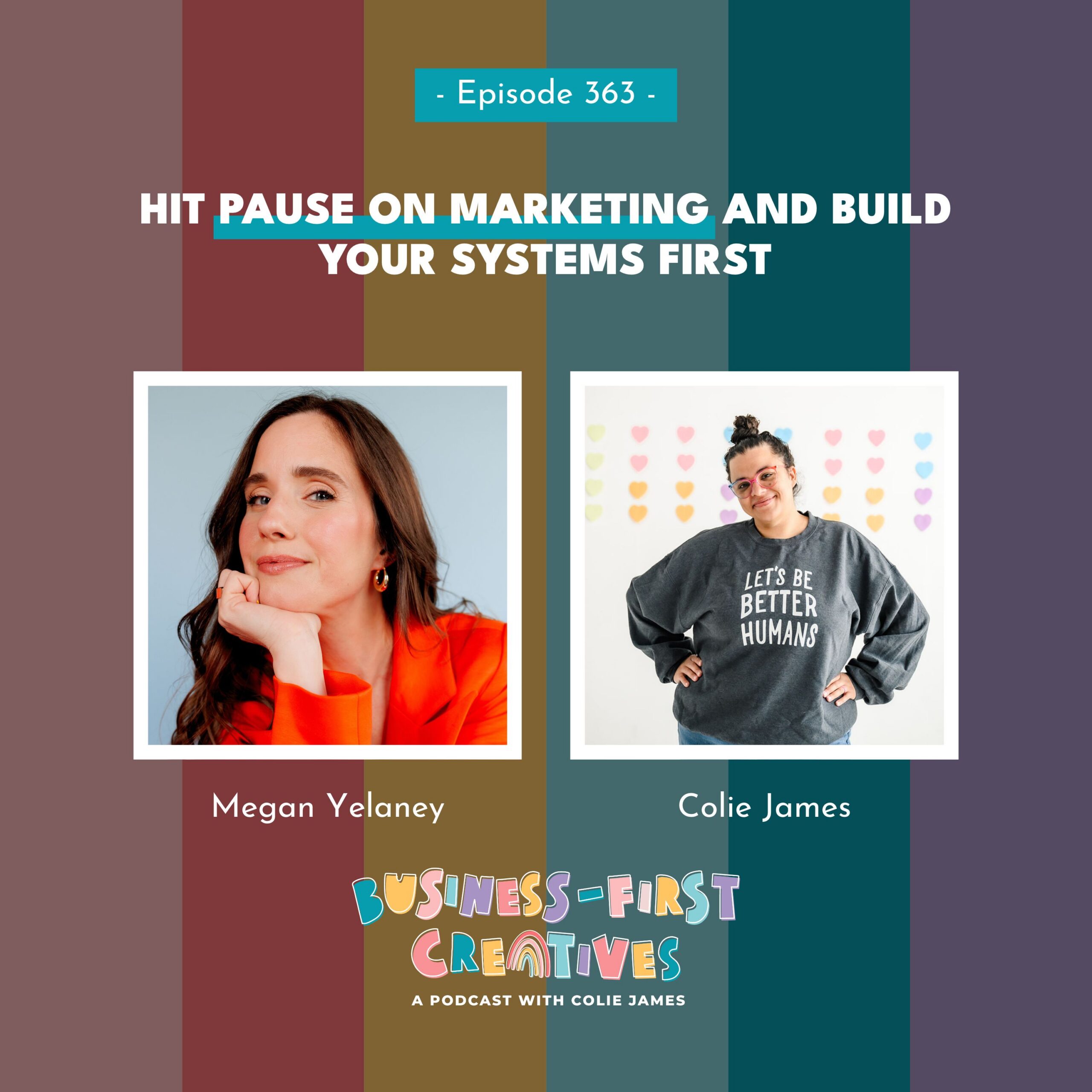
I was recently invited onto Business Not As Usual with Meg Yelaney, and y’all, we kept coming back to the same thing: most people just can’t hit pause long enough to set up their systems 😳
So they keep marketing and posting and showing up, and then the clients they worked SO hard to bring in walk into an experience that isn’t ready for them. Let’s talk about why a couple of weeks of pause actually pays you back, and what you’d build in that time.
Listen to the Episode
What You’ll Learn in This Episode
- Why hitting pause on marketing can bring in more clients than pushing through
- The compounding math behind buying back 10 hours a week, and why it starts with one offer
- How long a full system actually takes to build, so you know exactly how long to pause
- The low-tech first step I give every client before we open Dubsado or HoneyBook
- How one simple offboarding ask (borrowed from a Disney cruise) turns happy clients into repeat revenue
- Framework vs. system: the distinction I figured out live on this call
From Math Professor to Systems Strategist
Okay, quick origin story first, because Meg and I talked a lot about origin stories when she was a guest on my podcast (you can listen to that one here 😉).
Before I ever touched a CRM, I was a college professor for 10 years. Math and statistics. (Yes, I see that look.)
When we moved to Colorado, I knew I wouldn’t be teaching in a physical classroom anymore, so I taught online and figured the move was temporary. Two years turned into four, and when my husband started job hunting, I told him we weren’t leaving. I wasn’t going back to the classroom either.
So I started a photography business. I officially opened in 2012 and did in-home family sessions, hospital Fresh 48s and births. Then 2020 hit, and every single one of those sessions disappeared overnight. I couldn’t go into homes, and I wasn’t allowed back in a hospital for more than a year.
Around that time, my bestie interviewed me on her podcast as “the CRM expert.” I didn’t have a single CRM offer at that point. I was just helping the photographers I mentored set up their systems. The moment we stopped recording, I knew that was my next offer.
I built a Dubsado course for photographers and sold 11 beta spots. Then people started asking, “Colie, can you just do it for me?” So I launched VIP Day setups too, and those became my whole business for the next five or six years.
Meg pointed out something I don’t say often enough: your lived experience isn’t something to hide. My professor brain is the reason I think about systems the way I do. Every client experience I design is basically a curriculum. And it’s why I am so passionate about every business owner taking some time to figure their systems out NOW, rather than later.
“I’ll Deal With Systems Once Things Slow Down”
Here’s what I hear all the time: “Colie, I’m spending all my time on marketing and sales, so I can’t even think about systems until I have more clients.”
And I get it, because when you’re the one doing everything, stopping feels like falling behind 🙃 But let’s do the math, because I’m still a professor at heart.
If your systems buy you back at least 10 hours a week of client management, you can use those 10 hours to go find new clients. And guess what? Every one of those new clients saves you another 10 hours 🤯
It’s a compounding effect, and most of y’all just can’t hit pause long enough to get it started.
Meg put it perfectly: this is your permission. You can take a week or two off promotion, get your systems set up and come back to marketing with a back end that can actually handle what you bring in.
What It Costs to Keep Marketing Without Systems
Meg said something I loved: sometimes we market with nervous energy. Part of us is quietly hoping nobody books, because we don’t know what happens when they do.
The Client Who Had No Contact Form on Purpose
I didn’t realize how real that was until I worked with a personal organizer (definitely not my usual photographer). She was a HoneyBook user, and she was also a full-time teacher. She had a website and a podcast, and she was doing all the things…
But she had NO contact form on her site. She knew she didn’t want to bring in clients her back end couldn’t support, so she didn’t let a single person in.
So we sat down and planned her client experience and her systems. Then she put her contact form up.
Within about three days, someone found her on Google, inquired and fully booked her. That one client brought back about half of what she invested to work with me. And she got to watch her new systems run with that very first client, which gave her the confidence to keep going.
Why Your Marketing Needs Your Systems
In the content world, people think you have to keep making content over and over to bring in new clients. And hey, I want your marketing to work for you!
But if it DOES work, and all those new clients walk into a shitty experience, they’re not coming back and they’re definitely not referring you.
So yes, I am now of the opinion that one more post can wait until your back end is ready for the people it brings in 😉
How Long Should You Actually Pause?
Meg asked the question everyone’s thinking: how many hours do I need to set aside?
It depends. If you’re doing the tech implementation alone, plan on adding at least 15 to 20 extra hours just to figure out the tool. But I’ve worked with people where, added up, it took less than 20 hours to have a full system. Built, tested, refined and ready to duplicate.
Pick One Offer
I’ve got ONE rule across every offer I have: you pick one offer. I don’t care how many you have.
Your first Experience Edit is about getting that one offer mapped from beginning to end. Then most of my clients take everything they learn and build out their first offer inside Systems in Session, together. Then they take all the systems and duplicate them for a second offer, with updated emails and updated forms, in less than a week. Some have done it in a couple of hours.
The first offer takes real thinking and planning. After that, you’re just repeating what you already know works. Getting one offer done from beginning to end is such a relief, because you finally see how easy it can be.
This is exactly why I teach the Order of Operations: Check It, Map It, Build It, Test It. Your systems are designed to be flexible, but the order in which you build them is not.
Want to learn more about my approach? Here’s my Order of Operations framework.
What to Do During the Pause
So you’ve cleared a week or two. Where do you start?
Start With a Pen and Paper
When people ask me the first step of setting up systems, my answer is always the same: a piece of paper, a pen and an hour in a corner with some music.
Write down everything you do with your clients. Every email, every form, every call, every reminder.
Where most people go sideways is jumping straight into the tool. They open Dubsado or HoneyBook and try to figure out what they want it to do while figuring out how to build it. That’s two hard problems at once, and it’s exactly why systems feel so overwhelming. Just write the list. And if you want an outside opinion on where your gaps are, take my “Is Your Client Experience Actually Shitty?” quiz (it takes about 3 minutes, I promise 👀).
Once it’s on paper, we can have a real conversation about what can be automated in your CRM, what you still need to own and what might eventually go to a VA.
Your CRM Is the Cheapest Employee You’ll Ever Have
A lot of people assume they need a virtual assistant before they can get their time back. I’d argue that a good CRM, even at $50 or $60 a month, is the cheapest employee you’re ever going to have in your business.
But (and this is a big but) that employee can only do what you’ve told it to do. Automation doesn’t fix unclear communication. It just delivers it faster.
The tech part is honestly the easier part. You can hire help with it. You can call Dubsado, HoneyBook or 17hats customer service. What nobody can answer for you is what do I actually want to do with my clients in the first place?
Not sure which CRM fits your business? Read The Best CRM for Photographers, my comparison of the five I recommend.
Map the Journey, Then Design the Experience
Okay, let me put my professor hat on.
Your customer journey is the collection of touch points you have with your clients. Every time you ask them to do something, send an email, send a text, get on a call, give feedback. Everything you do with your client inside your offer, listed on that piece of paper.
Your client experience is how your client feels while they’re moving through that journey.
People use the two terms interchangeably, but you need both, in order. You map the journey first. Then you design the assets around it so people get from A to Z feeling like they got what they paid for. That’s how you get an experience worth raving about to their friends.
Not sure where to start? Here’s how an Experience Edit works.
What the Pause Earns You
So how does a system actually generate revenue? Let me tell you about my first Disney cruise.
I’m a Disney adult with a pass and zero shame about it, so when they gave me the chance to put $250 down on my next cruise before I even stepped off the ship (fully refundable for two years, by the way), you KNOW I paid it 😂
And that’s really all there is to it. Tell someone the logical next step for working with you, and most people will bite.
A lot of us skip the ask because we’re scared of hearing no. We tell ourselves that if a client had a good experience, they’ll just come back when they’re ready. That’s the quickest way to lose money.
Even if only 25% of your clients say yes, that’s 25% you wouldn’t have kept if you hadn’t asked.
Build It Into Your Offboarding
This is a big part of my Three R’s framework. A rave-worthy client experience brings you more rave reviews, referrals and repeat clients.
When I build offboarding with clients, it takes us a couple of hours to plan it, create the form and set up what I call a booking magnet: a link that lets them book the next thing right away. A couple of hours, once.
And every person who says yes and pays you? That’s revenue you might have gotten eventually, now showing up right now.
Want the full framework? Read about how happy clients can bring you more reviews, referrals, and repeat bookings or listen to my interview with Kylie Kelly below.
After the Pause: Keep Listening to Your Clients
Now, building your systems once doesn’t mean you’re done forever, because your clients will tell you exactly how to make them better if you actually ask 👀
What My First Clients Taught Me
Systems in Session started with two people. One was a past client who’d been waiting six months for me to launch it. The other was David, who got on a call wanting to build his own custom offer. I told him I had something that already had what he wanted plus three more things, and offered him a beta price.
He said yes. I went home and built a sales page in three hours straight (I can’t sell anything without a full sales page, I’m weird like that). I had two clients in less than 24 hours.
But what those first clients experienced and what my clients experience now are completely different. Several people told me they felt shy about scheduling calls with me, even though I kept offering. They said they wished they’d known how valuable the calls were and started booking them from the beginning.
I heard it enough times that I changed it. Now everyone who joins gets their first four weekly calls pre-scheduled. No excuses.
Build a System for Asking
I don’t wait for feedback to show up. I have a midpoint form and a form at the end. In the beginning, every single client also got an hour-long offboarding call, because people say things on a call that they’d never think to write down.
You have to put your big girl panties on and be willing to ask for it.
And you don’t have to overhaul your offer for the outliers. If someone was expecting way too much, you don’t have to cater to that. But if the same thing shows up three times from clients who got great results, listen. Track the results you expect every client to get, somewhere you can see it all (Airtable, a Google Doc, for heaven’s sake), and make changes when the data says it was you.
Want to build yours with me? Here’s how Systems in Session works.
Framework vs. System: What I Figured Out Mid-Interview
This is the part where I literally grabbed a pen and scribbled something down.
Meg was talking about how she kept revising her content curriculum. She’d been resistant to giving clients one set content system, because everyone’s brain works differently. Then she realized there were three main entry points people use to create content.
That’s when it clicked for me. Our job is to figure out the framework. How someone implements that framework is the system, and the system can be customized to every single person.
So my job is to hand you the framework, and your job is to build the version that fits YOUR business. That’s the whole point of done-with-you.
How the 3 P Framework Came From This
When I was still doing done-for-you work, I asked clients what surprised them most. So many of them said, “Colie, I just love the emails you wrote for me.”
I am not a copywriter by any stretch of the imagination. So I dug into what made those emails land, and I realized it was how I think about client communication. That became my 3 P framework. Every email you send a client needs to clearly identify the purpose, show off your personality and give them a preview of where they are in the process.
Once I knew those three things belonged in every email, I could teach it. And once I could teach it, my clients could go write their own.
Want to write client emails like this? Learn more about The Experience Edit.
Ready to Hit Pause?
If you’ve been holding off on marketing because you’re scared of what happens when people actually say yes, or you’re marketing hard and leaking clients on the back end, this is your permission to pause and build the system first.
Not sure the pause is worth it yet? Start with Systems That Sell, my free four-episode private podcast. You can binge it in under an hour, and it’ll reframe why systems are worth your time right now. Get Systems That Sell the private podcast.
So before you schedule another week of posts, can you block off a week to figure out your systems instead? Please and thank you 😍
FAQ
Is it worth pausing marketing to set up my business systems? Yes, for most service providers. Client experience systems can buy back 10 or more hours a week of client management, and that time compounds with every new client. Colie James recommends taking a week or two off promotion to build one offer’s system end to end before scaling your marketing.
How long does it take to set up a client system in a CRM? A full system for one offer can take less than 20 hours to plan, build, test and refine. If you’re figuring out the CRM tech on your own, expect at least 15 to 20 extra hours. Once the first offer is done, duplicating it for another offer often takes less than a week.
What’s the first step to setting up client systems? Write down every touch point you have with a client before you open a CRM: every email, form, call and reminder. Once the customer journey is on paper, it’s much easier to decide what to automate and what to keep personal.
What is the difference between a customer journey and a client experience? A customer journey is the list of every touch point you have with a client. The client experience is how the client feels while moving through those touch points. You map the journey first, then design the assets around it.
What is the 3 P framework for client emails?
The 3 P framework, created by Colie James, says every client email should clearly state its purpose, show your personality and give a preview of where the client is in the process. It’s taught inside The Experience Edit.
Links Mentioned in This Episode
- Business Not As Usual with Meg Yelaney on Apple or Spotify
- Your Origin Story is Your Marketing Superpower
- Systems That Sell private podcast → coliejames.com/sts
- Client Experience Quiz → coliejames.com/leak
- Experience Edit → coliejames.com/experience


Signature Series


Your business works, but your backend is costing you.
A 4-Part Audio Series for service-based business owners who are ready to upgrade their “just fine” client experience, unlock higher pricing, increase referrals, and grow more sustainable revenue—without overworking behind the scenes.
Get the FREE 4-part audio training series
Systems That Sell


© 2022-2025 Colie James


