


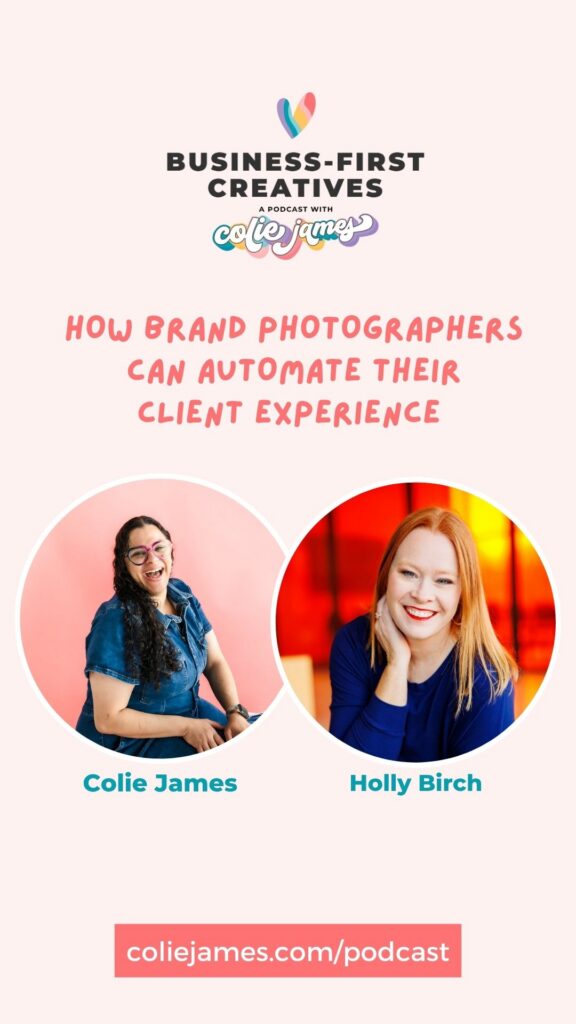
If you’re already booking the number of clients you want to work with, but it feels like you’re spending so much unnecessary time behind the scenes, your systems and automations might need an update. In this episode, I sit down with Holly Birch to talk about what happened after she completely overhauled her HoneyBook workflows using automated systems.
What’s especially interesting about this conversation is that Holly wasn’t starting from scratch. She already had templates, proposals, email sequences, and workflows in place. But she knew her systems could be more efficient, more professional, and more scalable. A year after implementing new automations, we’re looking back at what’s actually changed in her business, from booking studio headshots automatically to creating a completely hands-off client experience for brand photography sessions.
We also talk about why switching CRMs isn’t a decision to make lightly, how automation creates consistency, and why the ultimate goal isn’t simply saving time—it’s deciding what you want to do with the time you get back.
Review the Transcript
Colie: Hey, y’all. Welcome back. So today, I am gonna talk to one of my clients, but she is not a Systems In Session client. She is actually a different kind of client. And so I am super excited to, like, have a conversation with her because as you guys know, I closed down my template shop completely a year ago, but I’m actually gonna be talking to one of my template clients today.
And so you guys might be like, “Well, why are you doing this if we can’t buy templates?” And we’re gonna get into that. Holly, welcome to my podcast.
Holly: Thanks for having me. I was excited when you asked.
Colie: I mean, I love talking to people who buy my shit and actually do something with it, and you are, like, a key person that, like, bought this toolkit that I created last summer, and you implement it into your business. And just for the listening audience, she is HoneyBook, not Dubsado. And
Holly: yes
Colie: you know, it’s so infrequently, even though I have a lot of HoneyBook clients…
Well, actually, a lot is probably, like, really, really overemphasizing what it is, but I have enough HoneyBook clients. And so I just kinda wanna put it out there that, you know, they’re just as happy with me as the Dubsado people. And at this point, I don’t really care which one you are ’cause they are almost equally good.
Can you believe that I said that out loud?
Holly: I can’t actually.
Colie: Well, and it’s funny ’cause you know… Uh, just in case you guys don’t know, I am a co-coach inside of Maddie Pechanec’s program, Rebrand, and that is actually where I know Holly from and, like, all of the things. But in there, I get asked all the time, “Okay, but, like, Colie, like, which one should I choose?” And both Maddie and I, if you’d asked us two years ago, absolutely you get Dubsado.
Like, we don’t even wanna talk to you about any of the rest of them. And you know now, I mean, I’m, I’m team HoneyBook. Like, it… I, I would possibly wear a T-shirt if they gave me one. But I’m also, like, inching my way over to be accepting of a few other CRMs, which is just absolutely crazy to say out loud. But at the end of the day, I want you to find a tool that you enjoy using that is going to help you run your business more efficiently, and it just so happens that for Holly, that tool is HoneyBook
Holly: Yep. Yeah, I think that’s the bottom line is, like, you just need to have some sort of CRM. You know, test them a little bit, see what fits for you. Um, I was an early HoneyBook adopter, so I’ve been with them for a long time, and I can’t imagine trying to switch now, so that’s why I’m HoneyBook forever.
Colie: Well, I mean, Colie, but that’s how they get you. I mean, when people s- and when people are on Threads or Instagram or wherever it is, and they just nonchalantly say some crap like, “Oh, well, they raised their price. I’m looking for a new CRM,” I laugh. Like, clearly I’m at my house, so I mean, I’m not being a keyboard warrior.
I’m not hopping on there and being like, “You are a fucking idiot.” But I’m definitely thinking that in my mind, and the reason that I am is because I feel like people have no idea how much effort it actually takes to move from one CRM to the next, depending on how long you’ve been in business, depending on all of the systems that you’ve set up.
And so, like, no one should just decide one day, “Oh, I’m gonna change my tool,” without a really good reason to do so.
Holly: Yeah. And it’s not like you can take, like, a Word doc and transfer it, copy and paste it. Like, it doesn’t work like that with CRM because it’s custom-built and everything, and, like, trying to transfer templates and, you know, the proposals and the way they’re set up, like, you can’t just shift it over
Colie: Mm-hmm. you said, you’ve been a HoneyBook user forever. Um, what did your HoneyBook look like prior to last year when you bought this template toolkit from me? Like, what were you using? What were you struggling with? I mean, were you happy?
Holly: Yeah. So I had quite a few of my own templates set up. Like, I had proposals for everything, but they weren’t, converting necessarily. They were kind of clunky. Like, my brand proposal had, I think, way too many pages. Um, so that’s… I know that’s probably a big one. But I mean, some things were working.
You know, I’d had, I had a lot of email templates already set up, so I wasn’t, like, retyping things every time, which that’s a big one just to get, get started with, like, automations and workflows is having s- co- like, copy in place. And I had some lead forms, and I was using my calendar. So I was using quite a few things, but I knew it could be better and more efficient
Colie: Mm-hmm. Were you using automations? ‘Cause I mean, you mentioned the forms, you mentioned the scheduler, but were you actually connecting everything together with automations? Or were you… Was it like piecemeal? Was every asset doing a job separately and you weren’t actually using automations to like put it all together?
Holly: I, I had a few automations, but not very many, and they were very basic, and I didn’t really fully understand it. I think that was, like, part of the reason why I ended up buying your templates was I needed to, like, somehow wrap my head around it. And until, like, someone showed me how to do it, it didn’t really make sense to me.
And so having the, like, step-by-step setup process was, like, definitely… I hate using the word game-changer, but it definitely was,
Colie: Oh, you’re AI, Colie. That is such an AI phrase right now. Now, I will admit, I used to say game changer all the time, and now it’s one of those words that I like…
Holly: It’s cringey, yeah.
Colie: not to say it. Yes. I mean, that is what AI is doing for us at this point. It is taking things that… ‘Cause I have always said I give you clarity.
Like, I have always said I give my clients clarity in what they want to do and what they want to say with their clients at any given point. And now I have wiped the word clarity from everywhere on my website because, you know, then people are like, “Oh my God, that’s so AI.” And I’m like, “But I, I’ve been saying it for like five years, and I have a framework that had the word clarity in it.”
So this is definitely pre-ChatGPT, Claude, you know, all of those things.
Holly: Yeah.
Colie: All right. So let me ask you a question, ’cause right now your bread and butter is brand photography, correct? And is it brand photography for humans, or are you doing about equal parts of like brand-led photo sh- shoots versus product photography?
Holly: Yeah, I actually would say I’m, I would consider it more like 75% commercial photography. So I’m not doing as many personal brands. I like doing those and I want to do more of those, but most of my business right now currently is from commercial work. Like, so bigger businesses, lots of people, products, um, like team headshots, that sort of thing
Colie: Ooh, let’s talk about your systems for commercial jobs. Okay, ’cause technically
Holly: Okay. Okay
Colie: the brand toolkit was created for personal brand shoots. I mean, you know, that’s what all the language was in it, even though everybody, you know, changes the template language clearly. But what is your process for putting a booking proposal in the hands of a commercial inquiry? Like, how, how much back and forth are you doing in order to figure out what they need in their shoot before you’re actually making the offer to book?
Holly: Yeah, I, I will say I don’t use my systems too much for commercial stuff. The one thing that I do though is I’m usually sending an estimate, and so that’s one of my HoneyBook templates is line items with, like, my creative fee and then however many assets they think they need. And sometimes they don’t know how many they need, and so then we’ll have a little bit, like, a conversation or a call, and I’ll, I’ll kind of determine how many assets they need.
And then, you know, anything else, like, extra, like travel or they’re like, “We want a group photo too,” whatever it is. And then I invoice after the fact. So there isn’t as much, like, automates- automation with commercial work. But with brand photography there definitely is
Colie: Man, but I feel like we could create some automations for your commercial
Holly: Yeah, I
Colie: let’s make a little note
Holly: Yes.
Colie: when I see you in
Holly: We’ll table
Colie: just make a little note. We’re gonna, we’re gonna talk about this. Okay, so let’s flip over back to brand photography then. So for your brand photography shoots, how much of it is now taken care of by the systems versus how often you’re popping in there to do personalization and customization of your forms, your emails, whatever it is?
Holly: Yeah. So pretty much, someone, like, inquires with me about brand photos. I have– my proposal is, totally retooled based on what I bought from you. And so it’s, basically one long page now with, like, my packages, my FAQs, all of that. But it, it, you know, looks nice and everything too, and I’ve dropped in some of my own photos there.
And then it’s attached to my scheduler. So when they go in and based on, like, how long of a session roughly it is, they choose a time in my calendar, and then it takes them to invoice, which that’s another thing I learned from you, is I put invoice before contract
Colie: contract.
Holly: invoice, contract, pay, um, and they can leave a tip if they want.
But anyway, um, and then, and then after that’s done, the whole system starts from there. So then they get a series of emails leading up to the session, um, prep guides, a questionnaire, all that stuff. They can book a follow-up call if they want before the session. Um, and then after the session, there’s a series of emails too.
It’s all automated. They get asked for a review afterwards. They get tips for choosing and downloading their photos. And it’s all– I don’t have to touch anything after that point. I think the only thing I have to touch is that, I have to approve the initial email because I go in and make sure that it’s, you know, something isn’t wonky.
And I know we still can’t edit emails in Automations in HoneyBook, so that’s one hang-up. But I like to write an email and attach that brand proposal to it, and then everything else is pretty much automated after that step.
Colie: I mean, and you know what I just realized, Colie, is that you were one of the first people to buy that toolkit, and now I’ve actually adjusted. There’s two ways that you can get the proposal, the smart file to book in their hands. The first is that you can send it through the automation, which is what my automation templates told you to do when you bought it.
But now there is a second option, and instead of starting with a action that actually has the smart file waiting for you to send it, it’s actually a to-do task now, so that it tells you to go to the project dashboard and send it from there so that you can modify the smart file or the email that’s attached when it goes.
Now, you know, we’re now what? Two and a half years in, and you still can’t edit the email that goes with the smart file in 2.0, and I’m just like, how ridiculous is this? Hey, HoneyBook, if you’re listening, I am still waiting for this update and so are each and every one of my HoneyBook
Holly: Yeah. But at least we can skip tasks now too, which like if someone contacts me, and they s- like specifically ask for brand photos, but what they really need is just headshots, I can skip those automations and not have it send a bunch of stuff to them that they don’t need.
Colie: Let’s talk about your headshots, ’cause when you and I were chatting before we started talking, I’m like, “Hey, you know, yes, you’re my client. Yes, you used my product. Yes, you love it, which is why you’re here, but also, there’s gotta be this thing. Like, what are we gonna tell the audience?” And you were like, “Oh no, but I’m booking headshots just without anything all the time.”
So tell me about your lead form process for booking these headshots, because I feel like for brand photographers, headshots are like, I don’t necessarily wanna say easy money, but they are the lowest lift thing that you can do, especially if you have your own studio. So what’s your process for getting people to book these with ease so that it’s easy on you and it’s easy on them?
Holly: Yeah, so I basically took the, uh, templates again that I bought from you and retooled the whole thing and basically copied each step. Taking out a few steps that weren’t necessary for headshots. But created a whole, um, series of steps, automations that are just for headshots. I do have a studio, and that was one thing I wanted with a studio was, like, if I have a space, I want people to be able to automatically book and I don’t have to do anything.
And, like, literally, that is how it is now. I don’t have to do anything else. There’s a link on my website. Every once in a while, I will post to, like, stories and say, “Book your headshot here.” It goes out in my newsletter every month. There’s links everywhere to if you need to book a headshot, this is the way to do it.
And they go in, they, select their one option, head- headshot option. That’s the only one. I think there may be an add-on, like, if you wanted an extra outfit or something like that, but it’s pretty basic. And then they, select a time on my calendar, which is set for only, my only studio hours, which is usually, like, Tuesday through Thursday.
And then, and again, invoice, contract, pay. And then I meet them at the studio, and that’s it.
Colie: And I mean, so you just said invoice, contract, pay. So were you really excited when HoneyBook announced that now the contracts are attached to lead forms?
Holly: Uh, I don’t remember. Was I not doing that before? I guess I wasn’t. I don’t remember that switch. But yeah, lead forms has been huge because it allows you to put a link out there for people without ha- someone having to contact me first and then me send something back to them. The link thing is a game changer.
Oh God, I said it again. Yeah
Colie: that this is not a drinking game because, you know, I just pour a little shot, have a little shot. It’s okay. Um, so I have a question because I find it really interesting that you have a scheduler inside of your smart file to book brand photo shoots. You also are using the lead capture forms in…
Well, I’m sorry. You are also using the lead forms in order to get headshots scheduled. Is that, like, a non-negotiable for you? Is there anyone that doesn’t use an automated scheduler in order to get on your calendar?
Holly: Uh, yeah, so like commercial sessions wouldn’t because it’s usually like, um, they’re working with a team of people and they have to check a bunch of people’s calendars and… But even having said that, like sometimes I will go in and check my scheduler. I’ll be like, “Okay, this company needs an hour session.
I’m gonna see what, if I open my calendar, what it s- shows me.” And then I don’t have to go through and like pick and choose on my calendar. I just look at what my scheduler says, and I can send them a couple of dates like really easily without me having to like, yeah, like sort through it. So even though they’re not selecting it directly, um, it makes it a lot easier for me to find what dates I’m available.
Colie: That’s amazing. I don’t know that anybody’s… I mean, I personally, when I was doing Done For You and we were setting up, you know, your strategy call, which for Dubsado used to be up to four hours, and for HoneyBook it was two to three. But like, I never sent schedulers to my people. Everybody always finds that, like, really puzzling.
I’m like, “No, I’m, I…” That’s the one thing that I will label myself a control freak about, is that I am very particular about my schedulers. And so while I would go in and, like, enter the day and time for you, I was never sending you a scheduler. I was sending you the options in an email. You were coming back to me and telling me, and then I was using the scheduler to make sure that you got the confirmation email and the reminders.
And so that was a good thing. But especially when I was doing a lot of traveling, I mean, I don’t anymore, but I was always, like, wanting to be in complete control of my calendar just in case, you know, there’s something that I didn’t add. There’s, you know, whatever the situation called for. But I’m always in love with people who are like, “I am using these schedulers to the absolute max.”
Holly: Yeah, I have … I mean, honestly, if you went and looked at my scheduler page right now, there’s probably 20 schedulers in there. ‘Cause I
Colie: Why are there
Holly: all kinds of things. Well, some … There’s probably a couple that are duplicates and I could delete one, but, like, I have one specifically for discovery calls. I have one for the studio head shots.
It’s, like, 15 minutes. I don’t know what el- Then the brand- there’s three options for the brand sessions, um, that sort of thing. And I’m trying to think. Oh, I have one. I, I may have gotten this idea from you. I don’t remember exactly. But I have one, like, if someone contacts me, they’re like, “Can I just pick your brain for 15 minutes, half hour,” whatever.
I have, like, a coffee chat one, that I would just send them that link. But yeah, I think the key is you have to make sure you’re keeping your calendar up to date. But I get what you’re saying about being in control of it. Like, for example, this week, I was on vacation last weekend through Tuesday, and on Tuesday, I had a guy book a headshot for the following morning in my studio.
And so I had to, like, scramble and make sure I could get it done. But it worked. It was fine, and he booked it. And so, like, you know, I’m not gonna turn down money when it’s prepaid and everything. So
Colie: And all you gotta do is show up with your camera. I’m with you. Yeah. I mean, so let’s, let’s actually, let’s dive into one more thing about your schedulers before we kind of like turn the page on them. So you said that you’ve got a bunch, and you specifically said your discovery call scheduler. How many discovery calls are you actually doing?
And has that decreased or has it stayed the same since you implemented your new smart files to get clients booked that have like all of that additional information in it, which is a lot of what you typically discuss with people on a discovery call
Holly: Yeah. Um, I, I really don’t have people book that many. I think for, I don’t know if it’s the area I’m in or what, but I feel like people are way more inclined to just email me first. But I do, like I probably would say maybe one to two calls a month that are scheduled automatically for brand sessions specifically.
So, and then I have, one of the calls I have set up is like a commercial call where if someone contacts me and maybe we have a little bit of back and forth email and I’m like, “Look, I really need to get you on a call to suss this out a little bit,” and then I would go back and say, have them schedule a call on my commercial one even though it’s basically the same as the brand one.
But I don’t know, I think just having two different ones helps me keep it straight in my brain too
Colie: Is the amount of time that you’re scheduling for each call the same?
Holly: Uh, yeah, I think they’re both 15 minutes. They may- maybe
Colie: wow. You’re do- I was like, you’re doing a 15-minute consult for commercial? That’s impressive, Holly.
Holly: Well, I think it, I think it’s 30. I don’t remember exactly. I don’t have that many people book those either, but yeah.
Colie: Yeah. So on your website, do you currently have a contact form? Is that the first point of contact if they don’t just jump and send you a direct email?
Holly: Yeah, so contact form would be the first place, but right above my contact form on my page is that link where they can book an individual headshot. So that’s where most w- people are probably, like, s- hunting around my website. They, they’re like, “Okay, I’m gonna go to her for a headshot.” They go to my contact page to, like, do the next step, and they see that link, and then they know they can book automatically, and done and done, you know?
Colie: I mean, that’s just so fantastic though. I’ve got a question. How do you treat your headshots as an offer inside of your offer suite? Are headshots really just quick and easy, you need this thing, I’ve got this studio space, I give it to you? Or do you ever use headshots as, like, a test to, to where people are, you know, testing you out, getting your photos from you, seeing what they’re like, and then they eventually hire you for, like, a personal or even, I guess, a commercial brand shoot?
Holly: Most of mine are not. Most it’s just like someone’s like, “I, I have to have a headshot for work. I’m gonna come in and do it,” and that’s it. I think, sometimes it, it is a headshot turns into a brand, but that doesn’t happen very often. It’s more so, yeah, not for me at least. And yeah, the studio headshot, they’re very basic. They’re, they’re very well edited though. But I mean, I can do other things with headshots too, but I can kinda tell off the bat what someone needs. And if they, they’re like, “Well, I don’t really wanna do a studio headshot,” then I- hopefully they would email me and say, “This is what I want instead,” and then we’d go a different route
Colie: Yeah, to where it’s not in studio, 15 minutes, all the things. So where are your headshot clients coming from? Is your SEO just that good, Holly?
Holly: My SEO is really good. So I’m in a university town, so I get a lot of, university people. I get a lot of, businesses. I’m trying to think of any, like, specifics. Um, a lot of them are just random. And then I have a lot of businesses that I work with, like, on a repeat basis where they’re like, “Okay, we just hired two or three new people.
We’re gonna send them to you for three headshots.” So I have several clients like that where it’s kind of a ongoing thing, but not, like, a regular basis necessarily, but they usually come to me maybe a couple times a year
Colie: Do you book those people differently? So like for example, you just said if a company gets a couple new employees, they send them to you to direct. I’m imagining that you’re charging the company for those headshots and not the individual people.
Holly: Yeah, and so like in that case, they already know my pricing and everything, so they’ll just, they just, they’re like, “We’re sending these people to you.” I’ll send them possibly the scheduler so they can see what I have available. They send the two or three people to me, and then I just send an invoice back to my contact at that company.
And it is priced a little differently because if it’s multiple people, I offer a discount on the additional people, just ’cause it’s makes sense for me. But yeah, a single person is just one price, and then, they get the automation, so
Colie: Okay. Wait, so they get an automation, Holly. What automation do those people get? A- is it after they’ve booked their time slot?
Holly: If someone contacts me about a headshot but they didn’t do it through the automatic, like the lead form, then yeah, they would get essentially still what would go out with the lead form, they get in my reply email to them. So it’s essentially the same process, but they took the extra step to email me through my contact form.
Colie: Okay. And so if someone is booking off your website, it’s a lead form. They’re choosing it, you know, it says the price, they’re choosing a day and time, and then they’re paying you, signing the contract right there from that one link. And so these people who come to you from the companies, you’re sending them a scheduler where the individual people can pick, pick a day and time, and then they’re getting an automation.
Like, do they get the same kind of prep work that the other people do? Like, you know, I, I mean, do you do what to wear? Do you have prep work for those people? Or is it just like, “Show up at this time, I photograph you quick, and then we’re done”?
Holly: They get my prep guide essentially ’cause like I would say 60% of people email me back and they’re like, “Can you tell me what to wear?” And I’m like, “Yes, here’s a link.” Like, so it’s, it’s not any extra step on my part. And, uh, it kinda depends on again how they contact me, but if they end up, if they end up dropping into the automation, whether I put them there or they did it on their own, then, uh, they will get a prep guide automatically which is part of all my headshot sessions.
If it’s someone that like I’m doing like back and forth emails with them, which I try to avoid, but sometimes it happens, then I would still probably send them the prep guide. But again, it could still be that automated email that I send through HoneyBook. It d- wouldn’t have to be me typing it out again.
Colie: I mean, well, it sounds like you were doing a good job though, even before you bought my toolkit. It sounds like you were doing a good job of using templates so that you were not one of those people wasting hours writing every single email from scratch over and over again
Holly: Yeah. I w- I mean, my ultimate goal was to save me time and to not do s- the same steps over and over that were just repeat things. I mean, that’s the whole point of automation, so
Colie: It is the whole point of automations. Colie, how much time have you saved with these automations? Like ballpark. You can tell me per client, per week. I mean, you know, pick one. Give me a number
Holly: oh gosh. I would say per client would probably be the easiest to figure out. I mean, I would say I probably save an hour per client not having to do back and forth and not have to, like, track down them paying invoices or back and forth, like them asking me questions. I try to cover all the bases, so anything they would ask me is covered in my brand session emails or the headshot emails, et cetera.
Yeah
Colie: What happens if someone asks you a question that you didn’t cover in there? What do you do?
Holly: Uh, I would just email him back.
Colie: But then what would you do?
Holly: I feel like this is a trick question.
Colie: is a trick question, and I’m sure that the listening audience knows
Holly: Oh, you would add it, you would add it to the original proposal.
Colie: I wish you guys could see my face right now. I’m like, ding, ding, ding. Yes. So let this be a lesson, everyone. I love that Holly is like, “No, every single question that they’re gonna ask me is covered.”
And you know what? I feel like that’s true 90 to 95% of the time, especially if you sit down and you, like, really think about all the things that anybody who’s ever hired you has asked you. But if you do come across a question that you’re like, “Oh, well, that isn’t covered,” and it could just be that it’s just one person and no one else would ever ask you that question.
But if it is something that you’re like, “Damn, that’s a really good question. I should have answered that in my prep guide,” you should go add it, and you should also put it in the emails. It was really funny, Holly, I had one of my systems and session clients recently that was… You know, she’s been out for a few months, and she was saying that she f- she feels like she is going back over her process because when these automated emails that were answering these questions were gonna go out, she was like, “You know, we’ve already discussed it.”
And she was like, “That means that, like, the email shouldn’t be automated.” And I was like, “No, that’s not the conclusion.” The conclusion is that you send that information earlier. Like, it’s not that you don’t automate it, it’s that if you feel like you are about… this email is about to go out and the client already asked you that last week, okay, well, the information in that email needed to go out a week and a half ago.
Like, I would just encourage everybody to move the information earlier rather than, you know, eliminating the automation altogether
Holly: Mm-hmm. Yeah, that makes a lot of sense
Colie: I mean, so are there any things that are like on your systems to do tackle lists that you haven’t done?
Holly: Well, I really like what we talked about earlier, the idea of creating more systems for my commercial work, because I think I could, streamline that to avoid a little less back and forth also. Um, one other thing I was gonna add that I really like is the did not pay email automation. So if someone signs a contract but doesn’t pay, it reminds them, like, “Hey, you didn’t pay.”
Which that d- doesn’t happen very often because, you know, it, it’s just like anything else you buy online. You’re signing up, you’re putting things in your cart, and then you pay and you’re done. And if they don’t pay, like, you didn’t finish the process, so. But yeah, as far as additional things, I don’t…
I’m sure there’s something. I’d have to com- I mean, I’ve niched down pretty hard, so, like, pretty much I’m only doing commercial brand headshots. I do events. There’s probably some automation I could come in with event photography, but that’s, I kinda lump that in with commercial. But I could see having a whole series of emails, or automations for events specifically, too.
But yeah. And maybe somehow connecting my gallery system to it better. I don’t know, maybe.
Colie: Oh, you know what, Holly? Let’s talk about that nice and juicy. Did you see my email about the new features that HoneyBook did for photographers?
Holly: No, and I s- I saw the HoneyBook email go out too, but I haven’t had a chance to read it
Colie: Yeah. Uh, you have
Holly: They added galleries, right? Yeah. Okay
Colie: I don’t know that that is something that you’re gonna wanna dive into. Of course, it’s the first iteration. Um, you know, you currently can’t sell them extra photos out of the HoneyBook galleries, but, like, just the fact that they gave you galleries, and if you go look in there, Holly, like, when you click on the gallery part of HoneyBook now, they have on there that a store is coming.
And so, you know, you know that eventually you are gonna be able to sell additional photos and stuff like that. And you know how I feel about all-in-one software. Like, it’s, it’s not my favorite. But I gotta admit, the fact that it’s a CRM that’s adding the gallery versus a gallery that’s adding CRM-like
Holly: Yeah.
Colie: I’m actually looking at this with, like, different eyes ’cause VSCO also did the same thing.
They have now combined their CRM features and gallery together. But again, they were a s- like, they bought Tave, and so Tave was a CRM on its own. And so I am watching, like, like a hawk to see if I think that these are a better fit for most photographers rather than something like Pixieset or Cloudspot that was really, like, deliver the photos, and now they’re letting you manage some of your client, um, you know, tasks.
I just, I see this going differently, and it could just be because, you know, I feel like everyone should have a top-tier CRM that does all the things that Holly’s talked about on this call. But, you know, how much are you guys using your gallery software, and do you really need all of the store features?
Because I would argue that for a lot of brand photographers, you guys are not selling products. You guys might be
Holly: Ja.
Colie: digitals, but y’all are not selling them products. And so I can see that, you know, HoneyBook introducing these galleries is going to make it a lot more appealing to a lot of photographers that are either all-inclusive or that they are just digital images and that they don’t sell products
Holly: Yeah, I, so I use Pic-Time, and I love Pic-Time, and that’s one of the reasons I switched to them was because of the selling features. And a lot of it was automated too, where, like, I didn’t have to do anything, and it was like I was making money in my sleep. And like you said, I, but I’m not selling as much anymore.
I do still occasionally sell prints for different things. Like, I have this one off, like, preschool that I still do their pictures of little, little guys every year. So they buy prints or whatever. But, I could see switching to HoneyBook as long as they offer the option to sell digital. I have to be able to sell digitals.
Um, so that would be, that would be a d- deal
Colie: You’re like, “No, I need my extra money.” I got you, girl. Now, do you have Pic-Time and HoneyBook connected to where you can actually link their galleries with their projects in HoneyBook?
Holly: Um, they’re connected. I don’t really use it.
Colie: Okay
Holly: I feel like, I, I mean, maybe it’s just I haven’t researched it enough, but, like, uh, I ha- I mean, I have a ton of projects going at any given time. So I mean, like, probably 50, 60 projects open in my HoneyBook, so I mean, maybe more than that right now. I don’t know. I try to go through and archive them occasionally.
But, but yeah, just, like, the idea of going through and, like, connecting it to a certain gallery,
Colie: It can automatically be connected. So the thing is, and if you don’t have this on, Holly, again, I don’t, I don’t know if you need this for, like, your brand photography, but it’s just a setting in there where you can turn it on, and then every single project that you book, it automatically creates the gallery in Pic-Time for you, so that when you are done with the shoot, when you are done editing the photos, you can actually go into HoneyBook, click the gallery link from there, and it opens in Pic-Time, and then you can put the photos in there.
And then, I mean, the benefit, I don’t know that they fully fleshed this out. I mean, there were things that they were planning on doing, and I don’t know if they’re still gonna do these things now that HoneyBook has galleries. But, like, the whole idea of when someone bought something from you in Pic-Time, and it was gonna actually bring that sale into HoneyBook so that you could see all the money that you’ve made for them, like, that was where they were going originally, so that, you know, HoneyBook didn’t have to be an all-in-one software.
Pic-Time didn’t have to be an all-in-one software. But you were kind of getting that warm and fuzzy feeling because they were connected to each other
Holly: Yeah. I did, now that you say that, I remember. I did have that turned on for a while, but I get so many, like, random things that, like, either I’m not available or, like, it’s not a good fit, whatever the reasoning is. And so I was getting all these extra galleries, and it was kind of stressing me
Colie: I thought it was if you got paid, but it could have been that it was the moment that a project was
Holly: If I could do it as just when I got paid, I’m all about it. That, I will sign back up.
Colie: You’re like, “But you know, you don’t want all that digital clutter in your Picktime account.” I got you. I mean, no, so sometimes I do have, um… And I guess it’s not really a problem in HoneyBook, this is more a Dubsado problem.
A lot of people are like, “Colie, I don’t understand why you have the inquiry and the booking processes separate.” And I’m like, “Well, it’s because I have a lot of clients that literally cannot stand the digital clutter.” And if you have inquiry and booking combined in Dubsado, and the proposal is there even if you never send it, it automatically creates the invoice.
And some of my clients just legitimately cannot live with going into their account and seeing all of these automatically created invoices that don’t have anything that’s due on them, and they’re just kind of sitting there. Like, I’m not one of those people, because I have 140,000 emails that are currently unread in my Gmail.
So clearly I’m not that person, but I do work with them, so you know, I try to minimize the digital clutter for other people whenever I can.
Holly: I think that’s me too. I like having the booking and inquiry separate
Colie: Well, and for you, I think that even if it doesn’t happen to you often, I think that totally makes sense for brand photographers, because you might get someone who said they wanted brand photography, but really they just needed a headshot. Or that they said they wanted headshots, but really in their mind they needed, like, a full brand photo session.
And so I like to make sure that, you know, when you’re looking at what someone says they’re interested in, that you verify that that’s actually what they need before you go down the path of getting them booked into your systems.
Holly: Yeah, I have that happen a lot where it’s a, what I would consider a bigger business. And you know, that could only mean they have a staff of six, but we’re not talking about personal brand photography. And they, they keep calling it brand photography, but it’s really commercial and I’m gonna invoice it com- as commercial, and if it did have an automation, it needs to be in the commercial automation, not the brand one.
Colie: Yes. I mean, ’cause Colie, you wanna make sure you’re getting your money. I
Holly: Yeah.
Colie: I mean, that’s a good example. So we’ve already talked about time saved. Was there any other benefit that you found to, like, actually buying a set of templates from someone else and getting them all installed in your business besides, like, you know, making sure that the things were where they needed to?
You, you mentioned the time saved. Was there any other benefit that you found once you… Yeah
Holly: I think some of the, um, like, What are they called? Like, the, the like s- different selections you can make within the automations. Like, I didn’t necessarily understand what certain things meant. Like, it’s been a while, obviously, over a year since I set this up. But like, I don’t know, just knowing, like, should I do this on a condition, or should I do this on, you know, like whatever the things were that you can choose in each, like, arm of the
Colie: The triggers. Mm-hmm
Holly: Yeah, so a lot of that was helpful to just have from someone else’s perspective. Um, and then the other thing, I had another thought on that too, but now I’ve lost it, as happens.
Colie: at brain fog, we could, we could once again say how old we are, Holly, ’cause I’m sure that that’s part of it.
Holly: Right
Colie: mean, you know, I, I tell people that all the time. I’m like, “No, my mind is not as sharp as it used to be.” And my mind was pretty sharp. I mean, so now I’m just, I’m just average. Like, now I’m just like everybody else.
My doctors laugh at me because I, I actually made my neurologist test me, and she’s like, “You passed with flying colors.” I’m like, “Yeah, but you don’t understand. Like a year ago, I would’ve done much better than this.” Like, “But now you have a baseline so that if I keep declining, at least you have a number to compare it to.”
I mean, you know, these things as we… Well, I mean, if we wanna bring it back around, Holly, and not just say it’s because we’re old, like, that’s what the systems do for us. The systems make sure that we are not mentally trying to hold everything up. And I mean, there’s a lot of factors that go into whether or not you need systems to do things for you.
For some of us, it is our age, it is brain fog. For others, it’s that we have kids that are sucking up all of our time, and we don’t know what to do with ourselves. For others, it’s that we have a client load of 50 to 60 open projects in HoneyBook like Miss Holly over here. I mean, but whatever your reason is, systems are like the fallback system.
Systems are what make sure that people who are inquiring with you, people who are hiring you, don’t get lost, you know, because no- nothing was set up to be consistent. I mean, I think that’s like the number one thing that I’m trying to sell systems for now, is that it keeps you consistent, and giving a consistent experience to your clients is what keeps them happy even if they don’t know it.
Holly: Yeah, I like what you said, consistent. I also, I’m all about anything that makes me look more professional and put together. Because I think most people that have booked me that, or know me, like, in my area know that, like, it’s just me. I don’t have a team or anything. But having those, the emails that go out systematically, um, with reminders and everything, it makes it look like I have my shit together even
Colie: do have your shit together, Holly.
Holly: mean, I do. I do for the most part. But it also, like, yeah, not letting things slip through the cracks and having it consistent and pr- very professional looking. And, like, I did have a system in place. Like, I want you to have all this information. I want you to get these emails with the reminders and things.
And, like, I wanna take care of you, but I don’t wanna be holding your hand all the way and having to email you personally all the time.
Colie: I mean, you sending them automated emails is holding their hand. You’re just not actually
Holly: It is. Right. Well, that’s what I mean, yeah.
Colie: and you scheduled it, and it’s being done on your behalf, but you are not the one inside of HoneyBook, no matter how much you love it, pushing the button every single time in order to make something happen.
Holly: Exactly
Colie: I think I’ve got one more follow-up question, Colie, and then maybe I’m gonna be done with you. Uh, depends on what you say after this. Um, so one of the things that’s really interesting about me interviewing you now is that you did this a year ago. So in this year, after you set it up last summer, ’cause I will admit, Colie is like an A+ student.
I mean, she got in there. She did all the things. She is one of the few people who came to the 30-minute call that she got with that toolkit, and, like, everything was built. Like, I gave her a few extra, suggestions, but, like, I should go back and, like, look at that call, ’cause I swear I must have told you five times how impressed I was that you had gotten everything done.
But in this year, how many times have you gone in to the personal branding systems that you set up and tweaked it? Like, it’s been a year. Have you had… You know, have you purposefully gone in and, like, looked at the emails and looked at the forms and updated them? Or is now when you should be doing that?
Holly: So I d- haven’t done a lot of tweaks. The one thing that I did do, and this was based on the call we had, I don’t know, two or four weeks ago, whenever it was, was I went through and renamed my th- so that they’re numerical now and based on, like, so chronological basically, but the numbers are based on time.
Because it was so hard for me to go in and look. Like, I had, you know, eight branding emails or whatever it is, and then four for headshots, so they all started with, like, headshots or branding. But I needed a better way to, like, at a glance go look at them. So that’s probably the biggest tweak I’ve made in the last few months is just renaming those files so that I can go in and see them quick- more quickly and s- make sure that they’re in the correct order.
Um, but as far as, like, tweaking, I mean, I think I’ve gone in and, like, maybe adjusted a couple things in my proposal. But for the most part, everything is working w- the way I want it to, so I haven’t had to do a whole lot.
Colie: and I have no doubt though, you are one of the people that if something wasn’t working, you would actually make time right then to fix it going forward. But I mean, people are always like, “Okay, but Colie, like what, what happens when something needs to change?” I’m like, well, I mean, at least every year, preferably every six months.
I would love it if it was every quarter. I mean, I do feel like people should just take a look at your systems, even if it’s just 15 minutes on your calendar that’s like, hey, go look at those emails and see if there’s anything that you told a client that you’re realizing now you need to tell all of your clients going forward.
Just putting something on your calendar to make sure that you have just checked it off, as like a self-audit to make sure that, you know, the systems that we built are great. And depending on how much your business changes, you know, some people need to do this more frequently. I do feel like, Holly, your offers are solid.
They are, you know, where they need to be. And so for someone like you, you actually don’t need to go in there and look at them that often because, you know, the offers themselves and how much you knew about your business and how you wanted it to work when you put those systems into place was like further along than someone that was just doing it because, you know, hey, I’m trying to do this.
And like now six months later, you have made changes in your business that now need to be reflected in those systems.
Holly: Yeah, I think I probably have tweaked my, the text in my emails a little bit. I don’t think I’ve really, um, tweaked anything, like any of the, um, what do we call them? The files within there. But yeah, the wording of email gets changed every once in a while based on, like I’ll see an email go out and I’m like, “I don’t really like the way I said that, so I’m gonna go and change that next time for next time, ahead of next time.”
Colie: But look at you looking at the emails after they go out. I like that. I like that for you, and I like that for me. All right, Holly. So in conclusion to all of this, if someone was like, “No, like my systems are working,” ’cause again, you had systems, they were working, you just thought they could be better. What would be your advice on what someone should tackle first, in order to put in better systems in place for their business going forward?
Holly: Ooh. Um, I would say look, take a look at your whole process and see what your biggest, like, log jam is. And whatever’s holding you up, and again, taking you the most time, I think brand photography is probably a big one for a lot of people with that is … I mean, even, weddings too. There’s a lot more streamlining that I think wedding photographers can probably do.
But for me as a brand photographer, I would say there, there’s, like, a lot of that should be, done for me. And so just figuring out, getting that all in place so that I don’t have to be doing all this back and forth, all the information is there, they get it, they can book, that was probably the biggest, like, eye-opener for me
Colie: You know what? I lied. One more question.
Holly: Okay.
Colie: What did you do with the time that you saved? Like, I, I feel like, uh, Jocelyn… Oh, Jocelyn, if you’re listening, hi. I asked the question. ‘Cause, like, one of the things that I’m trying to, you know, put forth on my sales pages and my website and in the podcast episodes is, you know, systems save you time.
They, they, they reduce your stress, but the biggest one that you get is time saved. And so did you book more clients? Did you pick up a hobby? Did you spend more time with your husband and your family? Like, what did you do with the time that you saved?
Holly: okay, girl, you’re gonna love this. I think I just wrote a blog post about this that went out this week.
Colie: Ooh, okay. Yay
Holly: think, I think your name might be in my blog post. So as part of Maddie’s rebrand group, um, one thing I’ve implemented this year is Marketing Monday. So every Monday morning is blocked off on my calendar.
I generally go to my local library, and I sit there, and I get shit done.
and honestly, like, I spend a lot less time working in my business, whether that’s editing, sending emails, whatever it is, and I’m able to spend a lot more time, working on my brand, finding new leads, working on my SEO, all of that stuff.
Like, the stuff that, like, really is gonna further my business rather than the stuff that’s just taking pictures. And so yeah, having all this in place has definitely saved me time. But I, yeah, in this, in this blog post, I talk about HoneyBook. I talk about Flodesk. I talk about, you know, all the things I use that save me time.
And definitely, like, having automations in place has been a huge part of that.
Colie: Oh my God, y’all, that’s in the show notes. I’m gonna go read it first, but it’s gonna be in the show notes. No, thank you so much for saying that, Holly, because, like, I feel like everybody is gonna save time and they’re like, “Okay, but what do I do with the time?” Whatever in the hell you want. Like, if you actually need the time to grow your business and market more…
I mean, I like to joke that, hey, if you like being on Instagram, set up some systems so that you can go spend more time on Instagram guilt-free, whether you’re looking for clients or not. Like, we could all use more time back in our life, and whether you use it to take a vacation, to spend time with your family, to put more into the business, to actually book more clients and spend more time with the clients that you’re working with, all of those are options.
But you gotta do the systems first so that you can have the time back in order to do those things
Holly: Yep.
Colie: Yep. Yep. All right. What I wanna say in conclusion, Holly, thank you so much for joining me on the podcast, coming to talk about your new systems. Um, guys, the reason that I really wanted to talk to Holly is, you know, Holly is one of those people, who knew that there w- could be something better for her systems and just wanted someone to tell her how to do it.
Now, she is a go-getter. Like, you know, she got this toolkit, which honestly, I mean, I guess I should say what’s in the toolkit ’cause I don’t sell it publicly. Inside the toolkit, there is a basic, like, client experience map that basically tells you everything that it’s gonna do for brand photography. It has a booking smart file in there or proposal if you’re Dubsado.
It has, I believe, like 42 emails written for you specifically for brand photography from the moment that they inquire all the way until, um, you know, you deliver the photos and you ask the review. It has a review form in there. It has a client questionnaire, which it’s like 40 questions. I… It’s, it, it’s honestly worse than my family photography questionnaire ever was.
I put all kinds of things in this thing for brand photographers. But it’s basically your systems in a box, and for, I would say, 70%, 80% of brand photographers, it is everything that you need, and then you can customize the rest. So I wanted to make sure that I was putting it out here that, you know, even though I’ve been going hard on done with you systems, you know, a toolkit isn’t bad if, if it’s what you want and it gets you where you need to go and it helps you save time with your systems.
I am all about it. And so, you know, my, my thing today is if you do anything, I would love it if you would all take some time in the next three weeks and schedule one hour on your calendar so that you can go through your systems and see what you could work on next to save yourself a little time, because that time is gonna be more time every single time that you, you know, use a new email template, you use a booking proposal, all of the things.
And at the end of the day, you get to do whatever you want with that time saved.
Holly: Mm-hmm.
Colie: All right. Like not working weekends. There you go. Like not working weekends. Ugh. All right. I hope that you guys find time on your schedule to check out your systems and see what can be improved. But that’s it for this episode.
See you next time
About the Guest
I’m Holly—a brand photographer who believes your business photos should feel just as confident and full of personality as you are. For the past 19 years, I’ve worked with everyone from hometown favorites to national brands, creating vibrant images that make websites, marketing, and social feeds actually work. When I’m not behind the camera, you’ll probably find me adding to my lobster collection, gravitating toward the color orange, or sipping tea (hot or iced—I don’t discriminate). I live in Mahomet, Illinois (near Champaign/University of Illinois) with my husband Aaron, our kids Max & Hadley, and three very different cats, Lucy, Moo, & Benny.
Find It Quickly
00:23 – Meet Holly
01:42 – Choosing a CRM
02:56 – Why Switching CRMs Is Hard
03:58 – Holly Before the Toolkit
06:24 – Commercial Workflow Gaps
08:25 – Brand Shoot Automation Flow
10:18 – HoneyBook Smart File Workaround
11:30 – Headshots Offer and Lead Forms
13:54 – Schedulers and Calendar Control
17:08 – Discovery Calls and Contact Paths
20:19 – Headshot Clients and Repeat Companies
22:39 – Prep Guides and Automation Savings
23:58 – Time Saved Per Client
24:27 – Updating Your Prep Guide
25:27 – Automation Timing Fixes
26:19 – Next Systems To Build
27:31 – HoneyBook Galleries Debate
30:23 – Pic-Time Integration Tips
32:32 – Reducing Digital Clutter
34:27 – Why Templates Help
36:01 – Systems Create Consistency
38:17 – Annual Systems Audit
41:56 – Biggest Process Logjam
43:00 – What To Do With Time
Mentioned in this Episode
The Systems Behind the Scenes: How Automation Buys Me Back Time for Marketing
Connect with the Guest
Website: hollybirchphotography.com
Instagram: @hollybirchphoto


Signature Series


Your business works, but your backend is costing you.
A 4-Part Audio Series for service-based business owners who are ready to upgrade their “just fine” client experience, unlock higher pricing, increase referrals, and grow more sustainable revenue—without overworking behind the scenes.
Get the FREE 4-part audio training series
Systems That Sell


© 2022-2025 Colie James


