
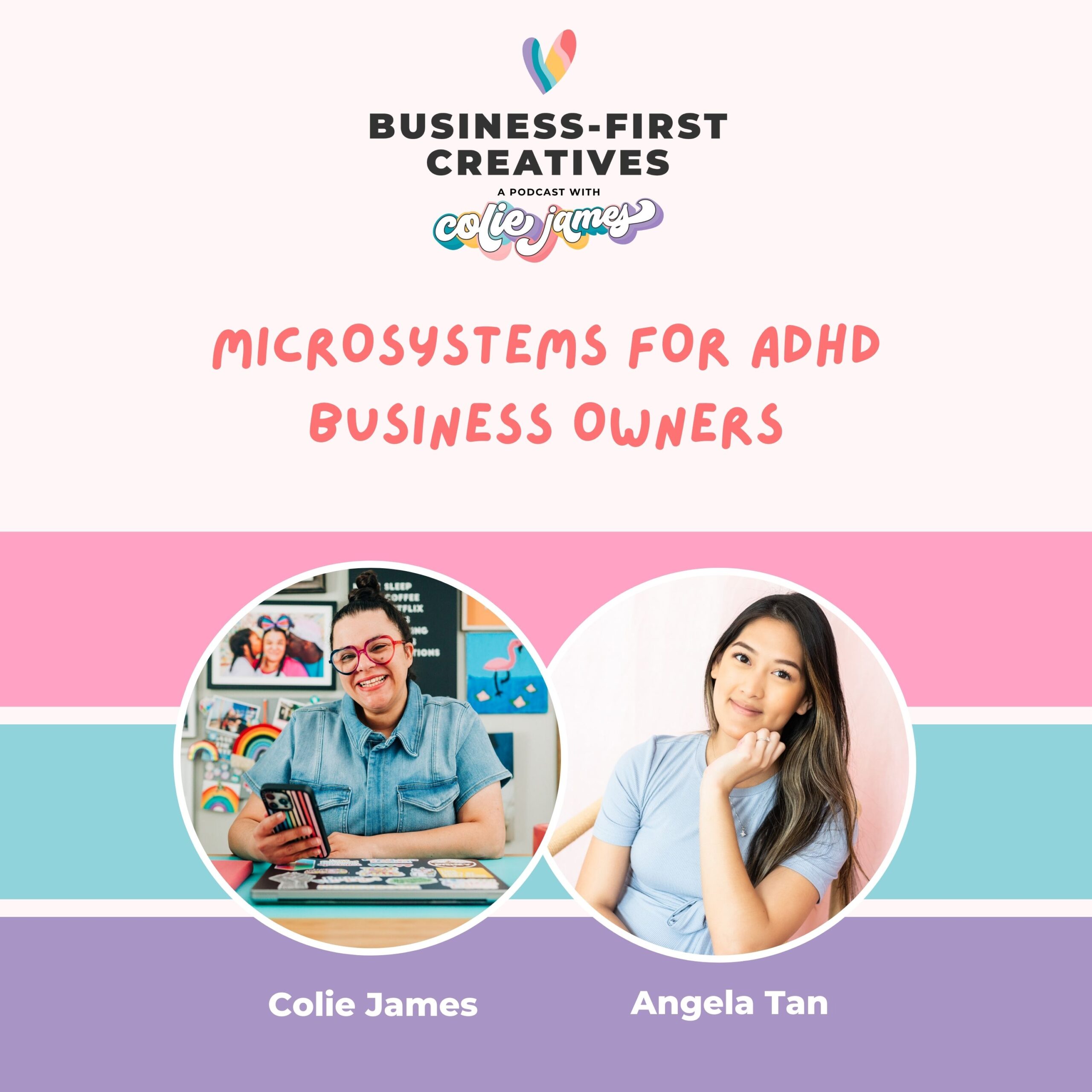



What if the secret to managing ADHD wasn’t massive systems or productivity hacks, but tiny, repeatable actions? In this episode, I’m joined by systems strategist Angela Tan, who shares how she uses “microsystems” to run her business and life with more ease, all while navigating ADHD.
From missed emails to abandoned leftovers to paralyzing decision fatigue, Angela opens up about her journey to self-awareness and how she built personalized systems that actually work. She walks us through how ADHD shows up in unexpected ways (especially in business) and the small steps she’s taken to stay focused, reduce overwhelm, and create structure without rigidity.
Review the Transcript
Colie: Hello. Hello, and welcome back to Business First Creatives podcast.
So today we’re in for a real treat. We’ve had a couple of reschedules, which Angela was very gracious about. But before we jump into today’s topic, let’s say hello and welcome, Angela Tan, back to the podcast.
Angela: Hello, I’m so. Happy to be
Colie: Hello. I’m so happy for you to be here. I mean, we were joking around before we started. Are we actually gonna record today? Is something else gonna happen because we are starting 40 minutes late today? Because I had to run to my doctor’s office because I got my flu and COVID vaccines on Friday and my arm still hurts, and this is three days later.
So I was like, Angela, can we push the interview by like 30 minutes so I can run to the doctor? And this is after rescheduling on her a few weeks ago because I woke up with tinnitus. So it’s been a thing over here, guys.
Angela: This was, I mean, if we look back at our first podcast interview, we had to reschedule that like three times. So.
Colie: We did, Angela was the first time that she was on the podcast, and that episode is linked for you in the show notes. But the first time that she was on my podcast, was when I was having all of my headaches, and I think I interviewed her right after I got my spinal tap, which gave me spinal headaches.
Yes, that is when I interviewed you the first time.
Angela: No, but you were a trooper through that and we managed to somehow chat for an additional like 45 minutes after that interview while you were like laying in bed. I remember that. I was.
Colie: And you know what I mean? When I listened to that episode, I was like, this sounds so good, even though I know that I was in pain. And the thing is, I, after saying all this, Angela, you’re not invited back to my podcast again.
Angela: I don’t blame you.
Colie: Well everyone, what we’re gonna talk about today, I am actually super interested in listening to, because while I am not diagnosed with a DHD. I am kind of just like going forward in my life, assuming that in some form I have it because I, as a lot of you guys know, have really been struggling over the last year and a half, two years to kind of focus and keep things, you know, together.
And so, Angela’s gonna be telling us about Microsystems that she is currently using, not only in her business, but also in her personal life to manage her A DHD. So Angela. Tell me about these microsystems, like I don’t even know where to start, so I’m gonna let you pick it up and run with it.
Angela: Yeah, so I got diagnosed with A DHD when I turned 30 and it. It was funny ’cause I had never gone to therapy before and my first therapy session within like 15 minutes a therapist was like, have you ever been diagnosed with a DHD? And I’m just like, me? No. I went to pharmacy school when I was 19 years old.
Like I graduated college at seven or high school and college at 17. Like me ADHD. Like, no. And then she started like telling me all of these things and I was like, ah. Oh, that makes so much sense. And so then she recommended that I try medication. But for someone who went to pharmacy school, I am very anti-medication.
So I was like, no, I don’t need it. I’m fine. I don’t need it. Like until I started to notice all of the different ways ADHD affect, not just my personal life, but also how I run my business. Um, I mean, there was. Thinking that I responded to clients’ emails or messages when I actually just like responded in my head, but not actually like responding or also putting off responding because there wasn’t a dopamine hit in responding to email to the email, not sending testimonial emails or forms because I was afraid of.
Getting negative feedback, so I’d rather just not send testimonial emails at all to avoid that, like so many different ways that my ADHD showed up in how I ran my business. And so then after a couple months I was like, all right, I think I’m gonna try medication. Let’s try it and see how it goes. And at the middle of all that was the.
ADHD medication shortage. So she first, I mean the loops that I had to go through just to even get a prescription was crazy. ’cause you have to go see an actual psychiatrist, go get blood work done, all this stuff. And then I finally got the script, send it to the nearby pharmacy and they’re like, oh no, we are, we’re not, um, we can’t fill this.
So I called every pharmacy within like the 15 mile radius. None of them had what I needed. Then I called the doctor again and they’re like, well ask them for this different medication. It was just a lot of that back and forth, and in the end found out that no one was filling scripts for new medication.
New A DHD medication scripts. And I gave up. I was like, this is too much work. This is just so much work, so many phone calls that I have to make and I don’t even know if it’s gonna help me. ’cause I’ve also heard like all the other side effects of A DHD medication. So I was like, I’m just gonna, we’re just gonna go back to what I know best.
’cause my business name is the Systems rx, so I’m gonna go back to systems. I know systems best and I know myself best. So let’s just go back to that. So then I was slowly but surely like getting more self-aware on my different ADHD quirks. And from that just developing micro systems that kind of treat those little quirks when I pick them up and be like, oh, I have a system for that.
Let’s fall back.
Colie: Okay. I feel like right now we should probably define what we mean as a microsystem versus a bigger system because you and I are system strategists. So like when you say systems, I’m like workflows. I’m like, woo-hoo. And you and I both know that that is not actually what a system is like. Everybody has systems.
So Angela, how are you defining like a microsystem versus the systems that we normally think of related to our business?
Angela: Hmm. Okay. That’s a good question. I look at it as just micro steps that I can take to get me to where I need to be to solve the the A DHD problem that I am having or facing. And then once I get into the examples, that might define it better. I
Colie: I feel like everybody has microsystems and I personally feel like when everyone has avoidance and anxiety to use some a words in this. In this conversation, but I feel like people have avoidance and anxiety when it comes to taking all of these microsystems that we have and putting them together to make like bigger systems.
And so I loved that when you sent me the email like, Hey Colie, this is what I want to talk about this time. I was like, cool, let’s go. I mean, I do think that us talking about Microsystems is really gonna help people take it a step down because one of the things that I have discovered this year, and it could be because again, like I just really think that I have a DHD and I have more and more clients that are coming to me telling me that they have A-D-H-D-I am no longer forcing people.
To update their systems as a whole. It’s like, no, let’s start with this one thing. And when we check that off of the list, then we can look at something else. But I think that one way that I am helping people do that is I am showing you the bigger picture. Like eventually this is where we’re gonna go, but like what are the micro steps that we can get to go there?
So that’s what I thought you meant by microsystem.
Angela: It’s one step at a time. ’cause it’s not like. These microsystems are gonna target or help the ADHD as a whole. We’re just finding like different ways to, to cope with it and it can change over time. But yeah, if you’re unmedicated with a DHD, it’s not, you’re not going to like just wake up a whole new person the next day.
You have to slowly and surely just find different micro steps to get there.
So I’m gonna
Colie: tell me about your first microsystem. What is the first one that you created?
Angela: So the first one is actually, it’s so stupidly simple. I’m almost embarrassed to share it. But as someone of ADHD, the amount of overthinking that happens up here in my brain is ridiculous.
And I know a lot of A-D-H-D-A-D-H-D people struggle with that, which then leads to paralysis, where you’re literally so stuck. You can’t even. Take action on what you need to do next. And so I call it the YAP method, where you just write down brain dump, type it out, I don’t care where it is. Write out everything that’s going on in your head.
It doesn’t have to be polished or perfect. You just take it all out of your head. I put it into chat, GPT, and it ends up like spitting out a to-do list for me. It prioritizes it for me and it helps me notices where I’m like. Overthinking so that I can like spot it out and I can have more of that self-awareness, and then I can take the next step.
Like once all of it is out of my head and it just feels so much lighter and easier to move, then I can take action on the next step. And I do this all the time in my business. It’s just like I have all these things that I wanna do. I wanna promote this, I wanna market this. I just brain dump it all out and chat.
GPT helps me organizes all of it.
Colie: I mean, a lot of us do have decision paralysis, like you said. I mean, I, it’s not, I mean, I have a lot of things, don’t get me wrong. And again, as you’re type, as you’re, as you’re talking about this, I am like recognizing things, but for me, my paralysis really comes from, I know that I need to do A, B, C, D. But I don’t have enough time to do A, B, C, D, and so I’m just not gonna start like I need to wait until I have enough time to tackle A, B, C, D.
And that’s basically what I did for like almost. All of 2024, and I guess the latter part of 2023, I was driving Chloe back and forth between the two schools. And so for like days I wouldn’t do anything because I’m like, oh my gosh, no, I can’t start this because then I’m gonna have to get in the car and go get Chloe.
And I think it was like my worst nightmare that I would start working on something and I would get really into it. And I would ignore all of my alarms. This didn’t actually happen, thank goodness. ’cause my child is not someone who would take it well if I just forgot to pick her up. But I mean, that fear is what kept me from even starting a lot of things when I was still doing this.
You know, I was Chloe’s personal Uber driver, and that was like my entire life for that one year.
Angela: Yeah, no task switching is definitely like an A DHD thing that I also struggled with and I totally relate to, like not wanting to start something ’cause you don’t wanna stop halfway through.
Colie: And I totally hear you. And so with this YAP method, you said that you do it all the time. Is there like a certain timeframe that you do it on? Do you wanna make sure that you are doing this on a regular basis or is it just literally when you find yourself with so many thoughts in your head that you can’t organize them, that you’re just like, Angela, I need a Yap session, and then you do it?
Angela: I do it at least once in the morning before I start my workday. Just get it again, get it all out, and then there will be certain weeks, you know, depending on my hormones, where I will be yapping more to. Once a day, multiple times a day. and then, but then there are some days where I’m having good days and it’s just once in the morning.
the best time to do it also is right before you go to bed, when you get a rush of thoughts right before you go to bed and you just need to park it somewhere. And so I’ve been doing that as well right before bed so that I can know that I have, you know, whatever it is. Somewhere I can revisit it in the morning and I’m not having to go to bed and like waking up in the morning, like, what was that thing that I was thinking about again?
Yeah.
Colie: oh yeah. Oh yeah. I do that all the time. And like I used to just open my phone and like do it on a note and my husband would be like, what are you doing? I’m like, I just have to get this thought down before I go back to sleep. But, so I wanna ask you a few like really technical questions. ’cause you said, you know, you can brain dump it anywhere.
You can put it wherever you are doing it. In chat, GBTI want you to get a little bit more specific. Are you using the voice? Um, activation with chat GBT and actually talking it out, or are you actually typing all of your thoughts? And then are you just doing it in a new chat window? Are you doing it in a particular project and do you have a.
Some kind of instructions on the backend where it knows to formulate it into a to-do list, and all of those things like did you train your chat GPT to do something specific with your app sessions, or is it just you’re getting it all out there and then it’s just responding with whatever it feels like?
Angela: So I’ll admit that I didn’t really. Familiarize myself too much with chat GPT until like three months ago. So when I first started doing this, it was just in a new chat every time. It wasn’t even in a project. Um, and then I realized that you can create projects and put instructions in there. So then I start, I put in
Colie: You sound so happy right
Angela: No, no, really. When I realized it, I was like, oh. So I gave instructions to my chat, GPT. I started a project and I gave instructions that I have ADHD. Don’t overwhelm me when you’re giving me information or when you’re talking to me. ’cause I will just walk away and I won’t consume anything that you tell me.
So that was the next step that I took. And then, so I used a new chat for every time that I did these YAP methods, and then I realized that I’m relying way too much on chat GPT as my therapist and business coach sometimes. So I was like, you know what? I’m gonna create a custom GPT with instructions for it to analyze all of my YAP for a whole week. Then determine what are my common, like overthinking patterns and thought patterns, and like all of these different things. I’ll send you the, the prompt that I use to, to create this custom GPT and we can put it into show notes, but I wanted it to essentially act as my. Like life coach, business coach or whatever.
So that every time that I put in new Yap like down the road, it can immediately, immediately be like, oh, hey, you’re doing that thing again. And so I did that for a whole week trade. It was on the same chat. I learned the hard way that it had to be in the same chat. You can’t have multiple chats for it.
So I had to go back and redo it. But um, so I did all of that for a whole week in the same chat. in the end I was like, all right, analyze all of my Yap from this week and let me know my overthinking patterns, like all the different things. I don’t remember what it all was. And then I created another custom GPT from that.
So now I have a custom GPT where I start a new chat every time I need to yap. But it knows me so well that it’s just like. Man, this is kind of creepy. So that’s kind of the progression, like technically how I got to, to where I am today with the YAP method.
Colie: And I do feel like, I mean, I know that you felt like that was a little weird to say out loud, but for those of us that use chat GPT so frequently, I think that we forget all the little nuggets that we’ve learned by kind of progressing. Because there was one time I was talking to someone and they had no idea what projects were, but then, you know, they were like, well, why do I have to make a project?
Like, why would I do that instead of this? And so, you know, then I was like, well, why do you wanna make a project instead? Like I had to. Think of the decisions that I made and why I started doing it in projects. But one thing that I thought you were going here and then you didn’t, and I’m like, I wonder if Angela’s thought about this when you said to analyze your YAPS for the week and figure out, you know, where you were overthinking and stuff.
I think what I would need to do is ask. I want you to ask me for progress on all the things that I was supposed to do this week, and that way if I made progress, I could tell it. But this is also a way of me kind of having a little bit of accountability in terms of, I said this thing and it was on a to-do task list.
But did I ever actually try or did I finish it? Like I think that that would be most useful for me because one thing that I have stopped doing, and if you’re watching the video on YouTube, you can see this, but I make all these little notes on pieces of paper, right? And like that is what I am trying to stop doing because then I’ve got all these random as pieces of paper all over my desk where I’ve scribbled notes. I mean, I used to try to do planners,
Angela: That’s
Colie: but it just, I know, and Angela’s showing me all of hers now, but like I really need it somewhere to where it’s organized. And the funny thing is someone recently said, you know, notion is really good for that. I actually have like this entire thing that I want to create, particularly like when your business coach gives you tasks or gives you feedback.
I’ve got this idea of this thing that I wanna do to like outline all the tasks that they gave me and put in my progress, but I was like, I don’t know, notion well enough to do it. But then I was like, I wonder if I could make chat GPT do that for me. So that’s like my next goal is to figure out how to use chat GPT projects.
In order to make sure that you know, all of these things that I get told to do in any given week, that at some point they don’t just drop off because I haven’t gotten around to it yet.
Angela: I’m trying to work on one where I can ’cause, again, A DH, D, all these random ideas all the time have like Chachi PD store all of my content ideas. And then if I like board one day I’m like, write me an email. It can just pull back for one of the ideas that I’ve spat out a while ago. Still need to figure out how to make that happen.
Colie: I mean, you should do that with, with the form of Airtable.
Angela: I do have, I have a whole air table. I need to, I need to figure out more. I need to, yeah, just need to learn more about how chat GBT works and getting there.
Colie: Okay, so we’ve got your Yap method. Tell me about Microsystem number two.
Angela: Yeah, so the next one is sales before hyper focus. So I love to create, I love to create new offers and I love to automate and I love to make things easier for my clients, and I will go down that hyper focus cave for days. Weeks if I could, but as a business owner, I know I need to sell. And selling feels like a dangerous thing because you’re putting yourself out there.
And if people don’t buy right away, you’ve like the RSD, the rejection sensitivity kicks in. You’re like, oh, people don’t like me. So then it’s safer for me to fall back to my hyper focus cave than to sell. But I know I need to sell to keep running my business. Right? So I’ve learned after I learned this.
Earlier this year, I need to sell more before I create, before I go create more offers. So I’ve always, I’ve been making it a priority that before I go down a cave of creating more content or creating a new offer or whatever it else, it is, I need to do one sales activity, if not two, just to cross that out of the list to know that I’ve gotten that part of my business taken care of, and then I can happily and guilt free go into my hyperfocus cave.
Colie: I mean, I love it. And the thing is, I’m wondering if there’s some kind of organization that we can do. To where it’s actually keeping track of what your sales activity is. And you could all, you could honestly. Start doing some kind of thing like, this is the sales activity that I just did. How did it make you feel?
And maybe after you’ve done this, you know, over a few weeks, over a few months chat, GPT will be able to analyze which sales activities actually make you feel good versus make you feel anxiety or avoidance to do them. Then you can prioritize those sales activities. Because here’s the thing, I just did a challenge, an email challenge, and I only sold one of my email courses on the backend.
And the funny thing is, I’m like you, I have to remind myself to sell, right? Because otherwise I will just go create shit for days and days and days. But what I finally realized was. I taught people in this challenge, and I ended up asking them to do feedback forms every day as a daily task to tell me what they did.
And getting that feedback made me so happy that I didn’t even care, that I only sold one course. And the thing is, could I have sold more? Absolutely. There were three diff, there were three other people that were absolutely ready to buy, but when they were telling me about their situation, I was like, no, the email course is not what you need.
For most of them, it was, you need something related to workflows. Or for one person it was like, no, you need an entire system. Like yes, you could start with emails if you want, but like I think that if you just bought this toolkit instead, or if you did these things, it is going to give you a higher return on investment than like just doing your email communication.
So in a way, I talked myself out of sales, but I truly think that it was because this time I got my dopamine hit by helping them. By teaching them. And so the next time that I do this, I have to learn how to pair the sales with the teaching so that I make sure that I get, you know, both sides of the coin, if you will.
But I was also at a different kind of place this time. I was like, you know it, I sold the email course before. So it’s not like, it’s not like I’ve never sold it. And then this was just me selling to the email challenge people. I’m actually about to do a full. Launch to like the public, right? And so I’m like, it’s okay that I only had one person that bought today because I’ll probably have more people that will buy later in the week and I am really going to like. Optimize, prioritize the sales activities for the next week. But I’ve already gotten, like my teaching hit. I already know that I helped people move forward with their email communication. But I do like this, you know, do the sales before you do the other ’cause. That’s what I probably need to, I need to, I need to do my sales activity before I do my teaching activity, if you will.
Angela: You would think after running a business for so many years, it’s just like, no, you have to sell. Like that would be like second nature, but like it’s. Scary. Like, especially, I don’t know why for like the overthinkers, it’s just like, it’s just not a, you don’t feel, I don’t wanna say you don’t feel safe doing it, but it’s just like you’re putting yourself out there doing it.
And there’s, it’s not always like an instant dopamine hit, so it’s just easier to avoid it in general. And I, I just get more dopamine hits from my hyperfocus caves. But yeah.
Colie: Okay, so sales. Before you get to hyper focus, girl, what’s Microsystem number three?
Angela: Number three is also really stupidly simple, but it has saved so much money, not just in my business, but also in my personal life. Reminders, automated reminders in so many areas of my life. Um, in my personal life. I have one every night at nine o’clock to remind me to put. The leftovers in the fridge because do you know how many times I have put the leftovers in containers and left it on the kitchen counter and woke up the next morning and it is still on the kitchen counter.
That’s like food that I’ve wasted and now I gotta cook dinner again the next day. yeah, so that’s one ’cause I’m tired of wasting food. Another one is I love signing up for free trials. But I don’t always remember to cancel them before the free trials expire
Colie: So I learned that one. I don’t, no seriously, every time I sign up for a membership now, I actually go and I put a reminder on my calendar like four days before I will get recharged. And it basically says, cancel this and it, I make it repeat every day after that so that all I see is it there. And what happens is if I come to the four days and I get this reminder, that’s a four day decision window for me.
Do I actually, have I used it enough to keep it another month or is it something that I need to consider whether or not I need to pay for it again? And so, you know, if I’m unclear, I will push that to the next month, you know? But if I’ve already decided, no, no, no, this is something that I don’t need, let me cancel it.
’cause yeah, I kind of got screwed with Kit. Speaking of price increases, um. I switched from KE to N charge and I lowered myself to like the $29 plan. But then the moment that they announced that increase, I was like, no. I realized the next day I had forgotten to like put myself on the free one. So I accidentally paid for another month.
Yeah. But then, you know, I cut it off and I was like, no, I’m good. I’m done. But yeah, every time I join a membership, and I mean, it makes my calendar a little cluttered, but the fact that my calendar is so cluttered when it comes to those reminders, it forces me to make a decision then. Or if I know that I’ve used it and I wanna use it again for the next month, I push it to the next month, and then I have, you know, another 30 days of a clear calendar in quotes from that particular cancellation.
Angela: Yeah, I do the same because I’ve definitely lost money on free trials. And then I also, from working in the backends of so many businesses, just see a lot of online business owners lose so much money in. Unnecessary software costs. So reminders to cancel, um, software subscriptions or even just like app sub subscriptions that I download on my phone.
You know how they get you with those free trials. Always set up. Reminder. I have an app that I just started using called Hero. And it will let you create reminders and you can’t just like x out of it when it reminds you what the reminder is. You have to update the date and the time to do it if you mark it as like critical.
So it really like holds me accountable to make sure that I, mm-hmm. And it’s designed for, uh, people with ADHD. So I rely on that pretty heavily. And then I have another reminder system. It’s kind of a reminder system. Two, one to pick up my kids at the end of a workday because if I don’t have that, I might go, I might be too, too deep down in my hyper focus cave and I’ll, I’ll be running super late to go get them.
and then another one is more of like a client experience thing where if I, ’cause my son has a pacemaker, my oldest has a pacemaker, so we’ve got lots of doctor’s appointments. And so whenever I have those doctor’s appointments. It’s an hour drive to the hospital. I need to block out the hour before and the hour after those appointments so that clients don’t book calls with me.
’cause I’ve had way too many clients, book clients and leads, book calls during those times where I’m supposed to be driving and I have to reach out to them and be like, sorry, can you please reschedule? ’cause I’m gonna be driving. So I created a, a Zap where it will automatically add a one hour buffer before and after doctor’s appointments.
What if the. Zap picks up that I created an event in the calendar with one of the keywords, so it’ll add those for me. So yeah, that’s
Colie: Okay, that’s brilliant because my neurologist, like when all the things happened last year, I got a new neurologist. I hadn’t had one in eight years, but I saw her for the first time here, 10 minutes from my house, and right after my first appointment, she told me she. Just so that you know I am transferring back to our Fort Collins office, I can either transfer you to the other doctor, which by the way, that other doctor had horrible reviews.
She’s like, or you can see me at the Fort Collins office, or I can see you virtually, and this is me. No, I like you. I don’t get rid of doctors that I don’t like, so you’re stuck with me. But do you know what I did? The next two appointments? I forgot that I had to drive to Fort Collins to see her, so I even had a buffer, but I forgot to adjust the buffer to be an hour instead of 15 minutes.
So twice I had to contact my clients and be like, Hey, I’m so sorry. You scheduled and I’m gonna be driving to Fort Collins for a neurology appointment. Can you, can you change it? Or if I don’t wanna inconvenience my clients, like today I had a doctor’s appointment. I had to get that quick one right. But I had a client call up until 11.
I actually drove to the doctor’s office, sat in front of the doctor’s building and did my whole call in the car so that then I could just walk into the building. So buffers are important and I think I’m gonna have to get you to give me that zap so that I can do it on mine to make sure that I’m taking care of it.
Angela: for sure. I’ll send that over to you. I, I’ll even include a, I’ll send it to you for the show notes too. It’s usually, usually a freebie that I give out.
Colie: nice.
Angela: Yeah. and then my last one was actually the chat, GPT, the custom GPT one. So we actually talked about that one already.
Colie: We already talked about it. Okay. I mean, everyone. I know that this was like a quick rehash and this actually more just sounded like friends chatting. I hope that you guys were still able to get something out of Angela and I bouncing back and forth. I mean, ’cause what I need you guys to realize is that we’re both systems people and so the fact that we have to have all of these systems to make sure that we do the things that we need to do on top of creating systems for you, it’s a lot.
But I love that Angela gave us these ways, not only to help us in our business, but also in our personal lives. I, I mean, I can’t, I can’t believe that we had this much fun talking about these microsystems, Angela.
Angela: Yay. Thank you so much for having me. This was, I’m so glad we got to chat about this.
Colie: Yes, and listen, both of us would love to know if you end up using one of the four Microsystems that Angela discussed, or if you create one of your own sharing is caring, like I think the both of us would love to hear about it because maybe it’s something that we need to.
Angela: Yeah. Start a group chat on Instagram. Find us and tell us, ’cause I wanna know.
Colie: There you go. All right, everyone. That’s it for this episode. See you next time.

About the Guest
Angela is the founder of The Systems Rx based out of Tampa, Florida. She is a funnel tech and automation specialist offering both DFY services and DIY products in her education resource shop, The Funnel Pharmacy. As a mom of two littles, she’s grateful for her automated systems to keep her sane while juggling all the things. That’s why she’s passionate about educating online business owners on easy to implement automated sales, client management, and marketing systems, so they can run a sustainable and hands-off business.
Find It Quickly
00:24 – Meet Angela Tan
02:12 – ADHD and Microsystems
05:53 – What are Microsystems?
08:09 – The YAP Method for ADHD
18:08 – Sales Before Hyperfocus
22:44 – Automated Reminders
Mentioned in this Episode
Scaling Your 1-to-1 Service into a Digital Product with Angela Tan
Connect with Angela
Website: thesystemsrx.com
Instagram: instagram.com/thesystemsrx



Signature Series


Your business works, but your backend is costing you.
A 4-Part Audio Series for service-based business owners who are ready to upgrade their “just fine” client experience, unlock higher pricing, increase referrals, and grow more sustainable revenue—without overworking behind the scenes.
Get the FREE 4-part audio training series
Systems That Sell


© 2022-2025 Colie James


