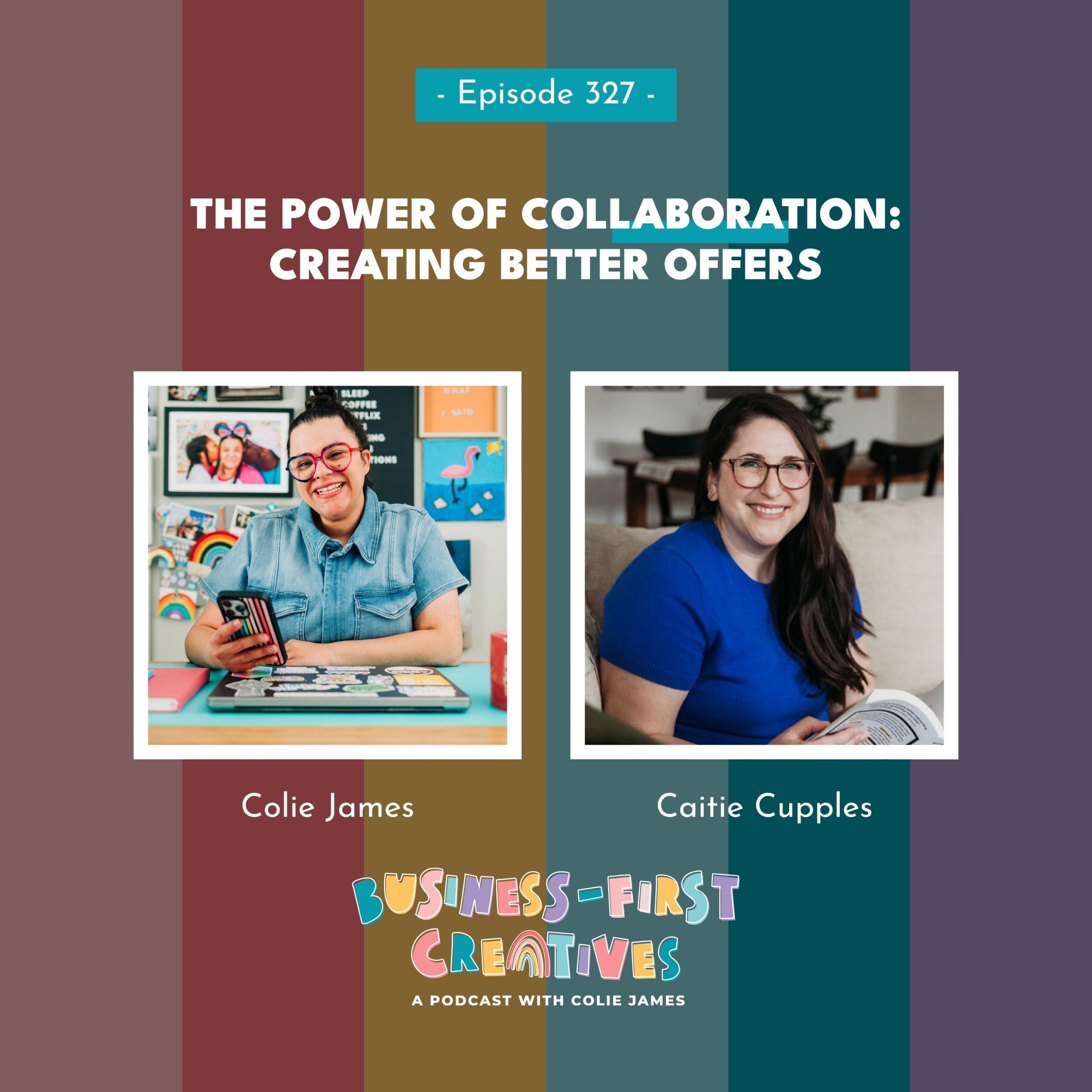


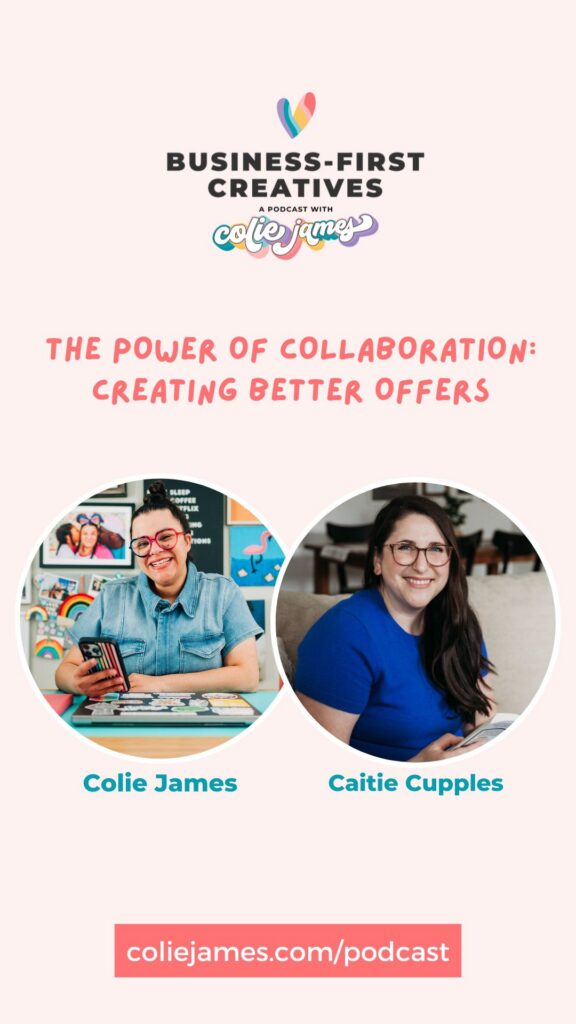
What if your next great offer isn’t something you build alone? In this episode, I sit down with website copywriter Caitie Cupples to explore the power of collaboration and how partnering with complementary experts can create a better client experience—and a stronger offer.
Caitie shares the story behind Signed, Sealed, Subscribed, a collaborative VIP Week she built alongside a designer and a naming expert to help business owners finally launch newsletters they’re excited to send. We unpack what it looks like to stay in your zone of genius, eliminate client roadblocks, and create offers that solve the entire problem instead of just one piece of it.
If you’ve ever wondered whether collaboration could help you create a stronger offer, this conversation might be the inspiration you need to get started!
Review the Transcript
Colie: Hello. Hello. Welcome back to Business First Creatives podcast. Now listening audience, if you’ve been around for any amount of time, you know that if I see something on threads that catches my eye, I will randomly get in people’s dms and be like, do you wanna come talk about this on my podcast? And so today’s guest is Caitie Cupples, and she was talking about an offer, and this was like back in like the.
Busiest launch period guys. It was like Black Friday. Okay. So it’s amazing that I even saw her post on threats, but like it had me so intrigued. I was like, oh my gosh, Caitie, will you come talk about this on my podcast? And she said, yes. But now we’re like. Almost three months later and we’re finally recording it because we had to reschedule more than one time because of illness.
But we are here and we are gonna do the damn thing. And I am super excited for you guys to hear about this offer that she launched. Caitie, welcome to the podcast.
Caitie: Hello. I’m so excited to finally be here.
Colie: No. So let’s kick off with you telling the audience what you do, and then that’s gonna lead us naturally into talking about what the offer was.
Caitie: Absolutely. So I am a website copywriter, but I happily side quest into a newsletter and email and launch copy. I’m not very picky when it comes to what you need written for your business. Um, and I have a special love for newsletters, so I write copy for a lot of online service providers. But again, not picky, anyone who’s doing nice or cool things, they’re a nice person.
I’m happy to work with them.
Colie: I mean, and I feel like you’re the kind of copywriter that I love because, uh, my copywriter, Hey Kara, you know, I love you. Um, it’s kind of one of those things where when you get someone and they like really get to know your voice, I’m just like, I don’t really wanna go look for another kind of copywriter.
Like, can you write this for me? I mean, if you don’t want to, that’s great. But can you, because I don’t wanna go through this hiring process again, so I love that while you call yourself a website copywriter, you are basically like, if we jive, I can write you all kinds of copy. Let’s do it.
Caitie: Exactly. Yeah. And I love that too. I like having that continuing relationship with clients and it doesn’t really matter to me where we start. Like some people are ready to jump all in on website copy, and it’s great to have that foundation of a strong website before you go into everything else. But some people don’t have the.
Budget for that. They’re not ready to do that, but they really need this other piece, like a sales page or a welcome sequence, or they just wanna get their newsletter off the ground. Like it doesn’t matter to me where we start. If there’s something that’s like you’re excited about and feel like it’ll make a big impact on your business, we can do it.
Colie: I mean, so let’s talk about the offer. Let’s, let’s not skirt around it. Uh, you had a newsletter offer and it was very interesting to me and it caught my eye for a couple different reasons. Number one, I think that newsletters right now are kind of having their moment in the spotlight. Again, I think everybody talks about email marketing.
Over and over again. Writing newsletters, writing you know, emails to your audience. It’s the only channel that you really own is what we hear out in the ethos, you know, all the time. But. Some people really struggle to get in there and just write an email. They get really hung up on like a lot of aspects.
And I think what caught my eye about your offer was in fact that you were hitting all of those things that people usually say, oh, but I can’t write my newsletter until, so Caitie first tell me what the offer was named. And then we’re gonna get into like. Why it is so unique that you decided to do this?
Caitie: Yeah, so the offer is called signed, sealed, subscribed, and yeah, it’s, it’s a done for you newsletter, VIP week kind of thing,
Colie: Hey Caitie, did you do it by yourself?
Caitie: I did not. It’s a collaborative offer between me, a copywriter and a designer.
Colie: So three different people had
Caitie: true. And there was another person.
Colie: Oh, wow. So it was like four. Let’s talk about the different pieces. So what did Sealed, signed, subscribed include? I, you know, I wanted to say delivered. I, it was
Caitie: I know.
Colie: my tongue, but I mean, but it also goes very well with what it was.
But tell me about the different components that were included in this offer.
Caitie: Yeah, so we decided that when we thought about what people are, what is standing in people’s way when they want to launch a newsletter like you were talking about, is all of these like components of like, what am I gonna call it? And like, you know, I have, if I’m gonna make it in Flodesk, I want it to look pretty.
Like what colors am I using? What’s my like header graphic gonna look like? I have to have a subscribe page. People actually sign up for my newsletter and then when they sign up, they have. To get a welcome email. And then when they do that and people are on my list, oh, I have to actually send emails. What am I gonna write about?
So that’s what we put all of these things into this one week. So it was me, a designer, Stacy Aguilar, and then also a naming expert, Caitie Pinnell. From 26 and then some, um, we had all collaborated on a project previously
together, so we can get into like the origin of like how that happens, um, after this.
But what we decided to include in the project or in the, in these VIP weeks were one A name for your newsletter. You could either work directly with Caitie, the naming X. Expert to, um, have her help you name your newsletter with like a, she has name storming sessions is what she calls them. So she gave us like a discounted price, to include those.
And we decided to make those like an add-on because some people already knew what their name was, they didn’t need that. So they could either book a session with Caitie or they could get a discounted price on her custom naming GPT, which we actually use to name the offer. I have it and it’s great.
Colie: I have
Caitie: Yes, it’s wonderful. And so they could buy one of those two things and then they would come to their newsletter week with the name already figured out.
Colie: in general, why is it that you decided, hey. This is the offer that we want to do. And I mean, you guys only did a limited number of spots, so I’m just really curious. Like you got on a call and you were like, Hey Stacy, I wanna offer this thing and I need there to be designed.
Do you wanna do it with me? Like how did that come about?
Caitie: Well, it came about because do you know the artist way?
The book The Artist’s Way. Okay, so I was doing the Artist’s Way and I was on five week five or whatever it is where it’s reading deprivation. And you’re not supposed to read anything.
You’re supposed to just like be quiet with your thoughts. And so I’m laying there thinking, and I’m just alone with my thoughts and I. Like Black Friday’s coming up, I have no, I have nothing. What am I gonna do? And Stacy and I were like wrapping up a project we were collaborating on, and so I was like, I’m gonna reach out to Stacy and see if she wants to do like a collaborative offer. At that point, I had no idea what this could look like, so I just deed her and was like, Hey, what like do you think this could be cool?
What do you think? Are you like, do the capacity for this? She was interested. So we just got on a call and we talked. I think Stacy was the one who actually suggested like the newsletter, VIP, we kind of like model. And the reason we thought putting all this together is because I could deliver all of these things to a client, but then they still need to design stuff.
Like there’s still steps, there’s still roadblocks in the way for them to like actually turn around and launch the newsletter, right? They still have to get their subscribe page, go.
Colie: I just wanna interject because I made this mistake four years ago and I feel like we should pretty much shout it from the rooftops. You go and you pay a copywriter to like write you these amazing words, and I did it one time. I was putting out a tiny offer and. I paid a copywriter for two back to back VIP days to basically write me the sales page.
And then also I think I got like five emails in an email sequence and then I got like one or two Facebook ads to run. And when she delivered it, it all sounded great. I mean, there was some massaging that I did, but it was great. And then it didn’t occur to me, literally, Caitie, until she delivered the document to me.
I was like, holy shit, I have to go put this and show it now. I have always DIYed my websites either with a template that I bought from someone, or I will just see something on the internet that I’m like, oh my God, that would be so amazing on my website, and then I just go create it from scratch. I mean, I’m, I’m very web savvy.
I love show it all the things that you can do, but I was like, okay, I just paid this copywriter for two back to back VIP days. And I didn’t realize how much time it was gonna take me to get it on the page, and I was like, oh my gosh. Like she had the copy structured in a certain way and I was like, oh, I have to design it around the copy and the way that she wrote it.
So I, this is just like my PSA to everyone listening. When you go hire a copywriter, please have a plan for how you’re gonna get it on your website. Like I just feel like this is just not something that we talk about very often.
Caitie: Yeah. And I think the opposite is also true. I have a lot of people who, you know, they book a designer and then they’re like, oh,
you need the words.
Yeah. And the, their designer’s, like, I don’t write the words. So either you’re writing the words or you know, you’ve gotta find somebody to write them. So I think that’s, it’s fun when the, when designers and copywriters can collaborate like that in these kinds of like offers.
Colie: And plus like if you already know someone that you work well with and like they can create a brand. I mean, ’cause you’re the words, so looking at the design part, you’re like, I know that Stacey does amazing work and she can get this design where this person needs it. I mean. It’s, it’s great when you present it as like one package, because I can’t tell, and I’m sure that you’ve heard this, I can’t tell you how many people, you know, hire a website designer, realize that they need the words and they’re like, oh my gosh, but I spent my entire budget on the website, or vice versa.
Like I spent my entire budget on the words and I didn’t realize I was gonna have this much trouble getting the design onto an actual website. And so if you only book one of these services. Without giving a lot of consideration to the other, you probably hired the first person and thought, oh, it’s just gonna take, you know, maybe a couple weeks to get it out and published into the world, and you’re like, oh my gosh.
I have to do this whole thing again with like another person, just so that I can get either the design or the words, whichever one you didn’t hire first, done. I mean, I feel like this should just be everywhere. Th this should probably be the tagline of this episode. Words and design are needed.
Caitie: yes, exactly. And then if you aren’t hiring a designer, you know you want to DIY, then you’ve gotta factor in like how long it’s gonna take you as that person who’s like, and I mean, I’m doing this right now as IDIY, my own website. I’m like, okay, like let me move this here and move this here, and do I need something else here?
And this section isn’t working. If you don’t, if that’s not your area of expertise or you’re not like Cole and you love to do those things, like you’re gonna be kind of hitting your head against the wall
when you thought you were gonna be launching,
Colie: You’re not gonna hit your deadline, whatever deadline you chose.
Caitie: so,
Colie: Okay, Caitie, so now that you’ve told me how you came up with this idea, I’m curious, like how did it actually go? Like what was the first thing that you guys did after someone hired you?
Caitie: The very first thing after someone hired, we had
all of our onboarding things, right? So Stacy had everything in her HoneyBook. We kinda went, I used obs, she uses HoneyBook. We were like, what are we gonna do? So. We both created our, questionnaires and I delivered mine, you know, in a Google
Doc. I said, here’s everything I need, and she put those into a questionnaire.
That way, everything was in one place.
I think that’s another thing when you’re working with multiple people, like you don’t want to have to go to different places to do all the different things. So everything was hosted in, in looking, all the invoices, everything went through Stacey’s, HoneyBook. , She uses Basecamp to communicate with clients.
And so we decided to just use that. With copy. I don’t normally need something like that ’cause it’s like, here’s your Google doc and we’re done. But when there’s lots of different moving pieces, it was helpful to have that kind of like backend set up. So we had all of that already prepared. Where in Basecamp they had access to all their questionnaires.
They had a welcome handbook, they had their invoices, all the things, the schedule, all the different things that were gonna be included. It was perfectly, beautifully organized. And so they got a welcome or onboarding email. And we scheduled kickoff calls for the Monday of each of their weeks. So
we had three weeks, you know, and each client had one week. Mondays were our kickoff call. Stacy and I got on those calls together with the client. And, you know, it’s even little things like we had to decide like, who’s going to kind of like lead the meeting. And so it’s like, okay, like I’m gonna like make a list of all the things I wanna say and then like, that way we’re not like talking over each other or sharing each other blankly.
Like, do you wanna say it? Do I wanna say it?
Um.
Colie: Well, I’m sure that by the time you guys got to the second client and the third client, you got better. I mean, that first client, hi. If your first client’s listening, uh, sorry that you were the Guinea pig, but there’s, you know, there’s al always value in being the Guinea pig, but I’m sure that you guys got that process down by the second and the third.
Caitie: and it was also January 5th was the first one. So it was like the first week, right after New Year’s, we were all like, hello, let’s jump right into this. And it was great, but it was also like my, you know, we had to like get our heads on right?
To like really start this off fast. So we had those kickoff calls on Monday and then after that we kind of just like split and everybody went on and did their own thing. So Stacy was working on, the newsletter brand kit where she was including. Like abr, basically like a micro brand identity for each newsletter. So, what colors you’re pulling from your like original branding.
We did like ask that each client come with kind of solidified branding already. So it wasn’t like I’m here and I need branding, like, you know, we need to be able to
pull from Yeah, we need pull from your existing branding to be able to like decide what would look right for your newsletter. So she created this micro brand kit where they had like a, um, a logo, which colors kind of their, like how your colors work together
and which colors. Thank you. The color palette. Everyone was using Flodesk with like a Flodesk template.
So here’s what
it looks like in flow desks. Yeah. And so it was like, here’s where your header is, here’s where your dividers are gonna be. Here’s what, like each of those. ’cause I created segments for each client’s newsletter. So like branded segments for their newsletter. So she created like what the.
Little headers would look
like for each segment. And then she also created, Canva templates to help them promote their newsletter. And then she was, obviously creating the design for the subscribe page, which I wrote. So those were all Stacy’s deliverables. Mine were the segments, like I mentioned.
So kind of creating a template on the strategy side for each newsletter. A promise for each newsletter. So if you like, I’m trying to think about one of them. One of them, the newsletter was called Groundwork and the promise was like helping you connect the dots between blah, blah, blah something and something, I think it was business and farm life to help you put social media out to pasture, something.
It was along those lines. It was great.
I was obsessed. And then. You know, so that’s at the top. We’ve got the promise, and then I’m helping them come up with the segments as they go through the newsletter. They also got from me at least 12 content ideas for their newsletter because of course, after you get all these things, you have to go and
Write the newsletter. You need ideas. Everybody got. Far more than 12 ideas for their newsletter because once I started I couldn’t stop. As well as like story prompts for each topic of each newsletter, because they all wanted to do storytelling newsletters. They wanted to start with a story transition into like the
point of their email. Exactly. So let’s see. And then they, for I was also writing their subscribe page, we also wanted their subscribe pages to be on their website. So we had, you know, a long, longer form subscribe page, that I wrote and then Stacy designed, and then they also got from me a welcome email. So their first email, when they people sign up for their, for their newsletter, they get this first welcome email.
You don’t need 5, 4, 3 even. Welcome
emails
Colie: on. I like writing those emails, but I’ll say I’m seeing a movement towards doing this like one all email that you’re delivering, especially when people are skipping the freebie and they are just directly signing up for your newsletter. If, if I wanted to write one of these welcome emails, I imagine that it’s gonna be like an introduction to me highlighting that promise that you helped them all craft, so eloquently.
And then is there any kind of soft pitch or direct pitch to kind of outline how we could work together in that first email? Or do you leave that for the subsequent emails?
Caitie: I like doing a soft pitch. So what we kind of did was like, we would say it in more of like a, you know, a storytelling conversational way of like, when I’m helping clients with blah, blah, blah, boom, those things are linked, right? Or like, you know, I spend a lot of my time helping clients inside of my membership.
It’s linked and here’s what I’m helping people with. So it’s not like. You should join this thing. It’s more of like, I’m telling you about me and my business and what I
do, and I’m inviting you in a more passive way to click these links if you would like to. Maybe I’m highlighting like the conversations I’m having with clients or I’m highlighting the transformations that they’re getting.
Um, but it’s not, it’s not a hard pitch, it’s just more of an invitation. Um, of course, like there’s a link to go look at their website so they can learn more. And then, yeah, the, the ending of that, there’s, I always like to end these with a call to action to reply
because we want that conversation to start happening.
And then it’s like, Hey, you’re gonna hear from me next
Tuesday, or whatever that date is. And so it’s just a, the, I. Mine tend to be, when I do this for clients, if they want it shorter, we can make it shorter, but each one I wrote for these weeks was a little bit on the longer side because there was a lot we wanted to tell.
We wanted to talk about who they are, what their business is, what the newsletter is about, and kind of give that like full picture.
Colie: I mean, but I’m okay with that first email really, that you give anybody for any purpose. I’m okay with it being longer because whether they’ve signed up for your newsletter or they’ve just applied to work with you, or they’ve signed up for your freebie, that first email is when they are most excited to hear from you.
And so whatever you want them to know. Now, guys, we’re not saying write a novel. I’m not saying that this should be a 3000 word email. Please tone it down. But I mean, you have their attention, so obviously take care of it. Okay. You said something and we kind of glossed over it, and so I wanna go back. All three people hired users,
Caitie: Oh, no, sorry. No, I just missed two of them were, one
of them uses Kajabi.
Colie: Okay. I, you know, I was just about to say, I think that it could have been who you were attracting or maybe, you know, like just the ethos flow desk at that point was about to cut off and change their, uh, pricing, you know, structure. I mean, I was just like, wow, wait. All three of them were flow, like, wait, stop.
Because a lot of the times. Some, some people come to me and they don’t actually have their tool. So like you said, you used Dubsado and Stacey uses HoneyBook. We’re gonna come back around to this in a minute ’cause I can’t not ask a question, but like the two of you had different tools and a majority of the time people come to me with a tool and we are like, you know, setting up their systems inside that tool.
But other times people come to me and they’re like, Hey, Colie. Like, this is my business. I don’t have a CRM. Can you help me pick one? And then I ask them some questions and you know, I’m usually recommending one of those two. ’cause if it’s not one of those two, uh, you can’t join systems in session. Like it’s only for those two tools.
So, I mean, you know, it’s either these two or I’m telling them, yeah, you need this and that’s not something that I can help you with. So, you know, here you go. But I was just wondering if anybody came to you. Brand new to a newsletter, not having an app yet, and if flow desks was just what you recommended to them,
Caitie: Flow desks would be what I would recommend. Stacy and I both use flow
desks, but everyone who came to us did have an existing. List. So they really were like, they came to us with this frustration of either being bored with their existing newsletter. Um, one of the clients was like, I’ve been writing my newsletter forever, and I’m just like,
over it.
Like, I need a different structure. I needed to like be refreshed. I wanna be excited about writing my newsletter again. Um, and the other two wanted it just to be easy. Like one of them wanted it to be their main driver of getting people on their email list. They’re like, I’m tired of freebies. Like, I wanna have this like really strong branded newsletter that I can be known for and that I can promote as it’s as a thing that people will sign
Colie: As an offer. I mean, I, I wanted to say that again because that is something that I feel like we’ve been talking about this for like the last six months, is people are like, the newsletter is the offer, like the newsletter is giving you value every single week. And so I just want people to join for my newsletter.
I don’t necessarily want to, you know, tease them with a freebie and bring them in and then give them this, you know, as you said, five, six email sequence in order to then start sending them the newsletters.
Caitie: Exactly. Yeah. And then the other one, she was before, previously sending only like monthly newsletters and she wanted to kind of get like a refreshed and really, like you said, branded official feeling newsletter that she felt confident sending every week. So they
all had existing, yeah, they had existing email lists and yeah, two of them were happy flow desks users, and one of them has Kajabi.
So everything was going through there.
Colie: Okay, so she had Kajabi. You couldn’t convince her to switch to Flo Dusts. That’s okay. Uh, let’s talk about HoneyBook versus Dubsado. So I find it so interesting, number one, that the two of you had completely different CRMs and how did you really decide to go with Stacy’s? Now I understand using her brand camp because.
There’s probably a lot of things that she needed to present to people in terms of getting feedback and showing them the mockups that, you know, you wouldn’t have had a system to do it because like you said, you, you write words, you just give people Google Docs, so I understand using her brand camp. But like what made you guys gravitate towards using Stacey’s HoneyBook versus your Dubsado?
Is it just that she already had all of her systems set up and so if she needed to use brand camp for the visuals, you were just gonna let her take the reins and do all of it? Or was there anything like specific that you guys were like, oh, I think that HoneyBook would work better than Dubsado for this particular instance?
Caitie: It was definitely not a HoneyBook is gonna be superior to Dubsado in this at all. Like I even using both of them, like I was kind of in the backend of hers, I was like, okay, I’m glad I have Dubsado. Like HoneyBook is like
great, and like it worked really well for what we were doing, but like for my brain, I’m like, okay.
And now that I’ve gotten this like kind of back end view of it, like I’m glad that I, you know, went on in Dubsado a while ago. yeah, it worked totally fine for what we wanted to do, and I don’t even, I think it was just kind of like a, Stacy was like, I can put this in, in, in HoneyBook. Like I can handle this part. There was not even really like a, what would be better or worse, like they’re both great tools and so it wasn’t like they were gonna have a bad experience with one or the other. And yeah, Stacy just took the reins on kind of that like backend, like she was kind of doing the communication, like sending the emails to the clients, like I wrote them, she sent them.
So I think it was kind of about trying to balance the workload between
Colie: Yes. Okay.
Caitie: and so I think that probably was part of it.
Colie: Let’s talk about workload. So Monday you guys kicked off together. You know, you kind of established, got, each of you got what you needed from the client, and then you kind of just said you guys just went, you know, along your merry way and did your things. But I would like to know a little bit more specific.
It’s a VIP week. And there are two of you that are basically coming to the client, presenting them with what you’ve done and kind of getting like approval type feedback. So when you guys would present, like let’s say with Stacy and her mini brand concept for the newsletter, and then you, with the initial maybe copy of the subscriber page, did you guys get back together to present the feedback as one?
Or were you guys each kind of sending her an email to view your portion separately?
Caitie: Yeah, so everything was, was housed through Basecamp. So each of the, like every deliverable had a card. And in Basecamp there’s like a, is it called Kanban? I always say
it wrong, but like the, like, um, you know, it’s a Kanban board. So everything was at first like. On deck. And then we were moving our cards across.
So the client knew like, all week, you’re coming here. This is your home base, you’re gonna see what we’re working on. You’re gonna see when things are waiting on feedback, you’re gonna see when they’re done. So we were moving them across to say like, okay, now we’re working on this thing. And then moving it over when it was ready for feedback.
And then in that same hub we were. Tagging the client to say, Hey, you’ve got this ready for
review. We didn’t ever get on another call. We said that that was possible if like ever you were like, whoa,
this is totally off base. But that wasn’t ever the case. So everything was asynchronous. There was, you know, we both giving, we were recording loom videos to explain, here’s how I want you to share your feedback.
and then, you know, we were leaving comments in Google Docs, leaving comments in Canva where Stacy was delivering things. And then. We would, you know, move it back to working on if we had some revisions to make and then moving it back over to review and then back, or like, you know, over to done. So we never got on a call again.
And we had given the clients like a welcome handbook that told them we, and we went over this on the kickoff call as well, like when they needed to be available for.
Reviews and when we were hoping to get their feedback so that we could move on to the next phase. And when we signed up for this, we said this is like a VIP week kind of sprint situation.
So we do need you to be available for those things. And we asked them, like on the questionnaire, the kickoff questionnaire, like are there any, like, do you have any other commitments this week that are going
to cause you know, you to be delayed with feedback just so that we could plan. But no, it was all asynchronous and it really moved smoothly.
Colie: Okay, I’m gonna jump ahead to the bat ’cause I think I’ve, you’ve told us a lot of what worked really well between you and Stacy, I think your communication was great. Making sure that you guys were all housing this inside of one central location, like base camp was probably good for all parties involved.
What. Do you wish you knew before you made the offer? Like was there anything that you kind of jumped in and you were like, oh, we really didn’t consider this, and if I do another collaborative offer, I will definitely consider this going forward.
Caitie: Hmm. I think that. Part of it was probably before the week started where like we agreed to do this thing and then just like we’ve talked about, there’s always this like, oh shit moment where it’s like, oh, we have like all this stuff to do before we can launch this offer. You know? And we’re doing client work on top of this.
So I’m like, okay, we have to write a sales page. We have to write what wait list emails. We have to like launch this now to the wait list. We were like, definitely like building that plane. As we were flying it, we were kind of joking at some point, like, you know, I was like. DMing Stacy, like, I’m heading home from swim lessons.
Like, I’ll be able to like launch, you know, send the launch email when I get there. And she’s like, okay. Like I’m in the lo in the lobby of the dance studio and like I’ve just got the sales page live. Like we were very much like doing it as we were like making this happen. And so I think for me that was a big part of like, okay, like when you’re collaborating, you know, you have two people who have pieces that. You are waiting on for the other person. So it’s like, I can’t just be like, okay, I’ve done everything and it’s live and like it’s ready to go. Like, no, like, you know, we, we, what’s the word I’m looking for? Like we. Divided the tasks. And so it was like, Stacy needed me to write the sales page before she could design it, you know?
And
I’m like, I promise it’s coming. And, and luckily like as with this, it’s like, I’m the copywriter, she’s a designer. It made making the sales page easy in that sense, but it also was like we still had to find the time to do it. Um, so I think that just maybe giving ourselves more breathing room for like getting this thing launched would’ve been a good idea. But as far as delivering it, I feel like. There are some things. You don’t know until you do it. So like when we finally, when we did these weeks, it was like, okay, these for us, like I really needed to have Monday and Tuesday. Like this was the only thing I was working on. Because Stacy needed what I was writing to design it.
So like she couldn’t do the subscribe page until I wrote the subscribe page. She couldn’t create the newsletter template until I decided on the segment ideas. , And I had to get those approved by the client. So I think that after that first week, like you said, moving on to the following week, so it was like, okay, like we have this cadence, we know. Kind of how this week is gonna go to make it even smoother as we move forward. And we actually did decide we are doing it again. So
Colie: I mean, I feel like that’s the only way for you to get like even better ROI, because like you said.
Caitie: Mm-hmm.
Colie: The only thing that you would change is, you know, how much, how much time each of you had to do your part in order to get it launched. But then it’s like rinse and repeat. I mean, you as a
Caitie: done
Colie: know this.
I mean, you might go tweak the emails, you might tweak the sales page, but other than that, the tasks are done. And so, yes, uh, why wouldn’t you do it again? So that. Your profit or your hourly wage for working with each of these people is definitely gonna be higher than it was the first time. Because the first time you’re accounting for like all of that time that it took you to seed the idea
Caitie: Mm-hmm.
Colie: to create all the assets and then to actually launch it.
So when it came to joining a wait list, I’m going to make the assumption, and I could be wrong. Were you the one that hosted the waste list and then ended up sending those emails?
Caitie: Yeah, we actually at the beginning kind of thought like we, I’m not exactly sure why we did this at, in the beginning again, we were literally by building the plane as we were flying it, right? So we were like, okay, like I made it a wait list page and Stacy was like, maybe I’ll just make a wait list page too.
So we, for a little while had two wait list pages, both on our Flodesk and I was just sharing her with her what the emails I was
sending to the wait list were, but I had more people on my wait list. And so we kind of just said in the end, I think. I think we’ll just use mine, as like moving forward.
That way it’s simpler. Like we don’t have to both be sending emails to everybody. I didn’t automatically add people from my wait list to my newsletter. So like, that’s another kind of weird thing where it was like, you know, I don’t wanna get all these people on my wait list that, that they’re getting on my newsletter, but they’re not getting on Stacy’s like, we wanted to make sure it was fair in that sense too.
So, um, I didn. Automatically subscribe anybody. They were just as a wait list segment and I was just emailing them about the offer at the end. I gave them the option to join both of our newsletters. But yeah, I think the wait list. Yeah, it was just online and we just had a simple flow desk form because again, we were like just kicking things off.
This time we will use the actual
like sales page for the wait
Colie: For the wait list and then go into when you actually launch it, that will also be your checkout page.
Caitie: Yeah. Yep.
Colie: Okay. So. Is there any kind of lesson that you learned in the end? Like if you were gonna give somebody advice and they’re like, Hey, like collaborative idea, like that sounds kind of awesome.
What advice would you give somebody now that you’ve been in the trenches of like a, make sure that you do this, before you attempt to put the offer out there into the world?
Caitie: I think that, I mean, it depends on like how. Like type, the deliverables are too. Like, you know, you, Stacey and I have worked together in like, you could book both of us for your website, but that’s like a much bigger thing. So like when you’re thinking about something that is more like the deliverables are really defined, it’s a quicker offer.
I think that that can be helpful. With this sort of thing. and I think too, knowing that you work well with the person, so like I said, Stacy and I had worked together previously. We’ve known each other for a really long time. Like I’ve known her since I started my first business supporting teachers.
’cause she we’re both former teachers. So we’ve known each other for a long time. We’ve worked together. With a client in that capacity as well as with the naming expert, Caitie Fennell, like we, she also was in on that project too. So we all knew each other. We had a preexisting relationship. We liked each other.
We worked well together. Um, and that helps, like, you know, if you’re gonna reach out to somebody, you wanna know either that you already get along and you never worked together or that you have worked together and like, there, you, you you also trust that that person is going to deliver high quality things because if you guys are. Saying both of our names are on this. You want that client to get a really positive experience and you want the, you know, it’s gonna reflect on you either way. So definitely just, I guess, selecting your collaborators with care
and, um, but I would definitely say do it. It was really fun and it made like the launching more fun, even though it was a little hectic going back and forth between some lessons and dance studios and like whatever else.
We also just exchanged phone numbers. I’m like, why didn’t we do this before? Like, why am I DMing you on Instagram? Like, I need to be off of social media and texting you. . So that’s a tip too. Don’t just DM each other, get each other’s phone numbers.
Colie: I mean, okay, so Caitie, you’re choosing your person with care and I get it. What would you do differently if you wanted to launch another collaborative offer and it wasn’t someone that you had worked with before, like there’s choosing them with care, but is there any kind of.
Like homework or due diligence that we could do if we haven’t had the opportunity to work with this person in like a professional capacity before. Because I, I think that you, you would like to expand this to other offers other than, the newsletter. And so like if you just saw somebody out in, on the internet and you were like, Hey, I was thinking of doing this thing, how would you approach them?
And is there any kind of like. Many, I guess, run that you could do in order to make sure that, you know, your collaboration would be, fruitful. And the reason that I’m asking this specifically for like copy and design, I had somebody, it was a designer. they basically wanted to launch an offer.
They did show it websites and she was like, well, I want really wanna test for Squarespace. She’s like, I wanna get a beta client. And I was like, why would you get a beta client? I was like, just take what you already did for somebody else and show it and just go produce it in Squarespace. Like, like cut that whole first part out and then.
In the second part, you can actually like take the copy that, or take the things that you’ve already gotten and then design it in Squarespace so that you can really judge well. How long did it take and stuff. So bringing it back to you, Caitie, I’m like, is there anything that you could do if you haven’t had the opportunity to work with that person?
Caitie: I think, I mean it depends on what, what, like industry or what niche that person works in. But I mean, I would say definitely like checking them out on socials. What are they talking about? Do they seem like they know what they’re talking about? Like are they having people, like do people seem like they like working with them?
Do they have positive experiences? What is their. Portfolio or whatever, like their case studies, like doing your homework to learn about that person and like what they’re putting out on the internet. I think that if they’re newer they might not have those things and so you kind of have to decide like maybe you’re newer too and you both wanna do this anyways.
Like I think there are a lot of different ways to check the
vibe as well as check the work. And so I think those would be my places to go is like social media and their website to see what that looks like and you know, what their past work has been like for clients.
Colie: I got a contract question. Did you and Stacy have a contract and or what did the contract look like with the clients?
Caitie: Yeah, we had one contract, the people signed, and both of our stuff
was within that contract. Yep. So Stacy, like, I think we might’ve taken her like initial contract and then we added pieces in about, um, the copy and, you know,
had different sections for that. So it was one thing, and Stacy and I didn’t have a contract with each other.
We only had that one contract with the clients. Mm-hmm.
Colie: like you talking about these collaborative offers is just like one more step.
It’s not only do you have to do your own business alone in a room. But guess what? Like you could reach out and do business with other people as long as you guys have like an ideal client together and you guys can put forth like this service that people clearly need, and that it would just make their life easier rather than trying to hire two separate people or just putting whatever that service is on the back burner, because doing the two parts is just too complicated.
Caitie: Yeah. And these weeks were so fun and because it was such a specific deliverable and it solved such a specific problem, everybody who signed up was like an immediate yes. Like we didn’t even, we had three peoples. From our wait list, the three people who did
this, they signed up, um, within 24 hours of us launching it to the wait list.
They were all like, just waiting for us to like say we finally did it. It’s live so you can book it. Like we’re, we’re so sorry it took so long. And you know, it just made it fun to, like you said, to have a partner. And because we had this such a specific thing that we both were passionate about and that our clients really needed, it just kind of all came together really seamlessly.
Colie: All right, Caitie, if people wanna learn more about sign sealed subscribed. See, I did it again. Yay.
Caitie: did it.
Colie: delivered. If they wanna hear more about that offer or just your copywriting in general, where can they find you on the internet?
Caitie: Yeah, so you can find me at CaitieCupples.com. Catie and Cupples are not spelled the way that you think they are, so make sure to check the show notes, um, as well as on Instagram and threads at that handle. Our signs deal subscribed offer is launching. Again, we will probably, I mean, I’m gonna say probably ’cause life is tricky with two people and everything else, but we’ve decided we’re doing it again in April and May.
So. Launching to the wait list in March. We host that on Stacy’s website though because Designer. But those things will always be like linked in our bios, so if you find us on Instagram, you can find us there. And it’s, Stacy Aguilar is our designer, so you
can find us both on the internet.
Colie: Yeah. And she will also be linked in the show notes guys. Alright, Caitie, thank you so much for having this conversation with me. I am so glad that we did finally get to have it and like neither one of us are like, you know, on our deathbed sick, all of the things Alright, everybody, uh, what I hope that you took away from this conversation is that working with other people can be super amazing and it can just be a way to not be in your business alone. And the second thing that I’m gonna say is if you happen to be one of those people that I talked about at the beginning of this conversation where I’m like, you keep putting your newsletter off because you can’t tackle it all together, Caitie has a solution for you.
Caitie: Sure deal.
Colie: That’s it for this episode. See you next time.
Find It Quickly:
00:25 – Meet Caitie Cupples
02:57 – Signed, Sealed, Subscribed
04:35 – What’s Included
06:01 – How It Started
07:19 – Words vs Design Reality
10:51 – Onboarding and Tools
12:49 – Deliverables Breakdown
15:44 – Welcome Email Strategy
17:48 – Platform Choices
18:28 – Choosing a Newsletter Tool
19:17 – Newsletter as the Offer
20:45 – HoneyBook vs Dubsado
22:35 – VIP Week Workflow
25:03 – Launch Lessons Learned
28:19 – Waitlist Setup and Fairness
29:42 – Picking Collaborators Wisely
33:50 – Contracts and Collaboration
Mentioned in this Episode:
Collaboration Partner: stacyeaguilar.com
Connect with the Guest:
Website: caitiecupplescreative.com
Instagram: instagram.com/caitiecupplescreative
Threads: threads.com/@caitiecupplescreative


Signature Series


Your business works, but your backend is costing you.
A 4-Part Audio Series for service-based business owners who are ready to upgrade their “just fine” client experience, unlock higher pricing, increase referrals, and grow more sustainable revenue—without overworking behind the scenes.
Get the FREE 4-part audio training series
Systems That Sell


© 2022-2025 Colie James


