
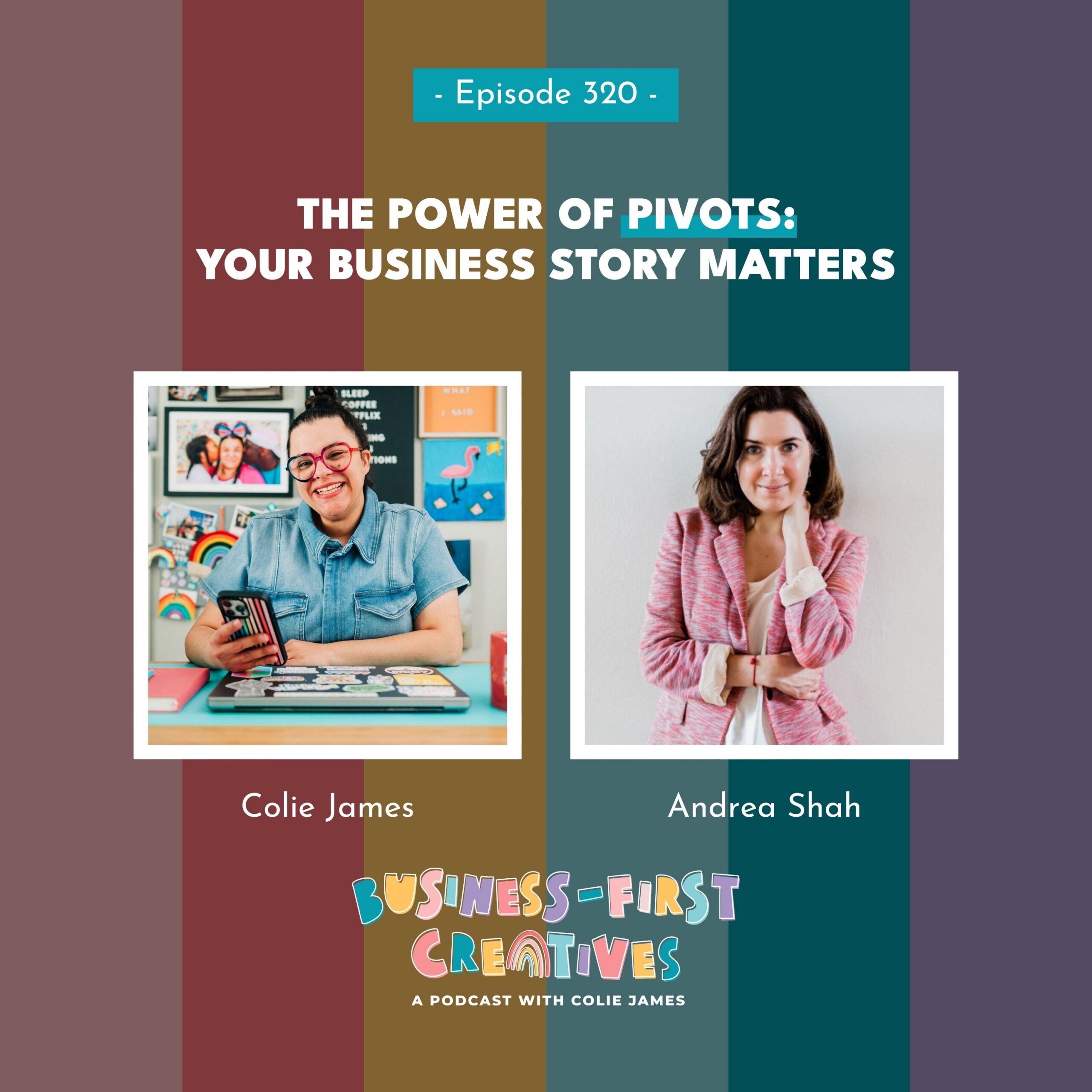



What if the jobs, hobbies, and experiences you think are irrelevant are actually the most valuable parts of your brand story? In this episode, I sit down with copywriter Andrea Shah to unpack the surprising ways our career pivots shape the businesses we build today. We’re exploring how seemingly unrelated experiences become powerful differentiators in your brand, website copy, and client experience.
Andrea shares how she helps business owners uncover the stories hidden beneath their surface-level origin stories, and why the details you’re tempted to leave out may be the exact thing that helps ideal clients connect with you.
Together, we discuss how your website evolves as your business grows, why your copy should attract the right clients and repel the wrong ones, and how consistency between your messaging, visuals, and systems creates a stronger brand experience.
Review the Transcript
Colie: Hey, y’all. Welcome back. Have you ever been on threads and someone is engaging with you, you see them commenting in the same threads, and you’re like, I think I would really like this person if I met them in real life. Well, that’s today’s guest for me. I met Andrea Shaw. At Dubsado at a VIP event earlier this year, and I will admit she was just as fabulous in person as she is online.
And so I’m very excited to have her on the podcast today to talk about something that I wanna talk about more. So girl, welcome to my podcast.
Andrea: That’s the best intro I’ve ever gotten. Thank you. I’m so, ah, I love it. I’m so happy to be here.
Colie: I mean, and she did pitch herself, which if she had just been just a tiny bit patient, I probably would’ve just invited her on. But I was a little lazy in inviting people from the Dubsado event. I mean, I have a list. I haven’t invited
any of them besides Becca, which I, who I interviewed earlier today. But I mean, I do have a list and so I’m slowly but surely gonna make my way around, but you beat me to the punch, so
Andrea: Yay. I love to, I love to pitch. I love to put myself out there. I try, we try to do it more often than we normally actually do, but.
Colie: Yeah, well what we’re gonna talk about today guys, is pivots, and I think that you guys will all agree. I’ve had quite a few pivots in my adult life. I mean, entrepreneurship is definitely not where I saw myself as an adult. I was a hardcore academic. I thought that I was going to be a professor and get tenure and like die in my position.
But that is definitely not what happened to me. And so I’m so excited that Andrea brought up this idea of talking about how Pivots impact our business and our origin story and basically our brand. Because I feel like a lot of people shy away from that, especially if like what they went to college for or what they did before is seemingly unrelated to what they do now.
But you and I both know. Everything that you do brings you to where you are today, whether you know it or not.
Andrea: Yes, absolutely. And I, I feel the same way. I did not think I would become a copywriter. I remember seeing, I lived in one of the big copywriting companies, does like financial copywriting. I remember seeing ads for it when I was fresh outta grad school. I’m thinking like, oh, I could never do that. I don’t have like the train. Of course here I am 15 years later doing exactly that. But I feel like a lot of us, especially with creative roles, entrepreneurial roles, we really back into them. And I’m sure a lot of us you were in like universities and that sort of thing, so I don’t know how much experience you have with corporate, but a lot of us also with corporate, if we worked in those agency jobs, those big company jobs, we kind of back into entrepreneurship.
But actually some of the work we did before is really, really interesting and a really important part of our story.
Colie: Yeah, I have no experience in corporate except as like a retail person. Now, before I was a professor, I actually paid my way through graduate school as a certified farm tech at Walgreens. And so that is my corporate experience, but I didn’t do it for that long. I did it right out of. Undergrad and then before I got my master’s.
So I mean that, that wasn’t that long a period of time. But I really did enjoy pharmacy work and for a while I considered pharmacy school. It’s a very well paying job. I like learning things about, you know, humans and health and drugs, and that’s why I passed my farm test so easily as a certified tech. I mean, everybody else at the Walgreens that I worked at was really stressing over the exam and I was like, oh, you know, it’ll be fine.
I mean, I read over the brochure. I think I did some kind of mandatory training, and then I passed on my first. Time, but that’s because I just love absorbing knowledge and like putting it elsewhere, which you know is why I work in systems now. I love learning everything about everybody’s business and how to apply it using the tools that they have chosen.
Andrea: It is so funny because you just gave the perfect example of like how to take something you did from your past and show how it applies to what you’re doing now. I also feel like nosiness is like a fundamental category of like skill we need as online business owners who like, how did they do that?
What’s your story? Walking up to someone and just starting a conversation. But I mean that’s a great example right there of how you can see like a through line between. The job that you had just for, you know, a few months or a few years and what you’re doing now? I don’t know that I can connect my retail jobs to what I do now, but I will say they gave me a ton of stories and ultimately those jobs teach you a lot about interacting with people that you will need because customer service is still customer service at the end of the day.
Whether someone is yelling at you ’cause they want to try to return a perfume bottle that they already opened or like you’re trying to work through. Something a lot bigger, like we do as business owners.
Colie: So let’s talk about you first. ’cause you just said you don’t know how you would connect your retail story to what you do now, but what do you use from your pivots before you became a business owner? How do you use that in writing? The copy that is on your website, or I guess even social media.
But today I really wanna stick to websites. ’cause you know, I get exhausted with all of the social media talk all of the time.
Andrea: Same. Yeah, and I, what I studied in university was I studied translation, so I started studying foreign languages and then went on for a graduate degree in translation, and you can start to see parallels there. I didn’t see them at the time, but I learned all about how to figure out what someone’s style is when they’re writing and really. Take apart their writing, listen deeply. And then you’re trying to reproduce that in a different language. And what I do as a copywriter is very similar in that I’m asking someone questions, listening to their voice, literally in some cases, listening. Like, if you were my client, I would wanna sit down and talk to you, get a transcript of that com conversation and find all the little nuances of your voice. And then put that back together into copy that represents someone. And I, it took me years to see the parallels. I kind of was like, oh, that’s not really related. Nobody wants to know about that. And I was actually just working with someone for some support on my social media, and she’s like, I want you to make this a main pillar of your content.
I want you to talk about it more. Because it really does inform the work you do and it makes it so clear how you came to be a qualified person for this work. But I think a lot of times we’re like, oh, but does anyone really wanna know? They wanna
hear, they just want results or whatever. But over and over with my clients too, I see the same thing, that there are all these fascinating stories lurking in the background and interesting stories come out when you start talking about all the different pivots you’ve made in your career.
Colie: I mean, no, I’m nosy as fuck. I wanna know what everybody like today, My interview with Becca Berg, the co-founder of Dubsado, I started that interview in a very different way than I typically do. I started asking her about her relationship with her husband, and I mean, I made sure that I asked her before I hit record.
Are you cool? Like, can you tell me how you met him? And like all these things, but. In particular, that was a big part of their brand story because you know, it is a co-founded company. And of course I brought in my own, I started making jokes about how I’ve been married for 25 years and I could never imagine owning a business with my husband.
He definitely doesn’t have any skills that to bring to the table like Jake did. I mean, can you imagine saying, I have this problem and your spouse runs off and is like, I can build you something to fix that. Like really?
Andrea: My husband will build me a spreadsheet if I have a problem that can be solved with a spreadsheet and some macros. He will do that.
Uh, but he is not gonna custom code anything. But yeah, that is Becca and Jake. That’s like such a fascinating story and I think you were like very right to go to that because they co-founded it.
They’re still working together. Like their story is the story. Ultimately, even if you’re not telling, like, you know, they might not be telling their first state story on their
Colie: Oh, no, I
Andrea: but we were I know you did. I know you did. I can count on you for that. And when we were there and they were telling us a story of Dubsado. Their family and their relationship was very much at the core of this whole history of Dubsado to begin with, and we got that, which was really fun. So everyone will have to tune in and listen to Becca’s episode to get the the tea.
Colie: But so what if you don’t co-found, I love that this is tying back to that episode, but what happens if you don’t co-found like a company, we’re talking about pivots, but like how important are your pivots in comparison to like maybe the things that have happened, you know, in however many years it’s been?
So as a copywriter, Andrea, I guess what I’m asking you is. When you are digging into someone’s story, how do you determine what is like the tidbit that is going to be interesting enough to draw someone’s attention or not?
Andrea: It. I feel like it jumps out at me. I’ll ask a bunch of questions that I’ll kind of sidestep around it and it’ll start to come out when I ask people, you know, what jobs have you had before? What did you do before? And this subtext, the, please answer this, even though it seems irrelevant, I swear it is relevant to the story. And very often we get a story in there about a job that isn’t related. So, you know, I work with a lot of wedding professionals, but most of them didn’t start out as wedding professionals. It’s relatively rare for someone to tell me. I always knew I wanted to be a wedding photographer, and so I became a wedding photographer. Instead, I’ve had attorneys that have been wedding planners. I’ve had attorneys that have been wedding planners and gone back to being attorneys. Like there’s these really fascinating career stories in there, and that’s when I wanna get on an interview with someone and say, okay, so now I know you were an attorney, you are a wedding planner.
What do you think brings these two things together? What do you think? Was this not the story, but what do you think is the common thread there? For my attorney turned wedding planner, it was really obvious. It, it’s that she’s a crossed t’s dotted i’s person. We say that in her copy. We don’t just dot your i’s we dot your j’s like she is. And we got such good copy out of it because we also called her a. Type a planner for type A people so you don’t have to be Type A about your wedding.
Colie: Mm-hmm.
Andrea: that through line of her being an attorney is like, yeah, you can trust someone who worked at a big firm. She wasn’t just like a, you know, totally unrelated to this stuff.
She worked in a big firm where she really had to care about the details, if she wanted to keep advancing, and that, that really played well into her copy, but it also drew this connection. Between her and a lot of her clients who really want someone reliable, who have to show up and perform every day in their job and want someone to show up and perform every day in the job they’re assigning to this person as their planner.
Colie: That is so interesting and I think right now I wanna say out loud the thing that I’m thinking in my head and that’s, I think when you first pitched this to me, I was thinking of pivots related to like your About me page and I just realized listening to you talk about how you got that we don’t just dot your i’s we dot your j’s and that she’s a type A planner for type A people.
Like that’s not copy that you probably put on her about page. You probably use that somewhere else. So
Andrea: is on our homepage. Yeah. Yeah.
Colie: mean, I’m realizing this now, so. Is that what you start with? Like do you start with someone’s origin story, their, their previous business experience, what they went to college for? Like are you getting all of that before you even think about writing the copy for the main pages?
Because again, I think in my mind, I sat here and I thought, oh, well she uses this to write like a really good about me page, and then maybe that gets sprinkled into other areas of the website. But it’s not like, it’s not the thing, it’s not the foundation. But I just realized I think you are using it as the foundation for the rest of their copy.
Andrea: It sometimes is the thing. Absolutely. Like I, it is the first question on my, I have two questions related to it and they’re on different parts, but one of my first questions is like, basically just start at the beginning. Tell me what I need to know. How did you, what is your origin story? Why did you like to do as a kid?
All of this stuff? Because I feel like the further we go back. Sometimes you have to tell me and you’re gonna tell me these irrelevant things. And to be honest, it’s not always about a career that you had. Sometimes it’s a goal that you had. If you were to tell me. That you were in training to become an Olympic figure skater, you better believe that’s gonna make that into
your, you know, it’s gonna be there and there somewhere. And sometimes it is just something that goes on your about page, but sometimes it really underpins your whole story and really informs that. Other times, like you said, we, it’s just a detail, a little supplementary detail. So I worked with a photographer who had worked for a company that specialized in retouching, but it was very ethically oriented that, you know, they retouched to make people look really good, but they would not, they had very strict policies about what they would and wouldn’t do.
And she’s like, I really want people to know this is something I believe in, that you can book me for your wedding and you’re gonna look great and I’ll do the little bit of retouching to make you look like the best possible version of you. But I’m not gonna go in. And start doing all kinds of crazy things to make you look like a completely different person.
Um, so sometimes it’s a supplementary detail, but sometimes it really is the whole story. It really depends on where someone is in their career. ’cause also so many of us start businesses in our thirties, in our forties, and we have a lot of previous life that went on before then.
Colie: is what every single person says. And so you, you do have to get beyond that. Yes, you picked up a camera because you became a mom or a dad and all of a sudden you wanted to document your kid and then you did it for others.
And again, they all have like the same origin story of well, and then my friends started asking me to take. Pictures of them. I mean, it is literally a carbon copy, like copy and paste every single time. I ask somebody that. But I always feel like I did try to take like one step back. I always make jokes about how, you know, I made an online course for photographers teaching them how to do lifestyle photography before I had finished my first year in business.
And that’s the most ridiculous thing that you’ve ever heard. But then I always follow up with, but before that, I was a college professor for 10 years and so making a course was probably easier than actually doing the photography. And again, like that ties it in. And I feel like for myself, I’m able to identify how those things go together, but that’s not what always happens for other people.
So. Is it that you feel like in your role as a professional copywriter, that you are able to see the connections better than someone who isn’t a copywriter? Or is it just that people are too close to their own story that they don’t see it? Like do you think it’s just a I I can’t see it because I’m not a copywriter or I can’t see it because it’s me?
Which one tends to be more true?
Andrea: I think it’s a little bit of both. Um, because like remember I said, I sometimes struggle to see the own through lines in my story until some other third party comes along and is like, no, this is, this is really obvious. You’re ignoring the obvious. It’s right in front of you. But also as a copywriter, I do think it’s about knowing what questions to ask, to elicit details about people’s strengths about their past, and really. Get to those things that they might otherwise be like, Hey, this is completely irrelevant to what I’m doing now. You know, I worked in a bank that doesn’t make me a great family photographer. And it’s like, well, maybe, maybe not. Maybe there’s something there. Maybe it really is totally irrelevant to your story. But maybe you’re gonna tell me that you ran a CVS, like it was the Navy and now you’re able to direct, you know, big chaotic wedding parties and get them all to go where they need to go. And yeah, there’s probably a through line there. Maybe it’s your personality, but we’re gonna pull that out and we’re gonna talk about it a little bit because there almost always is a connection, even if the connection is sometimes just, I hated what I did and I left it behind to have an artistic career, which you’re talking about family photographers. And just listening to you talk about it. Some of the story I’m hearing is probably the actual story is a layer deeper. Like, I had my kids and I left my previous job because X, Y, Z, it didn’t work. Childcare wasn’t compatible. I hated it, whatever it is. And now I’m doing something creative and fulfilling.
And there’s another layer of story there, but you have to dig a little bit. I’m, I would never say I’m a journalist, but I do feel like you use some of the same techniques where you’re digging for that story. Underneath the surface story, we all start telling about ourselves.
Colie: And I, it does require you to go deeper. It does require you to not accept what someone tells you is their story and ask additional questions to like pull it out. I feel the same way when it comes to systems. Like if I ask you what you want to do with your clients or what you want your systems to do for you, sometimes I get this, you know, list.
Some people come with a list, some people don’t. But when they come with a list, I’m always like. Hmm, but why do you wanna do this? Have you considered A, have you considered B? Is that really important to you? Like I have to get into it. And then that’s when we start to like really develop the full systems that will help them run their business instead of just what they, what they thought that a tool could do for them, what they thought that they wanted to do with their clients.
I mean, I do feel like. You, you probably consider yourself a little bit of a strategist in there with the
Andrea: Of course.
Colie: I feel like those of us that like add the word strategist to the end of our description are people who act like journalists. Like, no, I wanna get everything. I wanna get down to the nitty gritty, and then I’m gonna help you pick out which parts are important so that we can build systems that really do work for the way that you want to run your business, the way that your brain works.
What your clients actually need. Because even if all of us do the same thing, it might be that you’re attracting a client that needs something different than what you know this other service provider is the type of clients that they’re attracting. And so everything is really like personalized and customized.
Andrea: Yeah, and you have to, you have to find, for me, I’m also looking for the threads that are relevant to the customers you want to work with. Not just any customers, but the people you wanna work with. So going back to that wedding planner I talked about, she attracts a lot of people with high powered corporate jobs they’re used to and having. Packed schedules and really high expectations of the people that work for them. And so when they see that my client was a lawyer, they’re like, oh, she’s gonna get me. She’s gonna know what my expectations are for somebody else that might be relevant, but in a different way. Maybe they aren’t a lawyer, but they want someone who knows what a good contract looks like so that when a venue sends them. A 30 page contract, they have the faintest idea of what’s in it. And you have to pull out the threads that matter to your people too, which isn’t gonna be the same for everybody. So that’s why when we do this, I also wanna know, who do you want more of? Who do you want less of? What is it that keeps you getting up in the morning and going to work, and what could you be like, I never wanna do that again.
And I know, and it’s the same with you in systems. I know that you have the same questions for people because. I don’t just wanna get people more work, I wanna get them more work that they actually like doing.
Otherwise, what’s it all for?
Colie: I mean, and I think all of us ask a variation of the question, like, what’s your worst experience working with a client? For you, it’s, you wanna make sure that the copy doesn’t attract that particular kind of person. For me, it’s, I wanna make sure that we’re setting boundaries in your business and maybe like part of your inquiry process can weed those people out.
If your website or your copy, ’cause it wasn’t written by. By Andrea, you know, doesn’t weed the people out for you. But I also feel like I wanna pull this around to the people that you’re working with. Have you ever like uncovered someone’s story and they were like, yeah, I get where you’re coming from, but like, I’m very uncomfortable with using that on my website or like putting it into the process.
Has there ever been like a story that you thought was so juicy but people were like, no, I don’t wanna use that.
Andrea: I think I am. So actually one of the things I run into is I think people are cautious about not wanting to show their age necessarily in both directions. And so sometimes we’re vetting stories for that a little bit. Some people are younger than their typical client and they don’t necessarily wanna be upfront about that.
And then some people are older than their typical client, especially with wedding professionals. I run into that one where they don’t want people to think like, oh, she’s like my aunt who’s 30 years older. And so it’s this fine balance of like telling this story, but emphasizing the experience. You have to really kind of massage it.
I haven’t had anything so juicy that someone hasn’t wanted. To use it, but maybe that’ll happen in like the next week or so after we’ve recorded this episode. Like, you
know how I said it.
Right? Right. You like summoned it into the universe. But usually I will say that as a copywriter, if I pick up on a sensitive detail, I will come in and I’ll say, this is kind of the creative direction.
I’m thinking, if you don’t want to talk about this, tell me. So for some people they might tell me all about their private life, that they’re a parent, they have a partner, whatever. But once we get going through it, it’s like that’s a relatively, I want that to be 5% of my story.
Not 50%, not 90%. It really depends on who you are.
I am, I mean, you follow me on social media. I have, I’m married, I have a kid, and you’ll pick up that I’m married and have a kid, but they, you’re not gonna know their name. They’re not front and center just because they have their own lives. And, you know, I’m not, everyone’s different in that regard.
Colie: I mean, I feel like as photographers, we really feel this, I was literally saying this earlier, but Chloe has, you know, there, there’s, there’s a big difference between her now 13 years into my business and, you know, year zero now, in year zero she was only three, so she didn’t really get a say so in anything.
But I would say that I got a good. Probably seven, eight years out of Chloe where she loved taking pictures with me. She loved being like the center of attention, and now she loves being the center of attention on like her TikTok and her Instagram. But I mean, she doesn’t wanna be on mine anymore. Like, do you know what I mean?
So, I mean, I do feel like. I have lessened the amount that I talk about my family and talk about my daughter on my website and things like, I mean, I was literally just editing my about me page and I think I took off the whole part of, you know, growing my photography business. While Chloe was little, and I mean I did it for one reason, not to make her front and center anymore.
But the other thing is that like my origin story has changed quite a bit when it comes to presenting myself as the system strategist versus the photography that was really like the mainstay, even on my systems’ website for the first five years. I mean, it was all about still my origin story as a photographer and then how that led into systems versus now I’m just really focused on like.
Building systems, and so the photography part is like very, very small now, just to keep my credibility. Because I do feel like lots of people still hire me just because I used to be a photographer, I was a successful photographer. I can take my skills. I know what, it’s actually, actually someone last week, um, who is joining my offer systems in session, birth photographer and doula.
She’s like, no, I really wanna hire you because you know what it’s like to be in the delivery room. I was like, I do know what it’s like to be in the delivery room, and I’m not talking about as the parent, I’m talking about as the photographer. So yes, I do bring some skills to your systems that I know what I used to do, and so if any of this is helpful to you, we can build you systems that are even more custom because I used to do what you do.
Andrea: Yeah, and I, I do feel like there’s a point, especially if you evolve. Into being a business owner who isn’t doing who’s B2B instead of B2C. There comes a point where you often have to evoke your B2C history. You a lot of other people we meet who are working with, I think about some of the people we met when we were at Dubsado, who are now doing systems for different groups of people.
We met several people who were doing systems for makeup artists, and I bet if I went and poked at them. We’d find some sort of history there where their business came to be focused on this one group. And yes, it is relevant to a point, but I think you’re describing a really interesting process that gradually as your business evolves, it becomes a smaller part of your story and just one potential point of connection. And I think that also. Brings us to the fact that you’re gonna keep evolving and your copy and your story are gonna keep evolving. And the story you tell in year one of your business is gonna be different than the story you tell in year 10 because you’re not the same person you were and you’ve learned a lot.
Colie: How often should someone be looking into their story or like in a, in a broader sense, refreshing their copy? Because I like to make jokes. There’s almost nothing that you buy in business that set it and forget it. I mean, people like to think their websites are like that, you know, oh, I’m gonna pay, you know, thousands of dollars to both a website designer and a copywriter, and once I get this website, I’m gonna be golden for like the next decade.
Totally a lie, just so that everybody knows this,
but I mean, how often should you be looking into your story to refresh your copy? I mean, I have an idea, but I want you to answer first.
Andrea: So I would say that probably every two to three years, at a bare minimum, you need to dig in a little bit and you know, make sure everything is still relevant to you. I would, I mean, if I were telling you, I tell you to check once a year. Two to three years is probably where you’re gonna start to want to do some sort of investment, whether that is just dedicating a week to yourself to really rewrite the parts of your site that aren’t working for you, or hire someone. But it really depends on how consistent you are with your offers, and most importantly, the people you wanna attract. If you get to a point where all of a sudden the people coming in are not the ones you want, or you were getting a ton of people and now you’re not, that’s usually a sign that something somewhere is not aligned and you want to figure out what that is.
And sometimes it’s your copy. I’d be lying if I said it was ever only your copy. You know, there’s all kinds of things that make it, you know, make that misalignment happen. But a lot of times. People change their offers and then they go change a few bullet points and the numbers on their website and then they let it sit.
And the problem is when the offer evolved, the copy didn’t, and you’re not getting the right people for that new, that new offer. And you know this because I know you’ve evolved so much, what you’re doing over time with systems that I’m sure you’ve seen this in your own business, that if you just changed a few little words here and there, you probably wouldn’t be. Speaking to the problems or the stressors that people are having that come to your programs and your, you know, that choose to work with you now.
Colie: I mean, I literally just did that, Andrea, like,
Andrea: Yeah. I, know. I’ve been
Colie: I know I.
Andrea: You’ve been dropping a little trail of breadcrumbs and
I’ve,
been so curious.
Colie: finally finished, I mean, it’s, you know, done in quotes. ’cause for me, it’s never done. I mean, I’m one of those people that will check my website every single month and make tweaks as ne as needed. I mean, I, I love working on my website, but most recently I was doing like an, a complete overhaul, not just on the layout, but I mean, my offers, my offers in 2026 are not what I started with in 2025.
And with that. You would think that I didn’t have to change much because I’ve been doing dubs. I mean, this website has really been Dubsado setups for the last five years that it’s been, well actually, have I had that website for five years? No. I’ve only had the website for three years. Before that, I was selling Dubsado services off my photography website, which is a whole different thing that we could talk about,
Andrea: That’s episode two. We’ll, we’ll,
Colie: we’ll come back
Andrea: that one.
Colie: So I’ve had this website for three years, actually, I think it’s been exactly three years, but in the last year, I went hard from saying, I will do this for you. I want to do this with you, and I have to make sure that the copy reflected this because the offer page certainly did, but I feel like my About me was still saying what I would do for you.
My homepage was still saying what I would do for you, and it really was like a misalignment. I feel like people who hit the sales page for systems in session really knew what it was about. But if you hit my homepage in the last. Six-ish months and you read everything there and then you clicked on the button.
That was work with me. You might have been a little confused because I’m not saying I’m willing to do anything for you anymore except be there for you as your accountability, your feedback, and to help you along. So I mean, I really did have to look at it and I feel like I had Frankenstein the entire website so much that.
It. I had to like rewrite my entire homepage from beginning to end because there was almost nothing that was on there that was like, this is really applicable to what I’m doing now in 2026.
Andrea: And especially I think of someone like you that’s been in business for a while, and this applies to a lot of different people that are out there for five, 10 years. You have this entire. Like web of blog content that’s bringing people in from all over. And so you need to make sure, like, yes, you can be on threads and you can drop the link directly to the page for systems in session, but if someone finds you through a blog post about five tips you have on using Dubsado in your photography business, you wanna make sure that then if that person clicks home, they’re getting.
The full scoop on what you’re doing now, not what you were doing two years ago. Because otherwise, and especially you talk about such an interesting shift in your ideal client and someone, one that I’ve seen a couple other system strategists talk about is like, these systems are amazing tools, but not everyone necessarily wants to hire someone and then not know what they’re doing if
they have to make a change in their business.
And so that’s a, that is a different client avatar from the person who wants to hire someone and never even like. Pull open the hood and look at Dubsado once like they’re different people and you, I, you know, I’ve been excited. I’m gonna go open up your website as soon as we’re
done and like take a peek around.
I love your website. It’s so
colorful.
Colie: Oh, yeah, the, the rainbow thing. Oh, and I got new brand photos. That’s the other thing. Literally, those dropped into my lap on Friday and I, on Friday night, I went through the whole thing, and the next morning my brand photographer was like, oh. Holy shit. You did the whole website. I’m like, yeah.
I mean, I was sitting on my couch. I had nothing else better to do. Like the whole website ev. Almost every photo on the main pages are completely from my latest session. But it’s really interesting what you said about my client avatar because there are people that I worked with previously. Who are now working with me in systems in session, and seemingly they’re the same person, but the difference is they are in a very different place in their business than they were when I worked with them in A DIY or A done for you capacity.
So yes, I did really feel like I needed to address that. And you know, I’m pretty sure that you would like sign off on this, but everybody needs to be interviewing their clients or they need to hire a copywriter to do it for them. Because the one thing that I heard in like. Four different interviews is I’m such a control freak.
I couldn’t let anybody else take this over. I have to know how it works every bit because I don’t ever wanna feel like my business is running without me and I have no control over it. And I heard that in like four to five different. Interviews and I was like, and I still haven’t put control freak on my website other than in the case studies, but like it definitely showed me that the avatar, the client that I’m speaking to now is very different than when I started the system side of my business five years ago, because five years ago it was, I just want somebody to give me a blueprint.
That was why I called my course the blueprint. I just want somebody to tell me what to do, A, B, and C. And so literally when I was helping people, then I was just giving them what had worked in my photography business, like take this. Use it in your business and it will work. And it did for a very long time.
And that’s really what like the beginners needed. I would say the first, the people in the first couple years of business who really haven’t evolved to needing their own customized systems, but now. People that are coming to me with 6, 7, 10 years under their belt, their needs are very different. And those are the people who are control freaks.
They wanna know how everything works. They want to help put it together, but they don’t feel confident enough or that they don’t have the technical knowledge of the tool that they’re using in order to know what a best practice is. And so that’s what they’re looking for now versus what people came to me five years ago for.
Andrea: And I feel like we all go through that process. I’ve worked with some of the same clients. We’ve refreshed their websites and over time it’s, they’re going from, maybe they’re going from one person to all of a sudden they’re a team of six people and they want a website that reflects that. When you’re booking with them, you’re no longer going to get the one photographer I wrote this website for back in the day, but I love, I’m gonna, I’m gonna be like persuading you in the dms to put self-identified control freaks somewhere on your website because they do feel like that’s a sort of slightly spicy language. That people like see it and they’re like, oh yeah, I
Colie: That’s me.
Andrea: a control freak. Yeah, yeah, yeah. And that’s why I also put, um, you know, there are some people who would read that line about being Type A on my client’s website and be like, Ugh, that’s not for me. And that’s fine because it’s also not for her.
I, for, I wouldn’t read it. Well, I would read it as a type B person and be like, oh, I do need someone to be type A for me. I’ve never needed anything more in my life. Um, but there are some people, if someone. Backs away from something like that, that’s okay too. Like you cannot work with everybody. I, I feel like I say that all the time.
You can’t work with everybody. If someone is put off by a little joke like that and you’re the sort of person comfortable making jokes like that, then it’s not a match made in heaven, you know?
Colie: And we really do wanna work with our ideal clients. I do think that as business owners, you have to be pretty far along in business before you can let the scarcity go. Like I feel like a lot of people jump to say yes, even if there are red flags. Even if this is not like a perfect fit, You say yes because you’re afraid that someone else won’t come along.
But for most of us who have been in business, I mean, I’m 13 years in. I know that when someone tells me no, awesome. Great. I don’t have to take the chance of working with you and it wasn’t a good fit. And guess what? Someone else will come along that is a better fit than you were for this offer. I mean, because the offer is proven.
I love what I do in the offer. I just have to be patient enough for the people to come to me. That would work well within the container that I’m offering. And you know, I’m not saying that I’m some kind of special, you know, unicorn, but I do feel like. If you can get to that place, you will be more successful in your business going forward if you don’t say yes to the people that you really should say no to.
And guess what? That’s how copy can get you there because copy can bring you the right people. Tell the wrong people to go away, and if they get past your website and your copy and they actually hit submit on the contact form, that is when you need to have a, you know, a practice in place that ask them questions to be able to say yes confidently, or, no thank you.
Here’s maybe a few other people that would work better for you.
Andrea: Yeah. And that’s, that is the job that your copy is there to do is to, I don’t want to misuse the word funnel ’cause I know it has so many other applications, but kind of narrow down the people who are gonna come work with you and most of us. Realistically are not in a niche where we have so few, so few people that could work with us that we have to take all of them.
There’s very few of us that do, and usually by the time clients come to me, they’re at the point where they’re like, okay, I know how I have been saying yes to things I shouldn’t. Please, let’s
fix that. Can you get these people outta my inbox so that I won’t feel tempted? And I’m like, yes, we can. We’re not gonna tell them blank in giant letters.
No, I won’t work with you if, but you know, if you don’t want. If you’re a photographer who doesn’t wanna work with 15 person wedding parties anymore, we use the word intimate on your website and you know, we talk about how you wanna be surrounded by familiar faces and have, there’s a lot we can do without ever being truly negative.
Of course, there are people who are spicy and we love them, but the reality is that’s not everyone. And you don’t have to come out and say, this is what I hate. I don’t want to do any of it. To filter out those people, we can be subtle about it and still tell your story in a way that’s going to get the right people to you.
Colie: And can I just say right now that I’m talking to Andrea and she’s a copywriter, but this has to also be true of the photos that you are using on your website. So you just said intimate, and the first thing that popped into my mind as the systems person, if I’m going through someone’s website, is great.
Your copy is bringing in who you want. But are you still showing photographs of weddings that you did five years ago that have wedding parties of 20 people? You have to make sure that once you get your copy where it needs to be, that you are also adjusting your offers. Maybe how you describe, you know, your offers, your packages, whatever it is, as well as the images that are going on your website.
Because you don’t want somebody to be confused. You don’t want somebody to read. Intimate and think, you know, small party weddings or elopements, and then your entire portfolio are like these huge weddings in like a cathedral. Like make sure it’s all aligned. Don’t just focus on your copy. Make sure that everything fits together.
And that’s often why people do these huge brand refreshes because that includes your copy, your website. The photos of yourself or brand photos and then your systems, all of those things together are usually done because if something in one part of your business has changed, you really do need to go through everything with like a fine tooth comb to make sure that on the other side of this refresh, everything fits together to, you know, bring in the ideal clients that you want and repel the ones that you don’t.
Andrea: I am so glad you mentioned images, because yes, as a copywriter I think about that all the time. That there is. There’s also, and this is wedding industry specific a little bit, but I’m sure also a lot of other photographers can relate. It can be really tricky to find that balance between treating all of your customers like they’re incredibly valuable people who you liked working with and that work that’s going to expand your portfolio and the direction you want.
And I think there’s an art to learning. How to balance the two, how to make sure that people are seeing, you know, if people want to be seen on your Instagram, they’re seen on your Instagram, but you’re carefully choosing the images that you share so that maybe they did have a big wedding, but you’re sharing the flatly and a picture of the couple and a picture of the ceremony, you know that up close and that sort of thing.
There’s a lot to, there’s a parallel in how you select the images for your portfolio and what we say about them. In any sort of aesthetic endeavor, selecting the right thing, but also just making your customers happy, because sometimes you do need to get paid
and sometimes they might be lovely people, but the aesthetic is not what you want to promote in the future, and you have to find a way to say, okay, I’m gonna make them happy. But I’m also just gonna take the check-in. You know, like,
it is fine to take, to take a few people as long as they’re nice people. I don’t want you to take someone where the aesthetic isn’t what you want
Colie: And they’re mean.
Andrea: and they’re mean, and they’re making you go somewhere horrible and all of that.
No, but like sometimes you cannot have it all. I’m sure that even the people who are charging $85,000 to photograph one wedding sometimes take one where they’re like, you know what? Like not necessarily my
cup of tea. But I will, you know, I’ll build a swimming pool with that. So, yeah. Um, I, it is a really tricky balance and I think you have it right.
I am working now with a stationer and we are doing her brand designer web. She’s brand and web designer. We’re working together. We have an SEO specialist. She’s getting new photos done, and we spent a lot of time talking about not only what I’m going to write, but what pieces we want where, because we looked at her Instagram and we said this piece. It needs to be front and center. This piece, we really want to see more of it because if you are telling me that what you wanna do is more unique printing methods, we have to put those front and center. We cannot, I know that maybe 90% of what you do is one thing, but if 10% of what you do is what you want to do more of
That’s gonna be front and center, both in the copy and the images.
Colie: I mean, that’s what you need to be pinning. That’s what you need to be talking about on social media. I’m sorry I can’t help myself. I said we weren’t gonna talk about all that stuff, but all of it comes together, like every single bit for your brand and what you’re putting out there.
And I am really happy that this came back around and that we talked about the, you know, don’t say no, don’t say yes to things you should say no to, but also. A $5,000 offer, you know, comes into your lap and you need to say yes to pay your bills. There is nothing wrong with that. I don’t want anybody to think that I’m telling them you have to turn that down so that you can make the space for yes, but I am saying you can’t continue to say yes.
Over and over and over again without leaving the opportunity to get what you really want. And curation is a lot of it. And I mean, if you’re at a wedding that is a big party, like you said, I mean, you also have to shoot the photos that you want. In the moment though, like if you see an intimate moment between a bride and one of her bridesmaid or her mother or whatever it is, make sure that you’re taking those shots.
And then when you’re editing the full gallery, go ahead and put all of the ones that really represented. What you want to show going forward in one particular folder, and maybe that’s what you blog or that’s what you use on your social media. You don’t need to show a full wedding just because your client expects it.
I mean, there are other ways. I mean, they’re getting the full gallery. They could get an album, all of those things. But at the end of the day, what goes on your website should be what you want to show and what will actually bring in the clients that you are desiring most.
Andrea: And if you want me to elaborate on that, I’d also add that if you want a diverse client base, you have to show diverse
client work on your site and include it in your copy. It is not. Just enough to say that you work with everyone. Love is love, et cetera. And I know you and I, talked about a little bit about stuff like this.
I, when I was looking for wedding photos, I was looking for someone who could make my husband look great and me look great, and us look great in the same photograph,
Colie: Which you don’t think should be a big deal, but Hello? My photo on
my
wall behind
Andrea: skin tone, yeah, it can be really difficult. And it’s not just making him look good. I also don’t wanna look like Casper, the friendly
ghost, while he’s over there glowing and looking radiant. And what I think back to from that search is if I didn’t see something relatively close to what I was looking for within one or two pages, I’m not gonna read 50 pages of your blog
to look for it. We gotta see that upfront because I mean, people are tired at the end of the day. People are tired. They don’t wanna go digging like they wanna see themselves represented.
Colie: And something that I have been like, I don’t wanna say educating my clients on, because that sounds like, that sounds shitty, but inclusive language is a must in 2026. And if you want to be seen as an inclusive. Wedding photographer, stationary person, whatever it is, you need the copy on your website to reflect that.
And so practice that. Now, don’t use bride and groom constantly. If you know you want to attract, um, same sex couples, like you gotta figure out a different way to show it on your website, to do it on your contact form, to do it in all of the emails that you are sending out, because someone is going to feel like you don’t see them.
If every single intake form that you are using says name of groom. Name of bride. Well, you know what? That’s not what every wedding party looks like. And so we need language to reflect that in your systems. But even before that, they are unlikely to come to you if they don’t see that language on your website.
It’s one thing to say love is love. You gotta put your money where your mouth is. Like everywhere.
Andrea: And you nailed it because also what I’ve heard from people is the website will look great, the Instagram will look great, and then they get to the point where they’re dipping their toe into the systems. ’cause you, you and I crossed paths on that inquiry form, right? Like our two and the. Say, okay, this looked great.
I solved. And then they go, and maybe the inquiry form is fine, but they get the contract and it says, bride’s name, grooms name. And they’re like, okay, but
Colie: Do we flip a coin? I mean, who gets to be the bride? Who gets to be the groom?
Andrea: yeah. There’s, they, they start, and so, and that will cause people to hit pause and say, okay, wait, is this the safe space? I thought it was. So I think. What you and I are both saying is it has to be a consistent follow through. If you’re gonna do that from your copy to your systems, it all has to flow one into the other. Otherwise, you’re gonna turn some people off who might make amazing clients and
who you want to cater to, but it’s just that your sample contract came with something and you forgot to change that field and like, let’s not let them down over that, you know?
Colie: Yes. Okay. I feel like in order to, you know, do a service for the listening audience, we gotta bring this back around to pivot. ’cause I mean, our conversation’s been amazing by the way. She will be back there is going to be a part two to this conversation. But in order to like close out this idea of highlighting your pivots and making sure.
That you are thinking about what you’ve done in the past that is relative to like your business and the copy on your website and all of these things. If someone is not ready to hire a copywriter, ’cause I would say if you’re gonna hire a copywriter, they’re gonna help you uncover this. But like if you are trying to take a stab at DIYing, your copy initially.
What is like the first step that we can take in order to dive into our own history to make sure that we are pulling out the pieces of our pivots that are worth mentioning to our ideal clients?
Andrea: I would want you to take out a sheet of paper and a pen. Do it with pen and paper too. I mean it when I say that because I feel like we think differently when we’re in front of pen and paper. Um, maybe if you’re a verbal processor, give yourself a little voice memo lift, but I really like pen and paper for this. Write down everything you’ve done and go as far back as you can. Think about the sports you did when you were a kid, or the clubs you were in in high school, and then just work your way chronologically forward. Thinking about jobs you had, hobbies you’ve had. Put this all down because we do talk about pivots.
We talked a lot about careers. But especially if you’re on the creative side, it might also be that, you know, maybe in your, in your spare time you’re a glassblower and like that is a really cool story to tell. Even if the way you make your money is family photography, there is some way to tie those two together. But just go work chronologically and write this down and then maybe leave it for a day or two.
Colie: Yes.
Andrea: Leave it for a week and come back to it and say, okay, where are the stories? How does this relate to what I do now? But give yourself some time to think about it. Don’t just as with all things copy and branding, don’t try to force yourself to do it in one day and expect this incredible transformation.
’cause when you’re working with yourself and your own business, you need to step back and give everything time to breathe. When I do it, I have a process. I’m not you, so I can look at your story and say, okay, yes, I see this, but you need to give your own stuff. Time to breathe. I need to give my own stuff.
Time to breathe. We won’t even talk about what it’s like to write your own copy as a copywriter, it’s. It’s not fun, um, but you give yourself time to breathe. But that was an exercise taught to me by some of my mentors when I started copywriting to kind of find your differentiators. They might be lurking in something that you used to do with your grandma when you were 10 years old, that you’re a baker, but you really got started mixing stuff in the kitchen with your grandmother or making cakes outta Play-Doh when you were five or whatever the case may be.
Um, it might be a career pivot. If you’re a cake decorator, I wanna hear about how working at Publix’s influenced you or whatever. But I also maybe want to hear about a funny story when you know, you cried ’cause your cake didn’t look the way it wanted you wanted it to at your seventh birthday. There’s a lot you can unpack just by going back and then letting that sit and coming back to it and saying, okay, what’s relevant?
’cause maybe your job at McDonald’s was relevant. And maybe it’s totally irrelevant and you don’t ever have to mention it. Um, although sometimes I will add that those things that aren’t necessarily relevant to your career path, if they’re a commonality with some of the people you work with,
then by all means mention them. If you were a dog walker. And now you’re a wedding photographer. You don’t, there doesn’t have to be a story there, but if they know your dog people, they’re gonna be like, okay, My person.
if your people are dog people mention that. If your people are cat people, you know, there’s, there’s little tidbits too I have on my own about Paige things where there’s no story, there’s just a line two where someone can come on my, my call would sit down and you know, we have an icebreaker ready to go because they’ve read that I don’t drink coffee, and they’re like, oh, weird.
Why?
Colie: You don’t drink coffee?
Andrea: No,
Colie: wish you guys could see my face. Okay. You drink tea? Okay.
Okay.
Andrea: tea and I drink diet Coke. So it’s not like I’m living a no caffeine life over here. I just, I don’t
Colie: You’re not secretly from Utah. Okay?
Andrea: I am not. No, no, no, no, no, no. We need, we need, listen, I’m gonna hold up. I have a water bottle that says there’s nothing, a diet Coke. Can’t fix
Colie: that is adorable.
Andrea: diet. Yes.
Colie: I
mean, and you know what? I know people that would love you just because you love Diet Coke. I have a client, her name is Kelly. Hello Kelly. ’cause you’ve listened to every episode. Andrea’s gonna be your new best friend. She did an entire Diet Coke themed branding part of her session.
Andrea: I probably will do that too. I mean, actually I was just coming up with, I met with a social strategist and we came up with a fun hook for some reels that’s related to Diet
Coke, so Yes. Yeah, that’s a perfect example though. It’s like. You could just say, uh, you know, well, who cares if I drink a diet Coke every day?
And some people won’t. But some people
are gonna read that and be like, oh, that’s my girl. Okay. We’re gonna, We’re gonna,
sit down with a diet Coke. Yeah. Yeah. Yeah.
Colie: I mean, normally I tie this up in a nice little bow. Here’s what I’m gonna do instead for this episode, guys, if you have never sat down with a piece of paper and a pen, and doesn’t that sound familiar because I tell y’all to do that shit for your systems too, literally, sometimes the best thing to do is sit in a quiet room, or maybe you need some music.
I’m not gonna shame you if you need some like loud music playing in your ears, but whatever it takes you to get in the zone, I want you to sit down and I want you to chronologically think about all the. Things that Andrea just told us about your previous jobs experiences that you had in your childhood, so that you have a base for finding these interesting stories and hooks to create amazing copy for your website.
And if we have to talk about it for, you know, your social media too. But if you are interested in hearing more from Andrea, she will be back. And with that, that’s it for this episode. See you next time.
Find It Quickly
00:26 – Meet Andrea Shaw
01:35 – Why Pivots Matter
08:43 – Finding the Juicy Thread
09:38 – Pivot Copy Examples
11:09 – Origin Story as Strategy
13:43 – Digging Deeper Than Mom With Camera
20:35 – Privacy and Sensitive Details
22:33 – Evolving Brand Story
25:41 – When to Refresh Website Copy
27:53 – Website Overhaul Shift
31:27 – New Avatar Insights
34:58 – Your Copy Filters Clients
43:03 – Inclusive Language Systems
46:09 – DIY Pivot Story Exercise
49:41 – Personal Details Build Trust
Connect with the Guest
Website: andreashah.com
Instagram: instagram.com/andreashahcopy


Signature Series


Your business works, but your backend is costing you.
A 4-Part Audio Series for service-based business owners who are ready to upgrade their “just fine” client experience, unlock higher pricing, increase referrals, and grow more sustainable revenue—without overworking behind the scenes.
Get the FREE 4-part audio training series
Systems That Sell


© 2022-2025 Colie James


