
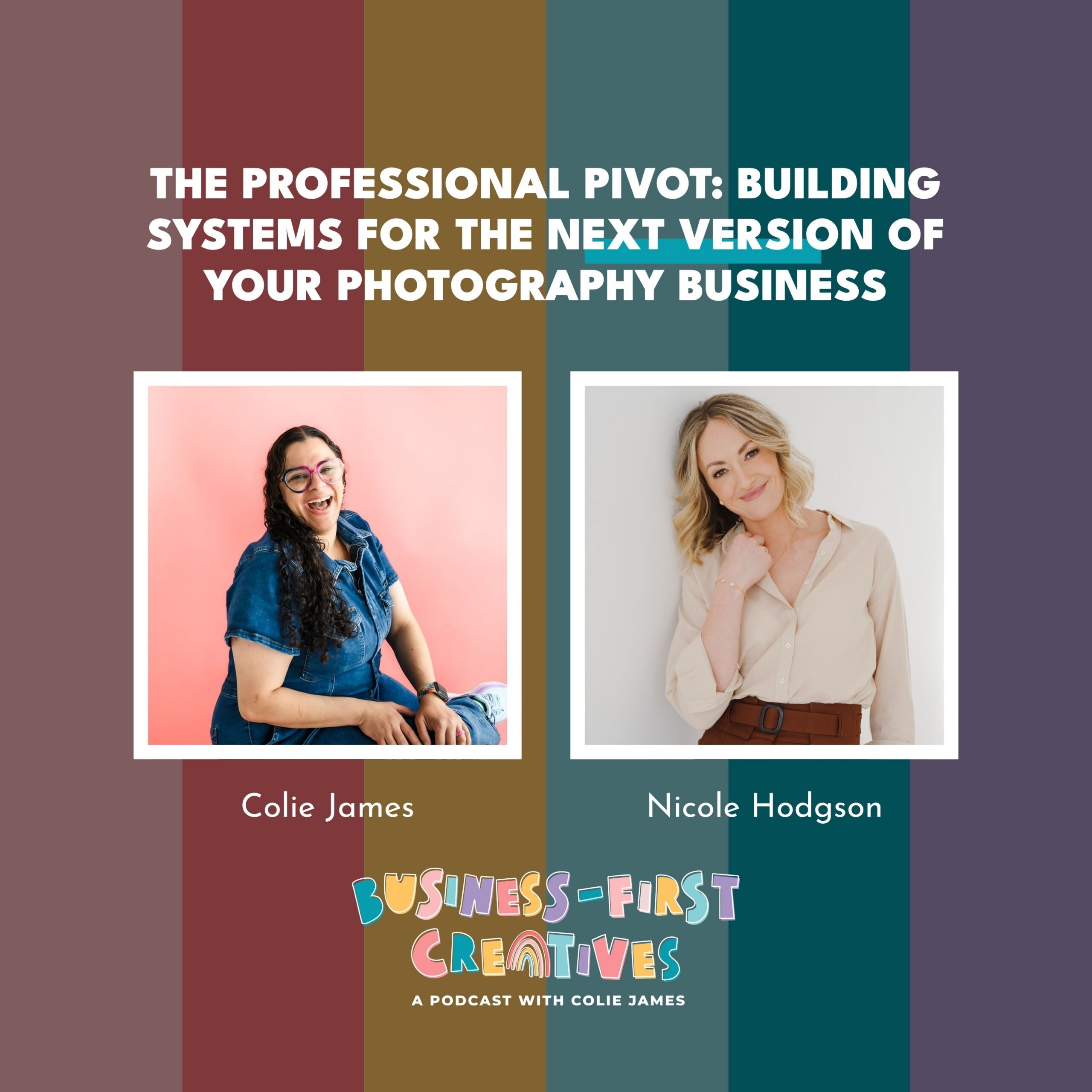



What if the business that worked for you a few years ago isn’t the business that fits your life anymore? In this episode, I’m sitting down with my longtime client Nicole Hodgson to talk about what it actually looks like to evolve your business intentionally. Nicole has transitioned from therapist to family photographer to brand photographer—and through every iteration, she’s paid attention to what works for her brain, her family, and the business she wants to build.
We get into why Nicole moved from Dubsado to HoneyBook, why getting your systems in place before your business gets busy matters, and what changed when she transitioned from family photography to branding and commercial work. But this conversation became about so much more than systems.
Nicole and I talk about the connection between your systems, visual brand, positioning, and the way clients perceive your professionalism. We also dig into visibility, pricing, mindset, and why likes and engagement aren’t necessarily the metrics that tell you whether your marketing is working. Nicole also shares how her previous career as a therapist influenced Content Therapy, her program designed to help women understand what’s really getting in the way of showing up as the face of their businesses.
Review the Transcript
Colie: Hey, y’all. Welcome back. So you may or may not know, I have actually had, like, a really good string of meeting my clients in person, even when they don’t live here in the Denver metro area. Um, I was lucky enough to take five of my clients to Snooze for brunch in the last, I would say, two and a half months.
But then, when I went to the Rebrand Retreat for Maddy Pyshonn’s program up in South Dakota in early August, I got to meet so many more of my actual clients as well as the people that I coach inside of Maddy’s program. And my guest today happens to be both. Now, also oddly, she has my real name, guys. So at the retreat, when people kept saying Nicole, I kept turning around and saying, “What?”
And people thought it was really weird, and I’m like: No, you know my name is not Colie. Like, my name is Nicole, but that’s very common, blah, blah, blah. So, I mean, we also share a name. So Nicole, welcome to Business First Creatives.
Nicole: Oh, um, Colie, I am just learning that that is your real name. I didn’t catch on to that at the retreat apparently.
Colie: it’s okay. I mean, yeah, my name is very common, and so when I launched my photography business, I could not possibly launch a business with that name because all of the URLs are taken and, like, you know. So I mean, it was a whole thing. I wanted to launch my business with Chloe’s name. I was originally gonna call it Chloe Reece Photography, and at that time, people discouraged me from doing it because they were like, “No, if you have more children, they’re gonna feel slighted.”
And I was like, “No, you don’t understand. I’m not having more children.” Like, she survived. You have no idea how hard that pregnancy was, getting pregnant, all of it. Like, there will be no more children. And people were like, “You never know.” And I’m like, “No.” I’m like, “Unless I have an oops baby,” which we did hold out for a little while to see if we’d have one of those.
But I am very grateful that even though I didn’t agree with their reasoning, that I didn’t choose to name my business her, because now what happens is, when I’m in clients’ houses, or at least when I used to, the dads would call me Colie correctly until the mom asked me about Chloe. They would just be like, “Oh, and how’s Chloe?
Like, you posted on Instagram.” And then for the rest of the session, the dads would call me Chloe, and I didn’t correct them because it happened every single time. Except this one time, the mom started yelling at the husband, “Her name is Colie!” And he was like, “That’s what I said.” And he looked at me, and I was like, “No, y-you called me Colie, but it’s okay.”
Or, “You called me Chloe.” See, I didn’t realize my mistake until a few weeks after she was born. My father-in-law met her for the first time, and he messed up our names, and I was like, “Oh my God, what have I done? It’s too late to change her name,” ’cause we already had birth certificates and everything, and I was like,
Nicole: Oh my gosh. “Oh, my gosh. Yeah, I didn’t even think of that either, but
Colie: Well, and it’s like when people call me Colie, I’m like, “No, I am not a dog. That is not my name. It is Colie, like a nickname for Nicole.” So see, now you know we
have the same name
Nicole: Oh, well, that makes me like you even more.
Colie: Oh. Oh, you love me. Come on.
Nicole: Yeah, I, yeah.
Colie: I mean, clearly you keep coming back for
more, so you love me. Actually, let’s start there.
So Nicole is a longtime client, in multiple things that I have offered, and she’s one of the very few people who has done my previous course blueprint in both a Dubsado and a HoneyBook version.
So the first thing that I wanna talk to you about is that transition, because I feel like you went to HoneyBook before HoneyBook was, like, the cool kid on the block. Like, I think we all know I used to really hate HoneyBook. Like, it had some missing features. And even this week, Nicole, one of the HoneyBook, specialists posted on Threads that said, you know, “We can finally mark clients as booked in HoneyBook.”
And I just had to roll my eyes ’cause what do you mean you can just now do this? Like… But clearly you bought a course from me, so I changed my mind at one point. But what kind of pushed you to transition from Dubsado over to HoneyBook when you did that? I mean, it’s been a couple years now.
Nicole: Yeah. Well, a little about me. I am a queen of pivots, and I am continually looking for the thing that I feel fits my brain and how I operate best. Um, the problem that I was having with Dubsado is it felt so clunky to me. Like, it felt like whenever I was in there, like nothing ran fast enough, and I felt like I had to like go back to get to where I wanted to go constantly.
And, just even… I mean, I’m having to think back to like the, ‘
Colie: Cause it’s been a long
time, I get it.
Nicole: exactly. I have the platform is now like in my mind when I was on it, and it just didn’t make sense for my brain. I think more and more being a business owner and learning how I operate best, you really… I ha- you have to try things out in trial and see like what fits for how your brain works.
And w- I just found in HoneyBook, it just flows a little bit easier for me. I, I just find like it seems a little more intuitive, not clunky. So that was like what drew me, to HoneyBook
Colie: And I personally don’t know, were you in HoneyBook for a significant amount of time before I started selling the course for HoneyBook? Like, had you tried to do it on your own? Like, I don’t know when you made that transi- that transition. I just know that you contacted me one day and you were like, “Hey, Colie, like I wanna buy the HoneyBook course.”
And I was like, “Girl, I will just switch you on the back end. Like, like just, just give me a minute and I will just go give you the new version.” but I don’t know like what you had tried to do in HoneyBook on your own before I gave you access to the course
Nicole: Okay, so now, like having to rack my brain. When I initially bought the Dubsado course, I was, um, so you know, I was a therapist before, and when I started my photography business, I didn’t know what a CRM was. I didn’t know how to set up all of the backend stuff in starting my business. So I bought the Dubsado course from you so that I could set everything up and learn how to do everything.
Once I learned how to do everything, I was like, “Okay, this makes sense.” So I just applied those same skills to setting up HoneyBook. But with the HoneyBook, like the 2.0 workflows, that was like, it– I, I think at this point also in my business, my business is running, right? Like I am booked out. I am busy. I don’t have like the time like I did when I was starting my business to sit down and figure everything out on my own.
You know, the time was like a luxury then, and now time is not a luxury. Time is important to me, and so that is why, I did want to first reach out just to see if I could like get the course to see if I could figure things out. But then that’s why I eventually just hired you for Systems in Session because I was like, “I wanna get this done, and I want someone to really walk me through it.”
And I’ll do it quickly, um, but I don’t wanna sit and, and fumble and figure things out on my own. Like that’s just wasted time to me at this point.
Colie: No, I get it. And that’s why the 30-day offer, ’cause you know, again, you’re very special, Nicole. You are only one of four people that have ever done the 30-day version, and two of you were– actually, three of you of the four were previous blueprint students. And so now that is like the stick that I measure it by.
It’s like, no, if you were in my course, I know that you have a good, foundation of your systems because the course was great. It’s just the course taught you what I thought everybody should do, and then once you get to a certain level of business, like you said, your brain works differently. You kind of have an idea that you want to like customize the way that it’s working, not be so cookie cutter.
And that’s usually when some of you guys are like, “Okay, like I don’t need a full overhaul, but like I wanna know how to make it better and like build on the things that I already got from you inside of the course.” Because the course was great. I mean, the course was good for what it was. I didn’t stop selling it because it wasn’t good.
I just transitioned my business. But, you know, all of us want this level of everything working as it should. And so I think it’s fascinating that that’s why you originally moved over to HoneyBook and then eventually why you joined Systems in Session.
Nicole: Yes. And another big pivot was that I transitioned from family photography to brand photography, and I had so many more touch points in my business. Discovery calls, planning calls, um, sending a lot more emails than I was with my family photography business. And that’s why I was like, “I need to really learn these workflows and have everything set up,” because there’s a– there’s things that you can miss, that with my family clients, it did not…
I, I felt like I had a good grasp of what I needed to do, and it was pretty simple. But brand and then commercial clients, it’s a lot more complex um, in terms of amount of communication that we are doing to plan a session.
Colie: I mean, do you think that that’s partially because I think everybody knows what to expect from a family session, particularly if you do portraits? I mean, I feel like I had a lot of educating to do with my clients because I didn’t shoot traditional portraits. I mean, I’m in your house. We are not talking about styling at all unless you tell me that your kid is gonna wear, like, their favorite pajamas for the whole session.
Like, I was very non-traditional in my sessions, but if you are a family portrait photographer, even if you tell me that you’re high touch and you offer this really awesome, you know, experience, I still think to myself, “Yeah, but it’s pretty self-explanatory sometimes.” Like, family photography is family photography.
So do you feel like you needed the additional touchpoints because brand photography just isn’t as understood?
Nicole: Uh, yes, especially I think in my market. What I notice where I am is that a lot of business owners, female business owners, had not ever even had brand photography, real true brand photography done. So I definitely, I noticed that with myself, and also because a lot of my family clients, they became reoccurring clients.
So yeah, initially, like for the, um, you know, initial newborn session or initial family session, there might be a lot more that’s going into it. But then when they’re repeat clients, it’s like they k- know, they know the game plan.
Colie: wash and
Nicole: yes, exactly. So, but with branding, there’s a lot more upfront than there was for any family session I was doing.
And then even for repeat sessions, there’s still like, y- you know their brand, you know the client, but there’s still a lot of planning that is going to be going into each one, and a lot of educating. So yes, I, um, definitely agree with that
Colie: So how difficult did you find transitioning from family photography into branding photography? And I don’t just mean for your systems, I mean for you yourself as a business owner. Like, what was that transition like? And the reason that I’m asking you, Nicole, is I feel like family photography often has a clock, even though a lot of people don’t wanna admit it.
I feel like family photography and wedding photography, like most of the people that I’ve worked with eventually get tired of, you know, sessions that are happening on the weekend, sessions that are happening every night. And so a lot of photographers try to look for things to shoot that fit more in business hours, and family photography is not it.
So a lot of people that I work with are transitioning to like newborn photography because a lot of people are on paternal leave and like family leave, and the kids are home from school, and so you can do that during the day, as well as branding and commercial photography. So what was that transition like for you?
Nicole: Yes. , I had felt like the writing was beginning to be on the wall for, for some time. I have three young children who were going into preschool and then regular school, which it worked a lot photographing families when they were little because I could be with them during the day, and then, you know, my husband would come home, and I’d say, “See ya,” and it felt like a break.
Um, and I really have enjoyed the families that I have met. Um, but I… Like, as they were getting into school, I felt like, well, then they were gone during the day, and then, yeah, they would come home, and then I would say bye, and then I’m like, “Well, I’m not even seeing them.” And then they were starting sports in…
I could already see my son is obsessed with all sports, so we already know what’s, what’s gonna be happening. And then I had some family clients that were starting businesses and were asking me to photograph their businesses, and I have put it off a little bit because I’ve started to understand that true branding photography is not just, like, show up like a family session and just photograph them with their laptop and a black blazer.
But that is, like, what I was seeing, or that’s what, like, in my head, what I was thinking. And I had heard Matty Peschong on a podcast episode, and I just immediately bought her course, Behind The Shot, and then ended up photographing, a session. Someone reached out to me via DMs and was like, “Kit, are you doing branding photography?
I have this business I’m starting.” And I loved it because I felt like I got to go through her course and then apply everything, and I was like, I really think this works more for, again, back to my brain, I love strategy. I love planning. I’m very organized, and that’s a lot of what brand photography is. I really learned, um, I eventually ended up joining Rebrand, which is Matty Peschong’s, branding, group program.
what I have, like, learned is branding is really learning how to market someone else’s business. Like, and, and really understanding and helping them to, like, build out their personal brand. I really love working with female solopreneurs because they are their business. They are the face of their business, how they think, how they engage with their clients, what the product that they make or the service that they provide, like that is all, it’s all them.
So I have found that, um, I just really, I really enjoy it. I love that it’s during work hours. I love that it’s like strategy. I love that I can, like, give them this folder of images that they can use to, like, grow their business. I will say that the transition was difficult in that you are just, like, starting over from scratch with marketing, and it’s the way that you market is very, very different And that was not something I initially expected when I was making that pivot
Colie: I mean, but you already mentioned that you had family clients that were basically asking you to do that. And one of the things that I find so interesting, ’cause you know me, I scream from the rooftops, if you’re low on money, if you need bookings, go back to your previous clients. The same thing is true when you start offering something new.
If there is anyone in your existing audience, particularly someone who’s paid you American dollars before, they should be the first people that you reach out to to tell them that you have this new offer, because they are always going to be the people most likely to tell you yes, because they’ve already experienced what you do, even if it was in another format.
Like, they trust you. And so that should always be who you go to first. But I feel like a lot of people miss that
Nicole: Oh, yeah, I agree with you, and that’s where I started. I, um, also did model calls where I did talk to and ask people that I had photographed their families that I knew had their own businesses so that I could experiment and try and, and just get portfolio, imagery. But a lot of my initial clients had come from either people that I knew through maybe I had paid for like swim lessons through that person.
People like through like family friends. those were all my initial clients. So that was really helpful to get the ball rolling. It was more learning how to market myself differently. I, I’m, I really do think in what I have learned now because I feel like I could market a family photography business so much better than I was.
And I, I don’t think I was doing anything wrong, but I think family photographers, I’m gonna speak in like general and, and I would say a lot of photographers in general, uh, when we’re on say Instagram, it’s a very visual– It’s a visual platform, and we think that our images will speak for themselves and sell themselves.
So we don’t really know how to position ourselves. We just think we’re gonna share our work, and we’re gonna say like, “Oh, this session was so fun,” and then other- they’re gonna re-share it, and then people are gonna book with us. But I don’t– I think that might have worked a f- you know, maybe back in the Facebook days, but now like things are shifting so much that you do have to position yourself, especially if you wanna charge
Colie: Premium
Nicole: premium prices.
And I don’t think a lot– Like I’ve now learned how to position myself, and I did not know how to really do that when I was running a family photography business. I was just really grateful that I’ve always invested in education, and so even when I was raising my prices, it wasn’t like this extreme for maybe some of my current clients, and I also, I started a family photography membership program, and that was like the best thing I ever could have done because it gave me reoccurring revenue and
families that I– Repeat revenue.
and families that I could continue to work with that I didn’t have to continue to market to those families.
And I still have it, and I– So I have recurring revenue, and I still do photograph families, but I don’t market them at all. Like I, I do in my emails ’cause I still have a lot of family clients that are on my email list. Um, and that’s all I have to do. And it’s been really nice to just be able to focus on branding and marketing branding and like, um, building up connections and stuff through, through that
Colie: I mean, but that’s the dream. And it’s funny that you mention that because I don’t think you were on the call. Were you on Matty’s webinar last week?
Nicole: Mm-mm,
no
Colie: So actually all of us rebrand coaches came on the call and she actually talked about you, so you should ask to see your slides. It was fabulous. I was like, “Ooh, I’m gonna use that when I talk to Nicole next week.”
But one of the things that, uh, somebody in the audience asked her was about marketing and what to do if you’re still shooting multiple things. And one of the things that Matty really tried to emphasize is it’s fine if you shoot it, but not everything needs to be front and center in your marketing. And that’s something that I always tell people with the systems.
If you are lucky enough to have systems in place that y- that, you know, invite your clients to give you, I know guys, here come the three Rs: rave reviews, referrals, and repeat business. That is how you grow without spending more and more time marketing your business. Because in your third, in your fourth, in your fifth year, if you are retaining a certain number of your clients every year in addition to getting new clients, that’s how you end up with like a calendar that’s 70% full of repeat clients and the amount of time that you need to spend to market is significantly less.
And one of the things that I’m gonna bring up now, because you and I are in the same age bracket, if you’ve had a good steady amount of clients from the beginning of your career to like now, like for me, I mean, you know, I started my business in 2012, eventually your clients and their children will outgrow you if you stay in business long enough.
And so you do really need to still have the skills to market to new people. I mean, if you’re a newborn client, it’s like you market to get the newborns and then you keep everybody as a family client and that is what you do on repeat year after year. But I just thi- I just feel like these are things that people don’t think about when they build businesses or in your case, when they decide to make a pivot
Nicole: Mm-hmm. Yes, I, I would agree. I, I also f- you know, when I started my business, I had a, a two-year-old and a… well, actually three-year-old and one-year-old, I would say, when I officially started, and then we got pregnant again. So I was in that phase of also, a lot of our friends had young children, a lot of our friends were having children, a lot of our friends knew people having babies.
It was like word of mouth was very strong. It spread. I’m out of that now. Our youngest is turning four next month, and so, yes, like through preschool or through school, we still meet people. But I, I’ve also noticed, I think p- I think families, I would say myself as a photographer, like I wanna get my family photographed every year.
Like I, that’s just important to me. But for a lot of people, I think they hit this age where they start also phasing out of photos. Like I just, you just see it. Like, okay, maybe not every year, maybe every other year, maybe every
Colie: in that year. Yeah,
we’re in that phase. But I mean, I only have the one, and now she’s 16.
Nicole: Yeah.
Colie: it’s not from a lack of effort. I mean, I don’t know that you know this, I actually hired someone, or I guess I tried to hire someone last year to photograph us at Disneyland for Colie’s birthday, and then she canceled on me the week before, and I couldn’t hire anybody else.
So we are getting photos soon.
Nicole: Aw
Colie: But like, this is our first time getting photos in almost five, four years.
Nicole: Yeah. Yeah. Yeah
Colie: Um, so I mean, I get it. I– And it’s funny because when you look at my wall, um, I knew that I needed photos really soon because I was talking to one of my Systems in Session clients, and I just asked her, I said, “You know, I normally don’t ask people this, but are you planning to have children?”
I had no idea she had a 15-year-old and a 13-year-old. And I just looked at her and I’m like, “How have we not had this conversation when we have children that are the exact same age?” And her jaw dropped, and she was like, “Colie’s fif- Colie’s 15?” I mean, and now she’s 16. I was like, “Yeah.” I was like, “I’m sorry, these are really old photos on my wall.”
And she was like, “I had no idea.” And I was like, “Okay, I need a new picture of my child on my wall so that people don’t think that she is still in elementary school,” ’cause we are definitely not in that phase
anymore.
Nicole: My gosh, yeah. That, that’s what I would hear from family. So I, I kind of saw, like when I say the writing on the wall, I am someone that… I can remember even when I was in a therapy job and our, you know, my, my boss was like, “What questions do you have for me?” And I’m like, “Where do you see, where do you see this in 10 years?”
I am always thinking like, where, where is this business going to be in five years, in 10 years? What, who are we? Like, what are we competing with? Like, what, how sustainable is this thing? And, and that’s why I’m always like, I say I’m like a constant p- I’m the queen of pivots, but more so, and, and my husband used to make fun of me because I had, I changed jobs, like, but I was always looking to like gain skills and move up and find out something that could work best for the season of life that I was in, or how my brain works, or like, how can I serve better?
So I’m always thinking like, what is… And I really, I do think personal branding is, is a really big thing because I do think a lot of women, especially women that have children, um, I’ve seen this, they’re leaving corporate jobs. It doesn’t work anymore. Like, maybe what they believed the, the, you know, I go to college, I get the job, I have the, I get married, I have the children, and everything will be fulfilled for me.
I felt the same way, but then I had kids, I’m like, “This isn’t gonna work,” you know? So I j- completely pivoted, and I think a lot of women are having that like awakening moment as well. Like, “I have some skills, I’d like more time back.” And I think they’re starting their own businesses. And then, but it takes a different skill set, and you have to learn to market your business on top of building a business.
It’s a lot, but I think having like visuals that represent you helps your business grow in a professional and trustworthy way. ‘Cause people can immediately look at it and see, “Okay, this person’s taking this seriously. This is someone that clearly…” Why, why are you
Colie: I’m sorry. I am listening to you, Nicola, and this is the first time that I’ve ever realized how strategic and aligned brand photos are with systems. Like, I’m listening to you, and I’m like, if I just replaced the word visual, like, I didn’t even know what you said. What– ‘Cause I was like, “Oh my God.” Like, if I just replaced what you said in terms of brand images with systems, that is exactly how I feel.
And when you said they wanna be seen as a professional, like, that is what I tell all of the people that I’m like, “No, you need systems.” Yes, it is possible if you are really organized and you have, like, a good paper checklist. Is it possible to run your business like that? Absolutely. There are many people that are making six figures in their business that don’t need a CRM and don’t need systems, or they’re managing them all on their own.
But the question is, how do you want to be seen to others? I don’t think it’s very professional for you to ask somebody to pay you on Venmo. I don’t think it’s very professional if you’re asking them to sign a contract in a Google Doc, and you can’t convince me otherwise. But, like, that is exactly what brand photos is.
It presents you as the professional. It helps you tell your brand st- I mean, my God, I’ve never thought about it like that
Nicole: Yes, but it, but it is. I think that’s the core of if you wanna res- if you want to run a sustainable business for growth, like, you have to have sy- systems. I think you have to have some, um, visual branding, your messaging and positioning and marketing. Like, they all work together because you want time back.
You didn’t quit a job to work… I mean, we… You know, that is the joke, that you quit a 9:00 to 5:00 to work 24/7.
Colie: You know that’s on my website.
Nicole: But that’s not what you wanna do. And, and so you in- Like, and, and you get smart enough that you learn that you, you do need to invest in things to get time and money back. Like, and, uh, there’s so many people that, like, it makes me kind of laugh that they are like, “I, I don’t have the budget for that.
I don’t have the budget for that. I don’t have the budget for that.” Where do you… What do you wanna do? Where do you wanna grow? Like, how do you envision this all happening for you? Because you’re gonna be spinning your wheels out. Like, I, I just learned very early that if I want to grow, I need to educate myself.
I might need to invest in things. But it’s returned for me, like, exponentially because it got me everywhere faster, and it’s given me a lot of time back
Colie: Yeah. I, I just wanna be clear that everybody listening to us understands, and Nicole even said when she first met me, she was in a DIY state of mind. There is actually nothing
wrong
Nicole: No
Colie: doing it yourself and, like, seeking resources that help you do it. There is always a stage of business where, to me, that is appropriate.
Maybe you are trying to see if this is going to be the business for you. Maybe you do need to grow slow because you don’t have the capital to invest or the time or those kinds of things. But I think eventually, like you said, all of us need to figure out, is this going to be the business that pays you the salary that you want or is it just a hobby?
And I, I’ve done a lot of research based on, you know, other people and my particular clients, and I have always found that, like, year three is a huge milestone for a business owner almost in any industry, but particularly for photographers. I feel like in year three is when you finally figure out, “Okay, like, I’ve been doing this.
I’ve been making pocket money. I’ve been paying maybe for our annual vacation. I’ve been, you know, playing it small.” But if you don’t, like, invest in systems and a good brand and these kinds of things, um, you are not going to be able to grow your business to what it is that you want. And again, that is not everyone’s vision.
But if that is your vision, eventually you are going to need to invest in some big girl things.
Nicole: Mm-hmm. Yes, and I, and I think that sometimes I, I think that everyone’s goals are like, that they might be similar to mine. That I just…
Colie: That’s a definite mistake, Nicole. Not everybo- not everybody is, is as ambitious as us, I will say that. Like, you do have to, you do have to think about that. And when people come to me and they’re like, “Oh, but Colie, like, I don’t really have a lot of clients right now. I don’t think that systems make sense to me, to me at this point.”
I’m always like, “Okay, but where do you wanna be in two years, in three years?” Like, it’s fine if you just want to have a part-time business. And it’s funny, I am going to link Jess Hoffman’s, um, podcast episode in the show notes, because she has a full-time job, and she has no intention of letting her photography be her main job.
But she is someone who really valued the systems because she knew that if she was gonna do it on the side, she didn’t have the time to invest, like I said, to like do everything manually. And so, you know, everybody needs different things. And I think that one of the things that we should say is that what you need today might not be what you need in six months.
It might not be what you need in one year. So, you either have to reevaluate your business and your plans on a quarterly and annual basis. Or if you are like Nicole and you’re already thinking, “Well, in five years this is what I want, and so what do I need to do in order to get there?” Hey, bravo. If you’re listening to this, I wanna chat with you, ’cause I definitely want more Nicoles inside of my client roster.
Nicole: Oh my gosh. Yeah, I think I just like, it is just the natural part of me to like see potential in people. Like, I can look and I’m just like, “Ah, there’s like so much there.” But I, what I notice too, and I wanna point this out, is, um, what you were talking about was like if I don’t have a lot of clients.
And what I’ve found is that once you get really rolling, it’s really, like, it is hard… Like, I always vision it as like you’re in a car and your car is going fast, and you’re like on this road. It’s really hard to like stop your car and be like, “Okay, now I’m going to do all this stuff,” and like put all this stuff into place when things are, like, busy and rolling.
I just have found that when you can try your best to like do, set it, plan for it or set it up as best you can, because things are gonna evolve and change. That’s very normal in a business. Like, my workflows when I started, they changed so much as I did more sessions and I realized, “Actually, I don’t wanna do that there.
I’d rather do that there.” You know? Like, that’s just what’s gonna happen. But having, like, that foundation, it just is easier to build things on top of it. S- more sustainable
Colie: The one thing that you have that other people don’t have, Nicole, is you’re thinking about it from a marketing perspective. And I always say, if you have time to shake your ass on Instagram, you have time to stop and build some systems real fast. And the reason that I try to put it that way is if you’re on Instagram showing up in your stories every day and your intention is not to do it for fun, your actual intention is to get leads and clients from social media, what are you gonna do when it works?
Like, I don’t think people think about that. Like, you want more clients, but when you get them, do you already have a plan to, like, manage their experience? Do you know what it is that you want to do? If 10 people inquired in your business tomorrow and all 10 said yes, would you be able to handle that? Or are you just praying that, “No.
Well, it’s fine ’cause, like, only two of them will say yes”? Like, that’s not a very smart way to approach it
Nicole: Yeah. Yeah. That it, it, yes, and I don’t think, um, I, I don’t think that makes it, it… I think for me, even thinking back, like those are the things that didn’t make sense while I was trying to build and get referrals and, and do those things. I was m- um, more just happy that I, I did have something in place to start.
A- and I can remember like just starting out and, and it was a friend of mine, and I had sent her things from Dubsado, and she said, like I’ll always remember this, she’s like, “Wow, this feels so professional.”
Colie: professional.
Yes
Nicole: like, “I’ve never had anything like this.” And I was like, “Okay, good.” Like that is, you know, the- I think what I have realized a- about myself as well, a- and I’m, I’m also trying to reckon with this, because I always wanna put like a professional front out there.
Like especially starting something new, I, I didn’t wanna be perceived as like I didn’t know what I was doing, even though, you know, I was definitely still learning. But I thought if I can do all these things and have all my systems in place and have a, a website through Showit and, and invest like in those things that I knew were gonna like return big in the long run, like SEO and starting an Instagram page and just starting posting, like those things pay off and like you just set them up, they evolve, but you are putting the best professional front forward, and people feel that, and that’s what they’re gonna tell people.
Like, “Oh yeah, you wanna work with her. She’ll take care of you. Like she knows what she’s doing.
Colie: She was so professional.
I feel like, you know what? That is gonna be the title of this episode. Don’t you wanna be a professional? I mean, seriously. I feel like I say that over and over again, but I also wanna point out, Nicole, you and I think about this very differently. We are willing to invest, and whether that is money or time, it’s either one.
But we are willing to invest knowing that it is not an instant return on investment. I feel like now, when people are posting on Instagram or wherever it is that they’re doing on social media, they are mistaking likes for actually doing something for your business. But it feels like it’s an instant return on your effort, even if it isn’t an actual return in your bank account or leads that are coming into your business or people who are actually booking.
You can see something rather than, like you mentioned, having a good website and having SEO. That’s definitely a long game. We’re talking about, like, six months to a year before you start seeing an increase in traffic to where you maybe think that paying that person to write those blog posts was worth it.
It’s definitely not, “Oh my God, 100 new people landed on my blog post last week. Woo-hoo
Nicole: Yes. Uh, yes. I think for me, when I came from doing– working for somebody else and, and doing a therapy job, when you have someone that basically tells you, like, “These are all the things you need to do,” and you go and you clock into work every day, and you do your things, and then you leave. When you start your own business, and then you’re in charge of of all the things, and Instagram to me always felt like, “Look, I’m working.
Like, I’m here, I’m doing– like, I’m showing up.” That’s what it felt like I was clocking in. I have definitely learned that, to not really… Vanity likes and, like, yes, I look at metrics in the sense of, like, things that perform well, like what does my audience seem to like? But I have just learned that, um, it’s a long game, and that’s why I, I mean, I’ve posted every day for over a year, daily posting, because, one, I just had to, like, get out of my own head and, and get out of the overwhelm that I felt from, like, being visible.
But I have just learned, like, everything is a long game. Like, where do I wanna be next year? I just put in the work daily right now, and I don’t overthink it, and I ju- And, and that’s with Instagram too. Like, I could get three likes on something, and I don’t care anymore. But, like, you know, I, I think I was telling you that I’m running this program, Content Therapy, and I’m sending out emails, and I’m marketing for it, and, like, almost booked out the program.
And you’ll look, like, my engagement has dropped significantly from launching something and, um, that’s what, uh, in talking with Maddie, she told me that likely that does happen. And it’s like, “Eh, okay, well, the, the actual evidence is, like, I have nine out of 10
Colie: You have nine out of 10 spots. Yeah, can– I’m sorry, can we just say that one more
time? You have nine out of 10 spots
booked. I mean, that is amazing, and that is really a testament to you don’t need tons of eyeballs, you just need the right
ones
to land on your… I mean, ’cause it’s kind of funny. I was working with a launch coach.
Hi, Kelsey, if you’re listening to this. It took me months to convince her that I didn’t give a shit about being on Instagram. She kept pushing me to think more top of funnel, and finally, I had to just bring the evidence. I’m like, “No, out of the 30 people who have…” I mean, at this point it was 30 when, when I had this conversation.
I was like, “Out of the 30 people who have joined Systems in Session, all 30 of them listen to my podcast. All 30 of them have said that they hired me because of listening to me on the podcast.” They gave me a specific episode. And I was like, “That is where I need to invest my time, because regardless of all the other things that I’m doing, threads, writing emails, if that is the conversion tool that is working, I need to put my efforts there because I have shown that it has an ROI.”
And do I still need people? Like, yes, I need to find a way to get more listeners. Hi, everyone. But in general, like if that’s what’s bringing me the people, that is where I should be spending my marketing time. I do need to extend it to like some of these things that I’m not quite so happy doing. But I, I feel like that’s what you’ve been talking about with your content therapy is, you know, people need to feel comfortable with showing up.
And that’s ne- that’s never been my problem. I will get on and like grab a microphone and talk to anyone. That’s not why I don’t like being on social media. But, I was really excited to hear that you had started this program, and I was shocked when you told me that you had nine out of 10 spots booked because, I mean, it’s very rare that people launch their first group program and y- like, you know, almost meet their goal that very first beta run.
So congratulations to you.
Nicole: Thank you. Yes, launching something is a surreal experience.
Colie: Ha! That’s one way to put it.
Nicole: there are so many emotions that come up. Um, you know, will anyone even join this? will it do as well as I think? And then also when people do book, you’re like, “Oh my gosh, now like people
Colie: you gotta deliver
Nicole: gotta deliver.” But it’s exciting.
I, I, I think what I have found is like I, I have found that anything I’ve ever done in my life, I used to think like, “Oh, I spent 10 years as a therapist, and now I’m a photographer.” And it used to make me kind of sad like, “Oh, that doesn’t matter anymore.” And I’ve just realized that everything you’ve ever done, you just bring with you, and it just shapes the way that you deliver something.
And I don’t know why I felt like, oh, I pivoted, and then you just like close this door. And it’s like no, you’re, you’re a whole person. And so I’m really excited about this because of photographing female business owners, it’s a very vulnerable thing to sign up to be like, “I wanna be photographed.” A lot of women tell me like, “I’m not photogenic.
I don’t wanna do this, but I know I need to.” And then they are so pleasantly surprised by how enjoyable it is, and then seeing photographs of themselves and think like, “Oh my God, I… That’s me?” And then they have these photos, and then I see like okay, now the next hurdle is actually sharing them online or like what do I even say?
And so it’s like they went from like they’re da- doing these big things, but then that becomes the next big hurdle. And I, I think a lot of it is mindset. I think a lot of it is fears, avoidance of feelings, and I think they’re very contracting. And it keeps us very small, especially as women because I think…
You know, I don’t need to go into all the things, but we’re conditioned to be a certain way. And so I wanted this course to start off with more of addressing those underlying fears. This is not therapy. It’s not therapy.
Colie: And she actually has to say that, guys, since she was a licensed therapist. We were joking around. I know someone else who launched an offer and it had the word therapy in it, and they keep saying, you know, “I’m not a licensed therapist.” But Nicole actually was, so like really, this is not therapy.
Nicole: Yeah, no. But it is addressing and understanding and becoming more aware of the mind, like, those blocks that are in your way to showing up. What are you really afraid of? Who’s that person in your head every time you go to post or show up on stories that you’re afraid is going to see it? Like, if you share a real opinion, what are you afraid is going to happen to you?
It’s understanding how you feel, even selling, um, and getting to uncover that r- and, like, how you’re gonna position yourself, and then understanding, like, how are you actually building out your personal brand. But we wanna do all the mindset work first because I think a lot of courses that teach content, they don’t talk about that.
They’re just like, “Get over your fears. Okay, here are 10 hooks,” you know, and, “Here’s what you do.” Uh, but I feel like a lot of people, they’re like… I- yes, doing the thing does make it easier, but I think the awareness of, like, what is actually going on can help to shift you and, like, shift your identity faster to build that foundation to then begin to show up very intentionally.
Um, and not just on Instagram. I want it to just be as the face of your business, but I feel like Instagram, to me, is like a playground. Like, I just love it because I don’t care that much anymore. I used to care so much, and now it’s like, it’s just a playground to me. You can just… It’s all data. It’s to test
Colie: storytelling.
Dan, yes,
Nicole: It’s like, yeah
Colie: I had to write, I had to scribble. I’m, I, I apologize, Nicole. It probably looked like I wasn’t paying attention to you, but I literally was like, “Oh my God, I cannot lose this thought.” Okay, first of all, I want to give a shout-out to Meg Yelaney, who was on the podcast on episode 334,
and she talked about your origin story being your superpower.
And so I wanna bring that up specifically because everything that you just said is amplified in her episode. Because, you know, it’s like what we bring with us impacts what we do now as a business owner, even if we think they aren’t related. So in that episode, we talked a lot about me being a professor and, like, think about the way that I run systems
Nicole: Yes
Colie: It took me a hot minute to realize it, but literally you guys are my students, even though it’s not a course. Y- I’m telling you what to do. You go do it, you bring it back to me, I give you a grade, and then we do it over again. Like lit- that impacted the, the offer that I now have that I am so proud of. I also wanna mention, you said something about implementation, and it’s really interesting to hear you talk about this from the perspective of coaching, like, women at large to take the brand photos and, you know, the other things that they’ve gotten and actually implement them for their business.
Because you know me as a system strategist, I am always yelling at s- specifically brand photographers, “You guys should be charging for your expertise in helping them implement the storytelling images that you have given them.” And so everyone listening, if you are a brand photographer and you do not have an add-on implementation session where you will help them take the photos and specifically help them create content, help them create, you know, messaging.
Even if you don’t feel like you are a copywriter, you still have a skill because you took the photos with intent and making sure that they actually get online. It could be as simple as helping them pick their image for LinkedIn. I know some people do it, some, you know, other people don’t. The people who are doing it now, like if you’re picking one image, that’s great.
It could be a nice little bonus, but also it’s something that you could get paid for. I just wanna put that out there. And the last thing that I wanna mention, because you, you said it, like, and I wanna make sure that we don’t gloss this over, is mindset
Nicole: Mm-hmm.
Colie: I feel like as a business owner, every single skill that you are, you are learning takes a certain level of mindset first.
And it’s funny because since you were in Systems Session, I actually take a different approach, and it’s partially due to what we did together at the rebrand retreat. Did you know that now everyone who comes into my offers, no matter which one it is, we’re looking and evaluating your offer so that you can feel confident selling it, so that we make sure that it has all the pieces that it needs?
So I took that thing that we did together at the retreat, and I made it part of my framework, because when you know that you have a good offer and you can confidently show up and sell it and then create systems that help you manage it, like all of that comes full circle, and that is how you build a business that you’re proud of.
And everything that you said said that so succinctly about mindset.
Nicole: Mm-hmm. I have truly learned the mindset I think is so big in entrepreneurship. Like, you will be challenged. You will be, you, uh,
Colie: will be stomped into the ground. I mean, yes.
Nicole: But it, it really is, like identity and identity work has been really big for me this year because I think you can only… Like, you have, like I have levels that I wanna achieve and reach towards, right? But you have to be able to like embody and hold that, and that requires expansion. And if you are constricted, like you can only go up so much.
Like you have to be able to like expand because it doesn’t mean like that getting to that level means like problems disappear. Like usually when you make more money, like sometimes or, or take
Colie: New problems appear.
Yes
Nicole: appear. Like, and so like boundaries,
Colie: It’s not puppies and rainbows
once you hit six figures.
Nicole: no.
Colie: You still have, like, an ego. Like, one of the things that I find so fascinating that I, I, I literally coach my clients through it, and, you know, I’m not a therapist, so that’s not where this
is
coming from. But every time we have a discussion of raising prices, I’m like, “No, your work is beautiful.
Check. Your offer is well-aligned. Check. You have systems to handle them when they say yes. Check.” But that last piece, I have to make my clients promise me, when we raise these prices, you cannot turn around and hide under a rock if the first three people tell you no. And so, I mean, I always have to tell them, “Someone will say yes.”
It might not be next week. It might not be with the first three, five inquiries that you get. But once you get that first yes, it is like an infusion of confidence, and then you know if one person will pay it, more people will pay it. And that’s why I don’t think anyone should wait until the end of a year to raise your prices.
Because we, as photographers… Well, maybe not brand photographers, maybe not y’all, but, like, the family photographers, things are always slow in winter, and it never makes sense to me that people raise their price in winter. Because you’re gonna get a lot of nos anyways. But then when you get the nos, you’re like, “Oh, I’m too expensive.”
No. So when you get 70% booked in fall, that is when you should raise your prices so that people are still actively looking for what you are delivering.
You have a better chance of people saying yes than if you’re waiting until dead of winter, and then, you know, you think you put forth all this effort to raise your prices, and that you’re never gonna find anybody to pay them, and that’s just not true.
Nicole: Yeah. No, that is so true. I think that the pricing thing, what I notice with so many women is, i- is like, I think I always say like, “What number could you say out loud that like doesn’t make you wanna throw up?” Because you have to be able to say it out loud, and there’s, if there’s like this, the part of you that can’t hold that number, yes, if you cannot just say the number, period, it’s like you have to really practice it.
Like when we were at the Rebrand Retreat, we were talking with another brand photographer and, um, I think it was Amber, was like, “I did this with another photographer where I would just say like, ‘You’re gonna just repeat the sentence. Like, my signature brand session is this much, is this much. And every time I see you, I’m just gonna point and you’re gonna say it to me.’
And we just kept doing it, and kept doing it, and kept doing it.” And it was, so this other photographer, she goes home, raises her rates, and books the next client
Colie: You know I was so proud because she did it because of the offer scorecard. So I’m gonna give you guys context without actually naming her because that would be rude.
She had recently raised her prices a little bit over $1,000, and that was a big move, right? But then we did the offer scorecard, and it told her that her offer should be $2,000.
So guys, she went from 1,200 to 2,000, and the first person that inquired paid her the $2,000 with absolutely no pushback. Now, that is like optimal. Like, you, you offer it to the first person and they say yes. That doesn’t… That, that’s like unicorns, guys. It’s like rainbows. It doesn’t really happen. But it happened for her, and she immediately told us inside of our retreat group, and I was just so proud of her, and I was also thinking to myself, “I’m so happy that it told her 2,000 and not something less.” Because think about it. I mean, that person just said yes, and now she raised her prices on her website. She is booking more people at a higher price point. I mean, all of that is so important, and it all comes down to mindset, implementation, and really feeling like you deserve to be a professional and kind of get the business that you’ve always dreamed of
Nicole: Mm-hmm. 100%. Yeah, I feel like that all, it all goes together and it, it works beautifully, and I think it just makes you, able to show up, like, a lot more proud to be the face of your brand. Because especially when it, it all aligns, it’s a, it is a very beautiful thing.
Colie: Yes! See? Okay. Nicole is like my twin, guys. So I wanna say, you know, she has nine out of 10 spots filled now. If you would like additional information, I am, of course, going to have her offer linked in the show notes, and she has told me that the next cohort, if I can call it a cohort, is going to be in January.
And so if you are someone who gets the photographs and you are not, like, an instant implementer like me… I mean, Nicole, I don’t know if you know this, but the last time I got my brand photos done, she gave them to me at 7:30 on a Friday night, and by 9:00 PM, I had my whole website redone. Like, every photo was a brand-new one.
Two sales pages, my About Me page, my homepage, all of it was redone. So, I mean, I am a brand photographer’s
dream
And of course, I’m sending her screenshots of everything as I’m
Nicole: Oh my gosh, gold stars all around, Colie.
Colie: Okay. Nicole, I feel like we’re gonna have something else to talk about. I don’t know what I’m gonna have you back on, but I, I f- I’m so happy that you hired me the first time and the second time, and that now, you know, we, we are friends.
And so I can’t wait to have you on next time, so we can talk about how Content Therapy is going and whatever the next iteration of your business is, because I know that there’s gonna be another one.
Nicole: I am sure there will be. , Thank you for having me on. It was so great to meet you in real life. I was like, “Colie, you’re like the exact same,” which is
Colie: The exact same, which is a testament to how I portray my brand online. Yes, I am the exact same. Yes.
Nicole: More gold stars for you, Colie.
Colie: All right, everyone. I hope that you have taken something valuable away from this conversation. And while I envisioned that this was gonna be like a case study of, “Ooh, look at Nicole. She’s worked with me multiple times.
Look how awesome she is,” uh, that’s not what we got. Like, we got so much more from this conversation. And so please do visit the, show notes for the other episodes that I told you were related. I feel like everybody should listen to this episode and, like, put forth what is the next iteration of your business?
Where do you want your business to be in three years, in five years, and even potentially 10? Okay. That’s it for this episode. See you next time
About the Guest
Nicole Hodgson is a brand photographer and studio owner based in Northern California. She spent a decade as a Licensed Marriage and Family Therapist working with children before picking up a camera during the pandemic. She left her career and started a family photography business before pivoting to brands in 2025. She now photographs female business owners who are the hidden gems of their industry, everyone loves them, and their online presence is mostly invisible. Her whole approach comes out of that first career: she’s less interested in posing people than in uncovering who they’re meant to become. In her free time you’ll find her with her husband and their three kids, traveling, attending sporting events and likely doing something active, usually outside.
Find It Quickly
00:23 – Meeting Clients IRL
03:46 – Switching to HoneyBook
06:24 – DIY to Done With You
09:05 – Family to Brand Pivot
15:11 – Marketing and Positioning Shift
18:49 – Repeat Clients and Systems
25:09 – Brand Photos Meet Systems
27:50 – DIY Stage vs Investing
29:15 – Systems For Future You
30:56 – Build Before You’re Busy
32:09 – Marketing That Actually Converts
33:08 – Professionalism Builds Trust
35:14 – Long Game Over Likes
39:54 – Content Therapy Launch Lessons
43:44 – Origin Story Superpower
46:54 – Mindset And Price Raises
Mentioned in this Episode
Even Part-Time Business Owners Need Systems for Efficiency with Jess Hoffman
Rebrand: maddiepeschong.com/rebrand
Your Origin Story Is Your Marketing Superpower: Here’s How to Tell It with Megan Yelaney
Connect with the Guest
Website: nicolehodgsonphotography.com
Instagram: instagram.com/nicolehodgson.photography
Content Therapy: nicolehodgson.myflodesk.com/contenttherapy


Signature Series


Your business works, but your backend is costing you.
A 4-Part Audio Series for service-based business owners who are ready to upgrade their “just fine” client experience, unlock higher pricing, increase referrals, and grow more sustainable revenue—without overworking behind the scenes.
Get the FREE 4-part audio training series
Systems That Sell


© 2022-2025 Colie James


