
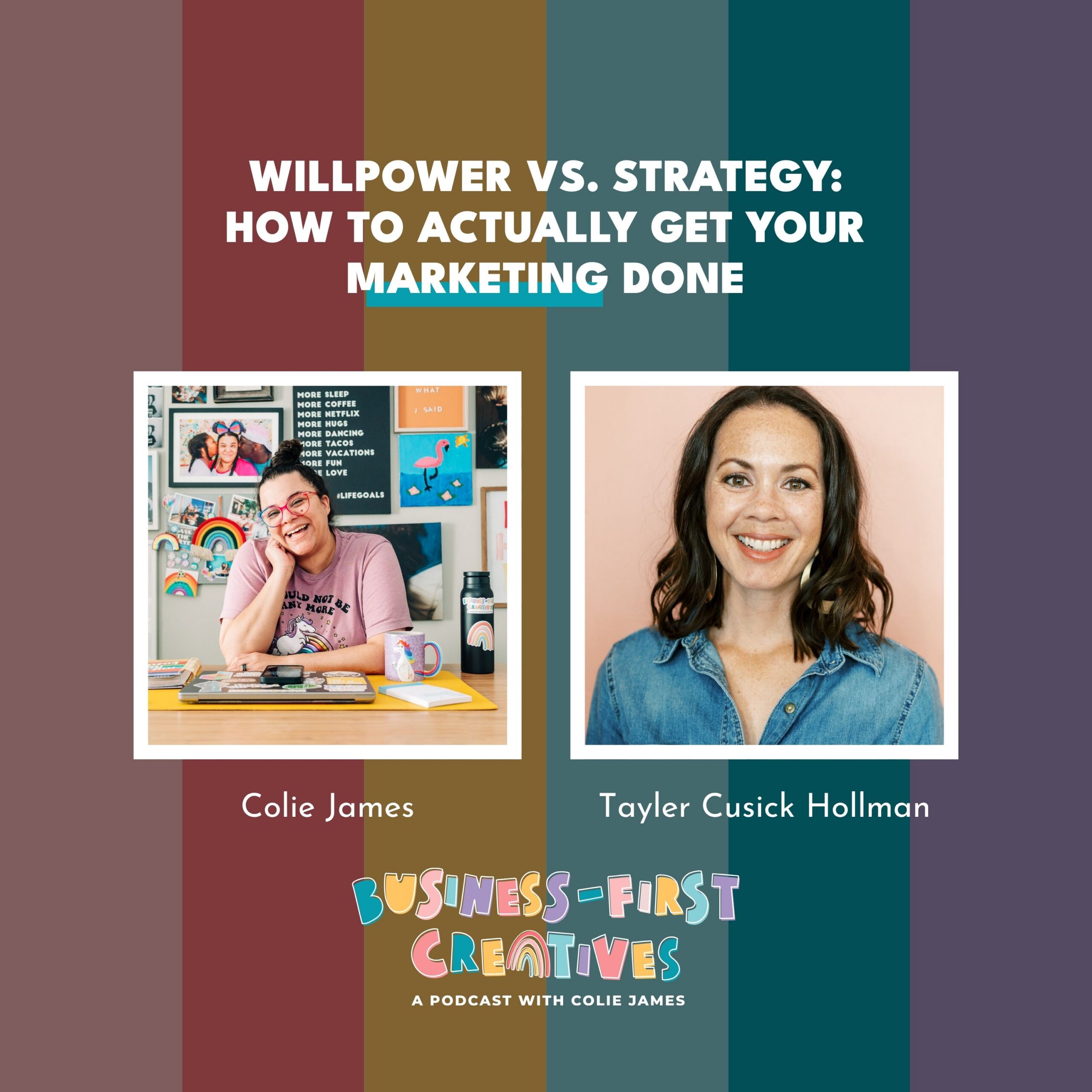




If you know you need to market your business but still find yourself staring blankly when someone asks what you actually did to market it this week, this episode is for you. Tayler Cusick Hollman is back on the podcast for a conversation about something that affects so many small business owners: we keep assuming we need more time, motivation, or willpower to finally become consistent with our marketing.
But what if willpower isn’t the problem? Tayler has spent more than a decade supporting small business owners with their marketing, and together we’re breaking down why collecting more marketing ideas isn’t the same thing as having a marketing strategy—and why knowing what to do means very little if you never actually do it.
We talk about creating a marketing plan based on your real goals and available time, becoming more biased toward action, and identifying the small steps that can actually move your business forward. We also get into the numbers behind your marketing, including customer acquisition cost, lifetime client value, and why your time absolutely counts as a marketing expense.
Plus, I’m sharing why documenting your marketing matters just as much as doing it. If something works but you have no idea what generated the lead or sale, it becomes pretty difficult to repeat that success.
Review the Transcript
Colie: Y’all, welcome back. So I have a repeat guest today. Her name is Taylor. She is awesome. Her previous episode is gonna be linked in the show notes. So when she said she wanted to come back on the podcast, my answer was an absolute yes.
I’m like, “Hey, what do you wanna talk about?” And then I literally tell them what my perspective on what they wanna talk about is to make sure that we’re going in the right direction. So I’m actually more excited about today’s topic, because I’m gonna let Taylor talk about marketing because that is her zone of genius, but boy, we are gonna get into the system side of the same thing also.
Because I cannot let this opportunity go past me without making sure that you are applying what we are talking about to all facets of your business. I know. You’re intrigued. Let’s get into it. Taylor, welcome back to the podcast
Tayler: Thank you so much for saying yes enthusiastically to my cold email where I just said, “Hey, um, can we book some time?”
Colie: Mm-hmm. And I was like, “I don’t even know why you did this.” It’s funny. Sometimes, like, I will say, I have a lot of clients that were in my best friend’s mastermind, and she did a mastermind after her original one. It was one for people who were getting into education. And I was sitting at my computer one day, and I opened up an email from one of my clients pitching to be on my podcast, and I was like, “Why, why would she do this?”
Like, I, I would just let her come on anytime. And then the next day, I got another pitch, and I was like, “Wait, what?” So I asked them, I was like, “Why are y’all pitching me like this?” They were like, “Oh, well, you know, Sabrina had, had recommended that we go on some podcasts.” And I was like, “Oh, okay.” So I sent an email to every one of my clients that I knew was in that, “Don’t pitch me.
Just text me, because you all have my phone number. Just text me and say you wanna come on the podcast.” Like, I don’t need a formal pitch where you guys are taking 10 minutes to write that shit out. If you wanna do it so that you can practice, hey. But otherwise, I, I don’t, I don’t need all that. The answer is yes.
Tayler: Yeah, ’cause you know them,
right? It’s not a… There’s, but that is very sweet that they wanted to go through the formal channels of putting themselves in, out there and asking for your
Colie: Taylor full email, like with, with bulleted possible topics. And I was just like… I was like, “Oh, some of these are really good.” I was like, “Okay, let’s talk about this one also, because if we talk about this one, then I get to talk about how I helped you set up your Dubsado system, so it’s a win-win.” But also, like, I don’t know, the pitch was just weird to me.
‘Cause most of the time I ignore pitches. I mean, I get the ones that are like, “This person made, you know, six figures in three months,” and I’m like, “Clearly you don’t listen to my podcast to know that I don’t give a shit about any of those kind of financial marketing, um, positioning that people use to get themselves on podcasts.”
Like, that’s, that’s not my thing. So no.
Tayler: Hard pass.
Colie: Hard pass
Tayler: plus that’s like one of the, for me, that’s one of the cringiest
things is like six, put six-figure or seven-figure in any sort of combination of words and I’m gonna tune out because the cynic in me is like, it’s not easy to get to those places, so please don’t make it sound like it’s easy, ’cause that just makes me feel like poo-poo and I don’t like that
Colie: All of that. All right, Taylor, let’s get into today’s topic because, you know, you and I could just have conversations forever, and I’m really excited to talk about willpower. That’s today’s topic, everyone, willpower. The willpower to do all of the things, but specifically, Taylor is here to talk about how this, uh, is related to the marketing in your business.
Now, we’re gonna make a couple of assumptions before we get into today’s topic. Number one, we are not gonna be convincing you that you need to market your business. We are assuming that each and every one of you listening to this podcast episode knows that you need to market your business in some way.
So we’re kind of skipping, like, that basic level of what is marketing, what can it do for your business, all of those things. And we really wanna talk to the person who knows they need to market, has the best of intentions, and still every month, if I asked you, “What did you do to market your business this week?”
Your answer would be, like, blank stare.
Tayler: An uncomfortable blank stare and one that, like, makes the, the person looking at your face know that you know you didn’t do… It’s like a tail, like a dog with a tail in between their legs, basically, right? Like, that’s, if that is you, then this is exactly who this conversation is for. Because, you know, I have been supporting small business owners with their marketing for 11 years now, which is not forever, but it ain’t, it ain’t two months.
So I have seen and heard all the things, and there is a shockingly high overlap with what I hear from people who don’t know each other. Like, y’all say the same things to me because as a marketing consultant and, and just as someone who I think feels, like, safe for people to admit their, like, deepest, darkest marketing like, “I didn’t do this” moments to,
Colie: Mm-hmm
Tayler: I mean, I’ve heard it over and over and over again. And one of the sort of really frustrating things for me to hear over and over again is what… And this isn’t something that actually is, is explicitly being said, but it’s what I am receiving as the pattern, is that a lot of people think that they just, like, need to try harder or have this, find this extra level of willpower that s- you know, they think exists in themselves that will somehow be this, like, magical pill that takes their color-coded to-do list and like, “If I just find a little bit more time, if I just…”
Fill in the blank, right, with whatever excuse you’ve said to yourself or actually to another person. Like, that is not actually going to help you because you’re already an extremely capable person. You already did the hardest thing and, like, started the damn business, right? And so you have a lot of willpower to push through hard things. So that’s not this missing sort of piece when it comes to actually completing some of these business tasks that y’all put off, and today’s conversation is just gonna be about the marketing one. I know y’all, like, probably put off your bookkeeping tasks maybe with even more enthusiasm than you put off your marketing tasks, but that is a whole nother conversation for a whole nother, um, expert to come in on. So yeah, I wanted to have a conversation with you about more of, like, the psychological shit that’s, like, swirling around in people’s heads that sometimes they won’t admit is the thing that keeps them from getting it done.
Colie: I mean, absolutely. But I just thought of something that we didn’t talk about before we hit record, but I realized the way that we consume knowledge is actually feeding into the problem. Because when you said that, “I just need more time,” and I told you what I hear and receive about systems all the time, I feel like people are consuming so much knowledge now, they think that hearing somebody tell you something that they did or a plan that they had, that you hearing it is therefore translated into your business as your current plan.
So, I mean, think about the Instagram gurus, girl. You know, you and I both hate them. But they’re all like, “Oh, you just need to post on Instagram three to five times a day.” Okay, but what are we posting? Like, that’s not a plan. That is an activity. That’s not a plan. And so I do think that when people are consuming knowledge off of a podcast, reading a blog, watching a YouTube video, whatever it is that they’re getting, that they think that that has then translated into a plan that they can take action on immediately if they just had time.
And again, like you said, these are people who are very capable business owners, but I think the part that’s missing is the translation. The translation between the activity that someone suggested to you and figuring out the strategy that will work for your business. So, like, where does strategy land into this conversation related to your marketing?
Because again, if you tell me to post on Instagram three to five times a day, I’m gonna be like, “Okay, but what the fuck am I supposed to post?” And I have a lot of ideas, I have a lot of content, but I still wouldn’t know, okay, but, like, what am I supposed to do?
Tayler: Yeah. You know, that whole, it’s like this curse of knowledge that gets wrapped, like people let themselves get wrapped up in. And so when it comes to creating an actual strategy, I mean, in the most simple terms, what we’re talking about is like deciding what you are and aren’t going to do in the direction of your goals, right?
Like, it doesn’t need to be any more complicated of a definition than that. And so when you are consuming gobs and gobs of marketing advice off of the internet, in your mind, you’re like, “I’m strategic as fuck, man. Like, I know everything about everything.” Right? But if all of that knowledge just stays locked up in your head because you are a procrastinator, because y- it’s rooted in perfectionism and overthinking things, right?
Like, then you actually don’t know anything. I mean, that’s really, this is… I guess the soft kids, the soft kid gloves are off for this episode. Let’s just, let’s just say it that way. And so when it comes to creating a strategy, really the most important thing is knowing what in the end are you trying to achieve, right?
Like, what is your goal? I know that’s so simplistic, but that is the thing that you need to, like, stick a pin in a, a location on a map and say, “This is where I’m trying to get to.” And so all of those marketing ideas that you have in your notes app and your different, like your Asana account and sticky notes and like all the places, I know that I am guilty of like screenshotting things that I see on Instagram on my phone.
So I am, I am a fallible human just like everybody else. But- The difference between, like, taking all of those ideas and then sorting through them and going, “Okay, these are things that actually I can apply to, I can put a spin on, I can use this to help me take the baby steps that I need to g- get closer to my goals,” then yes, those are in the, “Okay, strategically, these would be good things for me to do and to actually, like, get out into the world.” And that’s how you start to have direction with your marketing. Instead of, “Look at these 47 things that I have ideas for, and I’ll just put the 47 things on my calendar over the next three weeks,” right? Well, you should… A, 47 things is a lot of things. It should be more than three weeks that you try to accomplish them in. But if you just put those 47 things on your I’m gonna get this done list, then you are… Your marketing is like a herd of cats that you just let scatter across the internet, right? Because nothing is actually helping you work toward that, you know, final destination that you’ve said, “Hey, this is where I’m trying to take my business.” And then there’s, like, the whole sort of breakdown here of, “Okay, I have 47 things. Um, where do I find the time to do it?” And that’s the other layer of, I have just totally overwhelmed myself, finger quote, strategically with ideas that it just makes me think that I need more time, or I just need to try harder, right?
I just need to find that will to, like, birth these things and force them out, and that’s not actually a productive mindset to try to get this stuff done from
Colie: One of the things that I love from the first conversation that we had, which, my God, Taylor, I think it was over two years ago right now. But one of the things that you mentioned was when people are hopping into your software and they’re initially setting up a marking, marketing plan, it was how many hours do you have to dedicate to marketing every week?
And I love what you said on that, on that particular interview because it was, “I don’t really care how much time you have, as long as you protect the time that you set aside.” And so I feel like this is still part of like your philosophy in that if you have 47 things and you only have two hours a week to spend on marketing, I think the part that people miss is what can actually be accomplished from your list of 47 things in two hours.
It is not that you are gonna be able to do all 47 things, but like what will actually get you closer to the goal that you have for this week? Not next week, not next month, not next quarter, but like this week. What is your goal and what can you accomplish in two weeks? And so I feel like a lot of people are giving people like big picture advice, and I’m all about big picture.
Currently I have an offer and my big picture goal is enrolling 10 people in my one-to-one offer every quarter. That’s my, that’s my big goal. But okay, I can’t just get on Threads and announce, “I have 10 spots. Who wants one?” Yeah, that’s not gonna… That’s not the marketing that’s gonna be most effective for me.
So I have to break that down into what does my client or my potential client need to hear to know that they’re ready for my offer? And then what pieces of content can I create around that? And if I only have two hours, what should I prioritize this week? And the rest of it can happen next week or the week after.
So I mean, I’m with you. It is strategy, it is planning, but like I think that the, the fallacy of all of it is that people don’t just identify the one thing that you can do tomorrow that will get you closer to your goal, but that you don’t assume is gonna get you your entire goal in one day
Tayler: Mm-hmm. And I am someone who is on the opposite end of the spectrum. Like, I am not a motivational keynote speaker for a reason. because I, I want people to f- the thing… It’s not willpower, but what I would like people to find in themselves is a way to be more biased for action. And so I’m the, on, on the other end of the spectrum.
I’m like, “Let’s talk tactics. Let’s, let’s talk how you get this shit done,” right? Because if you’re just talking big picture, unicorn, rainbows kinda stuff all of the time, then you just stay exactly where you are. And I will always recognize that taking action for some people can be really scary for whatever reason, right?
Like, open that can of worms for yourself and talk to your therapist about why trying things is scary for you. But if you are not to whatever degree you’re comfortable with being biased for action, then nothing ever gets done. And I am a human who’s, like, so biased for action that it gets me in trouble a lot of times, and it makes me, like, get pissed at other people because they say they…
This is why I’m not employable. This is why I have to work for myself, folks. Because if you say, “Taylor, go get that thing,” I’m gonna go get that thing immediately, right? I am going to, like, come up with a plan, I’m gonna execute on the plan, and then before you’ve even turned around to, like, give me feedback, it’s done. And then people are like, “Oh, but, like, we wanted it done this way.” And then I’m like, “Fuck
you I already did it.”
Colie: your mouth. Yeah, no. I am one of those people, you know this about me,
um, sometimes I will send things to my team for them to review or whatever, and I’m like, “Oh, no, no, it’s okay. It’s already live.” Like, I’m sorry. In the– Since sending you the email that was like, “Can you look at this?”
Oh, no, I already ideated it, created a whole sales page, wrote three emails, and made it live. And the reason that I’m saying this is I literally did that last week with a new freebie. Like brand new freebie. Granted, I had thought about it for like a really long time but girl, I got motivated, and in a single day the Notion planner was done, the landing page was up, the email sequence was written, the tagging was done.
And so by the time people opened their email to look at it and give feedback on that question, I– Oh, no, the whole thing was done. So yes, you and I are very much in the same camp. And I, I wonder though, like what advice could you and I give people in order to bring them closer to our camp? Maybe not in our camp, because we don’t need everybody to be like us, right?
Tayler: We’re weirdos
Colie: to our camp. And one thing that I have found, and it’s actually the reason that I created this Notion planner, is because what I realized just this week working with one of my clients which, if you’re listening and you know who you are, I apologize. I’m not gonna say your name out loud.
But I had a client this week who was literally spiraling over the weekend. Like sent me a Loom video asking me all these questions, and I literally got on a Loom video and was like, “Breathe in, breathe out. You are not allowed to touch this until you do these things.” And do you know what the things were, Taylor?
Make a fucking list. Make a list of the touchpoints and then from the list of touchpoints, create a list of assets. You are not allowed to do anything else until you do those things. And if we wanna translate that to marketing, I feel like what you’re telling me is the actions are what you need to have written down so that as you cross them off, you get that feeling of accomplishment.
I, I feel like a lot of people that are not you and I get stuck in indecision. Like they, they do pros and cons lists, which I have actually never… I don’t know that I’ve ever done one of those in life. But like they’re trying to make sure that they’re making the right decision to the point to where they don’t make a fucking decision, and then they never get to the list of actions that they could take in order to get towards their goal.
Tayler: Mm-hmm. Oh, I 100% feel you. I also am not a pros or con… Like, I see the world in black or white. I’m like, I have very strong knee-jerk reactions to, like, knowing what I wanna do and what I don’t. It’s why my therapist is like, “Taylor, you need to learn how to live in the gray.” And I was like, “Ugh,
Colie: The gray is so meh.
Tayler: It’s so gray.” But, you know, I think that this is part of what the internet feeds us, and there is this impatience that people have with, you know, they’re being sold the, the, the big picture, the grand plan, and that they should be able to make six figures in three months with this launch if you follow, right? Yes.
Colie: Sorry guys, inside joke ’cause we were talking about this before we hit record. Continue, Taylor
Tayler: You almost did a spit take and oh my God,
that would’ve been
Colie: I was very worried I was gonna spit my coffee all over my computer, y’all. If you wanna go watch on YouTube, it’s, it, it almost came out.
Tayler: Yes, yes. Go to the 20-minute mark, on the video. and and so, you know, that is one of the combinations of things that makes people not do the simple step. And oftentimes also not do the simple step because it seems like it’s not gonna help because it’s so small when everyone around you is talking about big results, big plans, big picture, right? And so people overlook the tiny little baby steps that add up over time to create those things. You know- As a startup founder, this is like, it sits with me every day because there are unicorn… We call them, in the startup world, as unicorns, right? Like, these new startups that just immediately, their, all of their charts go hockey stick, like up and to the right in a really quick, you know, at a really s- steep angle. And it is really hard emotionally to not want, like want that and expect that for your own startup. When the reality is, is most software companies are gonna be around for 5, 10 or more years before that inflection point happens. And so for me, every single damn day, I am taking the little, tiny baby steps that at some point will have accumulated into that steep up and to the right direction. But if I only made decisions about the big picture, right, I would be making very different life choices every single day. And also, I would be thinking, like w- I would be questioning everything, like existentially all the time, right? Why isn’t this big thing happening for me when you haven’t done any of the work?
But then I, and I have had moments where I feel like I can just… I, Taylor, you can put, you can push harder. You can find the willpower to just do more marketing. Trust me, I’ve already conceded that I am a human on planet Earth just like you. Um, and so, but guess what? Like that, it didn’t do anything. Like, me working 14-hour days basically on marketing, 12 of those 14, didn’t move the needle. And so that’s just a very personal narrative around why you thinking that you just need to dig deeper is not actually gonna help you reach the big goals that you have for your business. It’s finding something that facilitates you doing the work well and within the time constraints that you have as a person who’s not trying to spend 14 hours a day doing marketing
Colie: Doing marketing. But let’s bring it around, ’cause I feel like for everybody listening, you know I like to do these, like, little mini recaps as we’re going. So first, we’re both telling you to start small. Like, you gotta figure out what the steps are, what the actions are that you can take within the time constraints that you have for the week.
We, we personally don’t care if you only have 30 minutes, if you have two hours, if you have four hours. However much time you have, make sure that you are using it wisely. But then I think the next layer, which is the one that gets me most excited, that really nobody fucking cares about most of the time, is your data.
So when you’re taking the small actions, what I heard you say, Taylor, was, “You know, I don’t wanna take them because it doesn’t seem to be getting me to the big goal.” Okay, but are you measuring your results, knowing that you’re not gonna get instant gratification on some of these? And so I feel like that’s why people don’t track.
Because if I… Like, oh, by the way, Taylor, I posted 28 blog posts in the last like, two months
Tayler: Holy bejeezus
Colie: Well, okay. So since you and I spoke last, I’ve kind of done like a major pivot from just talking to people about automated workflows and to some degree, client communication into a more holistic view of client experience and what that means.
And I’m also really focusing, and I, I swear it, it has a point to marketing. I’ve been talking a lot about the three Rs, which are getting rave reviews, referrals, and repeat business from your clients. And that everything that you do in your business should be to get those three things, because that is how you end up growing a sustainable and a profitable business without constantly chasing new people.
So this is my perspective, and what I realized was, oh, so many of the blog posts and the podcast episodes that I have are talking about like workflows, workflows, workflows, and I need to change the conversation. So I created all these blog posts, but what do I need to do? I need to make sure that I get my perspective out there.
So every week it’s how can I start conversations with people around this particular topic to get them where they need to go? And part of what I talk about personally is how are you spending your marketing time? Because I like to encourage people to think about marketing to your wider audience, but also marketing to the people who have already paid you.
And so that’s the part that people miss. And when you and I are talking about you have two hours in a week, what are you gonna do with them? I always push my people, even though I’m not a marketing expert, but I’m like, how much of that two hours are you going to spend towards new lead acquisition, and how much are you gonna spend towards people who have already paid you?
And the third thing is where this segment is going. How much of that time are you going to spend looking at the activities that you did last week, last month, to see what actually landed and what didn’t?
Tayler: Mm-hmm. You know, d- can we get, like, nerdy about numbers for a second? Let’s do it. So, okay. There are some metrics that we track f- as a startup that most startups and software companies would track. And as a service-based provider or service-based business, like most people are like, “I, I don’t know what you’re talking about when you…” When we’re talking about cost to acquire a customer and lifetime value. So let’s get into that because that is exactly what you’re talking about here with, like, are you gonna spend your marketing time going after new, net new business? Or are you gonna spend your marketing time nurturing existing customers to increase their spend? And, you know, I know that a lot of service-based business owners do… They understand the concept of, like, average booking value, right? How much money in general are my, my projects bringing me? But if you start to look at the lifetime value of one new client to your business, right? Is that one client going to spend $2,500 with you once and go away? Or if you can nurture them via the three Rs, right?
Is
Colie: I’m gonna have Taylor saying the three Rs. This is so exciting.
Tayler: I know. No. So, or if you’re, you know, if you’re continuing to nurture that one new client and that over, you know, the next few years that person is worth $7,500 to you, right? Then that is an extremely helpful piece of data for you to know as a business owner.
Like how much over a f- you know, a few year period does one customer or client bring me? And then on the other side of things, how much marketing does it cost me to acquire a new client? And this is, this is the… It’s C-A-C. You say CAC. And to me it sounds like a cat who’s like throwing up. I don’t know. Um, so it’s a weird…
I always feel weird talking about CAC. But like we know how much, how many marketing dollars go out every month and how many new subscribers Engie got. And that number fluctuates, right? Because some marketing is more successful than others, or we have a campaign where it just like pushes people. Like in May, that’s our birthday month, so we had a very low cost to acquire a customer because we basically like got everyone to sign up because we discounted
the software really deeply. , But if folks start to calculate that number, then that is also extremely insightful. And for those of you who are thinking, “But Taylor, I don’t spend any money on my marketing, like it’s just my time,”
then-
Colie: is valuable. Your time has a cost.
Tayler: Exactly. So if you, if you value your time at $100 an hour and you spend four hours a week doing your marketing, that means you’re spending $1,600 a month on marketing, right?
Like, you can use that as your baseline. But those are two really, really helpful numbers for folks to know in order to see like, okay, where is my time best spent when it comes to, like, the 30 minutes, the four hours that I’m gonna protect around my marketing?
Colie: But that’s also when we bring into the conversation outsourcing, because if you don’t know these numbers and you don’t know how much your personal time is worth each hour, you cannot make a good decision on whether or not you are in a place to outsource some of your marketing. I mean, I’m a firm believer the ideas still have to come from you.
I mean, you are the person that knows your business well, and a, a great marketing person is still going to need information from you to make a marketing plan, to implement it, all of these things. But, like, let’s say that your marketing person charges $75 an hour. You have to be able to know whether or not paying for that outsourcing is going to make sense within your budget if you are having them do it, which frees up more time for you to do your actual service and potentially have more clients.
So, I mean, I do feel like people don’t pay enough attention to the numbers. And when it comes to marketing, there are almost no businesses that can get away without marketing. I would say that if you are a service-based business and you run, like, a really high-ticket offer and you have four people, and these people have been with you for years, there is, you know, no s- there’s no end in sight to working with them.
You’re already making the money that you need. Well, maybe you don’t need to do marketing. But a- as you said, Taylor, that’s a unicorn. That is not most, um, that is not most service providers. And I will say, I’ve currently got one of my clients who is coming up against very successful, m- makes a ton of money, has a really deep client roster, but her client roster is…
She is aging out of her client, her current client roster. Because as a family photographer, you know, when they’re tiny, we take a lot of pictures, right? And then they get to be school age. I mean, Taylor was actually asking me about the photos behind me of Colie, and I’m like, “Oh, but she’s seven in that one and she’s nine in that one and she’s five in that one,” uh, because my child is 15 now, and we don’t do that as often as we used to.
But, I mean, you get to a point where, okay, all of the families that you are photographing are coming to you less and less, which is fine. So you do need an influx of new customers, but you need to know what kind of business you have and whether that’s appropriate to make the actions to get to the goals to do the thing.
And like you said from the beginning, Taylor, it is not about willpower. It is about trying to figure out what the fuck it is that you need to do, making an actual plan, and then doing it
Tayler: And then doing the damn thing, right? Like, be biased for action. And, you know, th- that is one of the things that I Have always known about myself is that I am really good at project managing myself and, like, keeping all of the balls in the air. Like, even before I was doing this work, even before I was a marketing consultant, like, that’s just, I think, how I came out the womb. I was gonna, I was gonna be good at this regardless of what I was applying it to. And that, at the end of the day, is what I really wanna encourage everyone who’s listening to this episode to think about, is that, okay, well, if it’s not willpower, how am I going to get this done? And I know that it is the most unsexy thing, but it is learning how to project manage yourself around your marketing,
right? It’s the, all the things that we’ve talked about today. Like, what are the tasks that need to get done? When do they need to get done by? How much time do I have that’s constraining, right, like, what I can work on in what sort of chunks? And that, at its core, is, like, if you were to go get a project management certification, that is a huge chunk of what this is all about. And so I want people to look at their color-coded calendars, the screenshots that they’ve collected, the notes to self. I also used to be notorious for sending, um, emails to myself
with the things. That used to be one of
Colie: my worst nightmare, Taylor
Tayler: Yeah. Um, or I would have one unsent email that just, like, stayed open, and I would just continue to make lists in that, right?
Like, I lo- I love me a good list, so I will… Give me a s- a, a surface to make a list on, and I will do it. But, you know, the w- what you will see in yourself is that you are just a collect- you’re a hoarder of ideas. And
Colie: sometimes you have to act on them. Yes
Tayler: So if you need to go and purge, go purge the things, and do it with the lens of, okay, if this is what I’m trying to accomplish this month, this week, what, at whatever timeframe, what is actually gonna help me get that done?
Like, that’s step number one is to sort of clear the board, and then it’s to come up with what you need that’s going to create some accountability, maybe some fun around, right, like closing the feedback loop so you’re getting positive, you know, uh, reinforcement about doing this thing for your business. something, someone that is going to help facilitate doing the work because- If your marketing never makes it out into the world, it absolutely has no chance of bringing money into your business
Colie: I mean, all of that is true, and I am very quickly trying to scroll and find this one episode, which I’m not gonna be able to do it, but guys, I’m gonna link it in the show notes. I remember a couple years ago, I had a financial strategist on, and basically what she was saying was make your bookkeeping or your financial strategy fun.
Like every month when you’re looking at your numbers, you know, uh, have your favorite meal, play your favorite playlist. Like make it a routine so that it is something that you don’t dread. And I think at the end of the day, we need to think of all the things that make us a successful business owner besides the service that you actually provide.
‘Cause as you were talking, Taylor, and I’m thinking specifically about photographers, but it could be anybody. If you asked a photographer what they had to do in order to deliver a session, I tell you what, they could rattle off 20 fucking things for the list. “Oh, I have to send the client questionnaire. I have to review it.
I have to text them the day before. I go and I do the shoot, and then I download the cards. I cull, I edit, I put it in the gal…” Like they could list those things off the top of their head. But if you asked them, “What do I need to do to market my business?” Blank stare. And so I think that part of this, you talked about getting better at project managing yourself, but really it’s identifying the different things that actually make your business successful, and in each of those silos, figuring out the tasks that need to be done on a weekly, a monthly, a quarterly basis.
And some of them we hate, like bookkeeping, or some people hate their marketing. They hate selling. Actually, I will say a lot of people don’t hate the marketing, they hate the selling, and us going between the difference of marketing and selling is an entirely different episode. But in general, I think that we have to get people to look beyond the service that they’re offering to make sure that whatever time you are dedicating to your marketing, to your bookkeeping, to all of the other things that make your business run, that when it comes to marketing, you have a plan, you have the actions, and you make sure that you are accountable to do them so that they don’t end up being something that you kick to the next week and the next week.
‘Cause I think the, the biggest issue with marketing is that when you’re doing really well and you have a full client roster, you think that you can take your foot off the pedal, so to speak. And what you don’t realize is that when you do that today, it actually doesn’t affect your bottom line typically for another 90 days.
And so by the time you get to the part where your leads have dried up, your calendar is not full, you’re like, “Holy shit, why don’t I have any booked clients?” It’s actually too late, because then when you start marketing, those are bringing you the clients for the next 90 days. And so making sure that this is part of your process, part of your routine, is what makes people successful business owners.
Tayler: 100%. Just at the end of the day, make sure that the time that you spend on marketing is time well spent
Colie: Mm-hmm. Making sure that you’re getting an ROI, which includes data, and making sure that you’re looking at the things that you’re doing to make sure that you know what the end result was. And again, I feel like I have to say this, just because I did something today doesn’t mean that I’m gonna have an immediate return the next week or the next month.
You wanna make sure that you are setting yourself up for success to be able to measure how long your marketing efforts take to bring in those sales. And I think that that’s just something that it’s the second part. You’re, you’re here to talk about the first, Taylor, which is the figuring out the fucking plan and actually crossing them off the list.
But I feel compelled to mention the other part, which is make sure that you are looking at the things that you are doing to know how they are landing so that you can revise your plan for the next quarter if needed
Tayler: Absolutely. I- that’s why we have KPI Day in the ENGIE community. It’s our own monthly holiday where on the first of every month we all log into our accounts, ’cause ENGIE has pulled in a lot of those numbers from our website and social media for us, and we look at our charts. It’s like, “Hey, how did the last 30 days go?”
And when you look at the historical view, are my charts and graphs going…
Are they pointing in the right direction or are they not? Because at the end of the day, marketing is frustrating for a lot of folks because it is a l- it is a living, breathing animal that sometimes wants… Is, like, an apex predator.
It feels like, like, currently marketing feels like an apex predator, and we’re not at the top of the food chain. And so, you know, it’s even more important for us to not be sticking our heads in the sand and just saying, “I c- I can, I can do this when I have time, when I’m inspired, when I find the right idea,” right?
Like, we just, at the end of the day, need to take regular and repeated action, and sometimes it’s gonna work, sometimes it’s gonna blow up in our face, sometimes it’s gonna be like, “Eh, that was okay. S- maybe I won’t do that again.” Um, but, you know, these, it’s the accumulation of what you’re doing that is good for your business over time, and also is a healthy mindset to have when you’re looking at these, you know, pieces of your business that are never going to go away
Colie: And I feel like, okay, so the one thing that I wanna add to this is documentation is so key because like Taylor said, if you go into wherever your data is and you see that your charts are trending in the right way, do you know why they’re trending in the right way? I mean, the worst thing that you can do for yourself is to see that you, you know, what- whatever you did resulted in sales, and you have no idea where they came from.
Because then you don’t know what to do next. You don’t know if it was the action that you took in the previous month or if it was the month before. So when I have people that are coming in and, you know, they’re setting up their systems for the first time, one of the just minor things that I make everybody do in their CRM is, are you asking people why they hired you?
Are you asking them where they came from? Unless you can track it on the back end with UTMs, because hello, those are amazing. But knowing where people are coming from helps you determine where to spend your marketing dollars, which is actual money and your time, as Taylor has already told us in this episode
Tayler: Exactly. No notes
Colie: Okay. So I mean, don’t know, like in order to wrap this episode up, if you wanted to say, “This is what I want you to do,” Taylor, what is our action plan for today?
Tayler: I mean, the action plan is to declutter your ideas and put them into an actual marketing plan, which is not just a list of ideas. And so you can do that regardless of what mode of, you know, organization you are using. But if I’m gonna do a shameless plug, which I feel like I have to do a shameless
Colie: I don’t know why she didn’t figure up that I teed her up for that shit, but, um, hi Taylor. This is when you should talk about Enji. I’m sorry.
Tayler: So, but I mean, actually doing that whole, that whole decluttering is important
regardless. Yes, regardless. And so that’s my altruistic, like, here’s a, just a super helpful piece of advice. But after that, I want everyone to actually have a documented marketing plan, and the, the quickest way for all y’all perfectionists, and over thinkers, and low self-esteemers when it comes to the marketing stuff, Engie will give you a personalized marketing plan. All you gotta do is play a game of 20 Questions, and it takes about five minutes, and it personalizes the plan to your business and also to your time constraints. So it’s gonna spread things out, it’s gonna, like, accordion the plan based on how much time you said you had. But from there, because I am here trying to, like, gently shake you into doing your marketing things, that’s exactly why Engie is not just a place to collect ideas.
It is a piece of software that is going to help you be biased for action. Because that same calendar where your tasks live, you can use the AI copywriter to get first drafts done. You can use the social media scheduler to actually schedule out your posts. But you can plan your email newsletters, you can plan your podcast episodes, and your YouTube videos, and all of that stuff, so you have this, like, really sweet one screen that has an entire view of what you’re gonna do. And then the metric tracking is built into this, because I would not be doing you a favor if I built a tool that didn’t close
Colie: and made you go somewhere else to get your metrics, I am with you. I think that one of the most important things that I have learned, perhaps in the last few years with the way that my brain is working now versus, you know, pre-2023, is being able to go one place when you are trying to do something is so fucking valuable, so that you are not going into one tool to use the AI to write something, another tool to schedule it, another tool for project management to basically cross it off when you’ve done it.
Like, having things in multiple tools is why a lot of y’all don’t actually take action, because you get lost between the tools
Tayler: Mm-hmm. Yeah, every click out into a different tab is creating an opportunity for you to go doom scroll here, or go down this rabbit hole, or da da da. And even for folks who consider themselves to be like, “No, I can sit down and I can do the work,” it is just a, a fact of life that every time we need to switch context, we lose a level of productivity.
So that’s, you know, a huge part of the reason why we wanted to pull the entire marketing machine, or as much as the marketing machine as we could pull into one place, into a single piece of software, because I know that when this is one hat on top of this… Re- what was the book with the guy with the monkey who had a stack of
Colie: I don’t know, but I feel like we’re getting back into the think of all the different places that you need to be in order for your business to run,
and this is a way to get one of them taken care of.
Tayler: Yes.
Simplify, make it easy for yourself, take the baby steps, and over time you’re gonna look back and be like, “That’s rad. Good job.”
Colie: Good job. You did the things. Good job. All right, guys. We talked a lot about a lot of things in this episode, and I wanna bring it back around to almost everything that Taylor and I discussed related to marketing is also true of your systems. You don’t know what you need to do unless you sit down and you make a plan.
And so I let Taylor pitch Enji. I am about to pitch my brand new freebie called Mind the Gap, and it is a free client experience planner that I have created inside of Notion, and it is what I expect every single one of you to do before you try to create client experience systems in your business. Guys, it starts with touchpoints.
What do you want to do with every single one of your clients? Write that shit down. Figure out the assets, which are forms, schedulers, emails that you need. Write that list. That is your to-do task for systems that mirrors what Taylor and I have talked about today for what you need in terms of tasks to get your marketing done.
So if you want to check out this free client experience planner, it is at coliejames.com/gap. Information on Taylor and Engie are all gonna be in the show notes, including her first episode, which was about writing your marketing plan. So I feel compelled to say, if you enjoyed listening to Taylor and I talk today, uh, that other episode was really fucking good too.
So, I mean, give it a listen. It is a couple years old, so if you are new to the podcast, you might not have been around when that marketing series came out the first time. All right, Taylor, thank you so much for joining me today. And just so that you know, you do not have to write me a cold email. You just have to nudge me and say, “Hey, Colie, I would like to come back on the podcast and talk about this,” and my answer will be yes
Tayler: I’m so glad that it was, ’cause that’s basically what I did.
So all y’all can take a little tiny note. Ask your friends. Your friends want to see you be successful,
and so sometimes all you need to do is put a simple ask in front of them. And that’s what I did, and I’m so excited. I’m so, so excited that we got to, like, see each other and have another nerdy conversation, because you and I are cut from the same cloth, my friend, so
Colie: We are, except for, I mean, if you wanna go hear all the ways that we’re different, go listen
Tayler: Yes, there’s
Colie: because Taylor’s outdoors and I’m indoors. Yes.
Tayler: Indoor cat, outdoor cat.
Feral, not feral.
Colie: not a cat, but yes.
Tayler: same. Also not a
Colie: like, cat is definitely not my spirit animal. All right, guys, that’s it for this episode. See you next time.
About the Guest
Tayler Cusick Hollman is a marketing consultant turned small business champion and the founder of Enji—a project management platform built specifically to bring planning and doing your marketing into one place. After more than a decade helping small business owners figure out what to say, where to show up, and how to stay consistent, Tayler saw the real problem wasn’t just strategy—it was *doing* te strategy. So she took everything she’d learned and built Enji to help business owners turn ideas into actual, finished marketing. Because let’s be honest, most of us didn’t start our businesses to become full-time marketing managers. But with the right system, it doesn’t have to feel so scattered or so hard.
Find It Quickly
03:39 – Willpower And Marketing
07:30 – Advice Vs Strategy
10:15 – Goals To Action Steps
15:11 – Bias For Action
17:55 – Make The List
23:36 – Start Small Track Data
26:38 – Marketing Metrics Nerd Out
32:55 – Project Manage Marketing
41:48 – Document And Measure
42:58 – Action Plan And Enji
47:10 – Mind The Gap Freebie
Mentioned in this Episode
Crafting an Intentional Marketing Plan with Tayler Cusick-Hollman [Marketing with Intention Series]
The Best Financial Strategy for a Sustainable Business is Overflow with Emilie Nutley
Mind the Gap Freebie: coliejames.com/gap
Connect with the Guest
Website: enji.co
Instagram: instagram.com/enji_co
Facebook: facebook.com/enjimarketing


Signature Series


Your business works, but your backend is costing you.
A 4-Part Audio Series for service-based business owners who are ready to upgrade their “just fine” client experience, unlock higher pricing, increase referrals, and grow more sustainable revenue—without overworking behind the scenes.
Get the FREE 4-part audio training series
Systems That Sell


© 2022-2025 Colie James


