
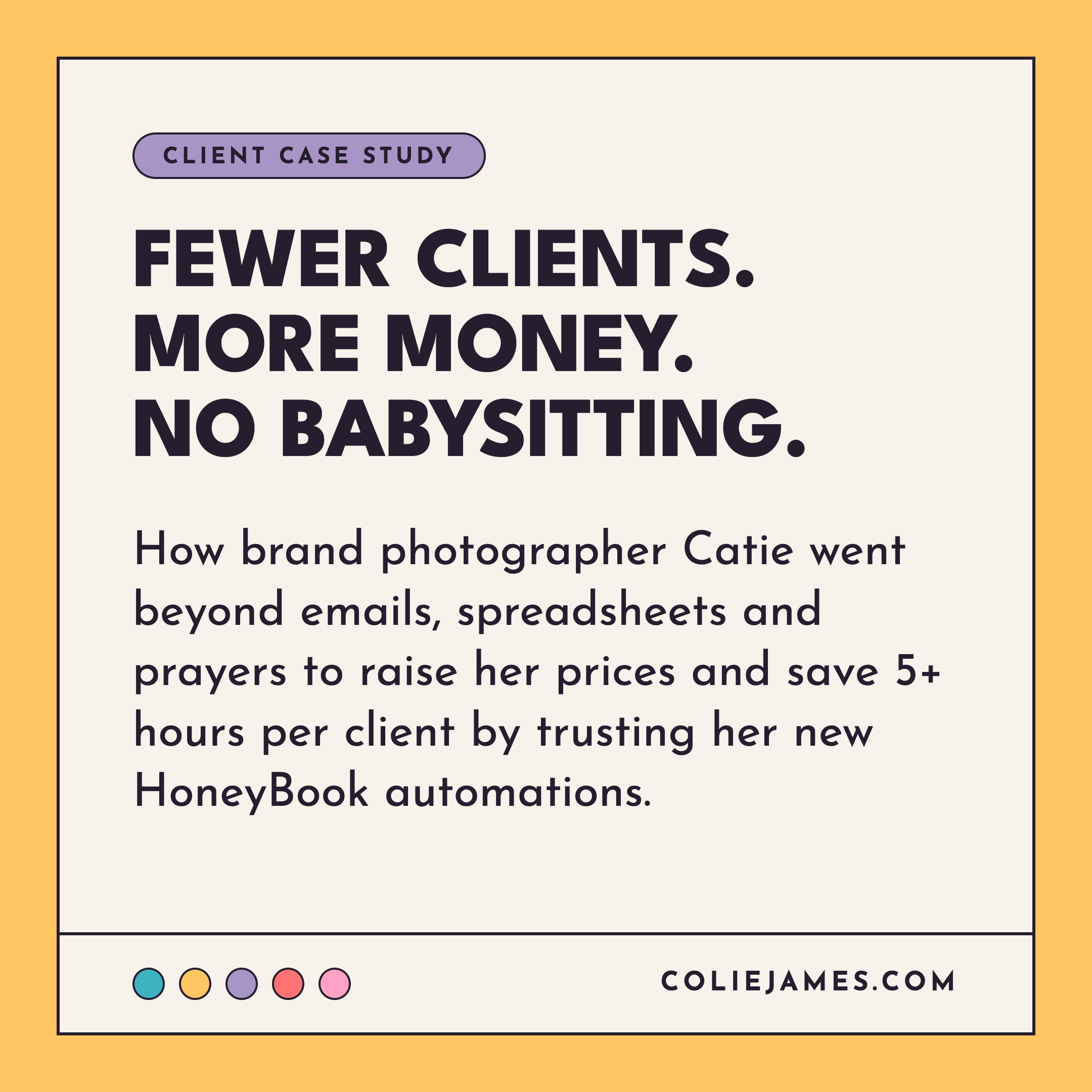




Catie is one of my favorite people to check in with a year after building her systems. When she first came to me, she wasn’t someone with nothing set up. She had HoneyBook, and she had automations. What she didn’t have was trust that any of it would work without her watching over it.
A year later, she’s booked a few fewer clients, made more money, raised her prices, and saved at least five hours per client. She’s also flying to Spain for a session. (And yes, we started this conversation talking about Disney cruises, because we’re both Disney adults. That’s a story for another day.)
Here’s how she got there with her HoneyBook automations.
The Placeholder Offer Lesson
One piece of our Disney chat is actually a business lesson. At the end of our last Disney cruise, Catie and I both bought a placeholder, which lets you put money down on a future cruise before you’ve picked one. Disney makes the path to booking again clear before you’ve even gotten off the ship.
As a branding photographer, Catie is primed for repeat clients year after year (in some cases, quarter after quarter). The moment a session ends, you should already be pointing clients toward what comes next. So I asked her if she has a placeholder offer in her business.
In her own words, she said:
“Nothing solid, but after being the receiver or the person who went through the placeholder experience, I was like, ‘Oh, this is brilliant.'”
So that’s what she and I talked about as soon as we stopped recording.
Where Catie Started: Set Up, But Not Trusted
A year ago, Catie came to me as a HoneyBook user. I asked her if she was barely using the tool she was paying for.
“I was a little bit further along, but I think I was still doing too much manually, or I had distrust in the automation to fire properly. I had it sort of set up, but I kept in the back of my mind, ‘Okay, but is this really gonna go? Is this really gonna work without me having to babysit it?'”
She’d built her setup piece by piece, figuring things out on her own.
“It had kind of been built brick by brick, hodgepodged, duct taped together by my own figuring things out. And so I knew there had to be a better way, and I knew you knew what you were talking about, and you’ve finessed so many people’s systems who I personally know that I was like, ‘Okay, well, let’s do it.'”
The First Thing She Tackled
Catie bought my HoneyBook toolkit and set up her systems over a year ago. I asked her what she did first.
“I put in the emails of just all the step-by-step of taking people through the entire, from inquiry to booking to onboarding to off-boarding. Once those emails were in, I took your instructions literally, step by step, watching the video in HoneyBook. Like, ‘Okay, click this, make sure it goes here.’ Because you have it so clear and color-coded that you really just have to be paying attention not to mess it up.”
That’s important, because the technical side was what always stopped her before.
“There’s a lot of technical things that are not clear unless you know what you’re doing, and that was always kind of my hesitation or fear, that I’m gonna set this up and it’s gonna be wrong, and then it’s not gonna work, and therefore why should I even do it? That kind of spiral.”
She would talk herself out of it before she even started. Or she’d get halfway through and start second-guessing whether it was right.
Starting Her HoneyBook Automations With the Inquiry Process
Catie built her systems one piece of the client journey at a time, starting with the inquiry process.
“Getting back to a client quickly is the number one thing that I hear as feedback. They’re like, ‘Oh, you got back to me so quickly.’ And I’m like, ‘Yeah, I know. There’s so many service providers out there who take weeks to answer an email.'”
Or they just don’t answer at all. Here’s what her inquiry process looks like now:
“Having an automated message that bounces back right away, that’s like, ‘Hey, this is automated, but I’ll get back to you within 48 hours.’ And it’s faster than that. I give it like 10 minutes, and then it’s a slightly more custom message. And then it funnels them into, if they didn’t already book a discovery call, it sends them the link to that. And then if they don’t book a discovery call, then it has the follow-up that goes automatically.”
That automatic follow-up is the part most service providers skip.
“Photographers, service people, we’re just like, ‘I don’t wanna bother them.’ But we need to follow up, because half the time they’re like, ‘Oh yeah, thanks for reminding me.'”
Catie recently saw this from the client side, when a physical therapist followed up after Catie had completely forgotten. Even when someone fully intends to hire you, things get lost in a full inbox.
Customizing the Emails (and HoneyBook’s Template Quirk)
Catie didn’t load my emails in word for word. She customized them first so they sounded like her.
“The base that you have in there is already pretty good. I just had to do some minor tweaks.”
She also learned one of HoneyBook’s quirks. If you edit a template that’s in your automation, it updates that template across the whole system, not just in that one email.
Funny enough, Dubsado users complain about the opposite, because Dubsado makes you go back into every workflow an edited email touches to update it.
When Her HoneyBook Automations Went Rogue
About a year after setup, Catie used some downtime to check that her automations were firing and nothing had an old link. One specific thing sent her back in.
“I did have one client who, we were already done, and then she paid for additional photos, and then the automation, because it triggers on a first payment, sent her a new questionnaire. And the only reason I knew that was that I got the notification from HoneyBook that so-and-so looked at the questionnaire. So I had to email her and say, ‘Oh, my system went rogue. Don’t worry about that. You already did that part.'”
She had sent the client a new invoice inside the same project. Since that was the first payment on that invoice, HoneyBook’s global trigger fired again.
That’s one of the trade-offs with HoneyBook’s global triggers. Narrowing the automation to brand clients only wouldn’t have stopped it.
I figured out the fix while we were talking, so I’m sharing it here in case you need it too:
- Tag completed projects. When a project is done, tag it “completed” (or move it to a specific stage). Then the automation only continues if the client doesn’t have that tag or isn’t in that stage.
- Limit the trigger to a specific smart file. Catie sends the same smart file to every new client for her first offer. The automation can be set to fire only on first payments made from that file, so a payment from any other invoice skips it.
Sometimes you don’t anticipate these things until an automation goes rogue once. If it does, you send an email, laugh, blame your technology, and move on. That’s exactly what Catie did.
“I used the exact words, ‘My system went rogue, so you can ignore that email or that questionnaire.'”
“It Was Like Magic”

A year ago, Catie messaged me on Instagram. She said she got an inquiry, everything worked, they paid her, and it was like magic.
I asked her if that feeling ever came back.
“Anytime I get a notification, once I’ve sent off the proposal and it’s in their court, and then it’s just, ‘You’ve been paid,’ or, ‘So-and-so signed something,’ and, ‘First payment was made.’ And then I see that they get the first email of, ‘Hey, I’m so excited we’re working together.’ And I didn’t have to do anything. It’s such a relief of, okay, I don’t personally have to remember to send any of those emails anymore.”
She also loves that late payment reminders go out without her having to be the bad guy.
“It kind of just happens in the background. And there’s just all these little touch points that make my client feel taken care of. And while I wanna take care of them too, perimenopause steals your brain cells, and you can’t remember anything. So it’s really helpful to have a system that works.”
Customizing for Realtors and a Referral Partner
The systems I gave Catie worked out of the box. So I asked whether she’d started creating semi-custom versions for specific groups of clients.
At one point she had a wave of real estate agents, so she built a proposal just for them.
“It covers their bases of what they’re typically looking for when they call me, and then what they end up landing with, which is more of a brand session versus just headshots. ‘Cause they’re usually, when they inquire, they’re like, ‘I just need a headshot.'”
She’s also built a custom flow for her web and brand designer referral partner.
“We do a lot of business together, and so I did put something together very specifically for her clients. She has a specific package… having a very specific proposal package flow for them that also brings her in halfway through the planning process, because she already does some of it, ’cause she’s doing their branding and their website.”
The two of them work so closely that the designer gets the photos first. She then builds the client’s brand book with their brand-new photos already inside.
“There’s just all these different, like, oh yeah, I could do that. Let’s get more efficient of custom every time.”
Emails, Spreadsheets, and Prayers
I asked Catie if her systems had given her anything else over the last year that she didn’t expect. She went back to how she ran her business around 2016.
“I’m like, ‘How did I do any of this without a system in place? What was I doing?’ It was like emails, spreadsheets, and prayers. Seriously.”
(I told her that was going to be the title of this episode, and here we are.)
“I still have them, the Google Sheets where I was tracking payments and figuring out what the sales tax was gonna be, and then I would send the invoices from either a pretty Google Sheet or a Google Doc. It was very literally emails, spreadsheets, and prayers, because it’s a miracle that anything was running or that I was remembering what to do.”
Catie gives the people she works with the same advice I would.
“If anything, have an automated inquiry process in place. That will change your life.”
Now Catie’s clients get touchpoints from inquiry to delivery, and we automated almost all of it so she doesn’t have to click a button.
The Results: Fewer Clients, More Money
Here’s what I’ve been asking every client about a year after their systems are in place. Systems aren’t solely responsible for any of this, and I say that upfront. But what did this year look like compared to last year?
“If anything, have an automated inquiry process in place. That will change your life.”
I asked whether the price increase was already planned, or whether her systems made her feel she was offering an experience worth more.
“After almost every project, I feel like, ‘Oh, I could have charged more for that.’ So it’s always kind of lingering there. But I will say that having a system in place made it easier to do that, because I have the system that backs it up, that I know that they’re taken care of. So if I increase the price on my sessions, the level of care they’re getting is already there. It’s not like, ‘Oh, it needs to catch up.'”
Her clients notice it too.
“I’ve heard this from my clients as well, of just like, ‘Oh, I felt like you were holding my hand the entire time.’ And I’m like, ‘I love that you think that.'”
And the time saved?
“I would say per client, as far as just communication and routine emails that go out to every single client, now that I don’t have to send them out individually or write them because they’re already written, maybe a little tiny tweak here or there, but being able to press the approve button if it needs to be customized versus having to open a blank page and write it from scratch, that’s saving me I think at least five hours per client.”
And it still doesn’t feel robotic.
“It’s not robotic in the sense that it’s cold, or they’re just getting the very automated, ‘Do not respond to this message because nobody’s here.’ It’s, ‘If you have any questions, you can reply to this email and you’ll get a real human.'”
What’s Next: Spain
In about 10 days, Catie is flying to Spain for a client, an American copywriter who booked her session before relocating her family to Spain. Catie pitched the idea of coming to her instead.
“I said, ‘Hey, so you’re gonna be in Spain. You still have this on the books. What do you think about me going to you in Spain?’ And she’s like, ‘I love it.’ And I was like, ‘I love it too.'”
Is It Time to Stop Babysitting Your Systems?
Your systems might not need a complete overhaul. But if a voice in the back of your mind says you’re doing too much manually or babysitting your tools, there’s a better way.
Catie didn’t need convincing that automation was a good idea. She needed a clear, step-by-step way to build it so she could trust it. Once she did, she raised her prices, took fewer clients, and booked a session in Spain.
Catie built hers with my HoneyBook toolkit. If you’d rather not do it alone, that’s what Systems in Session is for. In 60 days, we’ll turn your half-manual, half-memory client experience into a tested system you can trust. It all starts with an Experience Edit.
Ready to update your systems? Start here. Spots are limited, and I’ll be booking Q1 soon.


Signature Series


Your business works, but your backend is costing you.
A 4-Part Audio Series for service-based business owners who are ready to upgrade their “just fine” client experience, unlock higher pricing, increase referrals, and grow more sustainable revenue—without overworking behind the scenes.
Get the FREE 4-part audio training series
Systems That Sell


© 2022-2025 Colie James


