


Most of my clients used to end up with about 75-80% of their client emails automated.
I didn’t pull that number out of thin air, I’ve plotted this out for several service providers over the last 6+ years, and it landed in that range whether or not you counted the reminders that nudge clients to finish a form or pay an invoice. More of the people I work with now want to stay personally involved at every step, and they want to know where systems fit around them. Some still want as much automated as humanly possible, and some won’t let a single email go out without their approval. Both groups have clients who rave about them.
Choosing to approve every email is a legitimate decision. Approving everything because you don’t trust the setup is a different thing, and that’s the one that wears you out. What the happy clients have in common is that they decided, touchpoint by touchpoint, and then they made the call themselves.
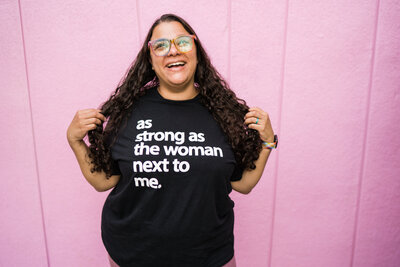
But first, hi, I’m Colie. I’m a Certified Dubsado Specialist and I’ve spent 13+ years in the creative industry, a lot of it inside other people’s client journeys. I’ve seen 30-step workflows with an approval button on almost every step because nobody trusted the system, and I’ve seen businesses running on sticky notes and good intentions. Neither one is working for the person behind it.
Why “What Percentage Should I Automate?” Is the Wrong Question
A percentage treats every email in your client experience as the same kind of email. They’re not.
A session reminder and a “here’s how your consult went and what I’d recommend for your walls” email do completely different jobs. One needs to arrive on time. The other needs you. Lump them together and aim for 75%, and you’ll automate the wrong ones, or you’ll get scared, automate nothing, and go back to sending reminders from the carpool line.
The useful question is smaller: how much of me does this moment need?
If you’ve ever felt like the more personal you make your business, the more trapped you are by it, read The Personal Touch Paradox.
Three Levels of Personal Touch
This is the core of my Human by Design framework. Instead of asking whether to automate, you give each touchpoint one of three levels.
Concierge: automation works behind the scenes to support you. Your clients hear from you personally at nearly every step. The system reminds you to call, tracks what’s done, and holds the template you’ll personalize.
Co-Pilot: automation handles the repetitive logistics directly with the client (confirmations, reminders, prep info) while you stay in control of the relationship. Some messages come from the system and the ones that matter come from you.
Autopilot: automation handles nearly every client-facing interaction. You’re choosing consistency and speed on purpose, and that’s a real choice.
One client journey can use all three. Your inquiry response might be Co-Pilot, your consult follow-up Concierge, and your gallery-expiration reminder Autopilot.
What This Looks Like in Real Businesses
Anthea: As Close to Autopilot as You Can Get
Anthea is a pet photographer who set up her systems before she had a single client. She told me she wanted everything working while her clients were forgiving and she still had time to fix things, so that when she got busier, it was already running.
Once a client pays, she’s out of it. The moment they sign and pay the invoice, they’re sent to her experience portal, where there’s a location guide covering the best time of year, the best time of day, and what to consider if their dog is reactive. Two weeks before the session, she gets a reminder to tweak the details for that client’s location. About three days before, a reminder goes out to the client. About six hours before, another covers what to actually bring: footwear, a long line, treats, toys.
She knows what she wants those emails to say. She also knows her memory is bad enough that she’d forget a key piece of information. So she let the system hold it. That’s Autopilot chosen on purpose, with one small human check built in two weeks before every session.
Read Anthea’s full story: Do You Need a CRM When You’re Brand New to Business?
Mori: Systems Without the Automations
Mori designs custom stationery for bar and bat mitzvahs and other big events. Concierge-level service was her goal, and she told me she needed the systems more than the automation.
We built her emails and workflows, and about four months later she turned off the auto-sends. She still uses her Dubsado forms and templates, and she sends most client emails from Gmail, pasting in a template and personalizing it. Because the body of each email is already written, a personalized one takes her a minute or two instead of a blank page.
She did take some things off her plate. A discovery call and guessed-at custom proposals were replaced by a video that walks prospects through her process and design fee before they book. Her clients see a person. Underneath, there’s structure doing a lot of the lifting.
Read Mori’s full story: Systems Without the Automations.
Xan: Hands-On, With Fail-Safes
Xan is a luxury portrait photographer, and she told me no more times than almost any client I’ve worked with. No to schedulers her clients wouldn’t actually use. No to proposals as her core sales tool. Totally fine. So we built around her.
She controls her own scheduling, so clients never touch a scheduler, but behind the scenes she built schedulers and proposal templates as fail-safes, so entering a date kicks off the right emails and tasks. And there’s an exception: her monthly Studio Petites children’s sessions. The very first thing we built was a scheduler plus automated prep and follow-up emails for those. Same photographer, same business, a different level of personal touch for a different offer.
Read Xan’s full story: Building Custom Workflows in Dubsado.
Ina: Templates That Still Sound Like Her
Ina is a pet photographer in Australia with one of the most high-touch processes I’ve seen: an in-person consultation in her home studio, an in-person ordering session, and no pricing sent by email at all. You’d think email wouldn’t matter much. It did. We found a four-to-five month silence for clients who booked well ahead of their session.
She left The Experience Edit with 34 emails, templated for different seasons, locations and client types and populated with custom fields like the pet’s name and breed. Personalizing one takes a couple of minutes and it still sounds like her. The system carries the logistics and fills the long gaps. Ina carries the consult, the sales conversation and the relationship.
Read Ina’s full story: Do Email Templates Work for High-Touch Client Experiences?
Me: The 1:1 Calls I Refuse to Scale
I’ll put myself in here too. I refuse to scale my one-to-one calls in Systems in Session, even though I know it would grow the offer. Those calls are Concierge. What I automate is the stuff that protects them: reminders, tracking, and the nudges that tell me when to reach out. For a lot of concierge-level providers, that’s the sweet spot. An automated reminder becomes a prompt to pick up the phone, so the personal touch happens consistently instead of whenever you remember.
More on this: How to Deliver a Concierge-Level Client Experience Without Losing Yourself in the Process.
Try This: Sort Your Touchpoints in 15 Minutes
- List every email, call, text and task from inquiry to offboarding. If you’ve never mapped it, a rough list is fine.
- Next to each one, write J if it needs your judgment (a recommendation, a nervous client, a follow-up after a tough review, a choice to be made) or T if it only needs your timing (a prep guide, a session reminder, a gallery-expiration notice).
- Circle every T your client doesn’t need to hear directly from you. These can likely be automated.
- Leave every J with an approval for now and the system will remind you to do it.
When we layer in the reminders and additional nurture emails, we get closer to 30-40 pieces of communication with less gaps. From the map you can easily calculate your percentage of automated emails from there.
The Real Risk Is Never Deciding
The photographers who struggle most never decided. They ended up with whatever their CRM defaulted to, or whatever felt fastest the week they set it up, and now they don’t trust any of it, so they check and re-send and rewrite everything by hand.
The quiet stretches suffer most. Discovery call, proposal, session and delivery are the obvious checkpoints. The silence between them is where clients drift, and it’s the easiest place to add a touchpoint at whatever level fits. Ina’s four-to-five month gap is a good example: nothing was wrong with her consults or her sessions, there was just nothing happening in between.
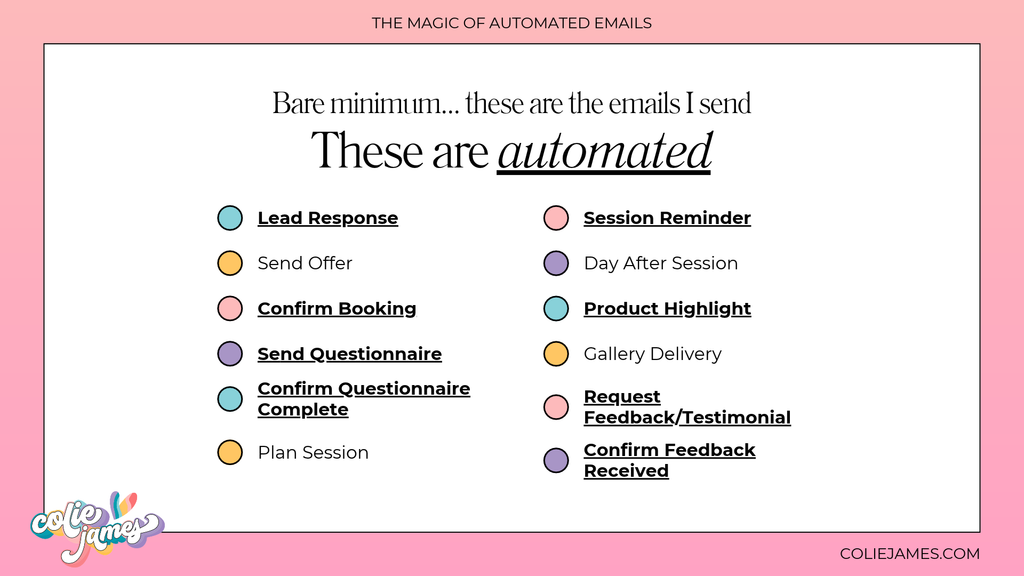
So where do you start? These are the easy ones. 12 milestone emails that can cover inquiry to delivery, but leave a lot of communication gaps and assume your clients do everything after being told once. [Which is very unrealistic, but a girl can dream 😍]
Want Help Deciding, Touchpoint by Touchpoint?
This is exactly what we do together in The Experience Edit. In 10 days, with two calls with me, we review your offer, map your client journey from inquiry through offboarding, decide what gets Concierge, Co-Pilot or Autopilot, and write the emails for every stage. It works with any CRM, or none, and you leave with a 90-day plan for building it out.


Signature Series


Your business works, but your backend is costing you.
A 4-Part Audio Series for service-based business owners who are ready to upgrade their “just fine” client experience, unlock higher pricing, increase referrals, and grow more sustainable revenue—without overworking behind the scenes.
Get the FREE 4-part audio training series
Systems That Sell


© 2022-2025 Colie James


