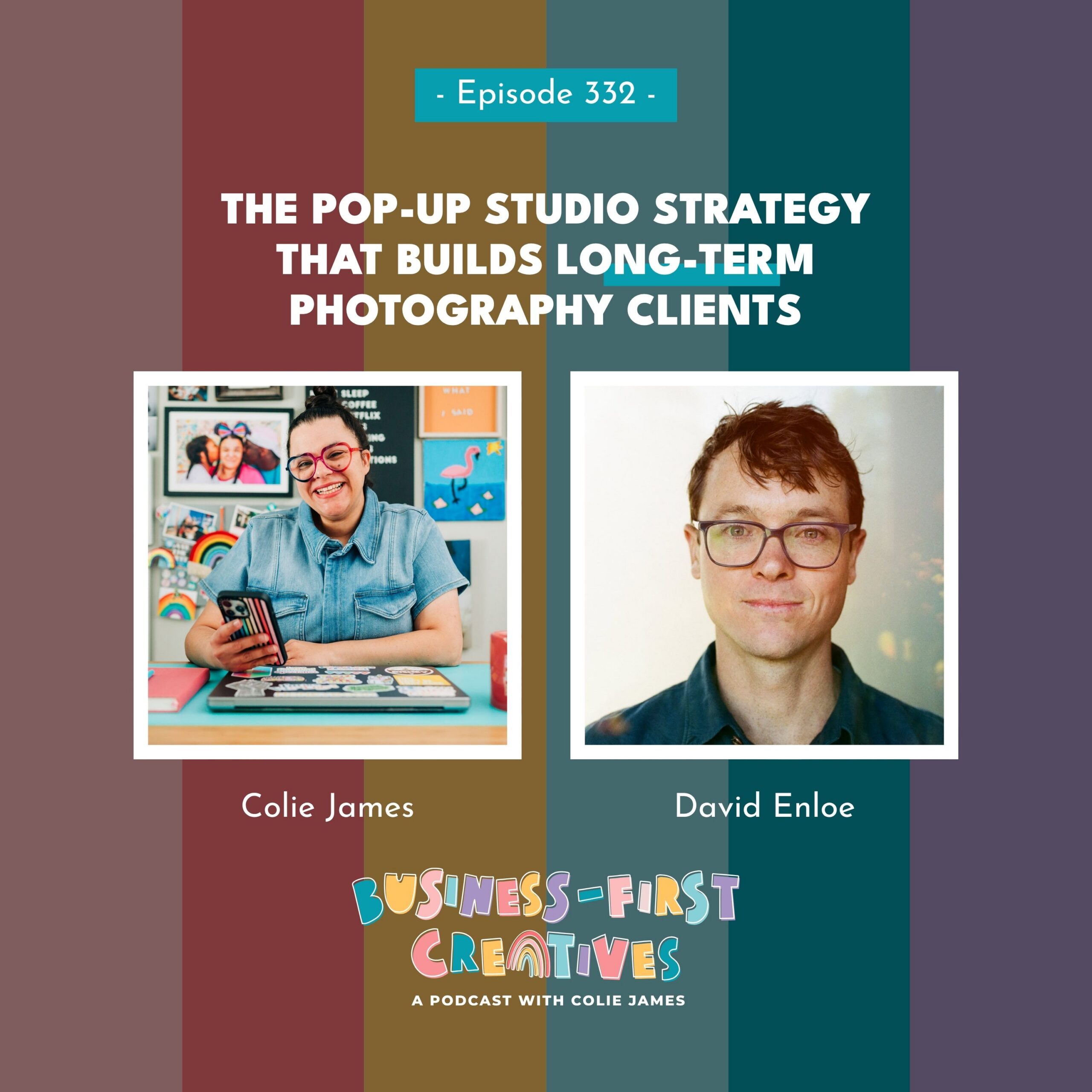


What if giving away something for free was actually the smartest marketing move you could make? In this episode, I’m joined by David Enloe, who shares how a simple idea born during the uncertainty of COVID transformed into one of the most effective marketing strategies I’ve heard for photographers. What started as a way to meet people in a brand-new city has grown into a long-term client acquisition system that continues to generate premium bookings years later.
Instead of chasing social media algorithms or relying on paid ads, David built his business through free pop-up photography experiences at local community events. We dive into why this strategy works, how it builds trust, and why nurturing relationships over time can outperform short-term marketing tactics.
Review the Transcript
Colie: Hello, hello and welcome back to Business First Creatives podcast. Today I’m chatting with one of my clients out of the Bay Area, and the funny thing is I went into this thinking that it was going to be a case study episode, and that’s not where we’re going. So I may end up asking David a couple of questions about how it was to work with me, but he is bringing like this brilliant idea to the table for those of us that are always like, I want to get more involved in my community.
And I just don’t know how to do that. David, welcome to the podcast.
David: Hey, thanks Colie. Thanks for having me here and thanks for the awesome and introduction. Brilliant is not a word I get all the time, so I appreciate
Colie: my gosh, you are brilliant. You know that. I think you’re brilliant. Anytime you need a little pep talk, David, you just hit me up. I’m happy to give you
David: I know I’ve got you on Voxer now, so that’s
what I’ll use that for.
Colie: See, so when I worked with David, which has almost been a year ago, guys, we worked on his HoneyBook systems, but there was one thing that he mentioned to me while we were working together and I was like, oh my God, this is brilliant.
Like eventually I’m gonna have you on the podcast to come talk about this. Now, it doesn’t normally take me a year. I am kind of hiding my face a little bit to bring somebody on when I mention it like this. But today we are gonna be talking about a concept. Of pop-up studios. So David, I want you to dive in and I want you to tell me about what brought this to you and like your first time doing it.
David: That’s a great question. I started my business right before the pandemic. So by the time I was getting off the ground at all, we were in the pandemic. I was one of those businesses and I was in a new city. I switching career paths entirely. I’ve never been a social media person, so I had no social media.
I didn’t have a following to pull from. No family in the area, very few friends. And we were isolated by COVID, not only in terms of our
network, but in terms of meeting people. It was really hard and I was like, well, how am I gonna meet people? And I honestly don’t know where I got the idea. It kind of feels like it came out of thin air.
But they had recently launched sort of a farmer, craft maker food market, like street Fair on Sundays near our home. And we, we were in a, a neighborhood that had a lot of young families. so I, yeah, the idea just came to me one day. I was like, what if I just showed up in this space? ’cause I, I would
go to the farmer’s market and hang out with, you know, my wife at the time.
I didn’t have a, a, a daughter yet, but I would have a great time and I, I, I could see that my people, the people I was looking for and my business were there. And so however it came about, I ended up putting together what I now call the popup studio. I initially called it, uh, um, a photo booth, which is kind of a, people have a different picture of a photo booth than what I do.
So I call it the popup studio. I bought a few, off-camera flashes and light modifiers. I had never used any of them before. Total experiment, but I knew, I was like, I need to create something that makes me look like, like, makes me stand out, makes this look like an experience. And so I did, I bought a, you know, a 10 by 10 tent set up at the farmer’s market, put up a backdrop, simple backdrop and some lights, and created, a, a simple signup system.
Ironically, at first it was actually within HoneyBook, although that’s not the best platform for, for this in particular. But the long and short of it is I quickly found out that creating a completely free. Surprise and delight kind of experience for families where they got to meet me in person. Interact with me a little bit in a photography environment, even if that environment was really different than the sessions that I do, and then I could get them on my email list and
nurture that. Over time. It was, I, I could see from the beginning even that when I wasn’t doing a good job, that it was a magic formula and so I kept doing it.
I truly did build the first couple years in my business on that platform almost entirely, and I’ve continued in. Certain ways using the popup studio. And I’m actually, now that I’ve new, moved to a new location, um, within the past couple of years and we’re kind of putting the gas pedal on my business again this year, I’m gonna circle back and do a whole new round of popup studios in local markets here in my new location.
Colie: Yeah, I mean, and, and listening audience. What I, what you don’t know is that before we hit record, I was kind of touching bases with David to like get the lay of the land. In case you guys don’t know this, I don’t give my guests any questions. They show up, we talk for about five to 10 minutes so that I make sure that I’m clear on where I need the conversation to go.
And then we literally hit record. So I asked him a few questions and I realized. I didn’t even understand the idea of the popup studio from when we had discussed it almost a year ago. So, David, you said a word and I wanna focus on it because the moment that a photographer hears, oh, you want me to shoot people for free, like, wow, that’s not a novel concept.
What is it that you would say to someone who was like, you know, you’re just basically doing free work. I mean, if I’m gonna take my camera out, I want to be paid.
David: That’s such, such a good question. Um, I mean I literally get, so I answer this question often ’cause I see it in forums online. There are other online educators who are pitching something like the popup studio idea, but it’s paid. The whole idea is to make money and you get the side benefit of people on your email list. But I came at this completely differently and. I’m sure that other model can work, but it wouldn’t have worked for me and it doesn’t do the same thing at all. So there there are two things I wanna say. First is, you will get way if you are doing this the way I’m doing it as a kind of surprise and delight scenario for families who are out not expecting to meet you, not expecting a photo session, they don’t even know they want photography yet. You are not gonna get 99% of those families in your popup studio if you are charging them anything.
It’s just a totally different frame of mind. When I say to people, it’s free, I typically get the question, what’s the hitch? Why is this free? I literally get that from the people I’m trying to take photos of, and I get to genuinely say to them, because I have met. Tens of long-term clients by doing exactly this. This is marketing and it is my favorite kind of marketing. I say that to these people at the popup studio. I say, I am here in front of you, meeting you in person, giving you this experience for free. Then I’m gonna put you on my email list and I’m gonna email you once a week and you’ll learn more about me.
And in three years you might decide to hire me and that’s absolutely worth it to me. And they love that. I love that. It feels good all around. So it’s, it’s just the, the whole thing about it being free, it takes the pressure off of everyone, myself included. And it started as free probably because I didn’t know how to use my studio lights.
And I was scared and I was like, I’m not gonna charge people for this. This is an experiment, but the first time I did it and was like, oh, this free thing is magic. The other side of that, and I, I, this is one that I, when I see this in photography forums, I push a little bit harder on this one, do the math. And unless you are really, really good at offering something like super quick popup. High quality portraits with a great sales system, how much money are you actually going to make?
I I also, you know, Colie and I were talking about this a little bit before we hit record, but, I’ve probably booked 20, 30, 40 clients over the years directly from the pop-up photo studio, and my price point is well over a thousand dollars.
For a photo session. It’s a substantial amount of money we’re talking about, and these are people who show up years after the event itself, so that that model, of nurturing these people in an email series or weekly newsletter, it’s still working for me even on the folks that I met five years ago. So it’s the this growing pool of potential clients.
Colie: But I mean, I think the magic of this, yes, it’s free because you know my stance and I feel like everybody else at this point knows my stance of model calls. I insist that everybody who wants to try something new does it as a model call. Why? Because if it’s free, they are not a paying client. You are not beholden to them to deliver something particular.
And so while I understand. The need to make it free the first time that you did it. ’cause you’re like, wow, like I don’t even know how to use these lights. I mean, did you really need the lights, David? You were outside. I mean, it’s, it’s also one of those things, you got the lights to make you look more professional.
But I don’t even know that you needed them. Probably. But I mean, I get, I get it. It when a photographer is there with a camera that is maybe not as assuming to where somebody is like, oh, that’s a $3,000 camera when you put the lights up. I mean, nobody can miss that. You
have these
David: it, makes it a party. People walk by and there’s things flashing and we’re like, it’s, it is the whole vibe. It’s, yeah. No, I didn’t need them, but it worked great.
Colie: It worked great, but so, I mean, I totally understand doing it for free and I think, you know, because you listened to the podcast, I did push you and I’m like, okay, you know what percentage of people are converting into being paid clients? And I mean, if I really wanted you to tell me a percentage, I could have made you go back through your data.
I could have told you before I got you on the podcast and made you go look these things up and give me a number. But you were like, you know, it would just be anecdotal and you were like. You know, I think I’ve gotten 2030 and I was like, okay, wait, stop, David. Like at your price point, tens of thousands of dollars.
That’s all somebody needs to know. Like you’re doing these, you’re growing your list, guys. He said he’s added thousands of local families to his email list by doing this, but he’s also gotten tens of thousands of dollars on the backend. And I wanna make something really clear. You know what I’m gonna ask you, David, so you can answer in your own words.
free for them to get in front of your camera and then you’re sending a gallery. Are you charging them after?
David: the short answer is no. And I’ve moved to a model where, what do they call it in Pic-Time? Web size downloads. Basically any photos that you could use in a digital platform are completely free, high resolution, and obviously, print those. I, I do charge for, And that model has worked really well.
It still feels free. They are getting photos that they can send to their
friends and family and even print at four by six or five by seven. And I even tell them that in person. But if they want to print these larger, either themselves or through the gallery service, then they can pay me. And, you know, I usually end up making enough to cover the expenses of the event.
And that feels good, but it’s really
nothing more than that.
Colie: Yeah. I mean, but imagine being somewhere. I mean, not only were you in a new community where you didn’t have family, you barely had any friends, but then COVID hits and you completely feel isolated. So. I understand why you started it. Like all that made sense to me. But the fact that you’re still doing it five years later, I mean, you know, you’re preparing for, to bring this back, \ to the forefront of your business, I think is just amazing.
And one of the things that you said before we hit record was, and I don’t expect this to bring me an immediate result, so like how long do some of your clients or do some of the people wait that participated in a popup? How long do some of these people wait in order to actually book a session with you?
David: Yeah, I just had an inquiry like a few weeks ago. Someone reached out and they said, Hey David, we met you four years ago at Coal Valley Neighborhood in San Francisco that has a street fair. You took photos of my now husband and I and we’re having a baby and we love some photos. Four years, and it, it, my business has only been around like five years.
That was my, one of my first pop-up studios. So. I imagine I’ll be saying the same thing in 6, 7, 8, 9 years. Part of the equation is I regularly send out an email newsletter. It is my major platform for communication. So I’m staying in touch with these people. And if they don’t like me or my style, they unsubscribe along, go if they’re still around, and a lot of them are, we’re probably a good fit.
So this is a truly long term kind of strategy.
Colie: I mean, and that’s amazing that when you, when you initially photograph them, they were a couple and now four years later, they’re entering that phase of life where they’re gonna have kids and they came to you for the first one. So, I mean, David, I would imagine if you do a good job for them this time. If they’re one of those couples, you know, you and I are not like that, but if they’re gonna have multiple kids, it could be that they’re gonna come back around to you, you know, for the second and the third kid.
And now you have created like this lifelong client off of a free event that you did four years ago.
David: Yeah, I mean, you hear all the time about the importance of these touchpoint, and I don’t, I, I’m not, I don’t get real technical into this stuff. I, you probably do more than me, but you need a, what is it? Seven
touchpoint or whatever, when one of those touchpoints is in person, surprising, delighting, and offering something of value. Oh, and then that creates another touch point, which is the delivery email. Not to mention the follow up nurturing emails. Like it’s, it’s, it’s like marketing all the best things in marketing, packaged in one little bundle
ready to just hand to clients with zero pressure at all. To me, it’s. It’s kind of a perfect little system now.
It’s not no work. In fact, sometimes it’s really hard work and I definitely don’t want to underplay that part of it, but it feels for me like, like quality work. Like I know what I’m doing and I’m getting not immediate results, but like direct and really well aligned potential clients and results as well.
Colie: No, I mean that’s, that’s great. I have just an off the wall kind of question to ask you. Do any of the people from popups give you reviews on your Google page?
David: great question. Also beautiful. Side benefit of the popup studio. I push reviews super hard. When you offer it for free. You get to push reviews really hard, and I do immediately after, the session or the popup studio, I send them one. It’s like, if you could, you know, talk about the few minutes you spent working with me, and then I send ’em another one when they’re delivered, like, please leave me a review.
And then when the gallery’s closing. I send them a reminder, download your photos, and like, by the way, can you please review this free service that I provided for your family? And yeah, I, I think, I mean, I have, I don’t know, not, maybe not quite a hundred, but nearing a hundred Google reviews. I would imagine a solid substantial portion of those, maybe 30, 40% are from popup studios.
They’re short, they’re probably not as
meaningful, but they fill up that like, you
know, five stars, 95 reviews bubble really quickly. So when you’re starting off, like when I was starting off, this was amazing. I went from, you know, five reviews that my re friends had written to like 15 five star reviews overnight, and that
was, that was huge.
Yeah.
Colie: I mean it, it’s kind of funny. One of the things that I used to really hammer when I was still doing photography coaching and mentoring, like way earlier in my career, I would tell people. You’re gonna open your business, you’re gonna publish your website, you’re gonna tell people that you’re available to take photos, but you are not gonna get overrun with people immediately clamoring to you to hire you as a photographer.
I’m like the only people that I have personally seen that have ever opened their business and immediately fully booked their calendar are doing one of two things. Number one, they’re running paid ads on Google or social media, or number two. They already had a full community of people. In their area, who know them, love them, and don’t already have a photographer.
And I’ve coached two different photographers like that, that, you know, inside of their community when they became the photographer, they were the only one. I mean, one of my clients, I, I think the first year that she was in business made 60 70 K, which anybody who’s a a family photographer knows, wow, that’s a lot of money for year one.
And you’re not doing, you know, like an outrageous amount of work, but like. If you don’t have a community, you have to find a way to build one. And yes, as a parent, if you’re gonna do family photography, you can go join all of those groups on Facebook. But like, this is a way to, to basically go meet the people where they already are.
I.
David: absolutely, yeah, it’s, it’s so much more powerful than meeting them. On Facebook or social media or via paid ads. By the way, I’m very jealous of those people who have that huge community. Like, I mean, I’m jealous of it for so many reasons, not just starting a business. Like that’s, that’s awesome. , And I think early on I remember being frustrated by seeing advice that’s geared towards those people.
That’s like starting your business, just, you know, you’ve already got your Facebook, like just start creating events or that I’m like, I don’t have. Any of that, tell your friends who are having kids go to your kid’s school, didn’t have any of that. So yeah, I had to find a different way. And I think a lot of people do, especially now that, you know, the, the photography spaces are, I don’t like the word saturated, but they’re busier.
They’re noisier. Um, there are more people doing the obvious, like Facebook shout out things. So yeah, you need something different. And for me. Not only was this different, but like it’s different for everybody because we’re all different and we are putting ourselves as a person, you know, in person, in front of our people interacting with them.
So even if we all did this tomorrow, I guess if we all did it, we, we might not have enough farmers’ markets to go to, but but the people would all be different, you know.
Colie: They would be, and I love that you brought it around to touch points because you know that I’m a big fan. I mean, I had Dana s Schoff on the podcast and we talked about how the Rule of seven is now like the rule of 24, and it’s probably doubled since I recorded that episode. I will link it in the show notes.
But people have to engage with you and your content so many times before they even realize that they might. Be interested in the thing that you’re selling. And so I love that you’re positioning this as you are giving them so many touch points in a very short amount of time to kind of bridge the gap.
Because again, the couple that came to you three, four years later. I mean, you were probably already on their mind from the moment that they, you know, found out that they were pregnant and you’ve probably been on their mind this whole time. So, you know, even though they’re still on your newsletter, they’re getting your weekly emails.
I mean, it was probably early on that they had already decided, hey. You know, when we have our baby, like we’re gonna contact David, this photographer from before and reach out to him. And you don’t even technically live in the exact same area that you did when you met them. I mean, you, you live a little, a little bit ways still close enough to where David can, you know, hop in the car and go back.
But I mean, he is now in a new community where he is trying to do this again.
David: Yeah, absolutely. And I think one thing I haven’t mentioned yet talked much about yet, and it’s a big reason that I am circling back and doing this in my new community in different ways, is that. The popup studio also gives you great connections kind of from the business to business perspective. That’s totally dependent on how you use it when you use it. You know, whether you go to a farmer’s market. I, I see it potentially as a really good tool for, um, photographers who do brand photography. If they were to offer like pop-up studio quick headshots at a, some sort of a networking, I don’t know,
event. Anyway, for me, like for example, this is a, a great example. I got involved with, an organization in my old community in San Francisco that was advocating for this giant public space where there used to be a highway along the beach. Basically the creation of a new chunk of national Park. I got involved in that and. At some point they started actually hiring me to do pop-up photo studios for their events. So these events are like, you know, many thousands of people, large Halloween events, uh, meet Santa on the Great Highway events, all these different community events that they’re doing on this, in this new park space.
And so now all of a sudden they are paying me. To offer this to clients, I’m still getting the same benefit. And at the same time, I’m aligning myself with an organization that, from a value standpoint and from a, uh, audience standpoint, community standpoint, I want to be aligned with. So you, it, it’s like a tool that you can kind of insert anywhere to network with your people, but also with other brands and organizations that align.
Colie: Yes. I mean, and I think, I mean, David just mentioned how you could actually make more money off of this. I mean, again, but the people, it’s free for them. It’s still free for the people in front of your camera.
David: yeah. No, I’m, I’m starting to get paid for this. I could probably charge a lot more than I do. I still think of it as something that I’m, that making money is not the intent, but I am starting to get paid to do this, and in some cases, even hiring an associate to where I’m, all I’m really doing is running the backend now that. Isn’t really the point of this ’cause people don’t get to meet me in
person, but I’m still getting them on my email list and they’re interacting with the process. So
anyway, I think this is, you know, if you were to have a business where you had associate photographers. You could potentially, allow them to run popup studios, in a way that, you know, brings all of you more business. Yeah, and I think the other thing that I wanted to mention too, and maybe we would get into this later, but it just came to my mind and it is important, which is I so you know, this Colie, but other folks listening don’t, I don’t offer. Mini sessions. I don’t really offer any sort of small session.
Typically, my starting price is well over a thousand dollars and the shortest session that I offer is 90 minutes in length.
So,
Colie: y’all see? Wait. Can y’all see why David is one of my favorite clients? I’m sorry. Continue. David, you know, I don’t do short. I mean, my shortest is two hours, but continue.
David: totally. And I, I think what, what’s interesting to me and what I’m most curious to see in other folks kind of putting this idea out there is. Whether or not it will be really effective in quickly booking shorter length sessions.
And the reason is that the jump from free, unexpected five minute experience to $1,500 two hour session with David or Colie is massive.
It takes years for people to kind of like make
that mental connection. Um, so in a way, the popup studio isn’t even. All that aligned with my style. But for other photographers who do offer mini sessions and quick portrait sessions or
headshots, going from the popup studio environment to that type of a session is a much smaller leap.
I could see actually booking people right then and there for mini sessions and things like that. So I think there’s a lot of, a lot more potential than I have explored.
Colie: Yes. And I will say part of the other surprise and delight of this is that these people don’t know that they’re gonna be in front of a camera. There’s no added pressure. You and I both know when people pay you for a photography session, particularly if it’s four figures, there’s all of this like added pressure to it.
Like, what are we gonna wear? How are the kids gonna act? Is my partner gonna be okay with this? Like all of these things that we usually coach our clients through, but in the moment for free five minutes. I mean, yeah, and if you get me a great photo, I mean like I will be really impressed because, you know, Susie just had a meltdown because I wouldn’t give her a lollipop 10 minutes ago.
Let’s see how this goes. Um. And I also love that you kind of tied this into, this might not be the perfect thing for you and I in terms of like getting conversions, because again, that leap. Is incredibly high to go from, you know, a five minute free event in a park to a two to three hour session, potentially film.
I would argue that those, that last inquiry that you got for the newborns, that is when it becomes easy because when people have a baby, like the importance of the photos are there, and so they just think back to any photographer that they know, that their friends and family know or that they had a connection with at some point in order to hire.
And that’s even better than them doing a Google search for like the best newborn photographer in their area.
David: Yeah. So I wanted to circle back to one thing you were talking about. ’cause I think it’s really, really important. The idea that people are not expecting these photos. Um, that’s, that’s a pretty key piece of the experience in my point of view. Part of that is, well, you talked about it, you talked about the pressure that people feel when they’re expecting a photo session, the pressure that they put on their families, the decisions in terms of what they wear.
And this doesn’t feel like that at all. And I think because my, because I’m not a studio photographer. And my session style doesn’t really align with these popup experiences. I wanted them to be extremely casual. Like especially early on, people would walk in and they’d be like, oh, you’ve got the lights and everything.
I would tell them straight up. I would be like, you know what? I don’t even know how to use these things. I photograph, I photograph outside with natural light. But I thought this would be fun to experiment with for the farmer’s market and it’s totally free. So let’s try, people would walk in with, you know, bags of vegetables.
I’d be like, let’s take pictures with the, they would
be like, well we’re, yeah, we’re not dressed for a photo session. I’d be like, yeah, like, bring the vegetables, let’s have fun. Like, um, so we would make it really light. We would make it like it should feel when it’s free. And I think people really appreciated that because, to be honest, that the way that felt is on is probably more aligned with my photo sessions
because even though people are asking me what should we wear?
And I try to give them some advice. I really try to put forward an ethos of show up as you are, as your family would show up, and let’s try to all be as comfortable and ourselves as possible. And I know you’re the same Colie. So I think that style has worked for me. Now, if you’re a studio photographer, you could do this differently where you do a little bit more marketing
to get people in the door and they show up looking a little bit more ready, but there’s an added pressure in the final product. And there’s then also, there’s also an added reality that you’re gonna get people showing up for a finished product. People that are like, oh great, this is free. I don’t wanna spend a dollar. I’m gonna go get my one headshot and move on. I don’t get those people when I’m not marketing this
at all. I’m getting people who are just there.
’cause it’s a new experience. So,
Colie: I wanna make sure before we wrap up this conversation, that we talk logistics, because I mean, you’re saying, you know, market ahead, get people to come, but like do you just show up at a farmer’s market? I’m sure you don’t. So what are you doing, David, to kind of get yourself in these spaces? And I guess you already knew some of the spaces to go to, but if you didn’t already know of a space to go to, what would you do to like find out about one in your community?
David: Yeah, and there’s, I’ve learned a lot over the years, you know, so I started with one of these street fairs and I’ve, I’ve coached some, clients on this as well, some photographer clients, and I’ve suggested the, the same thing. And it, it does work really well when you have the right, the exact right kind of street fair or market. In a neighborhood, you know, pretty close to the clients that you want to serve. But I’ve also learned over the years some directions you can go there, a little bit more direct, a little bit more high volume, and. Lead to a little bit less potential for a bust, you know, because I have, like, I have gone to new farmer’s markets or events before and paid to get into those spaces and had it just not be the right fit.
And yeah, I’d meet a couple families, but like people are just not ready to have their photo taken. It just isn’t the right vibe. So you my, my first to answer your first question. When it comes to these farmers’ markets and street fairs, there’s always like a typical application process. You have to pay some money. It’s all pretty standardized, at least in my area at this point. Some of them allow, you know. Arts and craft arts and crafts vendors like myself, some don’t. What we’re offering is a
little bit different. Sometimes you’d need to talk to the organizers and be like, look, I’m offering a ser a free service for participants. Will you let me in? And oftentimes they’ll even give you a discount ’cause you’re not really selling, you’re actually creating something that they can market as like a side benefit. I think if you pitched it well, they could probably give you a free space because. You, you’re bringing value.
so to, to go beyond that though, if you happen to have a street fair in your area that has, that is just packed with your target client and they’re out having a good time and people are smiling, like, that’s, that’s great. Get in there. That’s a great place to meet people. That’s a great starting point. Um, and it’s a great low pressure one because. Again, if no one’s paying you to be there, there’s no pressure on you. You can kind of feel it out that way.
Now the next step is. Pitching this to organizations, kind of like I mentioned, that are aligned with you in terms of both your target client and your values.
Typically, like nonprofit
organizations are great and nonprofit events or fundraisers are often a really good fit. For example, I just had a school that’s in my area, highly regarded school with a lot of kids. Reach out and ask the typical, will you donate to our auction In April, I looked up their auction event and it’s like a high profile gala where everyone’s dressed up, um, in this beautiful building in San Francisco.
So I replied and said instead, can I donate my pop-up photo studio? Um, and the reasons I think that’s gonna be a good fit. Obviously the target client is there, but number two, people are gonna be excited to have their photos taken because they’re dressed up The Halloween event, I do the Santa event, I do the Meet the Easter Bunny event.
I do. These are all events where people want there or their kids photos taken inherently. So. When you put yourself in one of those positions, you are guaranteed to have people walking into the popup photo studio. It’s natural. They’re there, they want photos, you’re there to take photos. So think in terms of events like that first, I think that’s actually the lowest hanging fruit. It’s taken me a few years to learn that,
but that would be my recommendation.
Colie: And I think I will just add, ’cause I’ve never done one of these, but I would add that if I was interested in kind of getting a vibe from a farmer’s market or a street fair, I would, I would attend first. I would go so that I can get the vibes. I, I just, I think, I wanna make sure that everybody knows.
That I personally wouldn’t recommend that you just pick some event off of a Facebook, you know, marketplace announcement or whatever, and then just go all in, not without knowing something about the event. And even if you haven’t attended, ask your friends and family if they’ve been what you know, how much they enjoyed it, or you know, what the crowds were like, or just any of those things so that you can get some first or secondhand knowledge of the event before you attempt to secure space, paid or for free.
David: Uh, absolutely. Yeah, that’s, that advice is gold. You. You should be targeting initially, and this is gonna be different for everybody ’cause some people live in rural environments and there’s less people around, less events, but. I’ll just speak to the people that have a fair amount going on around them.
’cause that’s where I was when I was starting. I started, I wanted to start hyper, hyper-local. I wanted when people to ask, Hey, do you live around here? I could like pretty much point at my house and that’s, that’s, that’s why I chose that farmer’s market initially. So start as local as you can and be if you’re starting local, yes, go and attend these events first, if it’s a recurring event because you can, it should be easy. Make, yeah. Make sure it’s a good fit in person. And the other thing I’ll add to this is when you first start thinking about this, like any other idea in the world, it’s going to seem limited. You’re gonna think of one or two events, and your brain is immediately gonna be like, oh, those are the ones. It has to be that one. Over the years I’ve learned that I, I could make a list of 1000 events that I have considered. Being a part of you will, once you kind of put your pop-up studio goggles
on, you will see lots of events. So take your time initially in choosing the right
ones. Now, don’t let that stop you from doing it the first or second
time quickly. Like get out there and just try it. And know that if you’re just randomly picking an event, like you might not get many participants and that’s okay. You’re just testing out your equipment and all the stuff like
Colie: Your lights that you don’t need.
David: Yeah, yeah, yeah. You gotta, you gotta learn to make the lights flash. Even if they don’t work for your photos, you gotta make ’em flash.
Um, so do that initial step, like just try it in some way, shape or form, even in your backyard. Kind of get over that initial hurdle, but then, then get really intentional.
Just like holy saying about your vents.
Colie: Yes. So don’t be scared to book the first one or two, but what we’re both telling you is don’t book seven or eight before you’ve done the first
David: Start with one.
Colie: Yes. Okay. David, I, I mean this whole conversation has been absolutely fascinating and thank you so much for joining me on the podcast. Is there any like lasting advice before what we just told them?
And I do wanna say, guys, he has a signup for his popup guide inside of the show notes. And so if you would like to learn a little bit more about this, you would like to join David’s newsletter, uh, you will have the opportunity. The link is in the show notes.
David: Yeah, I think my lasting advice is it’s a little bit more general. You really need to get clear early on or at any point within your business in terms of what marketing channels you’re gonna put your time and energy into. Something like the popup photo studio and the follow up, the delivery, and then the follow up, and then the nurturing via email. Is a lot of time and energy. It’s time and energy that is spent in a place that I really enjoy. I love writing newsletters. I’m basically off social media and I put all that energy into newsletters and I love it. So the popup photo studio and the newsletter, like that’s a perfect fit for me. I love meeting people in person.
I love the email side, but I don’t have the energy to do that and run a really good Instagram, feed. So you need to kind of choose where are you gonna put your energy. If you love writing emails and the more long form communication and meeting people in person, then the popup studio might be a great fit for you.
Colie: Yes, and I’m sorry. David was talking and in my mind I was thinking of two more very specific episodes that I want to mention to you guys that if you have found this absolutely fascinating and this in-person avenue as well as emails instead of social media has like hit a nerve with you. The very first episode of 2026 was an episode that I did with Kylie Kelly, who is a visibility coach.
She gave us a lot of ways to get off of social media, and I would say that David’s pop-up studio idea is right up there. And then also there was an episode that I did with Tiffany of animal house photography and she told me. Stories of how she gets people to sign up for her emails at in-person events.
Now, Tiffany was not taking photos at these in-person events, so I’m gonna link that one in the show notes as well because I feel like between David giving you the advice of the pop-up studio and Kylie giving you permission to not have to constantly be on social media and Tiffany giving you an avenue to do it, even if you’re not the photographer in the room is like the perfect trifecta.
Of getting visibility on a marketing channel that is not social media.
David: I love it. I love it. I, I, I need to listen to those episodes right away.
Colie: You know what, I will give them to you as well. Okay, everyone. So I hope that listening to David talk about this, what started as a completely free event, um, fueled by COVID VID. If you, I mean, so many of us have these COVID stories and I mean, I think that this one for David is a great one. But if this has fueled anything for you, I hope that you take a moment to research what events you could potentially do a popup studio for inside your area.
Grow your community. Alright y’all, that’s it for this episode. See you next time.
Find It Quickly
00:24 – Meet David
01:50 – Origin Story During COVID
05:13 – Why Its Free Marketing
10:38 – Delivery Pricing And Timeline
14:33 – Reviews And Community Building
20:00 – Business Partnerships And Events
22:45 – Who This Works Best For
28:00 – Logistics Finding Venues
Mentioned in this Episode:
Pop-Up Studio Guide: the-enloe-creative.myflodesk.com/popup-studio-guide
Applying the Rule of 7 with Dayna Schaaf: coliejames.com/applying-the-rule-of-7-with-dayna-schaaf
You Can Build Authority & Visibility Without Shaking It on Social Media with Kylie Kelly: coliejames.com/you-can-build-authority-visibility-without-shaking-it-on-social-media-with-kylie-kelly
How to Grow Your Email List as a Photographer at In-Person Events with Tiffany Crenshaw: coliejames.com/growing-your-email-list-at-in-person-events-with-tiffany-crenshaw
Connect with David
Website: theenloecreative.com
Instagram: instagram.com/theenloecreative


Signature Series


Your business works, but your backend is costing you.
A 4-Part Audio Series for service-based business owners who are ready to upgrade their “just fine” client experience, unlock higher pricing, increase referrals, and grow more sustainable revenue—without overworking behind the scenes.
Get the FREE 4-part audio training series
Systems That Sell


© 2022-2025 Colie James


