


I need to preface this one. Kelley of Hidden Path Creative went through The Experience Edit with me before it was The Experience Edit. Before the Systems Professor app, before the Offer Scorecard, before any of the tools my current clients use to map their client journey. Until the day we recorded, she had never even seen the app.
So as you read, keep in mind that Kelley built everything the old-school way: with me, a lot of questions, and a lot of “okay, but what happens if they don’t do that?”
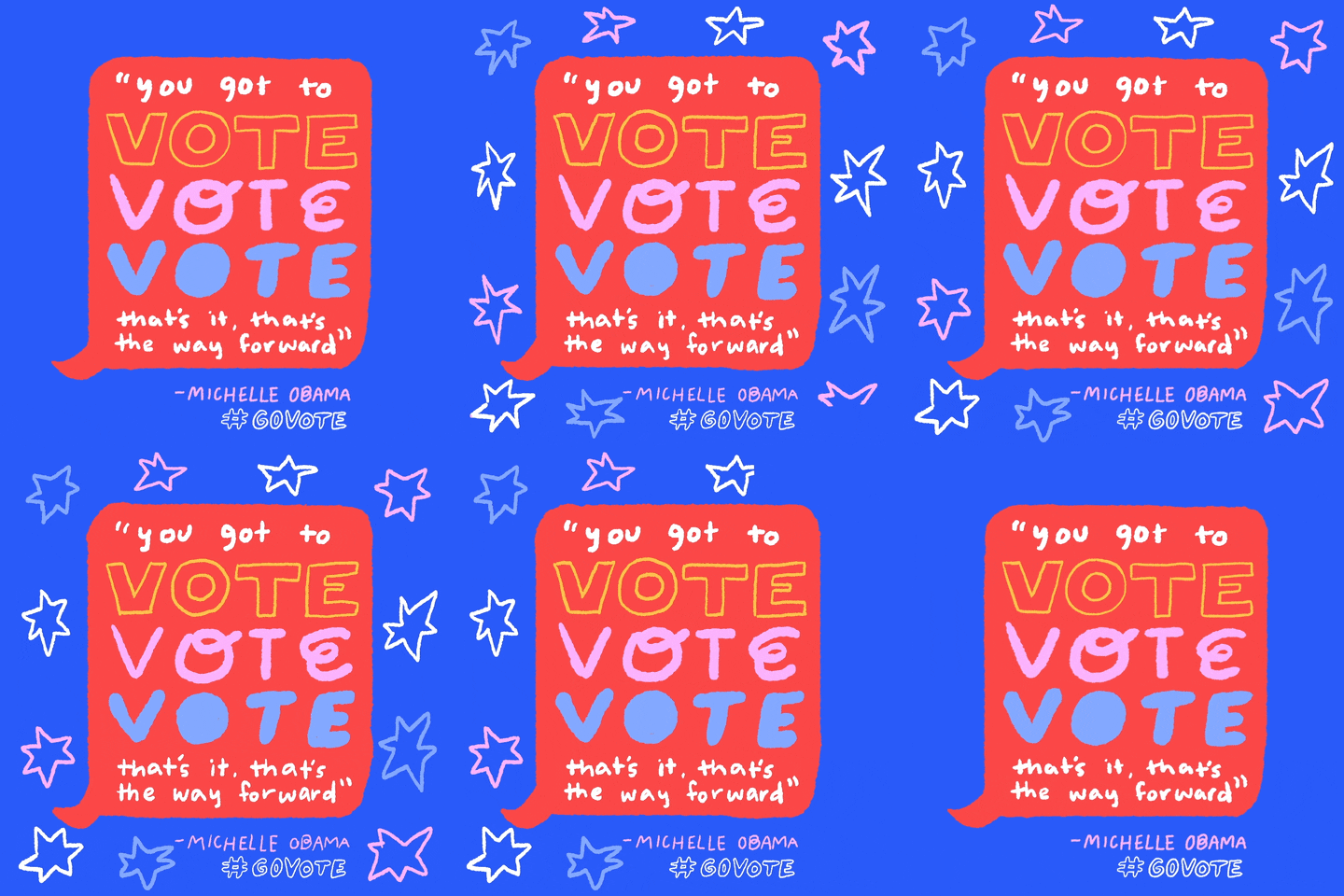
Kelley also happens to be my second client in six months to move to Colorado. (Yes, I took her to Snooze for brunch. It’s tradition at this point.) And because we recorded right as our mail-in ballots were on their way, we couldn’t help talking about voting. I promise it’s relevant.
What Colorado Voting Taught Me About Client Emails
In Colorado, you don’t request a mail-in ballot. They automatically mail one to every registered voter, and you get a text when it’s on the way. You fill it out, drop it off, and then get another text letting you know it’s been received. Then another one telling you it’s been counted.
That’s exactly what your client emails should be doing. Every one of those automatic texts is the equivalent of an email that keeps your client informed from beginning to end. And that’s what The Experience Edit is all about: sitting down, thinking through what you want your clients to experience, and mapping out every step so nobody is left wondering what happens next.
Meet Kelley (and Packaging Pronto!)
Kelley is a packaging designer. In her words:
“I work with physical product-based businesses to design the packaging, the graphics on the packaging, that help their products stand out on the shelf, attract more customers, sell their products, get more wholesale orders, and bring their brands together.”
Her signature offer is Packaging Pronto!, a VIP design day where she works solely with one client to design up to three product packages for their line.
“Packaging is that last step in developing your product and that first step in marketing your product, and it always tends to be this crunch point. That’s a big reason why I created Packaging Pronto!, so that I made it really easy for product businesses to get their packaging designed fast, but still strategically.”
If a product doesn’t have packaging, it can’t go on a shelf at Ulta. Or Amazon. Or anywhere. And timing matters more than most people realize:
“If my clients are working with a manufacturer overseas, the packaging not only has to be designed, it has to be produced before the product can be produced, because they’re literally going to build the product on the line and immediately put it in the package. And they’re not gonna hold your product and wait a month to get the packaging.”
What Her Client Journey Looked Like Before
Kelley runs her business in Bonsai for her CRM and Flodesk for email marketing (so if you think as a systems strategist I only work with Dubsado and Honeybook… think again!). So I asked her: before we worked together, did she have a consistent client journey from beginning to end?
“That was a main reason why I did the Experience Edit. I had some of those checkpoints down, but I knew they could be better. Somebody sends me an inquiry form; I email them back, ‘Hey, book a call.’ That wasn’t really automated. Then they got a standard, generic Calendly confirmation email. Then I would meet with them, and then I would send them a proposal, and that email was… meh.”
I love it when my clients come on here and admit how bad their communication was. And Kelley owned it:
“I’m a straight shooter. I very much subscribe to the five-sentence email. The bare minimum to get it off my plate. I would get more questions than I felt comfortable with, and then I’d be annoyed that I had questions. And I shouldn’t be annoyed, because my clients need to know what’s going on.”
She had the core emails: you inquired, here’s your proposal, here’s your contract and deposit invoice, here’s a welcome email, here’s something to review. Then a delivery email with the final files.
And that was where things ended.
The Talk That Started It All: Offboarding
Here’s the part I didn’t know until we recorded. Kelley signed up for The Experience Edit because of a talk I gave at Maggie’s BS-Free Business Summit about having an offboarding sequence.
“And I was like, ‘My offboarding sequence is one email.’ Bye. Here’s your stuff.”
If I could tattoo one thing on my forehead (and there are a lot of things I’d tattoo on my forehead), it would be this: your client experience shouldn’t stop at delivery.
Designers, photographers, everybody: you hand over the thing they paid you thousands of dollars to create and basically say, “Bye, Felicia. Thanks for the money.”
You will make so much more consistent revenue if you simply ask the people who have already paid you, “When are you coming back?” Because a lot of us think, “Oh, they’ll come back when they’re ready.” No, they won’t. Kelley agreed:
“They’ll forget. And then maybe they will come back.”
The Problem With Systems As a Service Provider Is That We’re Too Close to Our Own Process
Kelley made a point here that every service provider needs to hear:
“We are so close to our businesses that we know them inside and out, and we forget that it’s our client’s first time. Or if somebody’s coming back, they work with you once a year, so they may not remember all of those bits and pieces, whereas we’re living it every day. So I do need to repeat it three or four times to make sure they’re aware. And that’s actually a service to my clients.”
So often I hear, “But my clients don’t want all these emails.” I beg to differ. I’m 47 years old. You can tell me something on a call, and I swear I listened intently. But my brain doesn’t work the way it used to, and I need you to have put it in an email, a link, or a guide, so that when my brain fails me (and it will), I can go find it.
For Kelley, the question I kept asking was, “Okay, but what happens if they don’t do this?”
“I think I had the same answer every time. ‘Well, they have the email. They’ll do it because they bought the service.’ And it’s like, no, they probably need a reminder. I’ve seen clients come back and say, ‘I know I need to do this, but I can’t find the link.’ So even something as simple as having a reminder email set up, and not just saying, ‘Hey, reminder to do this,’ but, ‘Reminder to do this, and to make it easy, here’s the link.'”
Yes, say ‘Here’s the link’. And remind them why it’s important. People are far more likely to complete the task you gave them when they know why it matters.
Boundaries Are Easier When the Email Is Already Written
Kelley admitted that holding boundaries is a challenge for her, partly thanks to her corporate background, where you just figured out how to get it done. The structure of a VIP day helps:
“They’ve heard multiple times, ‘You’re going to get your first look around noon my time. You’ll get a form to help guide your feedback.’ This is your opportunity for feedback. We’re not turning this into a weeks-long design process. And if something delays the final files, then your print’s going out later, your production might be kicked down the road, you might miss your ship window. Those are big business consequences that clients don’t want to have happen.”
For her larger, more traditional projects, it’s a different story:
“It’s really easy to say in my contract, ‘You get two rounds of revisions.’ But in the moment, when I’ve sent that second round, and somebody comes back with, ‘Can we just change this?’, it’s very easy for me to go, ‘Oh, I can just do that.’ And it’s a slippery slope. Having language around that pre-done means I don’t have to feel like I’m being the bad guy.”
That’s exactly why we write the templates. When you’ve already decided what needs to be said and when, you’re consistent with every client, and you’re not scrambling for the right words while a client tests your boundaries.
“The structure’s already there. If I’m saying, ‘I need you to do something on this timeframe that is inflexible,’ that’s already written. I’m not writing it in the moment and then going, ‘Maybe I should make this a little softer.’ I just reread the part I’m customizing, and then I hit send.”
Yes, a Google Doc Is Enough (it pains me to say that out loud)
Kelley keeps all the emails she wrote in The Experience Edit in a Google Doc. Some are automated, but the rest live there so she can copy, paste, and customize them as she’s delivering her service.
A couple of years ago, I would have been horrified. Everything goes in the CRM! But The Experience Edit isn’t about the tools you send email in. It’s about deciding what to say and then which emails to automate and which ones you’ll send manually. A Google Doc of pre-written emails you can customize in two minutes is enough, because the goal is consistency, and consistency doesn’t always require automation.
“You definitely challenged me. Which of these can be automated? Are you sure that can’t be automated? But there are things I like to customize, and when I send them personally, I can track that my clients have received them, opened them, and clicked links. In certain parts of my process, that’s more valuable than automating it. But we wrote the templates. We took most of the mental work away, so they feel like a much lighter task.”
Her New Client Offboarding Process
This is the phase Kelley and I spent the most time on, and I was so excited to hear what it looks like now.
Before, Kelley sent a delivery doc (listing every packaging piece, print specs, file names, and where to get them printed) with an email that basically said, “Your final files are ready. Here’s your Google Drive. Let me know if you have any questions.”
Now, that delivery email sets clients up for their next step: printing, and ideally sampling before a full production run. And then the check-ins start.
“Now I have a cadence where I check in after that. ‘Hey, you should have sent this to the printer. How did that go?’ Then, ‘If you were sampling, you should’ve gotten your sample by now. Do you need any support?’ At all of those milestones, from getting their prints, getting their samples, getting their stuff shipped, getting ready to launch, I have a check-in email. And then I’ve got two points where I send a feedback form. One for the experience of the design day, and one for, ‘Okay, this should be out in the world now. What kind of business results are you getting?'”
This is why I love Kelley’s offboarding so much. The check-in email I hate most is “Let me know if you have any questions.” When reminders don’t have specificity, clients start ignoring them. But when you tell them exactly which milestone they should have hit, it either lights a fire under them or gives them permission to ask for help they didn’t want to bother you with.
Why Specific Check-Ins Keep Clients Coming Back
Packaging is a murky process. Print vendors are separate from Kelley, and the print industry is very decentralized:
“I understand that process from a high level, so why shouldn’t I check in and just help guide them? These are not complicated emails. It’s short and sweet, but it kicks off a conversation.”
And she’s noticed something else:
“Once somebody has worked with you and you send them an email about almost anything related to your service with some value in it, it prompts them to come back with something else. They go, ‘Oh, you know what? I’ve been thinking about this. I’d love to chat with you about it.'”
It’s like the oil change I kept forgetting about until my dealership texted me a link to schedule. Ten seconds later, I was booked. Your check-ins keep you front of mind, so when a past client is thinking, “I really need to reach out to Kelley,” your email is already sitting in their inbox.
What She Did With All That Feedback
After writing that results feedback email, Kelley sent it to every client who had launched in the past six months and got a ton of case study information. So of course I had to ask: what did she do with it?
“I was able to update some of my portfolio posts and create some new ones. And I just redid my Packaging Pronto sales page, and it’s much more results-driven than it was before. Yes, it shows the beautiful imagery, but it also has a gallery of the sales results.”
A few of those results:
- A client with a two-pack of artisan salted caramels sold out two or three times and had to order more packaging than they thought they’d need.
- A client whose product was rebranded with new packaging saw a 55% increase in sales.
As Kelley said,
“And I wouldn’t have known those things had I not asked.”
Now, I gave Kelley one more piece of homework, and I’m giving it to you too: take those wins and sprinkle them into your emails. The email someone gets after they inquire. The emails you send to get people rebooked. Especially results from clients who came back a second or third time.
(Kelley’s response: “Not today. But today I’m looking at my priorities for the month, so it’s going on my to-do list.” That’s my girl.)
Ready to Build Your Client Offboarding Process?
I bring people on the podcast to show you what it’s like to work with me, but what matters more is what happens in your business once you do the work. I don’t actually care whether you do it with me. But you need to do it.
Look at your offboarding process. Strategically check back in with past clients. Get them rebooked. Ask them about the actual results they got from working with you. Pick one thing. Just one. Go sit in a corner and work on it.
And if you’d like to work on it together, Experience Edit Solo Sprints are available anytime. Head here to learn how you can improve your client experience, from inquiry through offboarding.


Signature Series


Your business works, but your backend is costing you.
A 4-Part Audio Series for service-based business owners who are ready to upgrade their “just fine” client experience, unlock higher pricing, increase referrals, and grow more sustainable revenue—without overworking behind the scenes.
Get the FREE 4-part audio training series
Systems That Sell


© 2022-2025 Colie James


